Looking your best in your 40s in Melbourne, with confidence
November 25, 2026
Can non-surgical treatments look natural, or will you look “done”? They can create subtle changes when the plan reflects your features and goals, but results depend on factors such as skin condition, facial anatomy and the concern being treated. Managing expectations for non-surgical treatments means understanding what a procedure may change, what it cannot address and what recovery or follow-up may involve.
A considered plan starts with a clinical assessment of your goals, medical history and skin. It also gives you time to discuss the treatment process, possible drawbacks and whether the approach suits the result you want. Non-surgical procedures can involve temporary swelling or bruising, and visible changes may take time to settle.
This guide explains how to set realistic goals, assess suitability and plan for natural-looking results. It also covers how skin condition, treatment choice, follow-up and limitations shape expectations for people considering non-surgical options in Melbourne.
Key Takeaways
- Clarify the change you want and discuss your medical history and skin condition during assessment.
- Understand how treatment choice and your starting skin quality can influence whether results appear natural.
- Plan for follow-up and maintenance as part of the treatment journey, not as an afterthought.
- Discuss possible side effects, recovery and treatment limitations before deciding how to proceed.
1. Assessing aesthetic goals, medical history and skin condition
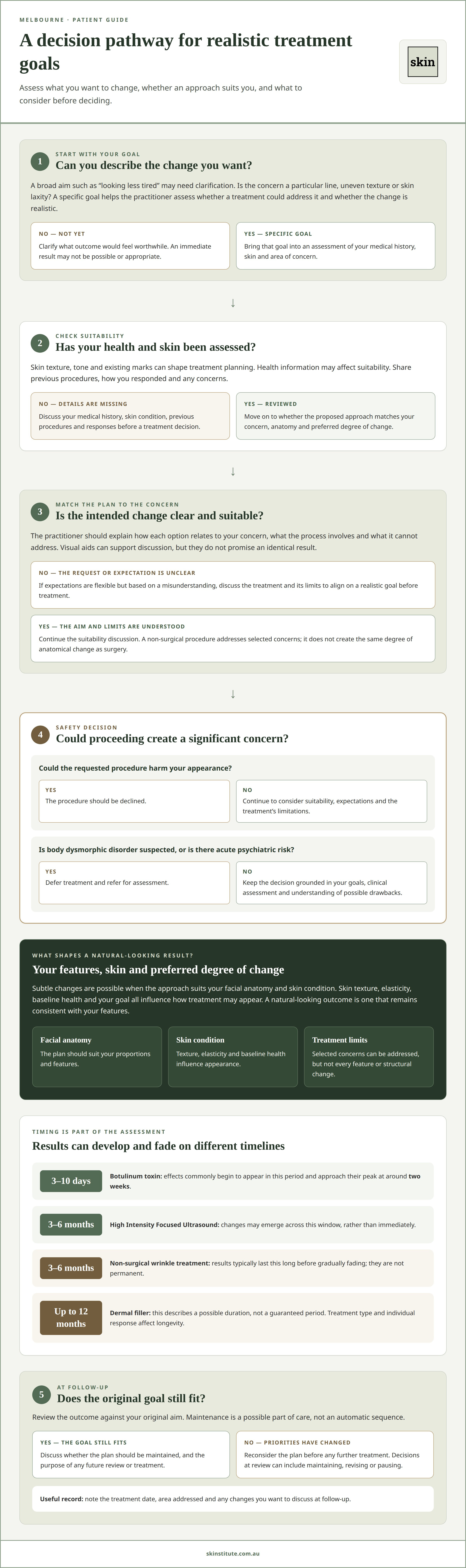
Begin by asking what you expect from treatment and what would make the outcome worthwhile. A goal such as looking less tired needs clarification: do you want to soften a particular line, improve uneven texture or address skin laxity? Specific aims help the practitioner assess whether a proposed treatment could enhance the concern, and whether the desired change is realistic. An immediate result may not be possible or appropriate.
Next, the practitioner reviews your medical history, skin condition and area of concern. Skin texture, tone and existing marks can affect treatment planning, while health information may influence suitability. Describe previous procedures, how you responded and any concerns. This helps distinguish the change you want from broader expectations shaped by social media or heavily edited images.
Visual aids can make the discussion more specific. Before-and-after photographs, anatomical diagrams or digital simulations may illustrate possible outcomes and clarify what a treatment is intended to change. They support discussion, but do not promise you will have an identical result. The practitioner can use them to identify which features matter most and whether the requested effect suits your facial proportions.
When comparing non-surgical options, the practitioner should explain how each approach relates to your concern, the likely process and its limitations. If your expectations are flexible but based on a misunderstanding, further explanation can help align your goals before treatment. If the requested procedure could harm your appearance, it should be declined. Suspected body dysmorphic disorder or acute psychiatric risk calls for deferral and referral for assessment.
Before choosing, understand what a treatment aims to change, what it cannot address and how your medical history and skin condition affect suitability. The practitioner should ask what outcome would feel worthwhile and check that you share the same definition of success. This discussion is central to managing expectations for non-surgical treatments, particularly if you feel pressure to match a social-media image.
2. Can non-surgical treatments look natural, or will I look ‘done’?
Non-surgical treatments can produce subtle changes when the approach suits your facial anatomy and skin condition. Skin texture, elasticity and baseline health influence how a cosmetic treatment may appear, while your goal guides the degree of change. A natural-looking outcome is not a fixed look; it is one that remains consistent with your features.
Results also develop on different timelines. Botulinum toxin effects commonly begin to appear 3 to 10 days after treatment and approach their peak at around two weeks. Changes after High Intensity Focused Ultrasound may emerge over a 3-to-6-month window, rather than immediately. These examples show why timing is part of judging an outcome, not just the initial appearance.
Longevity varies by treatment. Non-surgical wrinkle treatment results typically last 3–6 months before gradually fading, and they are not permanent. A dermal filler described as lasting “up to 12 months” refers to a possible duration, not a guaranteed period for every patient. Treatment type and individual response influence how long effects remain visible.
Non-surgical procedures address selected concerns, but do not create the same degree of anatomical change as surgery. They may suit someone seeking a measured enhancement, while a concern involving substantial structural change may call for a different discussion. The practitioner should explain the intended effect and the treatment’s limits in relation to your goal.
In Australia, ask the practitioner to explain their qualifications and experience with the specific procedure, and who will oversee your care. This helps you understand the treatment arrangement before deciding. For a natural-looking result, the plan should reflect your anatomy, skin quality and preferred degree of change.
3. Planning follow-up and maintenance treatments
A treatment plan should map the intended stages of care, from the initial procedure to any planned follow-up or maintenance. It can identify which concern to address first and when the practitioner will review whether another step is appropriate. For example, if you want to address several concerns, agree on priorities rather than treating everything in one appointment.
Follow-up is also a chance to revisit your priorities. The practitioner can ask whether your original goal still reflects what you want and assess whether the outcome feels right to you. If your priorities have changed, reconsider the plan before any further treatment. This keeps maintenance connected to your current aims.
Discuss maintenance as a possible part of care, not an automatic sequence. The practitioner can explain which future appointments are intended to assess progress and which would involve additional treatment. Knowing the purpose of each visit helps you make an informed decision about whether to continue.
A useful record can support these discussions. Note the treatment date, the area addressed and any changes you want to discuss at follow-up. The practitioner can compare your observations with the original plan and clarify whether they warrant a change. This gives you a practical reference for later appointments without making further treatment the default.
Agree on how decisions will be made at each review. For instance, you and the practitioner can return to the original goal, discuss whether it remains suitable and decide whether to maintain, revise or pause the plan. A clear process makes follow-up purposeful and keeps future decisions aligned with your preferences.
4. Explaining uncertainty and treatment drawbacks
Before you consent, the practitioner should explain what the procedure involves and what it may not achieve. A treatment can address a specific concern without resolving every feature you associate with it. For example, improving skin texture may not change facial shape. Understanding this distinction helps you decide whether the likely scope of treatment matches your priorities.
The discussion should cover the treatment process, how long results may take and whether further sessions may be recommended. These details affect the commitment involved, including appointment time and any recovery period. The practitioner should also describe possible side effects and explain how to raise concerns. This gives you a clearer basis for weighing the intended benefit against practical drawbacks.
Uncertainty means the outcome may differ in degree or timing from what you expect. The practitioner should explain the factors that may influence your response and avoid presenting an illustrative result as a prediction. If the expected change involves several stages, the plan should identify which decisions remain open after each one. This helps you consider the process without assuming every step is inevitable.
Consent should leave room to pause or decide against treatment. If you remain uncertain, take time to consider the information, and ask the practitioner to revisit any questions before proceeding. If the approach no longer fits your aims, discuss whether another option is more appropriate or whether treatment should stop. A considered decision includes the option not to proceed.
For a discussion centred on your goals, questions and treatment considerations, contact Skinstitute to discuss your treatment options. Understanding the possible trade-offs can help you decide whether the proposed approach feels right for you.
Skinstitute
Skinstitute helps patients assess whether a non-surgical approach aligns with their goals, skin condition and expectations. At a face-to-face consultation, you can discuss your concern, relevant medical history and the likely treatment process, including recovery, possible drawbacks and follow-up needs.
Depending on the assessment, options may include prescription injectables, PDO thread lift, Fractional CO2 or High Intensity Focused Ultrasound (HIFU). The focus is on selecting an appropriate approach and setting clear expectations, rather than treating every concern in the same way. If you’re considering treatment in Melbourne, contact Skinstitute to discuss your goals and questions.
Make your next decision with clarity
Before taking a next step, consider what change would feel appropriate for you and what would feel like too much. This personal boundary can guide a clinical discussion, including whether to proceed, consider another approach or pause. Managing expectations for non-surgical treatments is not about pursuing every available option; it is about making an informed choice that fits your priorities.
Skinstitute can discuss whether prescription injectables, a PDO thread lift or Fractional CO2 may be relevant to your concerns. The consultation is an opportunity to explore suitability and understand the proposed approach, without treating a procedure as the automatic answer. Your questions and preferences should remain part of that decision.
If you’re ready to discuss a considered next step, contact Skinstitute to discuss your goals. A clear conversation can help you move forward with greater confidence in the decision that feels right for you.
Frequently Asked Questions
Can non-surgical treatments look natural, or will I look ‘done’?
Non-surgical treatments can create natural-looking changes when the plan respects your facial proportions and aims for measured enhancement. During consultation, describe the degree of change you would be comfortable with, such as softening one line rather than changing your overall expression. A practitioner can use this preference to guide treatment choices and avoid treating areas unrelated to your goal.
How does a practitioner assess whether someone is a good candidate for non-surgical treatments?
A practitioner considers your concern, medical history, skin condition, previous treatments and desired outcome. They also assess whether a non-surgical approach can achieve the requested change. For example, substantial loose skin may not respond as you hope to non-surgical treatment. If your expectations remain difficult to reconcile with the likely outcome, treatment can be deferred while you discuss your goals further.
How much downtime should I really expect for a ‘lunchtime’ lift?
“Lunchtime” describes a convenient appointment, not a guarantee of no visible recovery. Downtime depends on the procedure and your response; temporary redness, swelling or bruising can affect your appearance after treatment. Consider work or social commitments when discussing timing with the practitioner. Aftercare instructions should explain what to expect, which activities to limit and when to seek clinical review.
Is there any permanent non-surgical treatment available?
Do not treat non-surgical aesthetic treatments as permanent changes. For example, wrinkle-treatment effects fade over time, while PDO Mono Threads gradually stimulate natural collagen production and are not a permanent solution. Maintenance may be considered as effects change, but repeat treatment is not automatic. The practitioner can explain the expected duration of the specific procedure and how its effects are reviewed.
What happens if I am not happy with my non-surgical results?
Tell the treating clinic what concerns you, when you noticed it and whether you have symptoms such as persistent swelling or discomfort. A practitioner can assess the area and compare your concern with the agreed treatment goal. Not asking for a revision does not necessarily mean you are satisfied, so raising a specific concern helps the practitioner understand what follow-up you need.
What does managing expectations for non-surgical treatments mean?
It means understanding the intended change, the treatment’s limits and the time needed to assess its effect before deciding to proceed. For example, a plan may aim to improve one defined feature rather than alter your overall appearance. Managing expectations for non-surgical treatments also means recognising that follow-up, temporary side effects and maintenance can form part of the decision.