Cosmetic treatment costs and what shapes your procedure price
November 22, 2026
What Happens If I Hate My Filler? Options for Correction
November 24, 2026
Financing options for cosmetic procedures in Melbourne can include personal loans or planned repayments, depending on the lender and agreement. Before committing, understand the repayment schedule, loan terms and credit assessment, and how the repayments fit your budget.
It’s understandable to want a clear picture of repayments before deciding whether to proceed with a cosmetic treatment. This guide explains how planned repayments and personal loans may be used, what lenders generally assess when reviewing an application, and how to weigh repayment obligations against broader financial commitments. It also outlines why financing options for cosmetic procedures in Melbourne should be considered separately from clinical suitability, so financial planning and treatment decisions can be assessed carefully.
Key Takeaways
- Assess the full repayment schedule, not just the regular instalment, to understand how the loan term affects total interest.
- Compare personal loan terms and fees alongside the repayment amount before deciding whether borrowing fits your budget.
- Credit history, income and employment stability can influence a lender’s assessment, rate and loan terms.
- Keep financial approval separate from clinical suitability: treatment planning should account for your needs, risks and recovery requirements.
Financing elective cosmetic procedures through planned repayments
In Melbourne, planned repayments may spread borrowing across a defined term, but the interest rate and agreement determine the total payable. Review the full repayment schedule before deciding whether lending fits your budget.
Loan terms and total repayment costs
A loan term sets how long repayments continue, while the interest rate affects the amount repaid overall. Medical finance terms in Australia can start at 12 months and extend to seven years. A shorter term generally means higher regular repayments but less total interest; a longer term may lower each instalment while increasing the total payable. Missed payments can lead to additional charges or interest under the agreement. Deferred interest can also become payable if the promotion’s conditions aren’t met, so read those conditions before signing.
Comparing estimated repayments
An indicative comparison is an estimate, not a lender offer or approval. Compare repayment frequency, interest rate, term and total amount payable rather than choosing solely by the smallest weekly figure. Review the practitioner’s qualifications and the clinic’s treatment information, then read the lender’s written agreement, fees, credit criteria and any deferred-interest conditions. Confirm the estimate reflects the amount and term you’re considering.
Loan amounts and repayment duration
The amount borrowed depends on the treatment plan and the applicant’s lending assessment. Repayment periods in Australia may range from 12 months to seven years, although the available term depends on the finance agreement. Before applying, set out the amount to borrow, repayment frequency and term, then assess the scheduled instalments against existing commitments. This step helps distinguish a manageable regular repayment from a loan whose extended duration raises the total payable.
Worked weekly repayment example
For a weekly repayment example, use the lender’s written estimate rather than a generic figure. Divide the stated total payable, including applicable interest and charges, by the number of weekly instalments in the agreement. Compare the result with the quoted weekly repayment and check how the term affects the total. This calculation is useful only if the estimate uses the same borrowing amount, interest rate and repayment period you’re assessing.
Non-surgical treatment planning
Non-surgical treatments may address some aesthetic concerns, but suitability depends on an individual clinical assessment. Consider the treatment plan separately from any financial arrangements.
Non-surgical treatment options
Non-surgical treatments vary in their approach, expected results and recovery requirements. A qualified practitioner can assess your concerns, medical history and suitability, then explain the potential benefits and risks of appropriate options.
Before proceeding with a treatment, discuss its purpose, expected recovery and possible risks with your practitioner. A personalised treatment plan should reflect your clinical needs and existing commitments.
Planning treatment
A treatment plan is useful when it sets out the proposed approach and its assumptions. Ask about the treatment schedule, recovery requirements and whether further sessions may be recommended. A single appointment does not necessarily address every concern.
For an informed discussion, ask your practitioner to explain the proposed treatment, expected results and any relevant risks. An initial assessment is not a guarantee of suitability or outcome.
Non-surgical treatments are distinct from surgical procedures and may not achieve the same results. The appropriate option depends on the concern being treated and your clinical circumstances. A consultation can help establish whether a non-surgical approach is suitable.
Before proceeding, review the treatment plan with your practitioner. Consider whether you can follow any recovery advice and understand the potential risks. Keep the decision to proceed separate from any financial commitment.
Credit and financial assessment
In Australia, finance approval depends on a lender’s assessment, not just the procedure being considered. Responsible borrowing also means weighing repayments against your income, commitments and circumstances.
Applications, credit checks and lender assessment
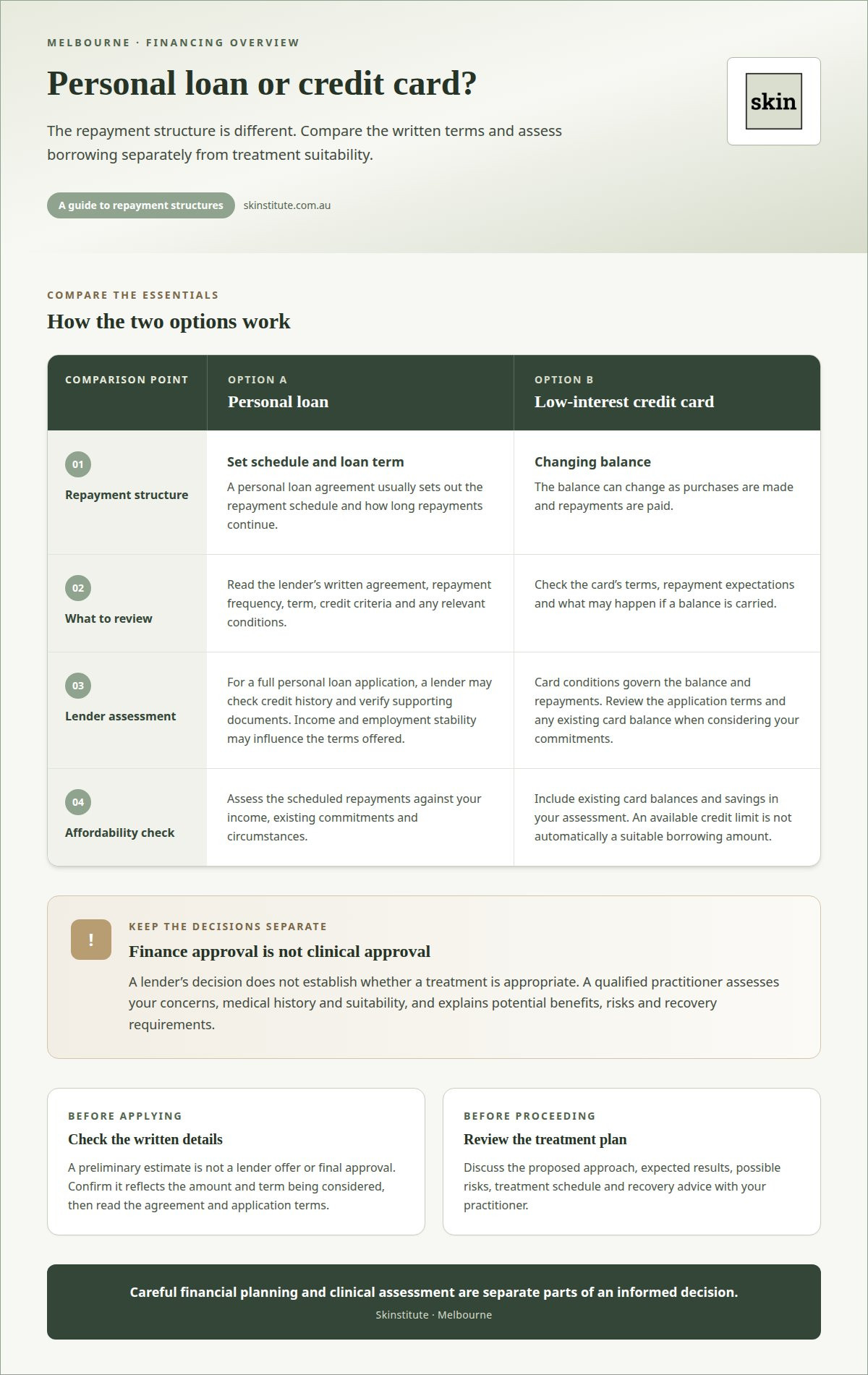
For a full personal loan application, a lender may check your credit history and verify supporting documents. Credit history, employment stability and income can influence the rate and terms offered, but do not guarantee approval. Review the requested documents and application terms before submitting them, and ensure the amount sought reflects your planned borrowing.
Responsible borrowing means considering whether repayments are manageable, not focusing only on approval. In Australia, consumer credit obligations form part of the lending context, so read the lender’s criteria and agreement carefully. Treatment suitability is a separate clinical decision; finance approval does not establish that a procedure is appropriate.
Personal loans and low-interest credit cards
A personal loan usually sets out a repayment schedule and loan term in an agreement. A low-interest credit card works differently: its balance can change with purchases and repayments, and interest depends on the card’s terms. Compare interest calculations, fees, repayment expectations and the consequences of carrying a balance. The lowest advertised interest rate alone may not show which option costs less overall.
For example, someone considering breast augmentation can compare a fixed loan schedule with a card’s ongoing balance terms. Include existing card balances and savings when assessing affordability. Don’t treat an available credit limit as a suitable borrowing amount; borrow only what you can repay.
Approval times and credit enquiries
Approval timing varies with the lender’s process and whether the full application and supporting documents are complete. A preliminary estimate is not a final decision. Before applying, find out whether the lender will conduct a credit check and how it handles the enquiry. This helps you understand what happens to your application before submitting forms.
For Melbourne applicants, keep the treatment consultation and finance application as separate steps. First understand the proposed treatment and its suitability, then review the lender’s conditions and repayment schedule. Approval, interest rate and loan terms depend on the lender’s assessment of your circumstances.
Non-surgical treatment finance options
In Australia, funding for non-surgical aesthetic treatments may come from a personal loan, credit product or clinic payment plan. The suitable structure depends on the lender’s criteria, repayment terms and your financial circumstances.
Medical finance providers may cover non-surgical aesthetic treatments, subject to their criteria and approval. Interest rates and agreement conditions vary between providers and applicants. Read the full agreement to understand how interest is calculated, when repayments are due and what happens if you miss a payment.
Some aesthetic clinics offer interest-free payment plans over 3-6 months. Availability and conditions vary between clinics, and an interest-free period does not necessarily mean every payment arrangement has identical terms. In-house finance and a third-party loan are different arrangements, so establish which party provides the funding.
When assessing a plan for a non-surgical treatment, distinguish the treatment decision from the finance decision. A payment schedule does not determine whether a treatment is clinically appropriate. Discuss the treatment’s purpose, potential risks and recovery requirements as part of clinical care; assess the loan term and repayment obligations separately.
Compare options by recording the repayment frequency, interest rate and agreement length. Check whether the rate is fixed or variable, and identify any introductory period or conditions that change later. These details can show whether a lower initial repayment reflects a short promotion or a longer borrowing term.
When considering finance for a non-surgical aesthetic treatment, discuss the treatment’s purpose and suitability with a qualified practitioner. Eligibility for a payment arrangement depends on the finance provider’s criteria, not simply the treatment’s name. The Medical Board of Australia has guidelines about how medical practitioners can promote financing, supporting careful, transparent discussion of finance alongside clinical care.
Skinstitute
Skinstitute offers medical-grade cosmetic treatments in Melbourne and can discuss which may suit your concerns before you make a separate financing decision. A clinical assessment considers your goals, suitability, risks and recovery requirements. Loan approval does not determine whether a procedure is appropriate.
Depending on the assessment, options may include prescription injectables, a thread lift, Fractional CO2 or High Intensity Focused Ultrasound (HIFU). Each has different uses and considerations, so treatment planning should be based on your individual needs rather than the repayment amount alone. Once you understand the proposed approach, you can consider its financial implications alongside your other commitments.
Contact Skinstitute to arrange a FREE consultation and discuss treatment suitability and planning.
Make your next decision with a clear plan
Financing options for cosmetic procedures in Melbourne should support a considered treatment decision, not direct your care. A manageable repayment schedule cannot establish clinical suitability, just as clinical suitability does not mean borrowing fits your circumstances. Keeping these decisions distinct gives you room to consider both your treatment goals and financial commitments.
A clinical discussion with Skinstitute can help clarify whether prescription injectables, a thread lift or Fractional CO2 may be relevant to your concerns. The appropriate approach depends on individual assessment, including treatment suitability, possible risks and recovery considerations. You can then consider any proposed treatment plan separately from your finance arrangements, without allowing an available loan to create pressure to proceed.
If you’re ready to discuss your treatment considerations, contact Skinstitute to discuss your options. A measured next step can help you make decisions with greater clarity and confidence.
Frequently Asked Questions
What financing options are available for non-surgical cosmetic treatments in Melbourne?
Options may include a personal loan, credit card, medical finance arrangement or payment plan offered by a practice. They differ in who provides the funds and how repayments are structured. For example, a lender may assess a personal loan application separately from a clinic’s treatment assessment. Check the repayment frequency, interest conditions and fees in the agreement before committing.
Can non-surgical cosmetic treatments be financed with credit cards, personal loans, or buy now pay later in Australia?
Personal loans and credit cards may be used where the lender or payment provider permits the transaction. Buy now, pay later availability depends on the provider’s terms and whether the clinic accepts that payment method. These options work differently: a personal loan has agreed terms, while card or buy now, pay later balances depend on account conditions. Review the consequences of missed payments before using either.
What eligibility, deposit, and credit-check requirements apply to finance for non-surgical treatments in Australia?
Requirements vary by finance agreement. A lender assessing a full application may review your credit history and verify supporting documents; income and employment stability may also inform its assessment. Some treatment payment plans may require an upfront deposit before regular payments begin. Read the written criteria to understand what information is required, whether a deposit applies and how the lender handles your application.
How do financing options compare by interest rate, fees, repayment term, and total cost?
Compare each written offer using the same borrowing amount and repayment period. Consider the interest calculation, establishment or account fees, payment frequency and total amount payable, not only the first instalment. An interest-free period may have conditions, so identify what happens when it ends. A longer term may lower regular repayments while increasing the overall amount repaid.
What Australian rules apply to advertising finance for non-surgical cosmetic treatments?
The Medical Board of Australia has guidelines about how medical practitioners can promote financing. Consider finance advertising separately from clinical advice: a payment option does not establish that a procedure is suitable. Read the finance terms alongside the treatment information, paying attention to conditions, repayment obligations and stated limitations. This helps distinguish a finance promotion from an assessment of treatment benefits and risks.