
Sclerotherapy Aftercare: How to Wear Compression Stockings
October 18, 2026
A fixed HIFU session count can sound reassuring, but it may not be a useful answer for a double chin. There’s no reliable one-size-fits-all response to how many hifu sessions for double chin, because the right plan depends on what is contributing to fullness beneath the chin and how the tissues are likely to respond.
It’s understandable to want to know whether one treatment is enough or whether a course is usually needed. HIFU isn’t suited to every cause of chin fullness, so a set number of sessions can create expectations that don’t reflect an individual’s anatomy. This guide explains why recommendations vary, what a clinician assesses before planning treatment, and why HIFU should be considered in the context of skin laxity and other features of the submental area. At Skinstitute, HIFU planning follows a face-to-face clinical consultation, with treatment tailored to the person rather than a fixed promise. For people considering HIFU in Melbourne, an assessment is a practical first step towards understanding suitability and realistic expectations.
Key Takeaways
- There’s no universal answer to how many hifu sessions for double chin; planning depends on an individual assessment and the area being treated.
- HIFU uses focused ultrasound, while collagen is one of the skin structures relevant to firmness.
- Skin laxity, fullness beneath the chin and skin redundancy can have different implications for treatment suitability.
- A clinical plan involves discussing your concern, assessing the area, considering suitability and reviewing the response.
- A face-to-face consultation with Skinstitute can help guide a personalised HIFU session plan in Melbourne.
How many HIFU sessions for a double chin? The clinical answer
There is no single number of HIFU sessions that can be recommended for every person with fullness beneath the chin. The answer to how many hifu sessions for double chin depends on an individual assessment: the anatomy of the submental area, the condition of the skin, the concern being addressed and the treatment area being considered. A number given without that context is not a personalised clinical plan.
HIFU, or High-intensity focused ultrasound (HIFU), uses focused ultrasound energy. Considering HIFU for the area under the chin is a specific treatment discussion, not a guide to every HIFU treatment area or medical indication. Assessment helps determine whether the approach is appropriate for the person’s concern, rather than fitting that concern to a pre-set session count.
A HIFU session recommendation should follow individual assessment, not a universal formula. This distinguishes a clinically reasoned plan from a fixed promise. Two people who describe a similar concern may receive different recommendations after their submental areas and goals have been assessed.
Why one fixed HIFU session number can mislead
The appearance beneath the chin can reflect different features, including skin laxity and the distribution of fullness. A clinician considers the area’s anatomy and the person’s treatment goals when deciding whether HIFU is suitable and what area, if any, should be addressed. Wanting a sharper profile alone doesn’t establish the cause of fullness or determine a session plan.
An initial plan and a later review are separate steps. The initial recommendation is based on the assessment and the concern being discussed. A review considers the individual’s response and whether the original plan remains appropriate. An additional session shouldn’t be assumed to be automatically necessary, and the first recommendation can’t predict a particular change in contour.
What a session recommendation can and cannot tell you
A recommendation describes the clinician’s proposed approach for an individual concern. It can clarify the treatment area being considered and provide a basis for discussing the next step. It can’t guarantee a visible result, a particular degree of change or a specific jawline shape. Specifying a number of sessions doesn’t assure these outcomes.
For a useful consultation, describe what concerns you about the area under your chin and what you hope to address. The clinician can assess the area, discuss whether HIFU is suitable and explain the reasoning behind any proposed plan. If treatment is considered, follow-up and review of the response should be guided by clinical advice, rather than by a standard interval or session count from a general guide.
How HIFU relates to skin firmness beneath the chin
HIFU stands for high-intensity focused ultrasound. In aesthetic treatment, the term describes ultrasound energy directed towards a selected area rather than applied broadly across the skin’s surface. The precise approach depends on the device and clinical plan, so general descriptions shouldn’t be taken as a statement about the settings or depths used for an individual.
HIFU directs focused ultrasound energy to selected tissue; it shouldn’t be described as a direct fat-removal method. For fullness beneath the chin, this distinction matters. The appearance of the area can involve different tissue features, and an explanation of how ultrasound is delivered doesn’t identify the cause of fullness or establish that HIFU is suitable.
What focused ultrasound means in aesthetic treatment
“Focused” refers to directing energy towards a chosen area. This differs from treating the entire skin surface uniformly. A clinician considers the area and the concern being addressed when discussing whether HIFU is appropriate. Without clinical assessment, it would be misleading to infer a specific treatment depth, device setting or tissue effect from the name of the technology alone.
Skin firmness is partly related to collagen, a structural protein in the skin that helps provide support. This offers useful context for conversations about firmness, but it doesn’t guarantee that treatment will change collagen or produce a particular contour. A treatment mechanism and a visible outcome are separate matters, and individual results can’t be inferred from the mechanism alone.
Why response and review are individual
After considering the area and agreeing on a treatment plan, a clinician can advise whether a review is appropriate and when it should occur. There is no response timetable in this general explanation: the clinic’s clinical guidance should determine follow-up. Patients shouldn’t assume everyone will notice the same degree of change or notice it at the same time.
This distinction also helps answer how many hifu sessions for double chin: understanding how HIFU works can’t supply a session count by itself. The number of planned sessions is a clinical decision, while any later review considers the person’s response. Neither the mechanism nor a planned count guarantees a visible change beneath the chin.
If you’re considering HIFU for the submental area, a face-to-face discussion can connect the general mechanism to your concern. Skinstitute offers HIFU and tailors treatment planning following consultation. You can discuss HIFU treatment planning to understand suitability and the approach relevant to your area.
Is HIFU suitable for every type of double chin?
No. The appearance of a double chin doesn’t identify its cause or automatically mean HIFU is suitable. The area beneath the chin can look full for different reasons, including skin laxity, submental fullness or a combination of features. These concerns can look similar in a mirror, but they are not interchangeable treatment considerations.
A treatment should be selected in response to the concern identified during assessment, not simply to the name used to describe the area. HIFU isn’t a universal answer to every type of chin fullness, and a session count can’t replace a decision about whether treatment is appropriate in the first place.
Skin laxity, fullness, and skin redundancy are not interchangeable
Skin laxity means the skin has reduced firmness and may sit more loosely over the underlying tissues. By contrast, skin redundancy is excess or loose skin that cannot be removed by non-surgical modalities. Submental fullness describes a fuller appearance beneath the chin, but that appearance alone doesn’t establish what is contributing to it.
For example, someone concerned about loose skin may be asking a different clinical question from someone whose main concern is fullness beneath the chin. A person may also have more than one feature. These descriptions are useful starting points for a consultation, not diagnoses to make from photographs or self-assessment. A clinician needs to examine the area and discuss the concern before considering whether HIFU is appropriate.
HIFU shouldn’t be assumed to address every possible contributor. In particular, it shouldn’t be described as removing submental fat or correcting every form of fullness. Its relevance depends on the individual assessment and the concern being addressed.
When a clinician may discuss other approaches
An assessment may conclude that HIFU isn’t the appropriate option for the concern presented. That is a meaningful clinical outcome: it helps avoid planning treatment on the basis of an assumption that may not fit the area’s anatomy. A clinician can explain the reasoning and discuss what the assessment indicates, without suggesting that one approach is automatically better for everyone.
This is why “how many hifu sessions for double chin” can’t be answered separately from suitability. If HIFU isn’t considered appropriate, increasing the proposed session count wouldn’t resolve that mismatch. If it is considered suitable, the number and scope of planned sessions still need to reflect the individual concern and clinical judgement.
For a useful discussion, describe what you notice, where the fullness appears and what you hope to address. Avoid assuming the cause or expecting a specific contour. A face-to-face assessment allows the clinician to consider the submental area, clarify the treatment goal and explain whether HIFU is a reasonable part of an individual plan.
What to expect when planning HIFU for a double chin
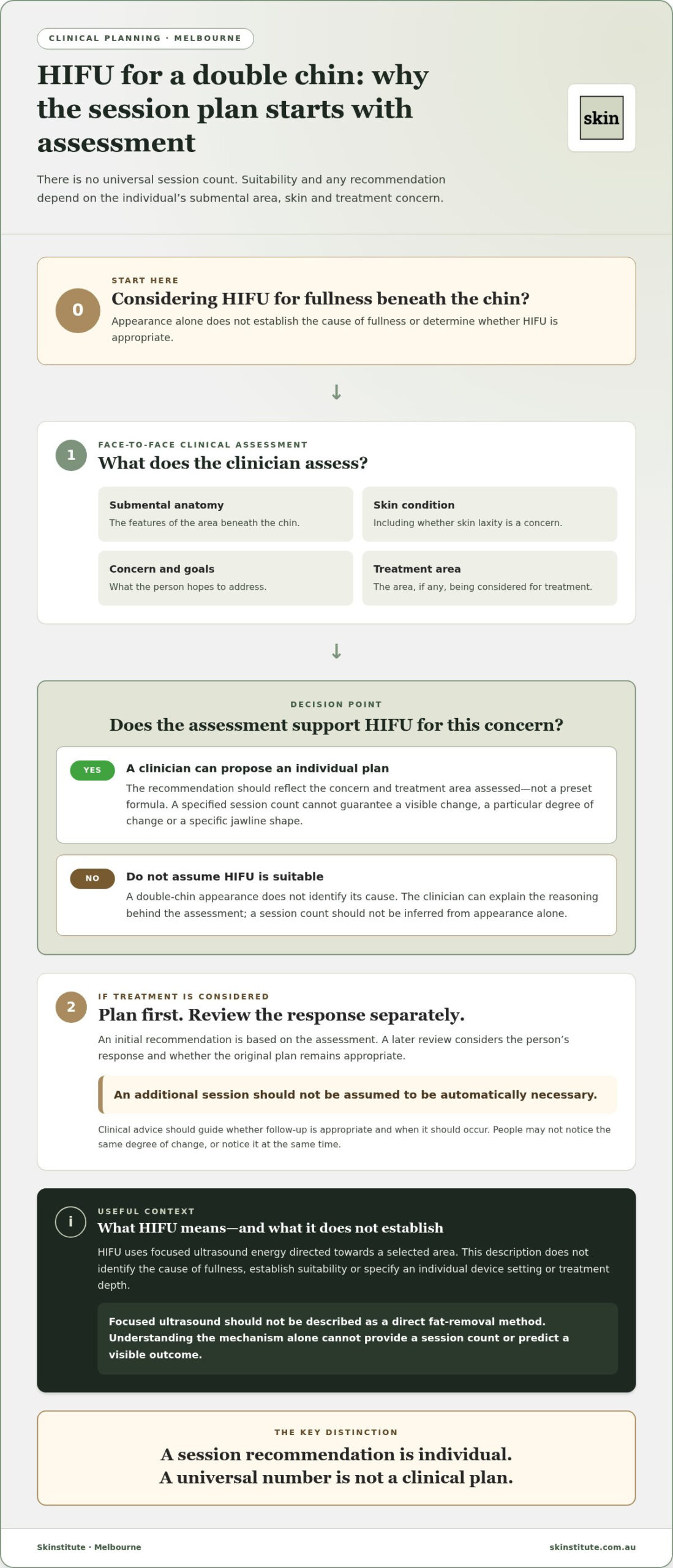
Planning begins with your concern, not a pre-set session schedule. A face-to-face consultation gives the clinician an opportunity to understand what you hope to address, assess the submental area and discuss whether HIFU is suitable. If it is, the proposed treatment area and session plan can be explained in relation to your assessment.
Questions a face-to-face assessment should address
Before your consultation, consider what you notice beneath your chin and what kind of change you’d like to discuss. You don’t need to identify the cause yourself. Photographs and online information can’t replace an in-person assessment, and a similar appearance can reflect different anatomical concerns.
A clinician can discuss your concern, assess the submental area and consider whether HIFU is appropriate. Raise questions about suitability, potential risks and what to expect from treatment and recovery. Advice should relate to your circumstances and the clinical guidance for the treatment, rather than assumptions drawn from another person’s experience.
Setting expectations and reviewing the plan
If HIFU is considered suitable, the clinician can explain the proposed plan and its rationale, including the area being treated and any planned sessions. A recommendation isn’t a guarantee of a particular contour or degree of change. Response varies, so planning should allow for a review of how the treated area responds, rather than assuming a fixed number will produce the same outcome for everyone.
Session timing and follow-up should be guided by clinical advice. General online guidance can’t establish an appropriate interval for an individual, and this section doesn’t prescribe one. Before proceeding, make sure you understand the proposed plan, relevant risks, recovery guidance and how any review will be managed. If you have questions after the consultation, clarify them with the clinical team before deciding.
The practical sequence is straightforward:
- Explain your concern and the change you hope to discuss.
- Have the submental area assessed in person.
- Discuss whether HIFU is suitable for your concern.
- Review the proposed treatment area, session plan and relevant expectations.
- Follow the clinician’s guidance on timing and any review of response.
This approach makes the answer to how many hifu sessions for double chin part of a wider clinical discussion, rather than a stand-alone number. For broader information about the treatment, refer to the HIFU guide alongside personalised advice given in consultation.
If you’re considering HIFU for the area beneath your chin, you can arrange a face-to-face HIFU consultation with Skinstitute to discuss suitability and an individual session plan.
Discuss your HIFU session plan with Skinstitute in Melbourne
A face-to-face consultation is the basis for discussing whether HIFU may be appropriate for your concern beneath the chin and what an individual session plan could involve. Skinstitute offers HIFU to clients across Melbourne. Treatment planning is tailored after consultation, rather than based on a standard session count applied to everyone.
How Skinstitute approaches an individual HIFU plan
The discussion starts with your concern and the change you hope to address. A clinician can assess the submental area in person, consider its anatomy and discuss whether HIFU is suitable. If a plan is proposed, the consultation provides an opportunity to understand its intended treatment area and the reasoning behind the recommendation.
Use the appointment to ask about suitability, relevant risks, recovery guidance and what a review may involve. These details should be explained in line with clinical advice for your circumstances. A session recommendation is a plan, not a promise of a particular contour or degree of change. If HIFU isn’t considered appropriate, the clinician can explain the assessment and discuss next steps relevant to your concern.
Skinstitute’s Melbourne medical-grade aesthetic treatments guide offers broader context about the clinic’s aesthetic care. For a double-chin concern, however, general information is no substitute for an individual assessment and a discussion of your expectations.
Choosing the next step in Melbourne
Skinstitute provides HIFU in Melbourne, but the treatment isn’t available at its Carlton or Ballarat locations. Keep this in mind when choosing where to attend, and use a face-to-face consultation to discuss your concern, clinical suitability and any proposed session plan.
Before an appointment, it may help to note what you notice beneath your chin, what you’d like to address and any questions about treatment or review. There’s no need to arrive with a diagnosis or a preferred session count. The purpose of the consultation is to assess your concern and explain a considered plan, including whether HIFU is appropriate.
The question of how many hifu sessions for double chin is best answered through that individual discussion. If you’d like to explore your options, arrange a face-to-face HIFU consultation with Skinstitute to discuss suitability and planning in Melbourne.
Make your next step an informed one
You don’t need to arrive with a preferred session count or a diagnosis. A more useful starting point is to be clear about what you’d like to discuss and what matters to you about the area beneath your chin. This gives the clinical conversation a practical focus and keeps decisions grounded in your individual concern, rather than a number chosen in advance.
If you’re still considering how many hifu sessions for double chin, treat the answer as part of a broader suitability discussion. A clinician can help you understand the reasoning behind a proposed plan, what expectations are realistic for you and what questions remain before you decide whether to proceed. Taking time to understand these points is a sound part of making an informed choice.
When you’re ready to take that step, book a clinical discussion about your HIFU options. A considered conversation can help you move forward with greater clarity.
Frequently Asked Questions About HIFU for a Double Chin
How many HIFU sessions are usually needed for a double chin?
There isn’t a standard number that applies to everyone. For how many hifu sessions for double chin, ask the clinician to explain what the recommended count refers to: the planned treatment area, the initial approach or a plan that may be reconsidered after review. This helps you understand the recommendation as a clinical decision for your situation, rather than a typical number that guarantees a particular result.
Can one HIFU session be enough for a double chin?
One session may be part of a plan, but it isn’t possible to say in advance that it will be enough for every person. At consultation, ask what the initial plan covers and whether a review will inform any later decision. You don’t need to commit to further treatment based on assumptions about what someone else needed; decisions should follow your clinician’s advice and your own treatment plan.
Is HIFU suitable if my double chin is caused by loose skin?
It may be discussed, but “loose skin” alone can’t establish whether HIFU is suitable. At your appointment, describe what you notice and whether your main concern is the skin’s appearance, fullness beneath the chin or both. Mention any previous treatment to the area, as this gives the clinician relevant context. Suitability should be considered after an in-person assessment, not self-diagnosis.
Can HIFU remove the fat beneath the chin?
HIFU shouldn’t be presented as removing fat beneath the chin. If fullness is your main concern, ask the clinician to clarify what the proposed treatment is intended to address and what it can’t be expected to do. This distinction can help you decide whether the plan matches your concern. A session recommendation alone can’t establish that fat will be removed or predict a specific change in your profile.
How long should I wait before reviewing HIFU results?
There isn’t a general waiting period that applies to every treatment plan. Before treatment, ask the clinician when they recommend reviewing your response and how that review will inform any next steps. You can note what you hoped to address and any changes you observe, so the follow-up conversation is specific. Don’t use another person’s review schedule to decide when to assess your own response.
Does HIFU for a double chin require downtime?
Downtime and recovery guidance should come from the clinician managing your treatment plan. Before deciding when to schedule treatment, ask what recovery advice applies to you and whether you should change any usual plans afterwards. Avoid relying on general accounts from other patients, as their experiences may not reflect your circumstances. Follow the clinic’s instructions if treatment proceeds, and raise any concerns with the clinical team.
Is HIFU available at every Skinstitute Melbourne clinic?
No. HIFU isn’t available at Skinstitute’s Carlton or Ballarat locations, so don’t assume every clinic provides this treatment. Skinstitute serves clients across the Melbourne metro area, but HIFU is limited to specific locations. Use the clinic’s booking information to identify an appropriate HIFU appointment location and plan your travel accordingly. This helps distinguish the clinic’s broader Melbourne presence from availability at every site.