Collagen Induction Therapy Benefits: What Skin Needling Can and Cannot Do
October 16, 2026
Sclerotherapy Aftercare: How to Wear Compression Stockings
October 18, 2026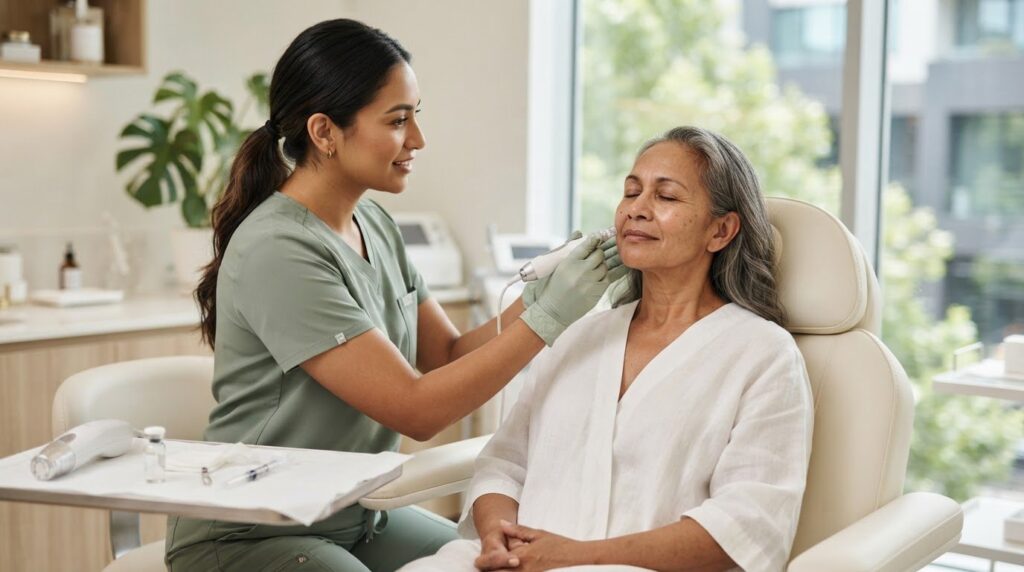
If you’re searching for “microneedling with exosomes cost Melbourne”, it’s worth looking beyond the treatment name to understand what the procedure involves, whether it may suit your skin and what factors shape a treatment plan. Questions about suitability, recovery and realistic expectations matter as much as potential benefits.
Microneedling creates controlled micro-injuries in the skin to stimulate collagen induction, while exosomes are discussed for their proposed role in cell communication and tissue repair. Research into using them together is developing, and results from one preparation or protocol cannot be assumed to apply to another. This guide explains the treatment rationale, where evidence remains limited and what a clinical assessment in Melbourne should consider, including your skin concerns, medical history and goals. Skinstitute offers Skin Needling and exosome treatments, with plans tailored through a face-to-face consultation. The aim is to help you approach that discussion with a clearer understanding of the procedure, possible recovery and the questions relevant to your circumstances.
Key Takeaways
- Learn how controlled Skin Needling stimulates collagen induction and how exosomes are proposed to support skin-repair signalling.
- Understand why exosomes may be considered alongside needling, while evidence and treatment preparations can vary.
- For microneedling with exosomes cost Melbourne searches, this guide explains the factors a personalised clinical assessment considers rather than quoting prices.
- Find out how skin concerns, health history and treatment goals can shape suitability, and what to discuss about possible recovery and risks.
- See how a face-to-face consultation can help you review options and develop a plan tailored to your skin.
Microneedling with exosomes: what the Melbourne treatment combines
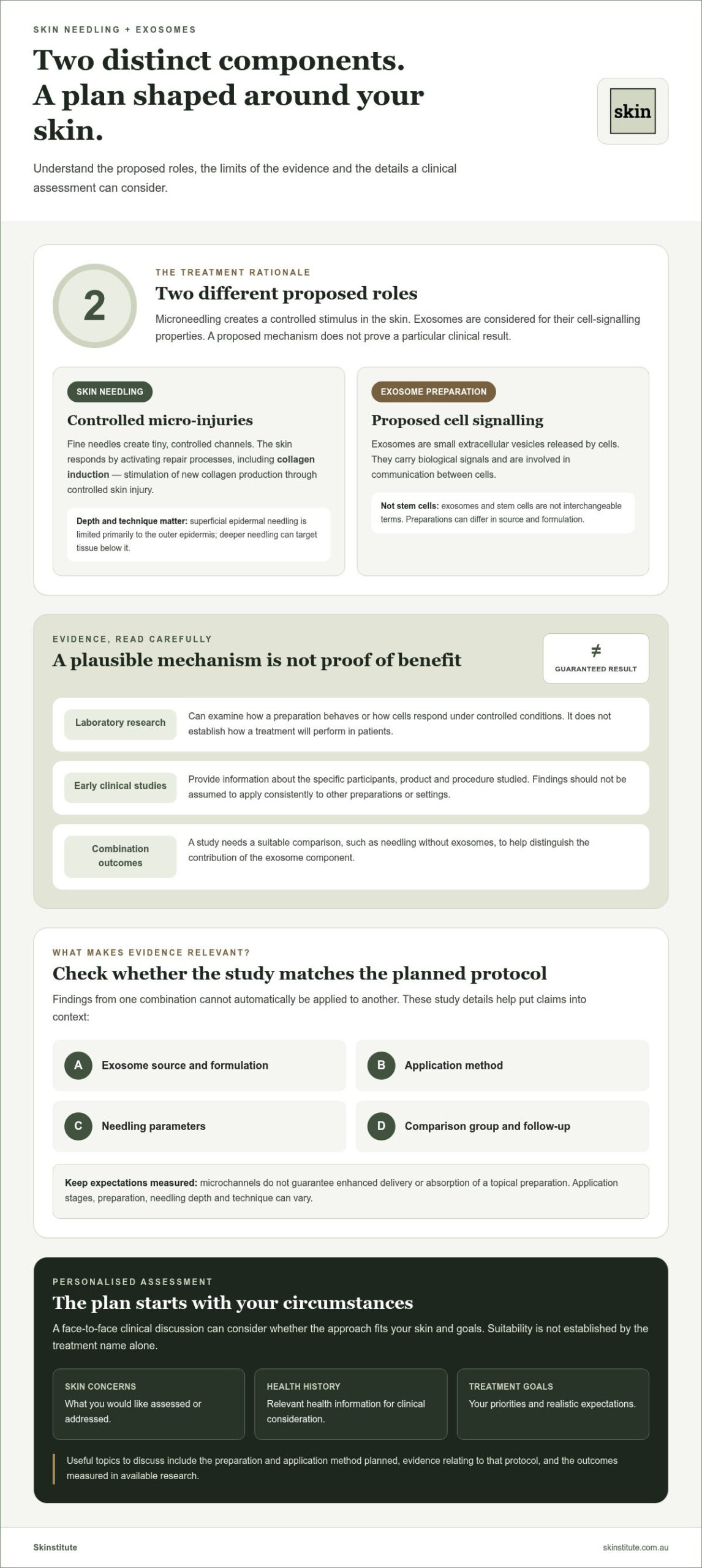
The term microneedling with exosomes brings together two distinct components: controlled Skin Needling and an exosome preparation. Understanding their separate roles helps distinguish the treatment rationale from claims about what the combination will achieve. It describes an approach, not a guaranteed biological response or one standardised protocol.
In brief: Skin Needling creates tiny, controlled channels in the skin. Exosomes are cell-derived extracellular vesicles associated with cell-to-cell signalling. They are not stem cells, and using them alongside needling does not establish a particular result.
What microneedling does to the skin
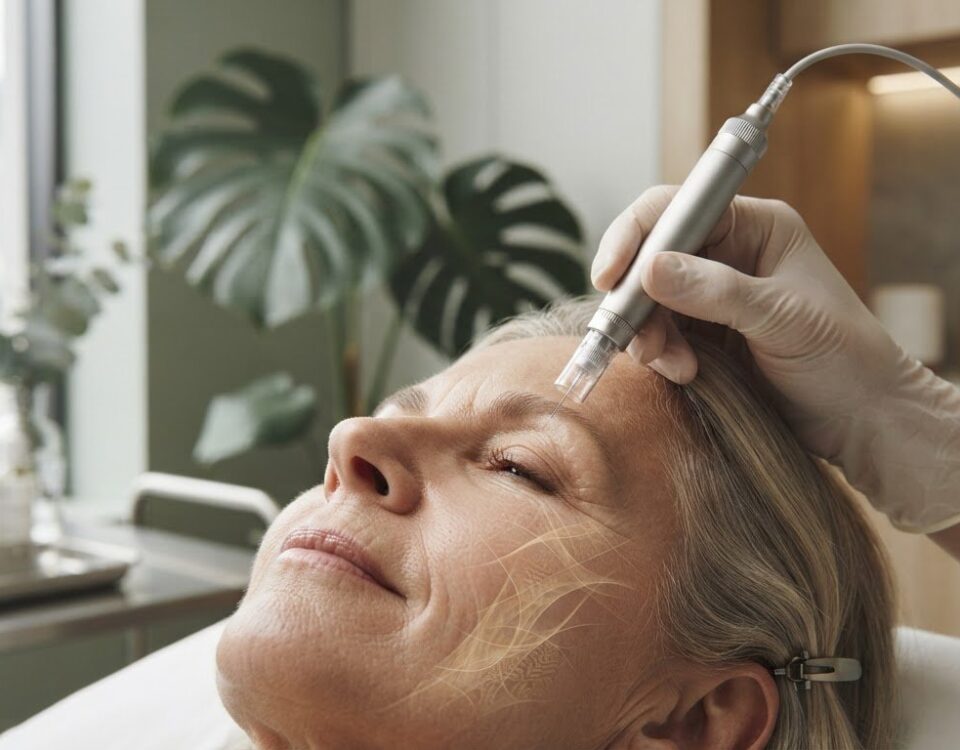
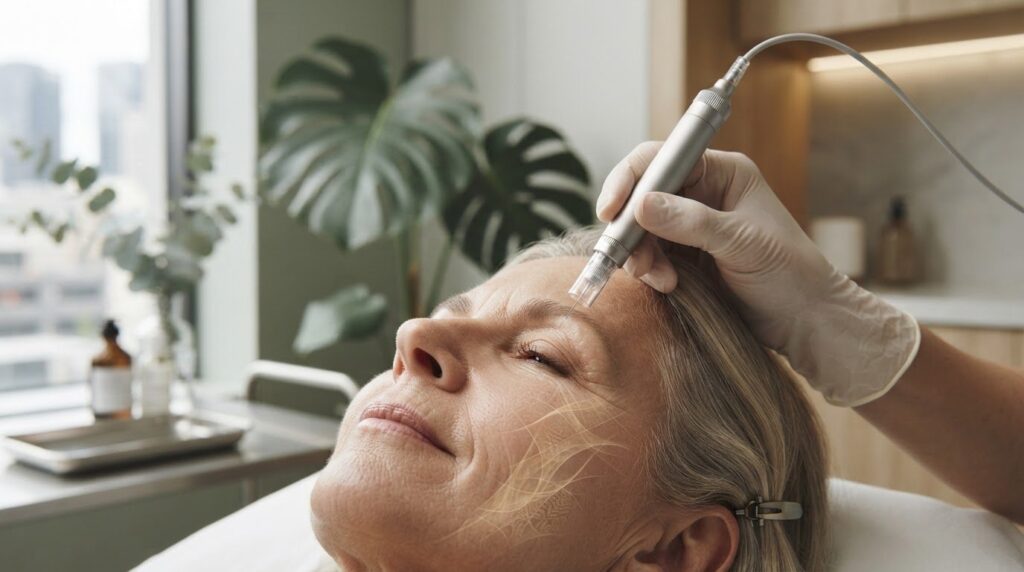
Skin Needling uses fine needles to create controlled micro-injuries. The skin responds by activating repair processes, including collagen induction, the stimulation of new collagen production through controlled skin injury. Collagen is a structural protein that helps support the skin. Responses vary between individuals, so this biological process should not be presented as a promise of a specific change in texture, scarring or firmness.
Depth and technique influence which skin layers are involved and how the procedure is planned. Superficial epidermal needling is limited primarily to the outer epidermis and may be considered for relatively minor concerns. Deeper needling can target tissue below the epidermis to prompt collagen induction, but the approach depends on the concern, skin characteristics and appropriate technique. Microneedling (also known as collagen induction therapy) is a general overview of the procedure and its applications.
What exosomes are, and what they are not
Exosomes are small extracellular vesicles released by cells. They carry biological signals and are involved in communication between cells. In skin treatments, they are proposed to influence signalling associated with repair, but a proposed mechanism does not prove that a particular preparation will produce a particular clinical outcome. Exosomes are not stem cells, and the terms should not be treated as interchangeable.
Preparations can differ in source and formulation, so the word “exosomes” alone does not describe a uniform product. It also does not establish how a preparation is applied or whether it is suitable for a particular person. Evidence needs to be considered in relation to the preparation and treatment method, rather than transferred from one product or study to another.
In practice, needling and exosomes have different proposed roles: needling creates a controlled skin stimulus, while exosomes are considered for their signalling properties. Application methods may vary, so there is no basis for assuming a universal sequence or protocol. If you’re researching microneedling with exosomes cost Melbourne, understanding these components is a useful starting point. A clinical discussion can then consider whether the approach fits your skin concerns and goals.
How microneedling and exosomes are proposed to work together
The proposed combination has two parts: microneedling creates a controlled stimulus in the skin, and an exosome preparation is used in connection with the skin’s response. This rationale draws on the roles of tissue repair and cell signalling, but biological plausibility alone does not show that adding exosomes improves outcomes for every person or concern.
The proposed relationship between needling and cellular signalling
After controlled needling, the skin initiates repair processes in response to the micro-injuries. Exosomes are proposed to contribute signals that may influence aspects of this response. That is a possible mechanism, not proof of a clinical benefit. Needling prompts a repair response; the presence of microchannels should not be taken as a guarantee of enhanced delivery or absorption of a topical preparation.
Application may take place at different stages of treatment, and preparations, needling depth and technique can vary. These details matter because evidence about one combination cannot automatically be applied to another. Treatment claims depend on the formulation and protocol studied. Without matching those details, a broad claim about “exosomes with needling” may overstate what a particular study can establish.
What evidence can support, and what it cannot establish
Laboratory research can examine how a preparation behaves or how cells respond under controlled conditions. Such findings can help explain a proposed mechanism, but they do not establish how a treatment will perform in patients. Early clinical studies provide information about the specific participants, product and procedure examined. Their findings should not be treated as proof of a consistent result across different preparations or treatment settings.
Clinical outcomes are most informative when a study clearly describes the exosome source and formulation, application method, needling parameters, comparison group and follow-up. If these differ between studies, their findings may not be directly comparable. Results from a combination protocol also do not isolate the contribution of exosomes unless the study design includes a suitable comparison, such as needling without the exosome component.
If you’re considering this approach, useful questions include what preparation and application method are planned, what evidence relates to that specific protocol, and which outcomes the available research measured. The answers can help distinguish an established treatment step from a proposed mechanism, without assuming that promising early findings predict your individual result.
Skinstitute offers Skin Needling and exosome treatments, with planning tailored to each person’s skin and concerns. A face-to-face treatment discussion can put the proposed rationale and available evidence in the context of your goals. For readers searching microneedling with exosomes cost Melbourne, understanding the treatment components and the basis for a recommendation is a useful part of comparing options.
Microneedling with exosomes compared with other skin-renewal approaches
Skin-renewal treatments differ in their intended role and the concerns they may address. Compare what each approach involves, the evidence relevant to it and the assessment it requires, rather than assuming one option is universally better. A clinician can assess whether your concern relates to texture, scarring or other skin changes, then discuss which approach may suit your circumstances.
Needling alone
Uses controlled Skin Needling to prompt a repair response. Suitability and treatment planning depend on the concern, skin condition and selected technique. An assessment helps determine whether needling is appropriate and how it should be planned.
Needling with an exosome component
Adds an exosome preparation to a needling treatment. Consider claims in relation to the preparation and protocol studied, and ask what clinical rationale supports adding this component for your concern.
Exosome therapy without needling
Refers to an exosome-based approach without assuming Skin Needling is involved. Application methods and preparations can differ, so evidence for one method cannot automatically establish outcomes for another.
Rejuran
A distinct treatment approach, not another name for exosomes. It should be assessed and discussed on its own terms, rather than treated as interchangeable with an exosome preparation.
Fractional CO2 resurfacing
A laser resurfacing modality, rather than a needling or exosome treatment. Its treatment rationale, suitability and recovery considerations differ, so it requires a separate assessment.
When a clinician may consider needling without an exosome component
Planning starts with the skin concern, current skin condition and treatment goals. A clinician may consider whether needling alone addresses the treatment rationale, rather than adding another component by default. A simpler plan may be appropriate if an additional component is not supported by evidence relevant to the concern. Technique and depth are individual decisions, not a standard prescription for every patient.
How other regenerative or resurfacing options differ
Exosomes and polynucleotide-based serums are not synonymous: they refer to different materials and should not be used interchangeably. Rejuran is also a separate treatment approach. Fractional CO2 uses laser resurfacing rather than needling, so assessment must account for a different procedure and its recovery considerations. A clinician can explain why a particular option is being considered.
When comparing options after searching microneedling with exosomes cost Melbourne, start by identifying what each approach involves and whether its rationale fits your skin concern. A personalised assessment can clarify which options merit consideration without treating them as equivalent or promising a particular result.
Suitability, risks and recovery: what to consider before treatment
Combining Skin Needling with an exosome preparation is not automatically suitable. A clinical assessment should consider your skin’s current condition, relevant health history, concerns and treatment goals. This helps determine whether needling, an exosome component or another approach warrants consideration, and supports a clear discussion of possible risks and limitations alongside potential benefits.
What a clinical suitability assessment should cover
Before treatment planning, discuss relevant skin history, current or recent concerns, medicines and previous procedures. These details help the clinician assess your circumstances and whether the proposed approach may need to be adapted or deferred. Suitability depends on the full clinical picture; a general checklist cannot replace an assessment of the individual and the specific procedure being considered.
Expectations also need discussion. The clinician can explain the intended rationale, possible risks and alternatives, including whether a simpler approach may better fit your goals. Share relevant information, such as previous reactions to skin procedures and changes in your health or medicines. This gives the practitioner context for their recommendation without implying that a particular result is assured.
Recovery expectations and aftercare planning
Visible skin responses and recovery can vary between people and depend on the procedure performed. Temporary redness, sensitivity or mild swelling may occur, but these should not be treated as a complete or predictable list of effects. Avoid relying on general promises of minimal downtime or a fixed recovery timeline. Discuss how the procedure under consideration may affect your activities and what changes should prompt you to seek advice.
Assessment and aftercare should be individualised to the person and procedure. Follow the instructions provided by your treating clinical team rather than applying generic guidance intended for another treatment or preparation. If your response concerns you or differs from the advice you received, contact the treating team for guidance. Clarify follow-up arrangements before treatment so you know how to raise concerns during recovery.
- Share relevant skin and health history, medicines and details of previous procedures.
- Discuss the treatment rationale, potential risks, limitations and alternatives.
- Follow aftercare instructions specific to the procedure and preparation used.
- Clarify how to seek advice if your response differs from the guidance provided.
For people searching microneedling with exosomes cost Melbourne, suitability and a clear understanding of the proposed plan are useful considerations alongside practical questions. A discussion with the treating team can explain how your circumstances inform the approach. Book a face-to-face consultation to discuss your concerns and possible options.
Planning a personalised microneedling and exosome consultation in Melbourne
A consultation gives you time to explain what is prompting your interest in treatment and what you hope to address. The clinician can clarify the concern, assess your skin and discuss relevant options, including whether microneedling with exosomes warrants consideration. The discussion should also cover the reasoning behind any recommendation, its limitations and what information remains uncertain.
What to bring to a face-to-face skin consultation
Make a note of the skin concerns you’d like to discuss, how they affect you and the changes you hope to see. Bring a current list of medicines and skincare products, and be prepared to describe previous skin treatments and any reactions. These details help inform the assessment, but do not predetermine which procedure, if any, will be recommended.
The clinician can review your skin and relevant history, then explain which options may fit your circumstances. Ask how the proposed approach relates to your specific concern, what alternatives could be considered and what uncertainties remain. A recommendation should follow from the assessment; discussing a treatment does not commit you to proceeding.
How Skinstitute approaches treatment planning
The planning discussion connects your priorities with the clinical findings and identifies practical next steps. This may include clarifying the treatment rationale, discussing relevant risks and aftercare, and deciding whether further consideration is needed before proceeding. Skinstitute has locations across the Melbourne metro area.
The medical-grade aesthetic treatments guide provides broader context for considering skin treatments. If you’re researching microneedling with exosomes cost Melbourne, use your consultation to understand what the proposed plan involves and how your individual assessment informs the recommendation, rather than assuming a standard combination is appropriate.
Before concluding the discussion, make sure you understand the proposed next steps, any preparation guidance and how to raise questions if your circumstances change. You can take time to consider the information before deciding whether to proceed.
Skinstitute offers a free consultation to discuss your concerns and suitability. Book your free consultation to start the discussion in Melbourne.
Make your next step an informed one
A considered treatment decision starts with a clear understanding of what you want to address and a discussion of whether the proposed approach fits your skin. The phrase microneedling with exosomes cost Melbourne may reflect one part of your research, but a personalised clinical conversation can also help you understand the rationale, suitability and practical considerations relevant to your circumstances.
Use your consultation to raise the questions that matter to you, including what the plan is intended to address, what alternatives may be considered and how recovery and aftercare would be discussed. You do not need to decide on a procedure before having that conversation. An informed plan should reflect your individual assessment, not an assumption that one combination is right for everyone.
Skinstitute offers Skin Needling and exosome treatments, with treatment planning based on face-to-face consultation. Book a free consultation with Skinstitute to discuss your concerns and explore whether a tailored approach may suit you. A clear, measured discussion is a positive place to begin.
Frequently Asked Questions
Can microneedling with exosomes be considered for acne scarring?
It may be considered for some acne-scar concerns, but suitability depends on clinical assessment. Scars can differ in appearance and depth, and active skin concerns or medical history may affect the options discussed. The aim should be framed as addressing a specific concern, not as a promised result. After reviewing your scar type and skin condition, a clinician can discuss Skin Needling and other appropriate approaches.
Is microneedling with exosomes suitable for every skin type?
No treatment should be assumed suitable for everyone. A clinician considers your skin’s current condition, medical history, ongoing treatments and individual risk factors before making a recommendation. Avoid relying on blanket claims about suitability based only on skin type or tone. A face-to-face discussion can help establish whether this approach, another option or no treatment is appropriate for your circumstances and goals.
Are exosomes the same as stem cells?
No. Exosomes are extracellular vesicles, not intact stem cells. Some preparations may be described in relation to the cells from which they originate, but the source and formulation should not be generalised across products. Exosomes do not become stem cells, and a proposed role in cell signalling does not guarantee tissue regeneration. If a preparation is being considered, its specific characteristics and intended use are relevant to the clinical discussion.
How many microneedling with exosomes sessions might someone need?
There is no standard number of sessions that can be recommended for everyone. Planning depends on the concern being addressed, your skin assessment, the selected protocol and how your skin responds over time. Questions about microneedling with exosomes cost Melbourne are separate from treatment frequency. A consultation can establish a tailored plan, but the treatment name alone cannot predict the number of sessions or guarantee an outcome.
Can microneedling with exosomes be combined with other skin treatments?
Other treatments may be considered, but suitability and timing depend on your skin, treatment history and the procedures involved. Do not assume that combining treatments on the same day or following a set schedule is appropriate. A clinician can review the options and discuss whether another modality should be staged separately or is unsuitable for you.
What should I avoid before a microneedling consultation?
Do not change your skincare routine or medicines based on general advice alone. Instead, bring a current list of skincare products and medicines, and describe recent procedures, previous reactions and any current skin concerns. This gives the clinician useful context for the assessment. If preparation is needed before treatment, follow instructions from the treating clinical team after they have reviewed your circumstances.
When should I seek advice after a skin needling treatment?
Follow the aftercare instructions from your treating clinician, and contact the treating clinic if your skin response concerns you or differs from the guidance you received. Describe what you’re experiencing and when it began so the team can advise on appropriate next steps. If symptoms are severe or require urgent attention, seek appropriate medical care rather than waiting for a routine follow-up.