City Skin Clinic vs Skinstitute for Fillers: A Clinical Comparison for Melbourne Patients
August 11, 2026
PDO Threads vs. Dermal Fillers Melbourne: A Clinical Structural Comparison
August 13, 2026
Restoring a defined jawline in 2026 is no longer a binary choice between surgery and temporary fixes; it is a precise calculation of tissue depth and structural integrity. When investigating hifu vs thread lift for jowls melbourne, many patients find themselves caught between the subtle tightening of energy-based devices and the immediate mechanical repositioning of sutures. You likely want to address sagging without the fear of looking “over-pulled” or the anxiety associated with significant downtime. It’s common to feel overwhelmed by conflicting clinical claims while seeking a result that remains natural and balanced.
This guide provides a definitive clinical comparison of these two leading modalities, clarifying which approach aligns with your specific anatomical needs and safety expectations. We will examine the physiological mechanisms of High-Intensity Focused Ultrasound and PDO Thread Lifting, evaluating their efficacy, recovery periods, and the 2026 AHPRA regulatory standards that govern these medical-grade procedures. By understanding how these treatments interact with the SMAS layer and collagen synthesis, you can make an informed decision rooted in scientific evidence rather than marketing trends.
Key Takeaways
- Understand the anatomical causes of jowl formation, specifically the descent of the malar fat pad and the weakening of mandibular retaining ligaments.
- Learn how High-Intensity Focused Ultrasound (HIFU) employs micro-focused energy to create thermal coagulation points for deep-tissue tightening.
- Compare the clinical outcomes of hifu vs thread lift for jowls melbourne to determine whether your skin requires thermal remodelling or immediate mechanical repositioning.
- Examine the role of PDO threads in providing structural support through absorbable surgical sutures that anchor into the subcutaneous tissue.
- Discover the “Hybrid Lift” protocol, a synergistic approach that addresses both dermal laxity and structural descent for superior jawline definition.
The Pathophysiology of Jowls: Understanding Lower Face Descent
The formation of jowls represents a complex interplay of anatomical shifts within the lower third of the face. Clinically, jowls are defined by the inferior descent of the malar fat pad and progressive skin laxity along the mandibular border. This process isn’t merely a superficial skin concern; it’s a multi-layered structural failure. Several key factors contribute to this descent:
- Bone Resorption: Age-related loss of volume in the mandible and chin reduces the skeletal projection required to support overlying tissues.
- Soft Tissue Migration: The downward shift of mid-face fat compartments due to gravity and weakened support.
- Dermal Laxity: The depletion of collagen and elastin within the skin’s matrix, leading to reduced recoil.
This loss of foundation causes the skin to drape over the jawline, creating the characteristic sagging appearance. Understanding the Pathophysiology of Jowls is essential when evaluating hifu vs thread lift for jowls melbourne, as each modality targets different depths of this structural decline.
The Role of the SMAS Layer in Jawline Definition
Acting as a continuous, tough, fibrous envelope, the Superficial Muscular Aponeurotic System (SMAS) links facial muscles to the dermis. It’s the primary architectural framework responsible for facial contour and stability. As biological ageing progresses, the SMAS loses its inherent tensile strength and elasticity, leading to a visible, characteristic heaviness in the lower face. Targeting this layer is the gold standard for achieving a true lift rather than just temporary skin tightening. Modern non-surgical interventions aim to either thermally contract this layer or mechanically reposition it to restore the youthful, sharp definition of the jawline. Without addressing this foundation, treatments often fail to produce a sustainable lift, merely masking the underlying descent of the facial mask.
Soft Tissue Atrophy and Ligamentous Laxity
Facial stability relies on a series of robust retaining ligaments, such as the masseteric and mandibular ligaments, which anchor soft tissues to the underlying bone. Over time, these ligaments lengthen and weaken, allowing the malar fat compartments to migrate downwards and medially. This migration results in the accumulation of soft tissue over the jawline and the formation of the pre-jowl sulcus, a distinct depression that interrupts the continuity of the mandibular arc. When patients compare hifu vs thread lift for jowls melbourne, they must consider that superficial skin ageing differs significantly from this deep structural descent. While energy-based devices focus on biological collagen synthesis, mechanical threads aim to counteract the effects of gravity by physically anchoring the migrated tissue back to its original position.
HIFU Treatment: Deep Tissue Thermal Remodelling
High-Intensity Focused Ultrasound (HIFU) represents a significant advancement in non-invasive aesthetic medicine, specifically designed to address structural laxity without surgical intervention. Unlike lasers that target the skin’s surface, HIFU utilises micro-focused ultrasound energy to bypass the epidermis and deliver precise thermal energy to deeper structural layers. This process of Deep Tissue Thermal Remodelling allows practitioners to treat the Superficial Muscular Aponeurotic System (SMAS) at a depth of 4.5mm, a layer previously only accessible through invasive surgery.
When evaluating hifu vs thread lift for jowls melbourne, it’s vital to recognise that HIFU is a biological stimulant rather than a mechanical fix. The device delivers energy at depths of 1.5mm, 3.0mm, and 4.5mm, ensuring that both the dermal matrix and the underlying structural framework are addressed simultaneously. This multi-depth approach triggers a cascaded healing response that results in gradual tissue contraction and firming over several months.
Mechanism of Action: Thermal Coagulation Points
The efficacy of HIFU lies in its ability to create thousands of discrete thermal coagulation points (TCPs) within the targeted tissue. By heating these microscopic zones to approximately 60-70°C, the procedure induces controlled cellular injury and immediate collagen denaturation. This state of controlled “thermal trauma” activates the body’s natural wound-healing mechanism.
Following the initial treatment, a biological timeline of neocollagenesis and elastin production begins. While some immediate contraction may be visible due to collagen fibre shortening, the primary clinical results manifest over a period of 3-6 months. During this time, the body synthesises new, high-quality collagen, which progressively reinforces the jawline’s definition. Because the energy is focused deep within the tissue, the surface remains entirely unaffected, ensuring there’s no downtime or epidermal disruption.
Clinical Suitability for HIFU
The ideal candidate for HIFU typically presents with mild to moderate skin laxity and maintains a healthy dermal thickness. It’s an excellent choice for Melbourne patients seeking “preventative lifting” or those who aren’t yet ready for the mechanical intervention of sutures. Because it relies on the body’s regenerative capacity, it produces exceptionally natural results that evolve with the patient’s own biology.
For individuals experiencing more advanced descent, a clinical consultation is essential to determine if energy-based tightening alone will suffice or if a combined approach is required. In the context of hifu vs thread lift for jowls melbourne, HIFU serves as the foundational treatment that improves skin quality and “shrink-wraps” the tissue, providing a firmer canvas for potential structural support.
PDO Thread Lifting: Immediate Mechanical Structural Support
Polydioxanone (PDO) threads represent a minimally invasive intervention designed to physically reposition descending facial tissues. Unlike energy-based devices that require months to manifest biological changes, PDO threads offer an immediate structural uplift. This material is a biocompatible polymer that has been utilised in complex medical procedures, including cardiothoracic surgery, for over 30 years. Its long-standing history in high-stakes medicine provides a robust safety profile for aesthetic applications. When patients evaluate hifu vs thread lift for jowls melbourne, they often prioritise this immediate visual correction of the mandibular border.
The procedure involves the precise insertion of these absorbable sutures into the subcutaneous layers of the face. While the threads themselves eventually dissolve, the structural changes they initiate provide a lasting impact on facial contour. This makes them a primary choice for individuals whose jowl formation is characterised by significant tissue migration rather than simple skin laxity.
The Biomechanics of Tissue Repositioning
The primary efficacy of a thread lift stems from the mechanical engagement of ‘cogs’ or ‘barbs’ located along the suture’s length. These microscopic structures are engineered to anchor firmly into the subcutaneous fat and superficial fascia. Once anchored, the practitioner can exert a directional pull along specific vectors to lift the malar fat pad and tighten the jowl area. This process effectively restores the ‘triangle of youth’, a clinical term for the high cheekbones and tapered jawline characteristic of a youthful visage. This repositioning is not merely a surface-level stretch; it’s a recalibration of the lower face’s architectural balance, moving tissue back to its original anatomical position.
Neocollagenesis: The Secondary Benefit of Threads
While the mechanical lift is instantaneous, the long-term benefit of PDO threads lies in the secondary biological response. The presence of the suture within the tissue triggers a controlled foreign body response, which stimulates fibroblasts to produce new Type I and Type III collagen. This creates a dense ‘collagen scaffold’ around the thread, reinforcing the tissue from within. Even after the polydioxanone is naturally hydrolysed and absorbed by the body, typically within 6 to 9 months, this newly formed connective tissue remains in place.
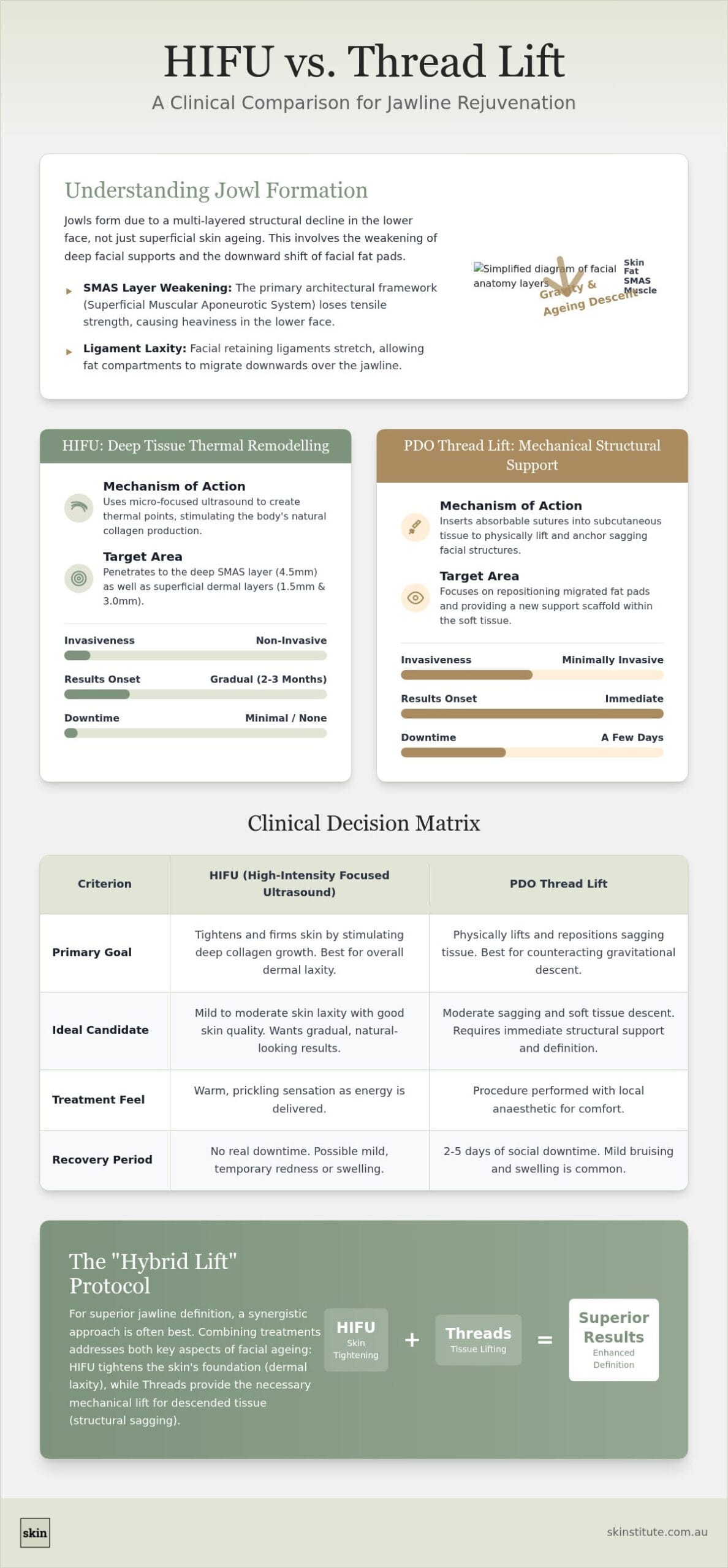
This dual-action mechanism ensures that the structural integrity of the jawline is maintained long after the physical thread has disappeared. At Skinstitute Melbourne, we observe that this biological reinforcement is what provides the longitudinal results patients desire. In a Clinical Decision Matrix, the distinction between thermal tightening and mechanical lifting becomes clear. Threads are superior for repositioning volume that has already migrated. Consequently, the choice of hifu vs thread lift for jowls melbourne often depends on whether the patient requires deep-tissue contraction or a physical change in tissue position.
HIFU vs Thread Lift: A Clinical Decision Matrix for Melbourne Patients
Selecting between hifu vs thread lift for jowls melbourne requires a technical understanding of the “Downtime vs Result” trade-off. High-Intensity Focused Ultrasound offers zero downtime and a non-invasive profile, yet it requires biological patience as results emerge gradually over several months. Conversely, PDO thread lifting provides an immediate mechanical correction of the jawline but involves a clinical recovery period of approximately 3 to 7 days. Under the 2026 AHPRA guidelines, Melbourne patients must undergo a comprehensive clinical assessment and observe mandatory cooling-off periods for higher-risk cosmetic procedures like thread lifting. This regulatory framework ensures that the chosen modality aligns with the patient’s physiological needs and safety profile rather than following a self-diagnosed preference.
Professional anatomical assessment is the critical first step in this hierarchy of care. A practitioner evaluates the degree of tissue ptosis, skin thickness, and the presence of underlying structural support. Without this expert oversight, patients risk selecting a treatment that cannot technically address their specific concerns, leading to suboptimal outcomes or unnecessary procedural risks.
Evaluating Tissue Quality and Degree of Ptosis
“Heavy” jowls, which are characterised by significant descent of the malar fat pad and substantial tissue volume, often possess too much mass for thermal contraction alone to lift effectively. These cases typically require the mechanical strength of barbed sutures to physically suspend and anchor the tissue. In contrast, patients presenting with “thin” skin and superficial laxity often respond better to the thermal tightening of HIFU. This modality “shrink-wraps” the dermal matrix, which might otherwise be too fragile to support the tension of a thread lift. Contraindications for these procedures include excessive skin folds that may require surgical excision or extremely low body fat levels where thread visibility could become a clinical concern.
Longevity and Maintenance Cycles
Clinical observations indicate that HIFU results typically persist for 12 to 18 months, depending on the individual’s rate of collagen degradation and lifestyle factors. PDO threads generally offer a longer duration of 18 to 24 months, as the secondary collagen scaffold remains structurally sound even after the suture has been naturally hydrolysed. Preserving a sharp mandibular line involves a structured maintenance cycle tailored to the patient’s biological ageing process. The Hybrid Lift protocol represents the emerging gold standard in 2026, combining these modalities to address both dermal quality and structural descent in a single, synergistic plan.
To determine the most effective path for your specific anatomy, you can book a clinical consultation at our Melbourne clinic to receive a personalised assessment.
The Skinstitute Approach: Synergistic Jowl Rejuvenation
The most effective clinical outcomes for lower-face rejuvenation often arise from a multi-modal strategy rather than a single technology. Skinstitute has maintained a 26-year clinical history in Melbourne, focusing on medical-grade results that prioritise anatomical integrity and patient safety. When evaluating hifu vs thread lift for jowls melbourne, it’s essential to view these modalities as complementary components of a sophisticated rejuvenation plan. While individual treatments provide specific benefits, a synergistic approach addresses the multi-layered nature of facial ageing, from dermal thinning to deep structural descent.
By moving beyond the limitations of a single-device solution, practitioners can create a more balanced and sustainable result. This approach acknowledges that the loss of jawline definition is rarely caused by a single factor, but is instead the result of changes in bone density, fat distribution, and skin elasticity.
The ‘Hybrid Lift’ Protocol
The ‘Hybrid Lift’ protocol is a sequential treatment strategy designed to maximise tissue response. This process typically begins with thermal tightening using High-Intensity Focused Ultrasound to prepare the dermal and SMAS layers. By inducing neocollagenesis and contracting the fibrous envelope of the face, HIFU creates a firmer, more resilient foundation. Following this biological conditioning, PDO threads are utilised to provide the necessary mechanical lift and structural support. This sequence ensures that the threads anchor into higher-quality, tightened tissue, which can enhance the longevity and stability of the repositioned fat pads.
A significant advantage of this combined methodology is the ability to restore a youthful jawline without the “over-filled” or distorted appearance that can occur when relying solely on volume replacement. By physically repositioning descended tissue and tightening the skin’s matrix, we achieve a result that respects the patient’s natural facial proportions.
Professional Consultation and Longitudinal Care
Every successful rejuvenation journey starts with a comprehensive clinical consultation. At Skinstitute, we utilise clinical photography and detailed anatomical assessment to map the specific vectors of descent in the lower face. This evidence-based approach allows for the creation of a bespoke treatment plan that aligns with each patient’s unique physiology and lifestyle requirements. We focus on longitudinal care, ensuring that results are maintained through structured follow-up and adaptive protocols as the ageing process continues.
For a deeper understanding of our medical-grade standards, patients are encouraged to review the Skinstitute Melbourne clinical guide. This document outlines the technical proficiency and safety standards that define our practice, providing a transparent overview of what patients can expect during their clinical journey. By choosing an experienced partner, you ensure that your treatment for hifu vs thread lift for jowls melbourne is grounded in scientific principle and clinical excellence.
Achieving Precision in Jawline Restoration
Restoring a defined mandibular border requires a clinical understanding of whether your anatomy necessitates thermal contraction or mechanical repositioning. While HIFU provides essential deep-tissue tightening through neocollagenesis, PDO threads offer the immediate structural support required for descended fat pads. The most sophisticated outcomes in 2026 are achieved through a hierarchical approach that addresses both dermal laxity and structural descent. Determining the correct path of hifu vs thread lift for jowls melbourne isn’t a matter of choosing a trend; it’s a decision that must be guided by professional anatomical assessment.
Skinstitute Melbourne provides an AHPRA-compliant clinical environment with over 26 years of aesthetic expertise in both PDO Threads and HIFU. We prioritise technical mastery and evidence-based protocols to ensure your results remain natural and balanced. A bespoke treatment plan is the foundation of long-term jawline definition and structural health. Our specialist Melbourne clinic focuses on providing the educational clarity required for you to feel confident in your clinical journey.
Book Your Clinical Jawline Assessment at Skinstitute Melbourne to begin your journey toward a restored and resilient facial contour. Our seasoned practitioners are ready to partner with you in achieving clinical excellence.
Frequently Asked Questions
Is HIFU or a Thread Lift better for significant jowls?
A PDO thread lift is typically superior for significant jowl formation because it provides the mechanical strength required to physically reposition descended tissue. While HIFU is excellent for deep-tissue tightening, its thermal mechanism is often insufficient to lift the heavy malar fat pads associated with advanced ptosis. When comparing hifu vs thread lift for jowls melbourne, patients with more pronounced sagging generally require the structural support of sutures to restore a defined mandibular line.
How long does the recovery take for a PDO Thread Lift in Melbourne?
Clinical recovery for a PDO thread lift generally ranges from 3 to 7 days. During this initial period, patients may experience mild swelling, bruising, or a sensation of tightness as the tissue integrates with the sutures. We advise avoiding strenuous exercise and excessive facial movements for at least two weeks to ensure the threads remain securely anchored. This short downtime is significantly less than surgical alternatives while still providing immediate mechanical results.
Can I combine HIFU and PDO Threads in the same appointment?
Combining these modalities in a single appointment is typically not recommended due to the thermal nature of HIFU, which could potentially compromise the integrity of the PDO material. The ‘Hybrid Lift’ protocol usually involves performing HIFU first to condition the skin and SMAS layer, followed by a thread lift several weeks later. This sequence allows the threads to be placed into a firmer, thermally tightened foundation, which can lead to more stable and long-lasting structural results.
What are the risks associated with non-surgical jowl treatments?
Potential risks include localised swelling, bruising, and temporary tenderness at the treatment site. Rare complications such as asymmetry, infection, or thread extrusion can occur if the procedure is not performed in a controlled clinical environment. Our adherence to 2026 AHPRA guidelines and sterile medical-grade protocols minimises these risks. A comprehensive clinical assessment is mandatory to evaluate patient suitability and ensure that the chosen treatment aligns with individual anatomical safety requirements.
How much does a non-surgical face lift cost at a Melbourne clinic?
The investment for non-surgical rejuvenation depends on the specific modality chosen and the complexity of the anatomical correction required. Factors such as the number of threads utilised or the surface area covered during a HIFU session will influence the final cost. Patients should seek a formal clinical consultation to receive a bespoke quote tailored to their unique needs. Prices across Melbourne clinics vary based on the practitioner’s expertise and the specific technology employed.
Will HIFU or Threads make my face look ‘plastic’ or unnatural?
Neither modality is designed to create an ‘over-pulled’ or unnatural appearance when administered by an experienced practitioner. HIFU relies on biological collagen synthesis for a gradual improvement, while threads reposition existing tissue to its original anatomical location. These treatments respect the natural contours of the face, avoiding the distorted volume often associated with excessive dermal fillers. The goal is a refreshed and refined version of your own features, rather than a fundamental change in facial identity.
How many HIFU sessions are required to see a difference in my jawline?
Most patients observe a visible improvement in their jawline after a single, comprehensive HIFU session. However, individuals with more pronounced laxity may benefit from a second treatment performed 3 to 6 months later to further stimulate neocollagenesis. Because the results of hifu vs thread lift for jowls melbourne manifest as the body synthesises new collagen, the full clinical effect typically takes several months to appear. Maintenance sessions are usually recommended every 12 to 18 months.
Are the results of a Thread Lift permanent?
The results of a PDO thread lift are not permanent, as the polydioxanone material is naturally hydrolysed and absorbed by the body within 6 to 9 months. However, the secondary collagen scaffold created during the healing process provides a lasting lift that typically persists for 18 to 24 months. While the mechanical sutures dissolve, the biological reinforcement remains. Regular maintenance and a focused skin health regimen are essential for preserving the sharpened mandibular definition over the long term.