How Many HIFU Sessions for a Double Chin? A Melbourne Guide
October 19, 2026
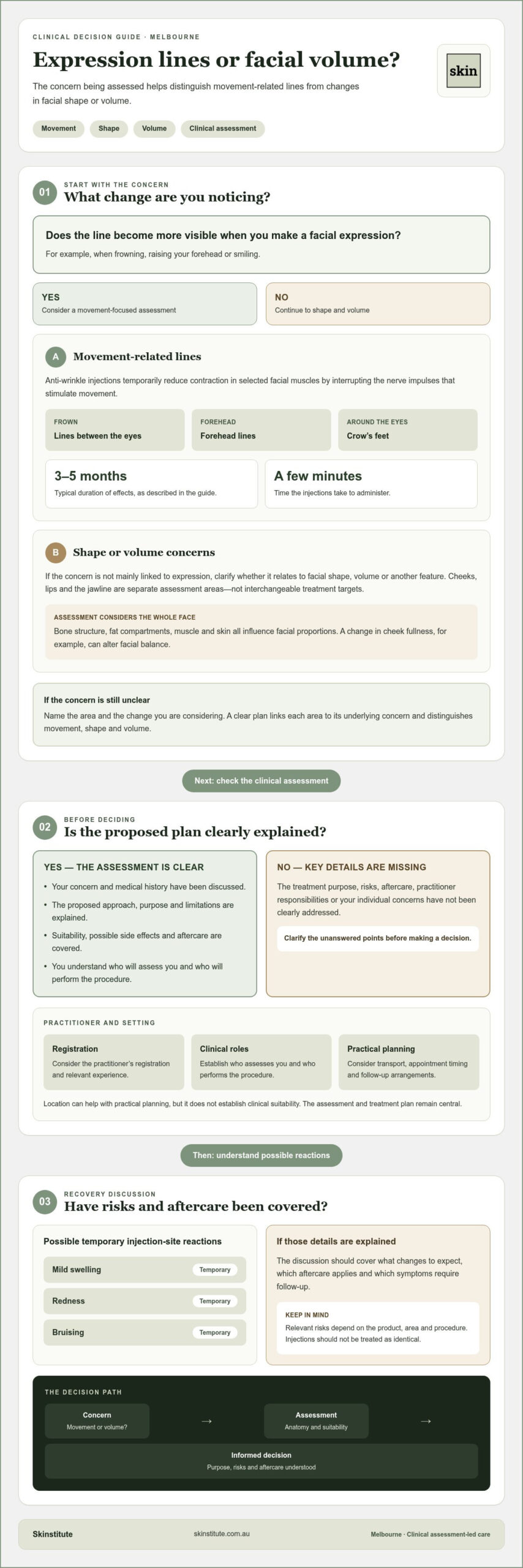
Anti-wrinkle injections temporarily reduce targeted muscle contraction by interrupting the nerve impulses that trigger movement. For people considering cosmetic injections in Melbourne, they may address frown lines between the eyes, forehead lines and crow’s feet. Effects typically last three to five months, and the injections take only a few minutes to administer.
It’s understandable to want clear information about what a treatment can change, how it works and what to expect afterwards. This guide explains who can provide prescription cosmetic treatments in Australia, how facial movement and anatomy inform treatment planning, and how cheek or jawline volume may affect overall facial balance.
You’ll also find an overview of treatment timing, aftercare and factors that can influence suitability. The aim is to clarify the differences between treatments and explain why a personalised clinical assessment matters before deciding on your next step.
Key Takeaways
- Understand how anti-wrinkle injections affect targeted muscle activity and which expression lines they may address.
- Learn why practitioner qualifications, clinical assessment and treatment setting matter when considering prescription cosmetic procedures in Australia.
- See how cheek and jawline volume can influence facial proportions, and which anatomical factors shape a treatment plan.
- Recognise the difference between reducing muscle movement and restoring volume when considering a balanced facial approach.
- Know what temporary injection-site reactions may occur and how aftercare supports recovery.
What are anti-wrinkle injections?
Anti-wrinkle injections temporarily reduce contraction in selected facial muscles by interrupting the nerve impulses that stimulate movement. They are used for movement-related lines, including frown lines between the eyes, forehead lines and crow’s feet. This differs from volume restoration, which addresses facial contour rather than muscle activity. Identifying your concern first helps clarify which treatment category may be relevant.
A personalised consultation starts with the area of concern and the change you’re considering. The practitioner can assess facial movement, discuss your medical history and previous procedures, then explain the proposed approach and its limitations. For example, lines that appear during expression call for a different discussion from concerns about cheek volume. The assessment should also cover suitability, potential side effects and aftercare before you decide on treatment.
Lips, cheeks and the jawline may each be considered during a cosmetic assessment, but they are not interchangeable treatment targets. Clarify whether your concern relates to movement, shape, volume or another feature. For example, lip definition calls for a different anatomical discussion from jawline contour. Naming the area and desired change helps keep the treatment plan specific.
Australian laws and TGA requirements depend on the particular product, its intended use and the advertising context. Before deciding on treatment, establish which product is being discussed and ask the practitioner to explain the requirements that apply.
Medicare or private health insurance eligibility cannot be determined from a treatment name alone. The clinical purpose and the terms of your individual policy are relevant. Clarify the documented purpose of treatment and review the applicable policy wording.
Anti-wrinkle treatment areas
Frown lines, forehead lines and crow’s feet relate to movement in specific facial muscles. Assessment should identify which movements contribute to the visible line and whether the proposed target matches your concern. Lips, cheeks and the jawline need separate consideration because shape and volume concerns differ from expression-related wrinkles. A clear plan links each area to its underlying concern.
Risks and possible side effects
Temporary mild swelling, redness and bruising may occur at injection sites. Relevant risks depend on the product, area and procedure, so discuss them beforehand rather than treating all injections as identical. Ask what changes to expect, what aftercare applies and which symptoms require follow-up. This discussion should inform your decision, not be an afterthought.
Registered practitioners and clinical setting
When choosing a cosmetic treatment in Melbourne, consider the practitioner’s registration, relevant experience and clinical setting together. Checking registration is only one part of the decision. The consultation should also establish who will assess you, who will perform the procedure and how your concerns will shape the plan.
Ask the practitioner to explain the treatment’s purpose, expected effects, possible risks and aftercare in language you understand. A plan for movement-related lines, for example, differs from one addressing facial volume. The practitioner should clarify which concern is being assessed and why the proposed approach may suit it. Skipping your medical history or treatment goals leaves important assessment steps unexplored.
The setting matters because treatment involves clinical assessment, preparation and follow-up information, not simply choosing an option from a menu. Before proceeding, understand who is responsible for each stage, how to raise questions and what instructions apply afterwards. A clear explanation helps you make an informed decision without treating location or presentation as a substitute for clinical judgement.
Melbourne spans central and metropolitan areas, so location can affect practical planning. A CBD appointment may suit someone working or travelling through the city, while a clinic elsewhere in Melbourne may be more accessible from home. Consider transport, appointment timing and how you’ll travel afterwards, particularly if you expect temporary injection-site effects. These details don’t determine clinical suitability, but they can make an appointment easier to manage.
Clinic hours also shape appointment planning, but schedules vary across Melbourne. Check that your appointment allows time for assessment and discussion, rather than focusing only on the procedure. If follow-up is part of the plan, consider how its timing fits your usual schedule. The clinical discussion should remain central, whether your appointment is in the CBD or another part of Melbourne.
Sydney is a separate city, so its clinic locations and operating hours don’t describe the options available in Melbourne. When comparing appointments across cities, consider travel, follow-up access and continuity with the practitioner. A Sydney address alone can’t establish whether treatment is appropriate for someone living in Melbourne. The relevant factors remain the practitioner, assessment and treatment plan.
During a consultation, ask specific questions to clarify the process: who will assess you, who will perform the procedure, what outcome is planned and what aftercare applies? Note whether the explanation addresses your individual anatomy and concerns. A suitable clinical setting supports informed discussion and an assessment-led decision, without pressure to proceed.
Volume restoration for cheeks and jawline
For people considering cosmetic injections in Melbourne, facial volume and contour are assessed in relation to the whole face. Bone structure, fat compartments, muscle and skin all influence facial proportions. A change in cheek fullness, for example, can alter the transition between the lower eyelid and midface. Volume restoration addresses a defined structural concern, rather than adding fullness without a specific objective.
Cheek assessment considers the midface as a connected structure. The practitioner observes cheek projection, nearby contours and how your face appears at rest and in movement. A hollow beneath the cheekbone differs from reduced prominence over the cheek. The discussion should identify your concern and intended change, rather than treating facial volume as one uniform issue.
Jawline contouring involves more than the outline of the jaw. Assessment may consider the chin, lower cheek, skin quality and the relationship between the lower face and neck. A soft jawline caused by reduced structural support differs from one influenced by skin laxity. A filler approach may address volume or contour, but it won’t address every possible cause of a blurred jawline.
Hyaluronic acid dermal fillers may add volume or refine contour in selected facial areas. Placement depends on your anatomy and treatment goal. A consultation should clarify what the proposed treatment aims to change and how that relates to surrounding features. For cosmetic injections in Melbourne, discussing facial balance can help keep the objective proportionate to your existing structure, rather than focusing on one feature alone.
Lip enhancement needs its own assessment of shape, proportion and movement. You may seek clearer definition at the border, improved symmetry or added fullness. These aims differ: adding volume doesn’t automatically create a particular shape. The upper and lower lips should be considered in relation to each other and nearby features, including the chin and nose.
A practical consultation can clarify your concern, identify the anatomical feature involved and establish a treatment objective. For example, “restore cheek support” is more specific than asking for a general facial refresh. The practitioner can explain whether volume treatment aligns with that objective and how the plan accounts for your facial proportions.
Dermal fillers don’t directly improve every aspect of skin quality or restore collagen production. A hollow cheek, fine surface lines and uneven texture are distinct concerns, each requiring separate assessment. Clear goals keep enhancement focused on the feature being addressed and help avoid adding volume where it won’t support the intended result.
Facial balance and natural-looking results
Facial balance is assessed by considering how features relate, rather than treating one line or contour in isolation. A practitioner may observe your face at rest and during expression, then identify whether your concern relates to muscle movement, volume, skin quality or structure. For example, a hollow cheek and a prominent jawline involve different anatomical considerations and treatment goals.
Start by describing the change you want to address, such as softening frown lines or defining the lower face. The practitioner can assess the relevant area alongside nearby features. A treatment target should be specific: reducing movement in a selected muscle differs from restoring cheek volume. This distinction helps ensure one procedure isn’t expected to address unrelated concerns.
Anti-wrinkle injections reduce activity in targeted muscles; dermal fillers address volume and contour. Their purposes differ, so combining them doesn’t automatically create better facial balance. A request to soften forehead lines, for instance, doesn’t by itself indicate a need for cheek enhancement. A considered plan links each treatment to an identified concern and explains its potential effect on surrounding features.
The masseter muscles show how function and appearance can overlap. Treating these muscles can help reduce excessive facial squareness and improve teeth grinding, also called bruxism. Assessment considers the muscle’s role and your jaw shape, rather than assuming every broad lower face has the same cause. The aim is to select a relevant target, not pursue a fixed beauty ideal.
Facial expressions matter, too. Frown lines may become more visible as the brows move, while crow’s feet appear with contraction around the eyes. Anti-wrinkle treatment takes only a few minutes, but its effect develops over several days. Changes become noticeable in two to five days and peak in seven to ten days. This timing explains why your appearance immediately after treatment doesn’t show the final response.
Facial aesthetics also involve skin texture and quality, which differ from muscle movement and volume. Collagen production relates to the skin’s structure, while anti-wrinkle injections interrupt the nerve impulses that stimulate muscle contraction. A consultation can distinguish these concerns and set an appropriate target for each, instead of treating every visible change as a wrinkle.
Before proceeding, agree on the intended change, the area being treated and the limits of that approach. Softening movement-related lines, for example, won’t restore cheek volume, and adding volume won’t change the action of a facial muscle. These distinctions support proportionate decisions and help avoid unnecessary treatment. Natural-looking results depend on matching the method to your anatomy and concern, not maximising change.
Aftercare and client support
Aftercare starts with understanding which procedure was performed and what changes may follow. Temporary mild swelling, redness and bruising may occur at injection sites. These reactions can affect how the area looks immediately afterwards, so consider them in context rather than judging the result solely on the day of treatment.
Follow the specific aftercare instructions provided for your procedure. Anti-wrinkle injections and dermal fillers have different purposes, so their post-treatment guidance may differ. If you have questions about an instruction, clarify its meaning before acting. Keeping the written guidance accessible makes it easier to follow your personalised plan at home.
Anti-wrinkle treatment effects develop over several days rather than appearing fully straight away. Changes may become noticeable in two to five days and peak in seven to ten days. This timing provides useful context when observing facial movement. A subtle early change doesn’t necessarily represent the eventual treatment effect.
After dermal filler treatment, observe the treated area for the temporary injection-site effects discussed during your assessment. Note where swelling, redness or bruising occurs and how it changes. Your practitioner’s instructions should explain which reactions are expected for your procedure and what to do if your experience differs from that guidance.
Aftercare also means knowing how to raise a concern and what follow-up arrangements form part of your treatment plan. Before leaving the clinic, make sure you understand the directions and the appropriate way to raise treatment-related questions. This is particularly useful when more than one facial area has been treated, as guidance may differ by injection site.
Keep your treatment details and aftercare instructions together, especially if you have separate procedures for wrinkles, volume or skin texture. At a later assessment, these notes can help you describe your response accurately. Explain what changed, when you noticed it and whether temporary swelling, redness or bruising occurred. Those details give the practitioner useful context for reviewing your plan.
Aftercare is part of the procedure, not an optional extra. Clear instructions help you understand expected changes, monitor treated areas and follow the agreed plan. If your treatment aims to balance facial movement and volume, discuss each area separately at follow-up. This keeps the review focused on your original goals and each treated feature’s response.
To discuss a personalised assessment and treatment plan, arrange a cosmetic treatment consultation.
Skinstitute: Prescription injectables
Skinstitute offers prescription injectables for people considering clinician-led treatment for facial movement or balance. A face-to-face consultation helps shape a personalised plan around your concerns, facial anatomy and goals, rather than assuming one approach suits every feature.
If your concern relates to skin texture or laxity rather than expression lines, Fractional CO2 or High Intensity Focused Ultrasound (HIFU) may be relevant options to discuss. PDO Thread Lifting is another offering for people exploring non-surgical facial treatment. The appropriate pathway depends on the concern identified during assessment and the treatment’s intended purpose.
To discuss an approach that may suit your goals, contact Skinstitute or visit skinstitute.com.au.
Choose a considered next step
A useful next step is to clarify what matters most to you: changing muscle movement, restoring volume or addressing skin texture. That distinction can guide a focused discussion about suitable options and your desired outcome. For people considering cosmetic injections in Melbourne, an assessment can connect those goals with a treatment approach that accounts for facial anatomy and individual priorities.
Skinstitute offers prescription injectables, PDO Thread Lifting and Fractional CO2. These treatments address different concerns, so the discussion can focus on the option relevant to your needs rather than assuming one procedure suits every goal.
Contact Skinstitute to discuss your treatment options and take an informed, measured step towards a plan that reflects your priorities.
Frequently Asked Questions
What should be expected after the treatment?
Expect instructions specific to your procedure and the areas treated. Before leaving, clarify how to manage routine activities, what changes to observe and how to raise a concern. If several areas are treated, write down which guidance applies to each. Keep the instructions available at home, and record questions or changes to discuss at any planned review.
What will patients feel during the treatment?
Anti-wrinkle injections usually cause minimal discomfort, although the sensation can vary by person and injection site. Tell the practitioner about any concerns before treatment starts, including previous difficulty with injections. You can ask them to describe each step and explain how to signal that you need a pause. This helps you understand the procedure and communicate clearly throughout your appointment.
What’s included in a free consultation?
A free consultation, where offered, should give you an opportunity to discuss your concerns, goals and relevant medical history. Ask whether it includes an examination, a discussion of suitable approaches, possible risks and aftercare. Clarify whether the appointment is solely an assessment or includes a procedure. “Free” describes the consultation arrangement, not necessarily what happens during or after it.
What cosmetic injection treatments are available in Melbourne?
Melbourne clinics may provide different injectable treatment categories, including anti-wrinkle injections and dermal fillers. These serve different purposes, so identify whether your concern relates to muscle movement, facial volume or another feature. Skinstitute offers prescription injectables. PDO Thread Lifting and Fractional CO2 are also available there, but they are separate treatment types, not cosmetic injections. A consultation can clarify which category relates to your concern.
How can I check whether a cosmetic injector in Australia is appropriately qualified and registered?
Ask for the practitioner’s full name, professional role, qualifications and registration details. Compare those details with official documentation, and ask how their training relates to the procedure being discussed. Establish who will assess you and who will perform the injection, as these may be different people. Clinic branding or a job title alone doesn’t explain a practitioner’s qualifications or experience.
What happens at a cosmetic injection consultation and treatment appointment?
The appointment usually starts with a discussion of your goals, relevant health information and previous treatments. The practitioner then explains the proposed approach, its limitations, potential risks and aftercare. If you decide to proceed, confirm the treatment area and who will perform it. You can ask for clarification or take more time to decide; agreeing to a consultation doesn’t require proceeding with treatment.
How long do cosmetic injections take to work and how long do results last?
Timing depends on the type of injection, so distinguish the appointment time from how long its effects remain visible. Anti-wrinkle injections and dermal fillers work differently, and their review needs aren’t interchangeable. Ask what changes to monitor and when the practitioner recommends assessing the outcome. This is more useful than applying one treatment’s timing to every injectable procedure.
How can I choose a safe cosmetic injection clinic in Melbourne?
Look for a Melbourne clinic that gives you time to discuss your goals, medical history and concerns without pressure to proceed. Ask who assesses you, who performs the procedure and what written aftercare you’ll receive. The explanation should connect the proposed treatment to your specific concern and address relevant risks. Be cautious if you can’t get clear answers about the procedure or your care afterwards.