Anti-Wrinkle Injections in Melbourne: A Clinical Guide to Prescription Muscle Relaxants
August 28, 2026
CO2 Laser for Acne Scars in Melbourne: Clinical Guide
August 30, 2026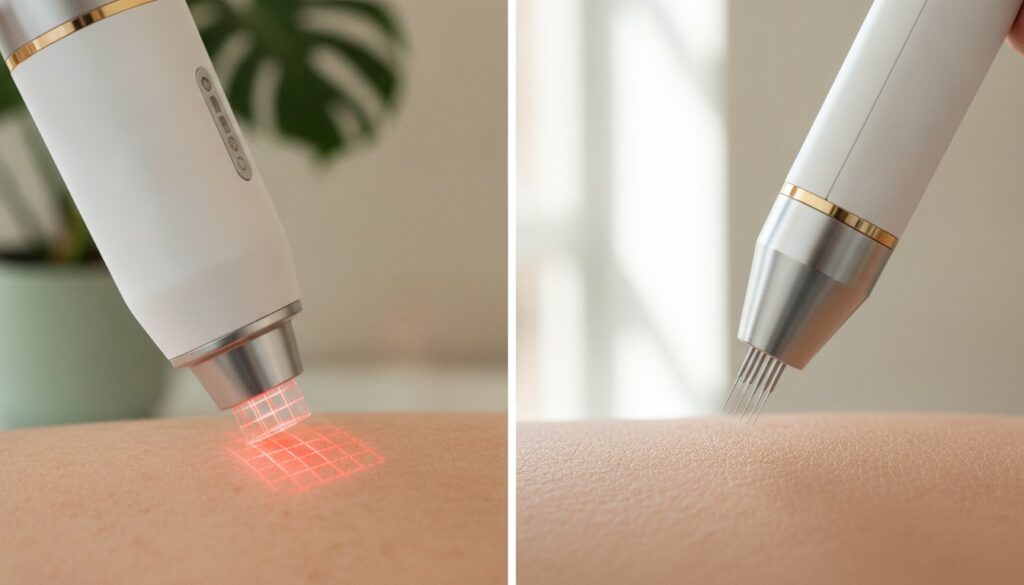
Choosing the most aggressive treatment isn’t always the fastest path to clear skin. While the “gold standard” label often follows high-intensity energy devices, the biological reality of your skin’s healing response might actually favour a more controlled approach. You’ve likely spent hours researching the co2 laser vs skin needling for acne scars debate, feeling caught between the promise of dramatic results and the very real fear of post-inflammatory hyperpigmentation. It’s understandable to feel frustrated by conflicting online advice when you’re simply seeking a smoother texture that doesn’t require heavy concealing.
This professional analysis provides a transparent look at how fractional CO2 laser and medical-grade skin needling interact with damaged dermal tissue. We’ll move beyond surface-level descriptions to explain the physiological mechanics of thermal ablation versus mechanical collagen induction. By understanding how these methods address specific scar morphologies, you can make an evidence-based decision that prioritises both safety and efficacy. We’ll examine the clinical trade-offs between downtime, depth of penetration, and long-term results to help you determine the most effective treatment for your unique skin profile.
Key Takeaways
- Understand the physiological distinctions between fractional thermal ablation and mechanical collagen induction to identify the most suitable intervention for your dermal concerns.
- Analyse the efficacy of co2 laser vs skin needling for acne scars based on the specific depth and morphology of atrophic tissue.
- Recognise the clinical trade-offs between intensive resurfacing results and the shorter recovery periods associated with epidermal-preserving techniques.
- Learn how modern regenerative bio-stimulators, including Rejuran and Exosomes, are utilised within a professional clinical setting to accelerate the healing response.
- Discover the importance of a formal clinical assessment to ensure your treatment plan is tailored to your unique skin type and tolerance for downtime.
The Pathophysiology of Acne Scarring and Collagen Induction
Atrophic acne scars represent a permanent alteration in the skin’s topography, occurring when a significant inflammatory response to acne vulgaris disrupts the underlying dermal architecture. This structural compromise is primarily the result of an inadequate replacement of collagen during the body’s natural repair process. When the skin attempts to heal from a deep-seated cystic lesion, the production of new connective tissue often fails to fill the void left by the infection, leading to visible depressions or pits. Understanding the nuances of co2 laser vs skin needling for acne scars requires a foundational grasp of how these treatments re-engage the body’s biological repair mechanisms.
Both modalities function by initiating a controlled “wound healing cascade.” This physiological process begins with an inflammatory phase, followed by a proliferative phase where new cells migrate to the site of injury. The use of thermal energy to improve skin texture falls under the broader clinical category of Photorejuvenation, where light-based systems are employed to initiate specific biological responses. While medical-grade skin needling relies on mechanical induction through the creation of thousands of microscopic physical channels, fractional CO2 lasers utilise thermal induction to vaporise columns of tissue. Dermal remodelling is the long-term reorganisation of collagen fibres within the skin’s matrix to improve structural integrity and surface texture.
Identifying Your Scar Morphology
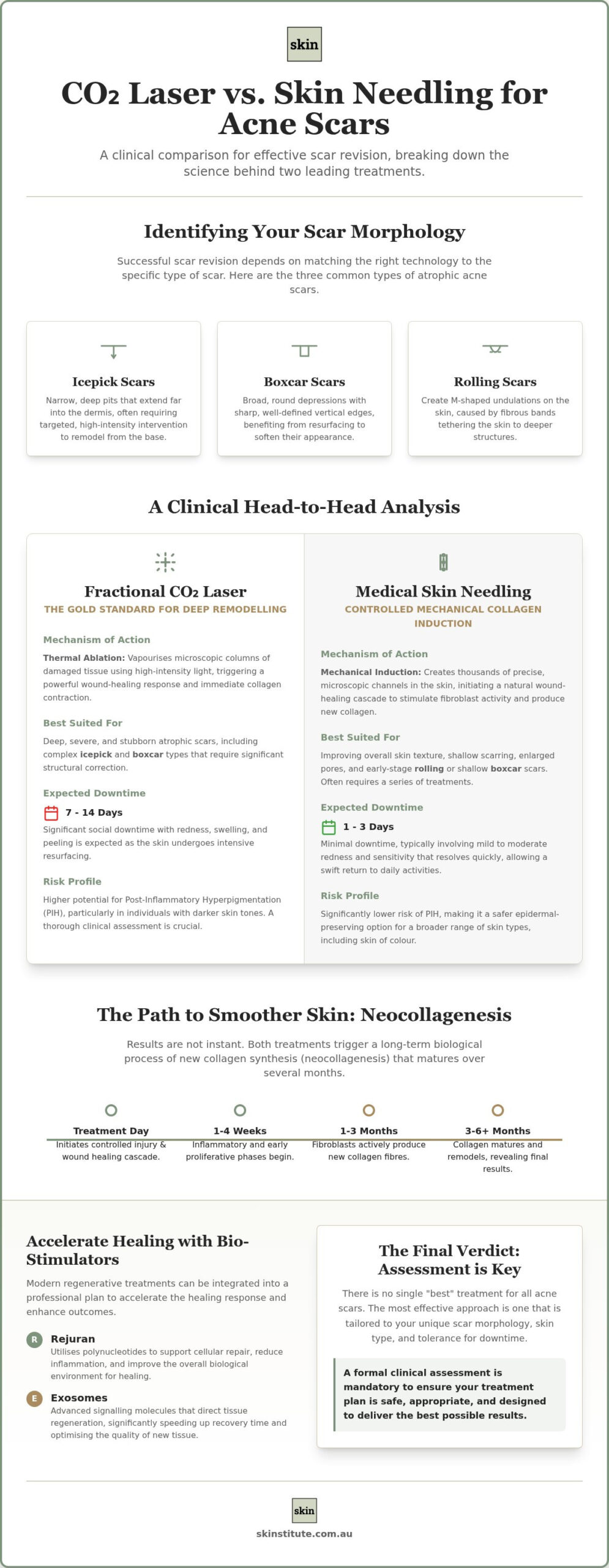
Success in scar revision is entirely dependent on matching the correct technology to the specific morphology of the tissue. Icepick scars are narrow, deep pits that often extend into the deep dermis; these typically require targeted, high-intensity interventions to reach the base of the defect. Boxcar scars present as broad, round depressions with sharp, well-defined vertical edges, frequently necessitating surface resurfacing to soften the transition between scarred and healthy skin. Rolling scars create M-shaped undulations across the skin surface, caused by abnormal fibrous bands that tether the epidermis to the deeper structures. These varied presentations explain why a single approach is rarely sufficient for complex cases.
The Role of Fibroblasts in Skin Regeneration
The primary objective of both fractional CO2 and skin needling is the stimulation of fibroblasts, the specialised cells responsible for synthesising collagen and elastin. Once triggered by controlled injury, these fibroblasts begin the complex work of neocollagenesis. This is not an instantaneous process. The synthesis of new, high-quality collagen typically requires a timeline of 3 to 6 months to reach clinical maturity. Because the depth of these scars can vary significantly between individuals, a professional clinical assessment is mandatory to determine the precise depth of the dermal defect and select the appropriate treatment parameters.
Fractional CO2 Laser Resurfacing: The Gold Standard for Deep Remodelling
Fractional CO2 laser technology represents a significant advancement in ablative resurfacing, offering a precise method for correcting deep structural irregularities within the dermis. Unlike traditional ablative lasers that remove the entire surface layer of the skin, fractional systems deliver high-intensity light in a pixelated grid pattern. These micro-beams create thousands of microscopic treatment zones, vaporising columns of damaged tissue while leaving the surrounding skin intact. This “bridge” of healthy tissue acts as a biological reservoir, facilitating a rapid healing response that is far more efficient than older, non-fractionated technologies. When evaluating co2 laser vs skin needling for acne scars, the laser’s primary advantage lies in its ability to reach the deeper layers of the dermis with extreme thermal precision.
The ablative process involves the immediate vaporisation of water-containing tissue, which physically removes scar tissue and triggers a profound wound-healing response. Beyond the physical removal of tissue, the laser generates a controlled thermal effect in the surrounding dermal layers. This heat causes existing collagen fibres to contract and tighten immediately, providing an initial improvement in skin tautness. Over the subsequent months, this thermal stimulus initiates a robust cycle of neocollagenesis, where the body replaces the vaporised columns with new, organised collagen and elastin fibres. This dual action makes it particularly suitable for patients presenting with severe textural irregularities or deep, stubborn depressions.
Clinical Benefits of Fractional CO2
One of the most compelling reasons to choose fractional CO2 is its clinical efficiency. While non-ablative treatments often require a lengthy series of appointments, the intensive nature of the CO2 laser allows for significant structural improvement in fewer sessions. This technology is uniquely versatile, as it allows a practitioner to address solar damage, fine lines, and dyschromia simultaneously with scar revision. Leading aesthetic practices, such as Finesse Cosmetic Surgery, utilise these advanced systems to provide high-calibre results across a range of skin and body concerns. For individuals with stubborn boxcar or rolling scars, the aggressive remodelling provided by a CO2 laser is often the only way to achieve a visible reduction in scar depth and a meaningful restoration of skin smoothness.
The intensity of fractional CO2 resurfacing necessitates a dedicated recovery period, typically ranging from 5 to 10 days. During this time, the skin will undergo a predictable sequence of erythema, swelling, and subsequent peeling as the treated columns are shed and replaced. It’s also vital to consider your skin type on the Fitzpatrick scale before proceeding. Because the laser targets water and generates heat, patients with darker skin tones carry a higher risk of post-inflammatory hyperpigmentation if the treatment parameters aren’t meticulously managed. A professional consultation at Skinstitute ensures that your treatment plan is safely calibrated to your specific skin biology. For a deeper look at the technology available, you may review our guide on Fractional CO2 Laser Resurfacing Melbourne to understand the expected clinical outcomes.
Medical-Grade Skin Needling: Mechanical Collagen Induction Therapy
Medical-grade skin needling, often referred to as Collagen Induction Therapy (CIT), operates on a mechanical principle rather than the thermal ablation utilised by fractional lasers. The procedure employs a device featuring a series of vertically oscillating needles that penetrate the skin at high speeds. This action creates thousands of precise, microscopic channels within the dermis, triggering the body’s natural wound-healing cascade without the use of heat. For those interested in how these techniques are enhanced with radiofrequency, click here to learn about Scarlet SRF at Exotica Skin Care. When evaluating co2 laser vs skin needling for acne scars, the preservation of the epidermis is a defining factor. By keeping the skin’s protective surface largely intact, the barrier remains functional, which significantly reduces the risk of infection and accelerates the recovery phase.
Precision is the primary differentiator between professional clinical devices and domestic derma rollers. Home-use rollers typically utilise a rotational mechanism that can cause unnecessary epidermal tearing and “track-mark” scarring due to the angle of needle entry and exit. In contrast, medical-grade devices offer electronic depth control, allowing a practitioner to reach up to 2.5mm into the dermis to target deep, fibrous scar tissue. The use of sterile, single-use cartridges in a clinical environment ensures a level of safety and hygiene that cannot be replicated at home, preventing cross-contamination and secondary infections.
Recovery and Cumulative Results
Patients typically experience a “social downtime” period of only 24 to 48 hours, characterised by mild erythema similar to a moderate sunburn. While the recovery is swift, achieving significant structural improvement for atrophic scarring requires a commitment to a series of sessions. In the ongoing comparison of co2 laser vs skin needling for acne scars, needling is often viewed as a progressive journey, typically requiring 4 to 6 treatments to see cumulative collagen synthesis. This modality is ideal for patients with active professional lives or those with lower pain thresholds who prefer a gradual, steady improvement in skin texture over the intensive peeling associated with ablative lasers.
Comparative Analysis: Efficacy, Downtime, and Suitability
Evaluating the clinical utility of co2 laser vs skin needling for acne scars requires a direct comparison of patient-specific variables and logistical capacities. Fractional CO2 represents a high-intensity intervention, while medical-grade skin needling is classified as a moderate, minimally invasive procedure. The recovery timelines reflect this disparity in intensity. Patients undergoing ablative laser resurfacing should prepare for 7 to 10 days of downtime, involving significant erythema and a predictable shedding phase. Conversely, skin needling typically results in only 1 to 2 days of mild redness, allowing for a rapid return to social and professional obligations.
The number of sessions required to achieve comparable results also varies significantly between the two modalities. While a single fractional CO2 treatment can produce dramatic structural changes in the dermal matrix, skin needling generally necessitates a series of 4 to 6 sessions to reach a similar level of dermal remodelling. Over a full treatment course, the total financial investment for a series of medical-grade needling sessions often aligns closely with the cost of a single intensive laser procedure, making both options clinically viable depending on the patient’s immediate goals and tolerance for recovery. The choice ultimately rests on the balance between rapid results and the convenience of shorter healing periods.
Choosing Based on Your Skin Type and Lifestyle
The Fitzpatrick scale is a primary consideration in this selection process. Because skin needling does not utilise thermal energy to trigger collagen synthesis, it is often the safer choice for individuals with deeper skin tones who are biologically predisposed to pigmentary complications. Lifestyle factors also play a critical role, particularly regarding sun exposure. The Melbourne climate makes winter the optimal “laser season” in Victoria, as reduced UV levels simplify the post-treatment requirement of strict sun avoidance. If your schedule cannot accommodate a week of physical recovery, the incremental, steady improvements of a needling programme are likely more appropriate for your needs.
When to Combine Modalities
Complex cases often benefit from hybrid protocols that utilise the strengths of both technologies. A seasoned practitioner might recommend fractional CO2 for focal, deep boxcar scars while using skin needling to maintain the surrounding tissue’s overall health and texture. For tethered rolling scars, neither technology may be fully effective without the addition of subcision, a technique used to release the fibrous bands beneath the skin. Designing a bespoke treatment plan is a nuanced process that begins with a professional clinical assessment. To begin your journey towards smoother skin, book a clinical consultation at Skinstitute today.
The Skinstitute Protocol: Customised Scar Management in Melbourne
Skinstitute’s approach to scar revision is founded on the principle that no two dermal matrices are identical. A professional clinical assessment is the most critical phase of our protocol, as it allows for the precise mapping of atrophic defects and the selection of the most appropriate technology. With 26 years of clinical experience in Melbourne, our practitioners understand that the choice between co2 laser vs skin needling for acne scars is rarely binary. Instead, we often design integrated programmes that address the specific depth and morphology of each individual scar, ensuring that the biological response is optimised for your unique skin type.
Melbourne’s unique environmental factors, particularly the high-UV index, necessitate a specialised approach to post-treatment care. Protecting the skin during the vulnerable remodelling phase is paramount to preventing pigmentary changes and ensuring long-term structural success. Our protocol emphasises strict adherence to medical-grade photoprotection and the strategic timing of intensive resurfacing during the cooler, less sun-intensive months. This level of clinical oversight ensures that the structural gains achieved during treatment are preserved and not compromised by environmental stress or inadequate aftercare.
Enhancing Results with Bio-Stimulators
We incorporate advanced regenerative adjuncts to optimise the healing response and improve the final aesthetic outcome of every procedure. Rejuran, a polynucleotide-based bio-stimulator, plays a pivotal role in DNA-level skin repair by providing the essential building blocks for cellular regeneration. When used alongside mechanical or thermal induction, it accelerates the synthesis of high-quality collagen and improves the skin’s overall resilience. This bio-stimulatory effect is particularly useful for patients with compromised skin barriers or those seeking a more robust regenerative outcome.
Exosomes further enhance this process by acting as powerful signalling molecules that reduce post-treatment inflammation and significantly shorten the associated downtime. These adjuncts transform a standard procedure into a comprehensive regenerative therapy. By modulating the inflammatory environment, Exosomes allow for a more controlled healing process, which is especially beneficial following the high-intensity thermal injury of a fractional CO2 laser. This dual-action approach ensures that the skin heals with greater efficiency and less discomfort.
Your Journey at Skinstitute
The journey begins with a thorough consultation where we map your scar morphology and set realistic, evidence-based expectations for your results. We believe in complete transparency regarding the number of sessions required and the expected recovery trajectory. Clinical aftercare is equally rigorous, focusing on maintaining the integrity of the dermal matrix while it undergoes long-term remodelling. This methodical approach ensures that every patient receives a treatment plan that is as unique as their skin’s history. To begin your professional assessment, book a clinical skin analysis at Skinstitute today.
Advancing Your Scar Revision Strategy
Navigating the clinical complexities of co2 laser vs skin needling for acne scars requires a meticulous understanding of your skin’s biological capacity for repair. While fractional CO2 technology provides the intensive thermal stimulus necessary for deep structural remodelling, medical-grade skin needling offers a versatile, epidermal-preserving alternative with minimal social downtime. The most effective protocol is rarely a singular choice; it’s a tailored strategy that considers your scar morphology, skin type, and lifestyle constraints within the Melbourne environment.
At Skinstitute, we leverage over 26 years of industry experience and medical-grade technology to guide you through this regenerative journey. Our specialist clinic prioritises evidence-based results, ensuring that every intervention is safely calibrated to your dermal needs. Book Your Clinical Scar Assessment at Skinstitute to begin a professional consultation dedicated to restoring your skin’s texture and integrity. Achieving smoother skin is a progressive process, and we’re committed to providing the technical mastery required for a successful outcome.
Frequently Asked Questions
Is CO2 laser or skin needling better for deep icepick scars?
Fractional CO2 is generally superior for deep icepick scars because it can reach greater dermal depths through thermal ablation to reorganise the skin’s structure. While medical-grade skin needling can reach depths of up to 2.5mm, it doesn’t provide the same level of tissue vaporisation required to close narrow, deep pits. We often recommend a targeted clinical approach that may involve high-intensity laser parameters or specific sub-surface interventions to address these complex morphologies.
How much downtime should I expect from a fractional CO2 laser treatment in Melbourne?
You should anticipate a recovery period of 7 to 10 days following a fractional CO2 laser treatment. During the first 48 hours, the skin will exhibit significant redness and swelling, followed by a phase where the treated micro-columns are shed through peeling. Given the high-UV environment in Melbourne, strict sun avoidance and the application of medical-grade photoprotection are essential to prevent pigmentary complications during this sensitive healing window.
Can I have skin needling if I have a darker skin tone?
Medical-grade skin needling is considered a safer alternative for patients with darker skin tones, specifically those on the higher end of the Fitzpatrick scale. Unlike laser resurfacing, needling doesn’t utilise thermal energy, which significantly reduces the risk of post-inflammatory hyperpigmentation. This mechanical method allows for effective collagen induction without triggering the melanocytes, making it a reliable choice for diverse skin types seeking a significant improvement in texture.
How many sessions of skin needling are equivalent to one CO2 laser treatment?
It typically requires a series of 4 to 6 medical-grade skin needling sessions to achieve results comparable to a single session of fractional CO2 laser. When comparing co2 laser vs skin needling for acne scars, the decision often hinges on your ability to accommodate a longer recovery period versus a series of shorter, less intensive appointments. Both paths lead to significant dermal remodelling, but the timeline for collagen maturity differs based on the treatment intensity.
Is the treatment for acne scars painful?
Discomfort is managed through the application of a high-strength topical anaesthetic prior to the procedure. While skin needling is generally well-tolerated and described as a vibrating sensation, fractional CO2 laser is a more intensive treatment that involves a heat-based response. Most patients report a sensation of heat similar to a moderate sunburn during the immediate post-treatment phase, though this typically subsides within a few hours as the skin begins its natural inflammatory repair cycle.
When is the best time of year to get laser resurfacing in Australia?
The optimal time to undergo laser resurfacing in Australia is during the autumn and winter months, typically from May to August. During this period, the UV index is significantly lower, which reduces the risk of accidental sun damage while the skin’s barrier is compromised. Because post-treatment sun exposure can lead to permanent hyperpigmentation, the cooler Victorian climate allows for a safer and more manageable recovery period compared to the peak summer months.
Can I combine Rejuran with my acne scar treatments?
Combining Rejuran with your scar revision programme is a highly effective way to enhance the biological healing response. Rejuran utilises polynucleotides to repair skin at a cellular level, providing the necessary foundation for the new collagen synthesis triggered by co2 laser vs skin needling for acne scars. By integrating these bio-stimulators, we can often accelerate the recovery phase and improve the overall quality and resilience of the newly formed dermal tissue.
Will these treatments completely remove my acne scars?
While these treatments can achieve a significant reduction in scar depth and a marked improvement in skin texture, the complete removal of acne scars is clinically rare. The objective of professional scar management is to restore the skin’s topography so that scars are no longer visible under normal lighting conditions. Most patients see a visible restoration of smoothness, but the final outcome depends on the initial severity of the scarring and the skin’s unique regenerative capacity.