HIFU Body Contouring in Melbourne: Suitability, Results and Clinical Guidance
October 13, 2026
What Not to Do After Sclerotherapy: A Clear Aftercare Guide
October 15, 2026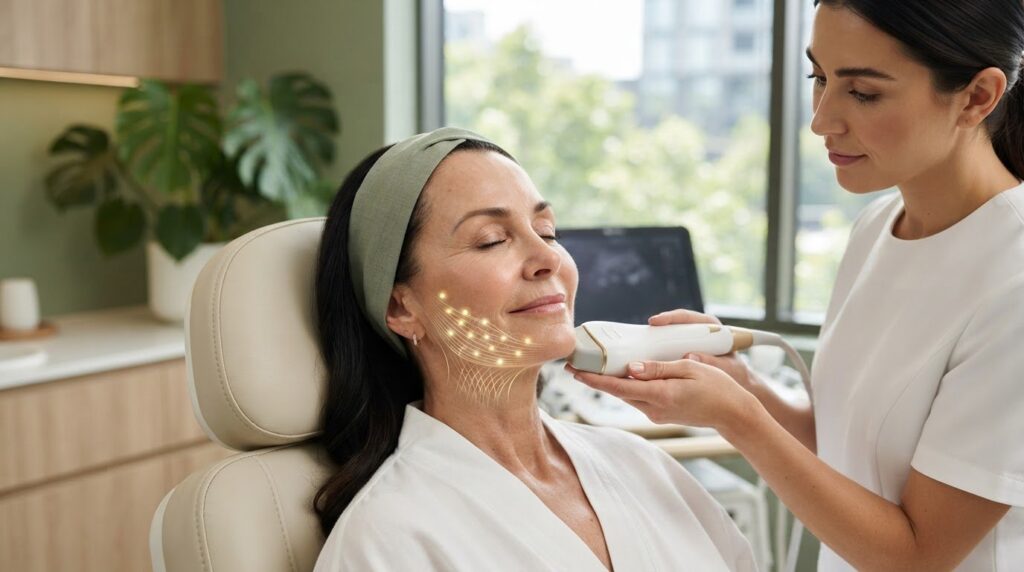
HIFU can gradually improve facial lifting and wrinkles, with results developing over 2 to 3 months and effects lasting up to 18 months. The long-term benefits of HIFU come from focused ultrasound heating tissue beneath the skin, encouraging it to contract and supporting new collagen formation. It can offer a non-surgical option for mild to moderate skin laxity, but it doesn’t provide the same degree of lifting as a facelift.
If you’re considering HIFU, its long-term benefits develop gradually rather than appearing immediately. Collagen remodelling takes time, and visible results depend on factors such as skin laxity and the areas treated.
This article explains how HIFU works, when facial results may appear, and what lifting and wrinkle changes it may support over time. It also outlines how treatment differs from a facelift, helping you assess whether HIFU may suit your concerns and expectations.
Key Takeaways
- Focused ultrasound heats targeted tissue beneath the skin, prompting contraction and collagen remodelling rather than removing loose skin.
- Assess facial changes over time, as collagen remodelling is gradual and an immediate appearance does not show the final result.
- HIFU can support a more lifted appearance and soften wrinkles, with the areas treated matched to the person’s facial concerns.
- A facelift can address more pronounced skin laxity; HIFU is a non-surgical option, not an equivalent replacement.
- Skin laxity, facial anatomy and treatment goals help determine whether HIFU is suited to the concern, particularly where excess skin is present.
Can High-Intensity Focused Ultrasound Treatment Replace Face Lifts?
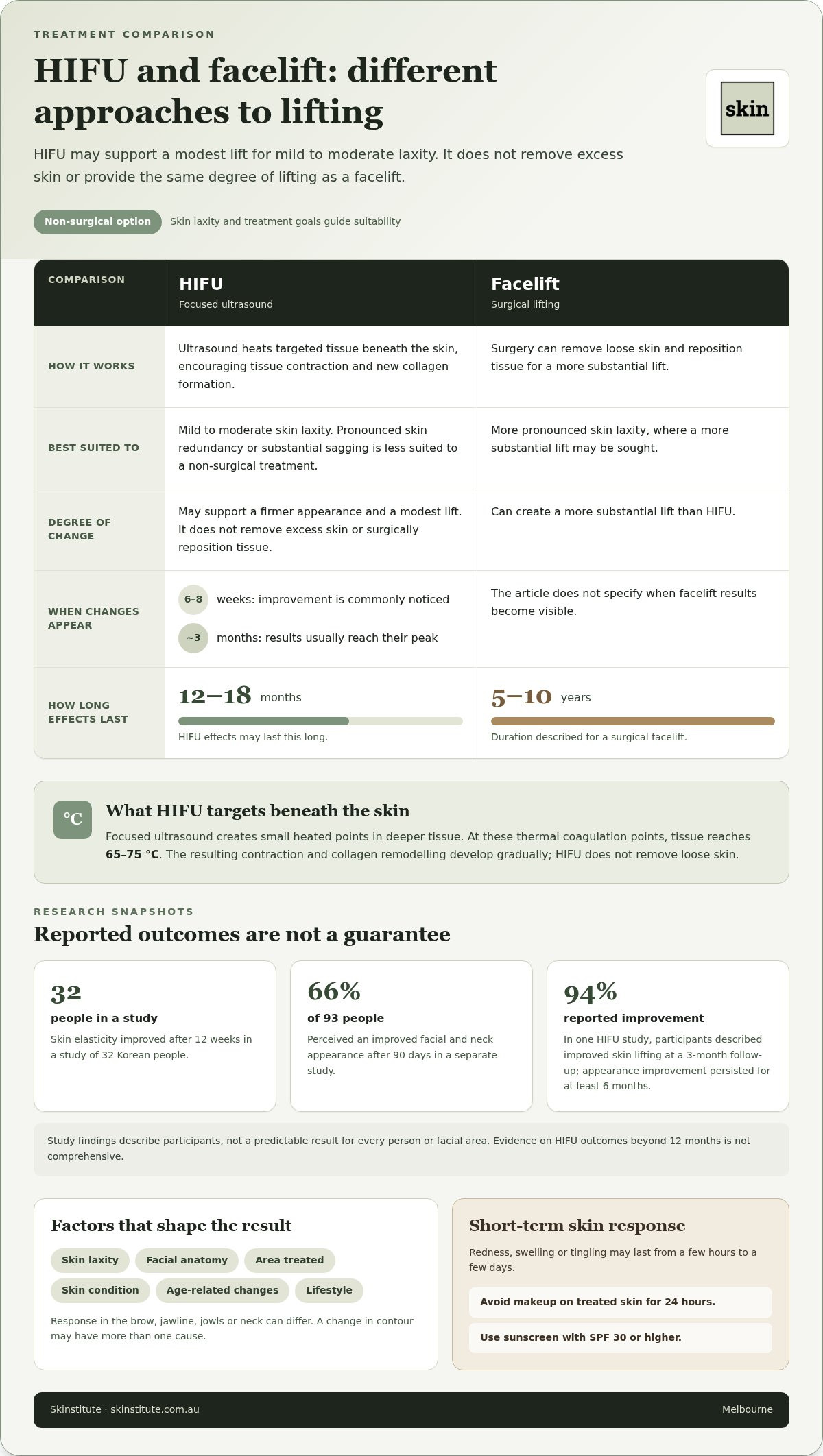
HIFU may gradually tighten skin with mild to moderate laxity, but it cannot replace a facelift for substantial sagging or excess skin. Its long-term benefits relate to tissue tightening and collagen remodelling, not the surgical removal of loose skin.
People with mild laxity may consider HIFU; pronounced skin redundancy is less suited to a non-surgical treatment. After treatment, redness, swelling or tingling may last a few hours to a few days. Avoid makeup on treated skin for 24 hours and use sunscreen with SPF 30 or higher.
Collagen Stimulation and Skin Tightening
HIFU focuses ultrasound energy beneath the skin, creating small heated points that contract tissue and stimulate collagen formation. At these thermal coagulation points, tissue reaches 65-75 °C. The energy targets deeper tissue rather than the skin surface, supporting gradual facial tightening. This matters because collagen remodelling takes time, so the long-term benefits of HIFU develop progressively rather than appearing as an immediate lift.
Long-Term Lifting Effects
As collagen remodels, HIFU may support a firmer appearance and a modest lift over the months following treatment. Its effects can last 12 to 18 months, while a surgical facelift is described as lasting 5 -10 years. The difference helps clarify suitability: HIFU addresses milder changes, while surgery can create a more substantial lift. HIFU does not remove excess skin or reposition tissue surgically.
Research on Skin Tightening and Elasticity
Clinical findings report changes in elasticity and perceived lifting over follow-up periods. In a study of 32 Korean people, skin elasticity improved after 12 weeks. A separate study found that 66 percent of 93 people perceived improved facial and neck appearance after 90 days. The American Board of Cosmetic Surgery says ultrasound skin-tightening results usually appear within 2 to 3 months.
These findings indicate potential improvement, not a permanent or identical result for every patient. Evidence on HIFU outcomes beyond 12 months is not comprehensive, so expectations should reflect the gradual, temporary nature of the treatment.
When will I see my HIFU results?
HIFU results commonly last 12 to 18 months, with improvement usually peaking about 3 months after treatment. Skin condition, age and lifestyle affect duration, and outcomes can differ across the jawline, jowls, brow and neck.
When Results Become Visible
HIFU changes emerge gradually as ultrasound energy stimulates collagen remodelling, rather than producing a finished lift during the session. Patients commonly notice improvement around 6 to 8 weeks after treatment, with results usually reaching their peak about 3 months after treatment. This timing helps set expectations: an early appearance does not show the full effect, and a firmer contour develops progressively.
Factors Affecting Result Duration
How long results last depends on the skin’s condition, age-related changes and lifestyle factors. These affect how the skin responds to energy and how facial tissues change over time. Natural ageing continues, so improved firmness is not permanent. Some people choose annual HIFU touch-ups to prolong the effects.
The treatment area matters, too. HIFU may target facial areas such as the brow and jawline, or the neck, but results in one area do not predict the response elsewhere. Jowls, for example, can reflect both skin laxity and changes in facial structure. Ultrasound tightening addresses the tissue response, not every cause of a changing contour.
For a useful comparison, note the appearance of your brow, jawline, jowls or neck before treatment, then reassess the same areas as collagen remodelling develops. A review around one year after treatment can help show how much improvement remains and whether natural ageing has changed the result. This gives you a clearer basis for considering further treatment than relying on an early impression alone.
Potential facial lifting and wrinkle-reduction benefits
High intensity focused ultrasound can support subtle lifting and smoother-looking skin by directing energy into selected facial tissue. Its effects involve tightening and collagen production, so both the treatment area and the concern being addressed matter.
For a brow with mild descent, the potential benefit is a modest lift rather than a surgical repositioning. The US Food and Drug Administration approved HIFU for brow lifts in 2009. This is a United States regulatory milestone, not a statement about Australian approval or a guarantee of a particular result.
At the jawline and lower face, tightening may improve the appearance of mild laxity. HIFU does not reposition deeper structures or remove excess skin, so it cannot address every cause of jowling. A visible contour change depends on whether looseness in the treated tissue is the main concern.
Wrinkles also have different causes. Fine lines linked to reduced skin firmness may look softer as collagen remodelling develops. Lines caused by repeated facial movement have a different mechanism, so ultrasound tightening may not change them to the same degree. Identifying whether a crease is static or movement-related helps set a realistic treatment goal.
Research provides examples of measured lifting outcomes. One HIFU study found that 94% of people described improvement in skin lifting at a 3-month follow-up, and appearance improvement persisted for at least 6 months. These findings describe study participants, not a predictable result for every person or every facial area.
Energy intensity, placement and the area treated influence which tissue receives focused ultrasound. Treating the brow, for example, targets a different concern from treating the lower face; the response in one area does not predict another’s. HIFU is best understood as targeted skin tightening, not a full-face substitute for surgical lifting.
The practical takeaway is to match the intended improvement to the underlying concern: mild laxity may respond differently from pronounced skin redundancy or movement-related lines. To discuss whether focused ultrasound aligns with your facial goals, arrange a personalised HIFU assessment.
Skinstitute: Prescription injectables
In Melbourne, Skinstitute provides High Intensity Focused Ultrasound (HIFU) for people considering non-surgical facial tightening. A personalised assessment can help determine whether your concern is mild skin laxity, deeper structural change or wrinkles that may call for a different approach.
Other available treatments include PDO Thread Lifting, Fractional CO2 and prescription injectables. These address different aesthetic concerns, so treatment planning should match the method to the area and the intended outcome.
Contact Skinstitute to discuss your facial concerns and HIFU treatment options.
Choose a treatment plan around your facial goals
Start by defining the change you want to address, such as skin laxity, wrinkles or uneven texture. This helps you assess whether an ultrasound-based approach aligns with your priorities or another treatment direction may be more suitable. Consider HIFU’s long-term benefits as part of a plan shaped around your facial anatomy and desired outcome, not as a standalone promise.
Skinstitute offers HIFU alongside PDO Thread Lifting, Fractional CO2 and prescription injectables. These treatments address different concerns, so a clinical assessment can help match the approach to your needs and discuss relevant considerations before proceeding. Your goals, skin condition and the area of concern all inform that conversation.
For a personalised discussion about HIFU and your facial treatment options, contact Skinstitute to discuss HIFU. A considered plan can help you take the next step with a clear understanding of the options.
Frequently Asked Questions
How does HIFU work?
HIFU concentrates ultrasound energy at selected points beneath the skin, creating controlled thermal effects in targeted tissue. This prompts tissue contraction and supports collagen production as the area remodels. For example, a practitioner may target facial tissue where mild laxity affects the jawline rather than treating the whole face uniformly. The placement and depth of the energy determine which tissue is addressed.
What is HIFU Treatment?
HIFU treatment is a non-surgical procedure that uses high-intensity focused ultrasound to target tissue beneath the skin. Unlike a treatment that works mainly on the skin’s surface, it directs energy to specific depths without making an incision. The aim is to support tightening and lifting in selected areas. Suitability depends on the concern being treated and the amount of skin laxity present.
What is a HIFU facial?
A HIFU facial uses focused ultrasound on selected areas of the face for skin tightening and lifting. Depending on your concerns, treatment planning may focus on the brow, cheeks, jawline or under-chin area. HIFU is not a facial massage or surface exfoliation treatment. Because the intended change is gradual, comparing the same areas over time gives a more useful picture than judging the result immediately.
Should I Worry About HiFU Side Effects?
Common short-term effects include redness, swelling, tingling or tenderness in the treated area; these can last from a few hours to a few days. Less common complications can occur, so treatment requires appropriate assessment and careful energy placement. After treatment, avoid makeup on the treated skin for 24 hours and use sunscreen with SPF 30 or higher. Report unexpected or persistent symptoms to a medical professional.
Does it hurt?
During HIFU, you may feel prickling, warmth or pulsing as ultrasound energy is delivered. Sensations vary with the treatment area and individual sensitivity, and brief discomfort may occur. If you feel pain during a session, tell the treating practitioner so they can assess your response and adjust the approach where appropriate. Clear communication helps keep the procedure controlled and tolerable.
Does the research say that it works?
Research reports improvements in skin tightening and elasticity after HIFU, supporting its use as a non-surgical option for selected concerns. However, studies use different devices, treatment settings and follow-up periods, which makes results difficult to compare directly. Evidence on outcomes beyond 12 months is not comprehensive. Research therefore supports potential improvement, but it does not establish a permanent lift or a reliable result for every patient.