
What to Avoid After Microneedling: Melbourne Aftercare Guide
September 17, 2026
Understanding the Main Benefits of Exosome Facial Treatment
September 19, 2026
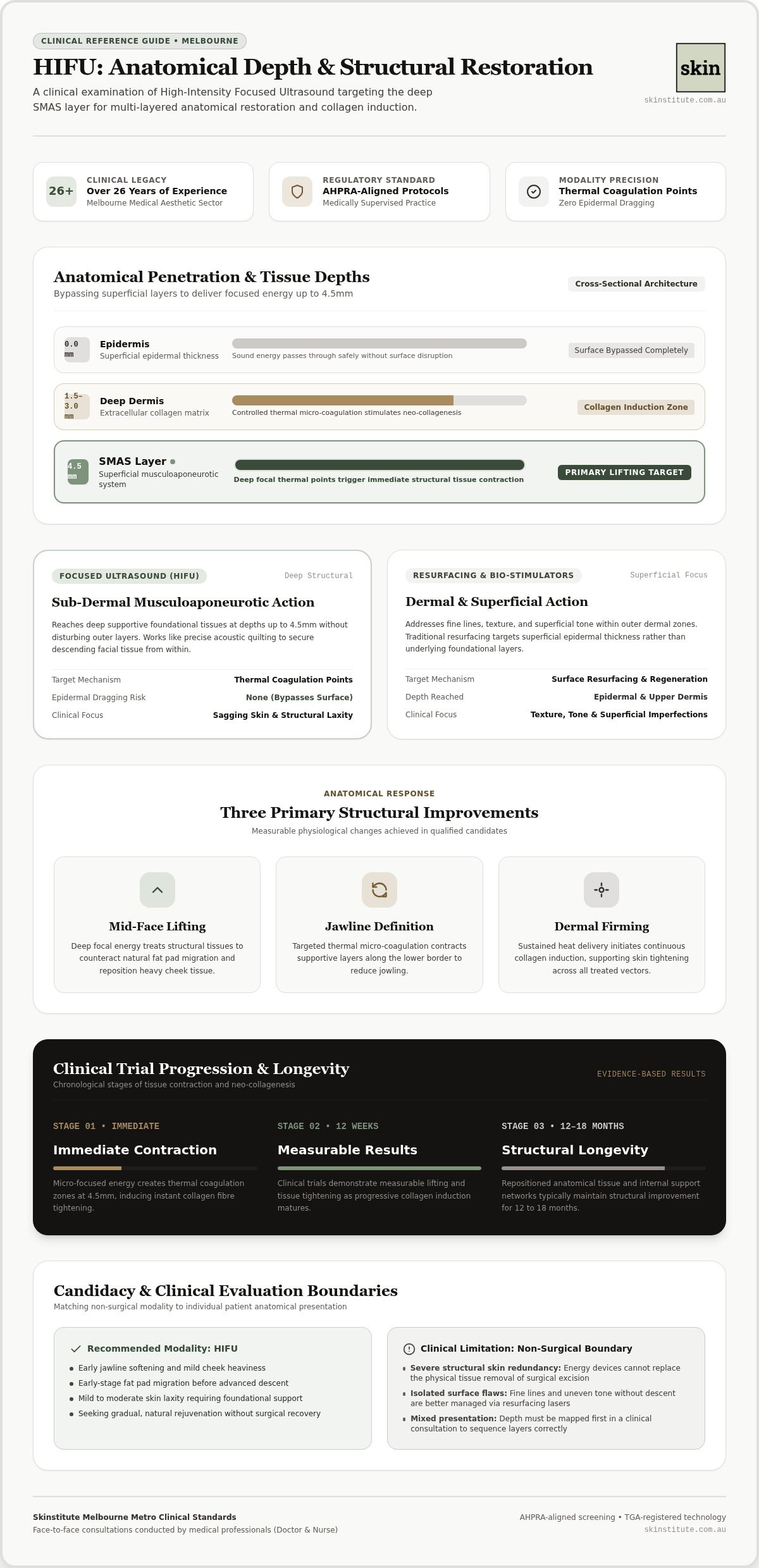
High-Intensity Focused Ultrasound (HIFU) delivers targeted thermal energy to the deep SMAS layer, inducing non-surgical tissue contraction and collagen induction (skin tightening). Clinical trials show measurable results over 12 weeks, with structural improvements lasting 12 to 18 months. The decision you face is practical: do you need deep structural lifting for sagging tissue, or surface rejuvenation for texture and tone? Skinstitute provides personalised consultations in Melbourne so you can match the modality to your anatomy before you commit.
Key Takeaways: High-Intensity Focused Ultrasound (HIFU) uses micro-focused energy to target the deep SMAS layer up to 4.5mm, inducing structural lifting and collagen contraction without surgery.
- Australian market prices for this procedure typically span from A$1,707 to A$7,562 depending on provider expertise.
- Except when managing severe structural skin redundancy, where energy devices cannot replace the physical tissue removal of surgery.
- Clinical trials show measurable results over 12 weeks, with structural improvements typically lasting between 12 to 18 months.
How to choose the anti-ageing path for your skin goals
Choosing the correct clinical modality depends on whether you need deep tissue lifting or superficial surface rejuvenation. Mistaking deep structural laxity for surface texture issues leads to disappointing clinical outcomes. Structural support beneath the surface is necessary whenever deep tissue laxity develops.
Typical situations you may recognise:
- Early jawline softening and mild cheek heaviness: a targeted HIFU protocol reaches deeper structural layers to address sagging skin (skin redundancy) with collagen induction beneath the epidermis.
- Fine lines, surface damage, or uneven tone without true descent: resurfacing lasers or bio-stimulators suit those superficial concerns better than deep ultrasound.
- Mixed presentation (laxity plus texture): map depth first in a face-to-face consult, then sequence structural lifting and surface work rather than treating the wrong layer first.
Match the treatment to your anatomy. While surface resurfacing addresses superficial flaws, sagging in deeper layers demands precise structural lifting. Clinical staff at Melbourne’s Skinstitute craft a custom rejuvenation strategy after a thorough face-to-face consultation.
Focused ultrasound acts on deep structural tissue, not the surface
By sending focused thermal energy far beneath your skin, High-Intensity Focused Ultrasound acts directly on deep structural tissue. Unlike surface treatments, it bypasses the surface without causing epidermal dragging.
Energy converges at precise focal points in the dermis and foundational layers. This process creates controlled thermal coagulation zones that induce immediate tissue contraction. Over time, this heat triggers natural collagen induction.
Targeting deeper structures achieves multi-layered anatomical restoration without surgery. Radiofrequency heats superficial layers, whereas focused ultrasound reaches deeper supportive tissue. According to Wikipedia’s 2025 focused ultrasound entry, this sound energy safely targets internal structures without damaging surrounding tissues. The process works like precise acoustic quilting that secures loose tissue from within.
Targeting foundational layers suits mild to moderate sagging skin. During a clinical consultation, practitioners evaluate whether this depth of treatment aligns with your facial structure. You can visit Skinstitute, Cosmetic treatments, Melbourne to discuss tailored treatment plans with experienced practitioners. Every protocol requires personalised anatomical mapping to support patient safety and natural-looking outcomes.
HIFU reaches the SMAS at depths up to 4.5mm
High-intensity focused ultrasound reaches deep sub-dermal tissues, specifically targeting the superficial musculoaponeurotic system (SMAS) layer at depths up to 4.5mm. Surface modalities only affect the outer dermal layers. Ultrasound energy bypasses the epidermis entirely and delivers micro-focused thermal energy to create precise focal coagulation points.
Sound waves bypass superficial layers without causing surface damage. This targeted delivery triggers a natural healing response and stimulates long-term collagen induction deep within the structural foundation of your face.
Targeting these foundational structural layers helps correct sagging skin. High-intensity focused ultrasound enables non-invasive thermal ablation at precise tissue depths, consistent with the same depth-safety principle described in the focused ultrasound overview cited above. Depth targeting remains vital: traditional lasers only address superficial epidermal thickness, whereas micro-focused energy bypasses the surface to treat structural support zones safely.
Understanding anatomical depth helps you evaluate overall value. For details on local investment, review this Melbourne HIFU cost guide. Depth-led tightening proceeds without surface disruption when your anatomy suits the modality.
Three structural benefits you gain when you are a candidate
You are an ideal candidate if you want to target early jawline sagging, fat pad migration, and mild skin laxity.
From clinical observation, addressing these issues early yields structural support before advanced tissue descent occurs. Early intervention allows deep micro-focused ultrasound energy to precisely target the foundational SMAS layer.
Three primary structural improvements occur:
- Mid-face lifting: Treating deep tissues counteracts fat pad migration to lift heavy cheeks.
- Jawline definition: Focused thermal points contract structural tissue to reduce jowling.
- Dermal firming: Targeted heat triggers skin tightening (collagen induction) across treated zones.
This targeted HIFU protocol suits individuals seeking gradual, natural rejuvenation and acts as a discreet internal support network for ageing facial contours. Experienced clinical assessment in Melbourne maps your unique facial anatomy before treatment begins.
When non-surgical lifting cannot replace surgical excision
A HIFU facial (non-surgical lifting) cannot replace surgical excision when managing severe structural skin redundancy (sagging skin).
In the Melbourne clinic, practitioner observations show that acoustic energy cannot shrink heavily compromised, redundant tissue. Deep structural displacement combined with extensive loss of elasticity requires surgical intervention to physically remove excess tissue. High-intensity focused ultrasound precisely triggers collagen induction to reinforce existing dermal layers. Targeting structural layers with thermal energy only works when the surrounding extracellular matrix retains sufficient regenerative capacity.
Severe tissue laxity requires direct surgical repositioning; energy devices cannot bridge that gap.
For moderate skin redundancy, non-surgical lifting provides structural support when suitability is confirmed in consultation. Anatomical assessment before you proceed keeps the plan aligned with what energy can realistically achieve.
HIFU vs Bio-Stimulators: 4 Key Differences
High-intensity focused ultrasound targets deep structural layers, whereas bio-stimulators work by prompting gradual collagen production within the dermal tissue.
| Feature | HIFU Facial | Bio-Stimulators |
|---|---|---|
| Primary Mechanism | Micro-focused ultrasound energy | Injectable biological activation |
| Target Layer | Deep SMAS layer | Dermal skin layers |
| Primary Focus | Tightening sagging skin | Volume restoration and texture |
From clinical practice, energy modalities provide deep tissue contraction, while injectables address surface matrix renewal. Combining both modalities often provides multi-layered anatomical restoration across different tissue depths.
Sound waves tighten underlying structural frames without adding physical product volume to your face. Skin tightening protocols require precise depth calibration for safety.
Non-surgical lifting suits structural laxity; injectables fit volume loss. At the Melbourne clinic, experienced clinicians evaluate your facial anatomy to design a tailored regeneration plan.
What a HIFU facial involves step by step
Treatment follows a structured clinical process to target sagging skin safely. Clinical observation confirms that precise mapping prevents unnecessary tissue thermal stress.
- Patient Screening: Staff complete a structured clinical screening so expectations align with what the modality can deliver.
- Anatomical Mapping: The practitioner marks targeted facial zones to direct micro-focused ultrasound waves precisely.
- Gel Application: A specialised conductive gel allows ultrasound energy to pass smoothly into deeper tissue layers.
- Energy Delivery: Micro-focused ultrasound pulses heat targeted dermal layers, triggering localised skin tightening.
Precision guides every step. This controlled approach prioritises long-term safety over fast fixes.
Tip: Ensure your clinic completes a structured assessment prior to energy delivery to align expectations with physiological outcomes.
Among clinic Google reviews, one patient (5★) wrote:
"Extremely skilled, professional service. Loads of knowledge to help guide best treatment options. Really happy with my results."
Situation: uncertainty about which option would suit the face. Action: skilled assessment and clear guidance on treatment choices. Outcome: the patient reported happiness with results and confidence in the path selected. That arc (problem, guided plan, measured satisfaction) is the same decision path you walk in consultation: map anatomy, choose depth, then treat only where energy can help.
What drives your HIFU facial investment
Your total financial investment depends on individual anatomical requirements and target treatment areas.
In clinical practice, multi-layered anatomical restoration requires careful evaluation of tissue depth. Individual facial anatomy determines cartridge selection.
Treatment scope drives overall expenditure. A full-face protocol requires more energy delivery than isolated jawline targeting for sagging skin.
According to broad Australian market sampling (market research lower bound A$1,707), standard clinical fees span wide intervals based on provider expertise and technology quality, with observed figures from A$1,707 to A$2,000 to A$7,562. Treatment protocols range from localised focal therapies to complete face and neck revisions. Separately, the clinic’s own published clinical background cites over 26 years of experience in Melbourne; that 26 figure is the clinic’s tenure marker, not a price sample.
Maintenance timing varies. Most patients need repeat sessions every twelve to eighteen months for sustained skin tightening.
Single-area treatments suit mild localised laxity; comprehensive full-face protocols fit more advanced tissue descent. Skinstitute tailors every treatment plan during a clinical consultation. Request a personalised quote for exact figures.
What HIFU sensation means for energy delivery
During treatment you will experience brief thermal acoustic prickles as focused energy enters deep structural layers. This sensation confirms precise delivery of acoustic energy to the deep dermal tissue. The targeted heat creates controlled micro-coagulation zones that immediately trigger collagen induction.
In clinical practice, patient discomfort remains brief and manageable. Pain thresholds vary widely.
A temporary, deep ache along the jawline signals energy reach to the foundational layers. The treatment environment is fully medically supervised, which helps manage mild inflammation and transient tender spots effectively.
Expected responses include minor erythema or localised swelling. These temporary effects subside within hours and require no downtime. Treatment remains entirely non-invasive.
Frequently asked questions
What is a HIFU facial?
A HIFU facial delivers micro-focused ultrasound energy to deep tissue layers, initiating collagen induction without breaking the skin barrier. Practitioners utilise TGA-registered technology in a fully medically supervised treatment environment backed by over 26 years of clinical experience in Melbourne.
What does a HIFU facial involve?
Your appointment begins with a face-to-face clinical consultation to establish suitability. The practitioner targets underlying anatomical structures with acoustic energy to trigger cellular repair. You can return to normal daily activities immediately afterward.
How much does a HIFU facial cost?
Total investment depends on the targeted treatment areas and the specific degree of skin redundancy present. A regional market survey shows prices ranging from A$1,707 to A$2,000 to A$7,562. Request a personalised consultation for an accurate quote tailored to your anatomical requirements.
What skin issues can it treat?
This procedure targets structural laxity, tissue descent, and loss of jawline definition. It addresses superficial skin redundancy through deep thermal stimulation. The approach works best for mild to moderate tissue softening rather than severe excess skin.
Does HIFU Hurt, and What Does That Sensation Mean?
You will feel brief deposits of thermal energy beneath the skin surface, indicating precise delivery into the structural layers. Most patients tolerate this temporary discomfort well. Sensations dissipate quickly once treatment ceases.
Next Steps for Your Treatment
The same decision questions you started with still apply: is your concern deep structural laxity or surface change, and does your extracellular matrix still have the capacity to respond to energy rather than excision? Choosing the right non-surgical lifting modality requires precise anatomical evaluation and evidence-based planning. In 2026, registered nurse Martin Desmarais brings bilingual clinical expertise and a Bachelor of Science in Nursing from Université de Montréal to your care.
The Melbourne clinic operates as a fully medically supervised treatment environment so you address skin redundancy only after suitability is clear.
Every tissue layer requires individual assessment. To explore your tailored collagen induction plan, review our pricing guide and arrange a personal consultation with the clinical team.