Fractional CO2 Laser for Acne Scars in Melbourne: Pain and Skin Remodelling
November 1, 2026
Skin Regeneration Therapy in Melbourne: Benefits and Options
November 3, 2026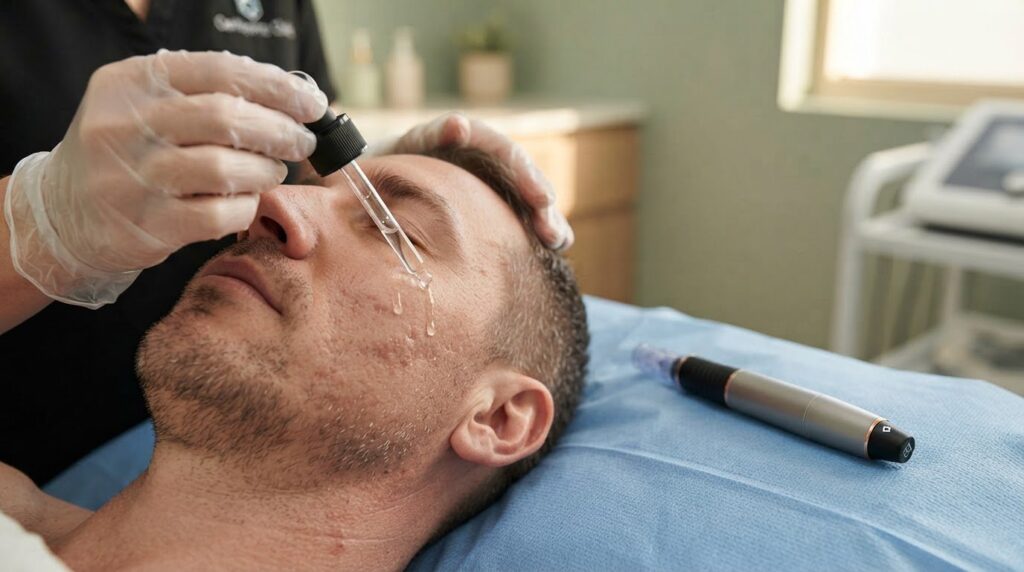
Exosome therapy for acne scars is best considered as an adjunct to microneedling, not a stand-alone correction. Microneedling creates controlled channels in the skin, and exosomes may be applied afterwards to support cell communication during recovery. It is not suited to every scar, so treatment should reflect scar type, skin type and individual goals.
It’s understandable to look for a non-surgical way to improve uneven texture. Acne scars vary in pattern and depth, however, so one method may not address every concern. The procedure and expected changes depend on the characteristics of the scars being treated.
This article explains how microneedling and exosomes may be used together, what the treatment can and can’t address, and why scar assessment matters when considering options such as fractional CO2 laser resurfacing. It also outlines the factors that shape a personalised treatment plan and what to consider before proceeding.
Key Takeaways
- Scar type, skin type and treatment goals help determine whether exosomes alone or a combination approach is more appropriate.
- Microneedling creates controlled channels in the skin, allowing exosomes to be applied as part of the post-procedure approach.
- Exosomes, stem cell treatments and PRP differ in what they involve; understanding those differences can help clarify treatment discussions.
- Fractional CO2 is another option to discuss when acne scarring and uneven skin texture are the main concerns.
Acne Positivity Day: Can Exosome Therapy Reduce Acne Scars?
Exosomes may be used alone or alongside procedures, but scar structure should guide the treatment approach. Evidence, product details and recovery requirements also matter when comparing options.
Treatment approaches and scar matching
Scar matching means selecting an approach according to scar form, depth and treatment goals. A reported case used two subcision and Flow exosome sessions, followed by two PRP sessions with microneedling; sessions were 45-60 days apart. Suggested exosome plans range from three to six treatments, depending on severity. Scar-specific approaches described include TCA for ice-pick scars, lasers and subcision for rolling scars, and soft-tissue injectables for atrophic scars.
Comparing scar treatment options
Microneedling, laser resurfacing and subcision address different scar features, so their effectiveness cannot be ranked without considering the specific scar. Microneedling creates controlled skin injury; ablative lasers remove damaged surface layers, while non-ablative lasers target deeper layers. Subcision releases tethered scars. A reported combination case does not show that exosomes outperform these approaches, alone or in combination.
Evidence for exosome treatment
Exosomes are extracellular nanovesicles, typically 30-200 nanometres in diameter, that carry cellular messages. The cited acne-scar case describes one patient’s combination treatment, not a controlled comparison or proof of typical outcomes. The treatment’s biological rationale should be distinguished from demonstrated clinical benefit. Stronger comparisons would need consistent scar assessments and larger patient groups, rather than relying on a single treatment example.
Risks and treatment suitability
Risks and contraindications depend on the specific preparation and any accompanying procedure. A generic exosome label does not establish a product’s safety profile or its TGA approval or regulatory status for cosmetic use in Australia. Before proceeding, discuss the product’s identity, intended application, known risks and aftercare with the practitioner. Protect treated scars from sun exposure during recovery.
Microneedling with exosomes for acne scars
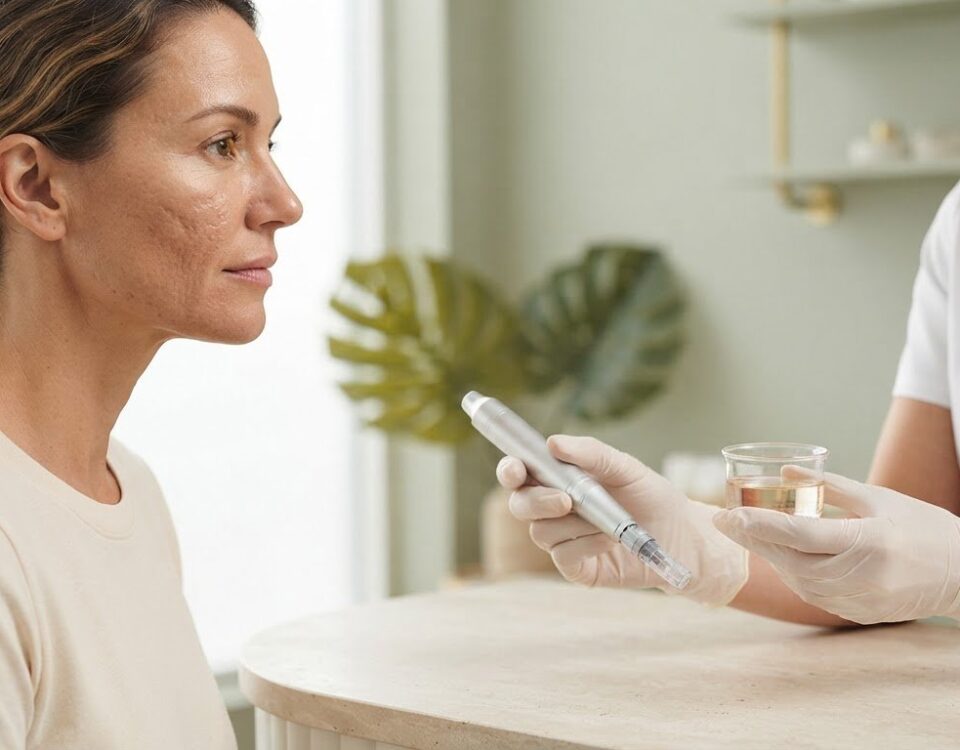
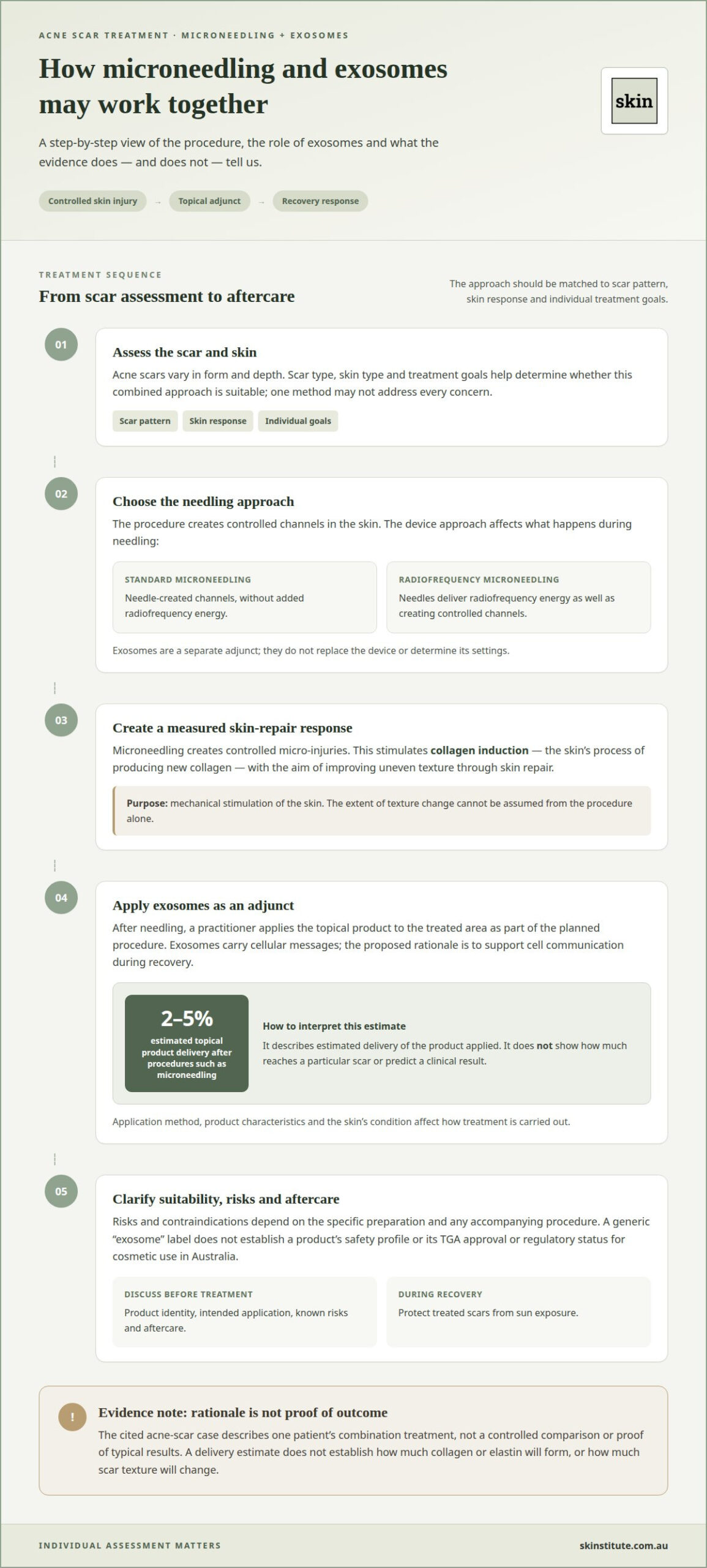
Microneedling creates controlled micro-injuries that stimulate collagen induction, the skin’s process of producing new collagen. For acne scars, the aim is to improve uneven texture through a measured skin-repair response. Exosomes may be applied after needling as an adjunct, not as a replacement for the procedure. The approach combines mechanical stimulation with regenerative molecules.
Claims about delivery need careful interpretation. One estimate places topical exosome delivery after procedures such as microneedling at 2-5% of the product applied. This figure describes estimated product delivery, not the amount reaching a particular scar or a predicted clinical result. Application method, product characteristics and the skin’s condition all affect how the treatment is carried out.
Radiofrequency microneedling delivers radiofrequency energy through the device’s needles, in addition to the controlled needling. Standard microneedling uses needle-created channels without this added energy. Exosomes can be discussed as a separate adjunct applied after either procedure; they do not replace the device or determine its settings. The suitable approach depends on scar pattern, skin response and treatment goals.
After microneedling, a practitioner applies the topical product to the treated area as part of the planned procedure. The proposed rationale is to support the healing process while the skin responds to controlled injury. However, a delivery estimate does not establish how much collagen and elastin will form, or how much acne-scar texture will change. A clinic should explain the product used, application sequence and aftercare before treatment. A clinical discussion of microneedling and exosomes can help clarify how the combined approach fits an individual skin concern.
Exosome therapy compared with stem cell and PRP therapy
Exosomes are extracellular vesicles, not stem cells, and they cannot replicate. They carry cellular messages, including proteins and other molecules involved in communication between cells. Stem cell approaches use cells themselves, while exosome-based approaches use particles released by cells without transplanting cells. This distinction describes what each approach involves, but does not establish which works best for acne scarring.
PRP, or platelet-rich plasma, is a separate treatment that uses a platelet concentrate prepared from a person’s blood. Platelets release signalling molecules associated with tissue repair, while exosomes carry messages between cells. Both may be discussed alongside needling, but they are not interchangeable. A reported acne-scar case combined exosomes with subcision, then used PRP with microneedling. It illustrates a sequence, not the superiority of one treatment.
Tretinoin is a topical retinoid, so it differs from PRP and exosomes in both form and action. It is neither a cell-derived product nor a platelet preparation. These approaches also differ from procedures such as microneedling, which creates controlled skin injury. Compare their intended roles, application methods and suitability for your scar pattern rather than assuming they produce equivalent changes.
Direct comparisons require well-designed clinical studies measuring scar outcomes across comparable groups. An ideal exosome-versus-PRP study would include more than 100 patients, allowing researchers to assess outcomes across a larger sample. Until such evidence is available, claims that exosomes outperform PRP, stem cell therapy or tretinoin should be treated cautiously. For a treatment discussion, separate the biological rationale from demonstrated clinical benefit, and consider how each option addresses the specific concern.
Exosome therapy for acne scars
About one in five people experience acne scars, but visible marks vary in structure and depth. Exosomes are extracellular nanovesicles released by cells that carry molecules such as proteins, lipids and microRNAs. Their proposed role is to communicate signals involved in repair and collagen production. They do not physically lift a tethered scar or replace tissue lost beneath a deep depression. That is why exosomes are usually considered as part of a broader scar-treatment plan.
Exosome therapy for acne scars aims to support the skin’s healing response, rather than directly remove scar tissue. Exosomes are not transplanted cells and cannot replicate. Their biological contents may influence cell communication, but that mechanism alone does not show how much a scar’s appearance will change. Consider the treatment’s intended role separately from procedures that release scar attachments or resurface damaged skin.
Scar pattern affects the treatment rationale. Ice-pick scars are narrow and deep, while rolling scars create broader depressions that may be tethered beneath the surface. Boxcar scars have more defined edges and may be superficial or deeper. A regenerative approach may complement other treatment, but does not address every structural feature by itself. A smoother appearance depends on matching the method to the scar’s anatomy and the person’s skin characteristics.
Planning can include a structured baseline assessment, followed by photographs and a consistent scoring method to track changes. The ECCA acne-scar scale ranges from 0 to 540 points, while the Patient and Observer Scar Assessment Scale rates each category from 1 to 10. Recommended plans may involve three to six exosome treatments, according to scar severity. These measures help frame progress; they do not guarantee a particular result. Patients can also protect treated skin from sun exposure and maintain suitable skincare during recovery.
Skinstitute: Prescription injectables
At Skinstitute, a Melbourne-based clinic, patients can discuss aesthetic treatments suited to their concerns and goals. Because acne scars vary in depth and structure, an assessment should distinguish surface texture changes from tethered depressions before selecting a procedure.
Fractional CO2 may be relevant when resurfacing is being considered for acne-scar texture. Prescription injectables address different aesthetic concerns and are not a substitute for scar-directed resurfacing. A face-to-face consultation can clarify treatment suitability, expected recovery and potential risks.
For patients considering treatment for acne scarring in Melbourne, Skinstitute can discuss whether Fractional CO2 is appropriate. Contact Skinstitute to discuss your treatment goals.
Choose a considered next step for your skin
When considering exosome therapy for acne scars, start by identifying what you want to address: surface texture, scar depth or another aesthetic concern. A treatment discussion can then cover the method’s intended role, suitability, recovery and how progress will be assessed. Individual circumstances should guide the choice.
Skinstitute offers Fractional CO2 for skin resurfacing, alongside prescription injectables and PDO Thread Lifting for other aesthetic treatment goals. These options address different concerns, so they should not be treated as interchangeable solutions for acne scarring. A clinical discussion can help clarify which concern should take priority and whether a treatment approach fits your goals.
For a considered discussion of your skin concerns and available treatment options, contact Skinstitute to discuss treatment. A clear understanding of the approach is a useful foundation for deciding what comes next.
Frequently Asked Questions
What is the best way to utilise exosomes?
Use exosomes only within a clearly defined treatment plan, with an agreed aim and review point. Before proceeding, clarify the change being targeted, how the product fits the procedure and what would count as a meaningful response. Ask for written aftercare instructions and follow the treating practitioner’s product-specific directions. This keeps expectations and decisions focused.
How are exosomes applied to my skin during therapy?
Application depends on the treatment protocol and the product’s intended use. In a microneedling approach, a practitioner applies the preparation to the treated area after needling. Before your appointment, ask how the skin will be prepared, what application involves and what to do afterwards. Don’t reapply a clinical preparation at home unless the treating practitioner has specifically instructed you to.
How should I choose between exosomes and another procedure?
Choose an approach by identifying the outcome you want, then comparing each option’s purpose, recovery demands and known limitations. Ask the practitioner why a proposed procedure suits that goal and how an alternative would address it differently. For example, a treatment aimed at surface texture may not address a depression caused by deeper structural changes. The reasoning should be specific to your concern.
What is exosome therapy for acne scars and how is it supposed to work?
It is a treatment approach using exosomes, small extracellular vesicles that carry biological material between cells. Before treatment, ask what the preparation contains, how it is produced, and whether it is intended for the proposed application. The term “exosomes” alone doesn’t describe a standardised preparation, so those product details are relevant when understanding the proposed treatment.
What types of acne scars may respond to exosome therapy, and which are unlikely to improve?
Exosome treatment aims to support skin repair, but a scar’s appearance alone cannot predict how it will respond. Active acne and residual scarring are separate concerns, so treatment planning should identify which is present. Raised or thickened scars also differ from depressed scars; don’t assume a regenerative approach will address every feature. Define the treatment goal before proceeding.
How many exosome treatment sessions are usually needed and how far apart?
Exosome treatment is generally planned as a course, with session count and spacing guided by scar severity and skin response. A useful plan sets review points before any further treatment rather than automatically repeating sessions. Ask how progress will be assessed and what might prompt a change in approach. Healing, treatment combinations and the response between appointments all affect scheduling.