Skin needling combinations: timing, order and aftercare
November 20, 2026
Cosmetic treatment costs and what shapes your procedure price
November 22, 2026
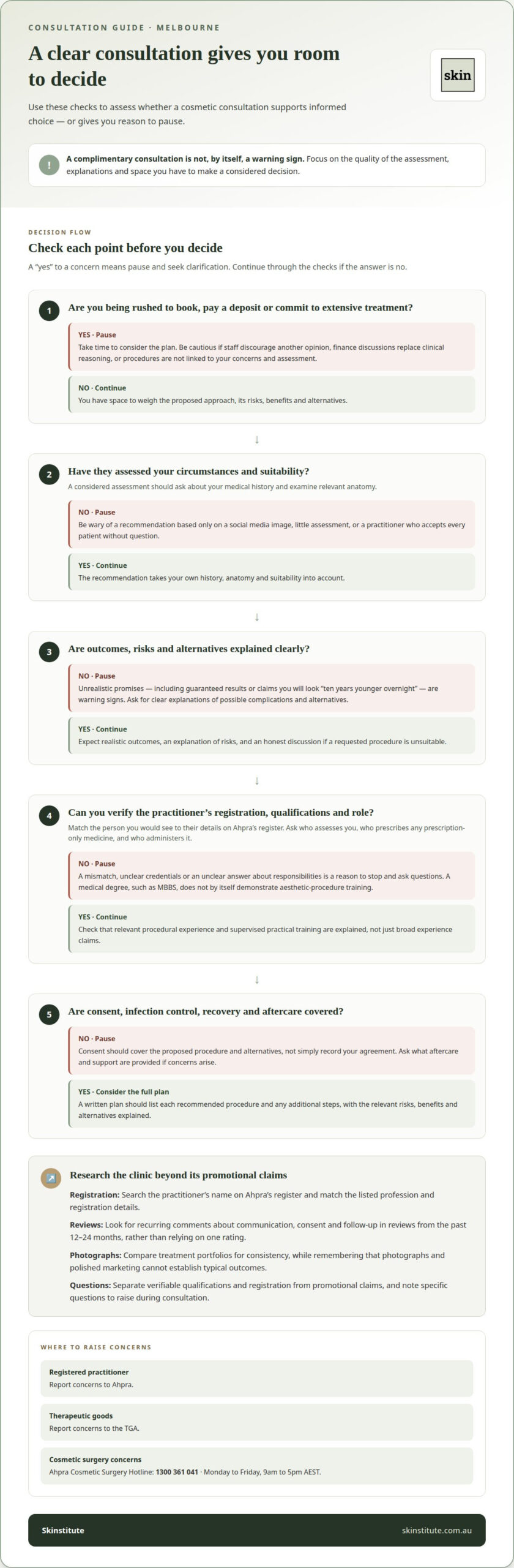
A complimentary consultation is not, by itself, a warning sign. The red flags for cosmetic clinics are behaviours that undermine informed choice, such as unclear explanations or pressure to proceed. Judge the consultation by whether it helps you understand the proposed approach and make a considered decision, not by whether the first appointment is complimentary.
If you are considering cosmetic treatment in Melbourne, this guide explains how to assess consultation arrangements, clinic reputation and practitioner credentials. It also covers practical ways to evaluate treatment options, including suitability, realistic expectations and patient safety.
Key Takeaways
- Pause if you feel rushed to commit, discouraged from seeking another opinion or steered towards more treatment than you expected.
- Assess a free consultation by the quality of its personalised assessment, discussion of realistic outcomes and risks, and the space it gives you to decide.
- Distinguish verifiable practitioner credentials and registration from promotional claims, reviews and treatment photographs.
- Consider how your skin concern, suitability, recovery and aftercare shape the choice between regenerative therapies, light-based treatments, laser resurfacing and injectables.
Pressure to book or commit to extensive treatment
Pressure to pay a deposit before you have considered the plan is one of the red flags for cosmetic clinics, especially if staff discourage you from taking time to decide. A practitioner should explain why each procedure is proposed and give you space to weigh its risks, benefits and alternatives. Ask for a written plan listing each recommended procedure and any additional steps. Be cautious if finance discussions replace clinical reasoning, or extensive treatment is proposed without connecting it to your concerns and assessment.
Other red flags for cosmetic clinics include unrealistic promises, such as guaranteed results or looking “ten years younger overnight”. Australian advertising rules also apply: the Therapeutic Goods Administration restricts advertising for cosmetic procedures, including terms such as “anti-wrinkle injections” and “dermal fillers”. Look for claims that are transparent and consistent with a measured consultation. Confidence should come from clear explanations, not pressure to book before you feel informed.
Are free consultations always a red flag?
A free consultation can be useful when it gives you room to decide independently. Assess whether the practitioner asks about your medical history and examines relevant anatomy. They should explain realistic outcomes and say when a requested procedure is unsuitable. A practitioner who accepts every patient without question is a concern. So is an endorsement based only on a social media image, with little assessment. Ask what qualifications support the practitioner’s title, experience and scope of practice. A consultation that skips informed consent or infection-control discussion is another warning sign. Social media claims should never replace explanations of risks and alternatives.
Report concerns about a registered practitioner to Ahpra. Report therapeutic-goods concerns to the TGA. For cosmetic surgery concerns, call the Ahpra Cosmetic Surgery Hotline: 1300 361 041. It operates Monday to Friday, 9am to 5pm AEST.
Check that qualifications and experience are clearly disclosed. MBBS and MBChB are examples of medical degrees. Prescribing prescription-only medicines without the required qualifications is a red flag, as are promises to make you look ten years younger overnight.
How to research an aesthetic clinic’s reputation
Search the practitioner’s name on Ahpra’s register and match the listed profession and registration details to the person you would see. Treat broad experience claims as marketing until qualifications and relevant procedural experience are clear. A mismatch is a warning sign to discuss before deciding.
Check reviews from the past 12-24 months for recurring comments about communication, consent and follow-up, rather than relying on a single rating. Compare treatment portfolios for consistent examples, while recognising photographs and polished marketing cannot establish typical outcomes. AHPRA guidelines prohibit advertising testimonials about clinical outcomes under Section 133. Separate verifiable registration and qualifications from promotional claims, then note specific questions to discuss during consultation.
Injector medical credentials and training
Check the injector’s Ahpra registration, qualification and scope of practice. A medical degree such as MBBS is relevant, but does not by itself demonstrate training in aesthetic procedures. Ask about supervised practical training and experience related to the specific treatment. The practitioner should explain who assesses you, who prescribes any prescription-only medicine, and who administers it. A rushed or unclear answer about credentials or responsibilities is a reason to pause.
Before proceeding, expect a discussion of your medical history, anatomy, realistic outcomes and possible complications. Consent should cover the proposed procedure and alternatives, not simply record your agreement. Treat advertising that promises guaranteed outcomes as a warning sign, because individual anatomy affects results. Ask what aftercare instructions and support are provided if concerns arise. If the practitioner cannot explain these steps clearly, you may not be receiving the informed, patient-centred care you need.
Exosomes and Rejuran regenerative therapies
Exosome therapy uses exosomes to support healing, regeneration and cell communication. A personalised assessment should establish the skin concern, medical history and suitability before treatment is considered. Discuss the evidence for the proposed use, how treatment is administered and the outcome being targeted. Claims of guaranteed rejuvenation or uniform results go beyond what an individual assessment can establish.
Rejuran bio-stimulation should be explained as an approach to skin renewal, not an instant correction. Suitability depends on the concern, skin condition and medical assessment. Discuss the evidence for the intended use, recovery and the changes that can reasonably be assessed. A sound plan identifies goals and limitations. Broad promises of dramatic, lasting rejuvenation cannot replace evidence-informed expectations. Both options call for clear discussion of risks, product use and follow-up before you consent.
Intense Pulsed Light (IPL) for visible skin concerns
Intense Pulsed Light (IPL) uses broad-spectrum light to address selected visible skin concerns, including uneven pigmentation and redness. It is different from laser resurfacing, and suitability depends on the concern and skin assessment. Before selecting settings, a clinical review should consider skin tone, current skin condition, medical history and treatment goals. Promises to clear every mark are unrealistic.
Before treatment, the practitioner should explain possible skin responses, recovery and aftercare, including sun-protection guidance. Discuss how to manage unexpected irritation and when to seek clinical advice. Ask whether the plan targets your specific concern rather than relying on broad cosmetic claims. IPL should follow an assessment by a suitably qualified practitioner, with clear consent and documented settings. A recommendation made without examining your skin or explaining limitations signals a weak safety process.
Fractional CO2 laser resurfacing
Fractional CO2 laser resurfacing creates controlled columns of thermal injury, prompting skin renewal and collagen induction. It can be considered for uneven texture and visible photo-ageing. A face-to-face assessment should examine the concern, skin condition, medical history and suitability before treatment settings are selected. The practitioner should explain how treatment depth and coverage shape the intended response. Broad promises of perfectly smooth skin overlook differences in skin healing.
Discuss expected recovery, aftercare and possible complications before you consent. Risks can include infection, scarring and pigment changes, so ask how they are reduced and managed. Clear instructions should explain skin care during healing and which signs need clinical review. Ask what results are realistic for your concern and whether another approach may better suit your skin characteristics.
Hyaluronic Acid dermal filler
Hyaluronic Acid dermal filler is an injectable option for selected facial volume or contour concerns. Its purpose should suit your anatomy, not follow a standard template. Assessment should consider the treatment area, medical history, facial proportions and desired change. Filler cannot address every concern, including loose skin or texture changes, so discuss suitability and alternatives clearly.
Before you consent, the practitioner should explain expected outcomes, limitations, the treatment plan and risks, including bruising, swelling, infection, vascular occlusion, scarring and blindness. Promises of guaranteed symmetry or fixed results are misleading because facial anatomy and individual responses vary. Aftercare instructions should explain recovery and how to raise concerns. A considered plan explains why the placement suits your features and gives you the choice to decline or defer treatment.
Cosmetic injectables in Melbourne
For cosmetic injectables in Melbourne, establish who assesses you, prescribes any prescription-only medicine and performs the injection. Confirm the practitioner’s Ahpra registration and relevant qualifications, then discuss their experience with the specific treatment area. Prescription injectables must follow prescribing requirements. An injection offered without appropriate assessment or prescribing is a serious warning sign. The consultation should consider your medical history, facial anatomy and goals before a treatment plan is proposed.
Before consenting, expect an explanation of likely outcomes, limitations and complications, including vascular occlusion. Ask what aftercare instructions you will receive and how to raise concerns after treatment. A clear plan identifies who is responsible for follow-up and explains which symptoms need prompt clinical attention. If the procedure, prescriber or aftercare arrangements are unclear, pause rather than relying on promotional claims alone.
Skinstitute
Skinstitute is a Melbourne clinic with over 26 years of clinical experience. Each treatment plan begins with a face-to-face assessment, where medical professionals consider your concerns, relevant history, facial anatomy and expectations before discussing suitable options. That assessment helps determine whether prescription injectables, a thread lift, Fractional CO2 or High Intensity Focused Ultrasound (HIFU) aligns with your goals. The appropriate approach depends on your individual features and the treatment’s benefits, limitations, recovery and risks. A considered consultation should leave room for questions and an informed decision, rather than pressure to proceed. If your concern is not suited to a proposed non-surgical option, the consultation should make that clear. The discussion should include aftercare and how concerns are managed. To discuss your options at your own pace, contact Skinstitute.
Frequently Asked Questions
Are “free consultations” always a red flag?
No. A FREE consultation is not, by itself, evidence of poor practice. Clarify whether the appointment is for assessment and discussion, or whether treatment is also being proposed. You should be able to leave without proceeding and take the recommendations away to consider. A consultation becomes concerning if its complimentary status is used to make you feel obliged to book or decide on treatment.
How Do I Research an Aesthetic Clinic’s Reputation?
Look for consistent, specific accounts of the same aspect of care rather than relying on a single overall rating. For example, repeated comments about unclear communication may be more useful than generic praise. Consider whether reviews relate to the treatment you are considering, and read how the clinic responds to concerns. Treat polished promotional material as advertising, not independent evidence of clinical quality.
How Do I Spot Unsafe Practices or Unqualified Practitioners?
Pay attention to whether the person treating you can clearly identify the procedure and the product or device involved. Pause if those details change between consultation and treatment, or if you are asked to sign incomplete paperwork. In Australia, concerns about a registered health practitioner can be raised with Ahpra; concerns involving therapeutic goods can be reported to the TGA.
How many of these red flags should I see before walking away?
Three or more warning signs are a strong reason to consider looking elsewhere, but you do not need to reach a threshold before pausing. A single serious concern, such as being asked to proceed while key details remain unclear, can justify delaying your decision. Focus on whether the concern affects your ability to make an informed choice, rather than counting minor inconveniences.
What Qualifications Should My Practitioner Have?
There is no single qualification for every cosmetic procedure. The relevant training depends on the practitioner’s role and the treatment being considered. Ask for the qualification’s full name and how it relates to that procedure, rather than relying on a broad title or course description. A credential should be relevant to the work being performed, not simply to aesthetics in general.
What Questions Should I Ask During a Consultation?
Ask what the proposed procedure involves, which areas it will address and what alternatives could meet the same goal. Clarify whether the plan is for one treatment or a staged approach, and what would lead the practitioner to revise it. Request a written summary of the recommendation, including the treatment area and agreed plan, so you can review the details before deciding.