HIFU vs. Other Skin Tightening Treatments: A Clinical Comparison
June 4, 2026Exosomes in Medical Aesthetics: A Clinical Reference Guide to Regenerative Signalling
June 5, 2026
Why does the price of a single dermal resurfacing session fluctuate by thousands of dollars across different Melbourne postcodes? You’ve likely noticed that the local market is saturated with conflicting offers, ranging from entry-level “lite” sessions to comprehensive medical-grade treatments. It’s natural to feel concerned about whether a lower price point compromises your safety or if a premium fee truly reflects superior clinical outcomes. You deserve a clear understanding of what constitutes a safe and effective investment in your skin’s long-term health.
This guide provides a transparent breakdown of the variables influencing the fractional co2 laser cost melbourne, moving beyond surface-level figures to explain the technical and safety standards required for deep dermal remodelling. We’ll examine the biological mechanisms of controlled thermal injury, the impact of practitioner expertise on your recovery, and the essential clinical considerations that define a professional treatment plan in 2026. By the end of this analysis, you’ll have the technical insight needed to establish a realistic budget and choose a provider based on clinical evidence rather than marketing slogans.
Key Takeaways
- Distinguish between baseline marketing quotes and the actual fractional co2 laser cost melbourne by accounting for anatomical complexity and specific skin pathology.
- Compare the physiological efficacy and longevity of ablative laser resurfacing against more temporary modalities like prescription injectables or skin needling.
- Recognise the clinical importance of dermal priming and specialised aftercare as necessary investments for preventing complications and ensuring tissue regeneration.
- Understand why a comprehensive skin analysis and medical consultation are mandatory steps for establishing safe and effective treatment parameters.
- Assess the value of clinical expertise and established technical proficiency when navigating the diverse range of laser providers in the Victorian market.
Navigating Fractional CO2 Laser Pricing in Melbourne
Fractional CO2 laser represents the gold standard in ablative skin resurfacing, utilising precise Carbon-dioxide laser technology to deliver high-energy light pulses into the dermal layers. This process creates microscopic columns of thermal injury, known as micro-thermal zones, which stimulate a robust wound-healing response and the subsequent synthesis of new collagen and elastin fibres. While many patients begin their research by searching for the fractional co2 laser cost melbourne, it’s essential to understand that this technology exists on a spectrum of clinical intensity. The price you pay reflects the level of tissue interaction and the sophistication of the device used to achieve it.
A common point of confusion arises from “starting from” pricing models frequently seen in digital advertising. These figures typically reflect the most superficial settings or the treatment of a very localised area, such as the periorbital region. For patients seeking to address complex pathologies like deep rhytids or atrophic acne scarring, these entry-level prices are rarely representative of the final investment. A comprehensive clinical assessment is the only reliable method to determine a bespoke pricing structure. This allows the practitioner to evaluate skin thickness, melanin density, and the specific depth of tissue remodelling required to reach your goals.
The “Cheap Laser” Risk: Understanding the Market
Low-cost clinics often operate on a high-volume business model that prioritises throughput over individualised patient care. These environments frequently utilise generic or underpowered laser devices that lack the sophisticated energy modulation found in medical-grade systems. While an initial quote might seem attractive, the risk of suboptimal results or thermal complications often leads to a higher total fractional co2 laser cost melbourne when corrective treatments are factored in. Expertise matters. A seasoned practitioner understands how to balance aggressive thermal energy with patient safety to avoid complications like post-inflammatory hyperpigmentation or scarring.
Clinical Grade vs. Beauty Grade CO2
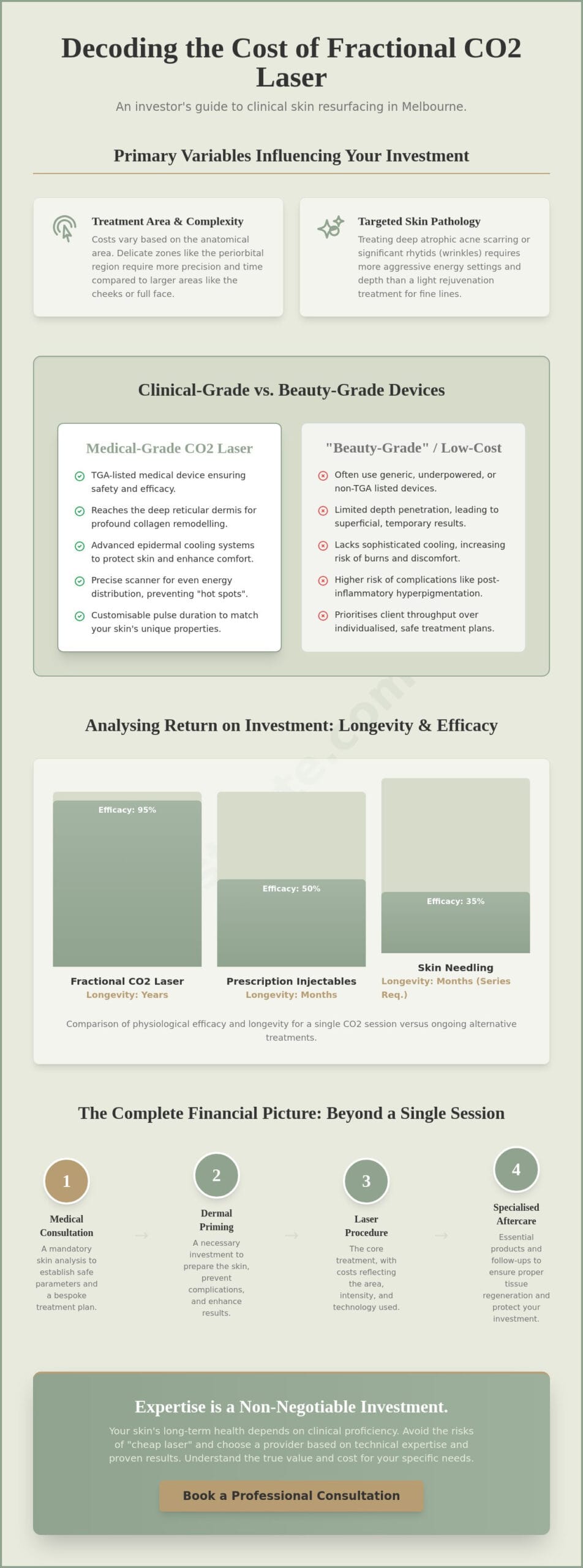
The technical distinction between clinical-grade and beauty-grade devices centres on energy delivery and spot size precision. Clinical-grade CO2 lasers are TGA-listed medical devices capable of reaching the deep reticular dermis with consistent, predictable pulses. They incorporate advanced cooling systems to protect the epidermis, which significantly enhances patient comfort and reduces the risk of unintended burns. Several factors determine why medical-grade treatments require a higher investment:
- The precision of the scanner, which ensures even energy distribution across the treatment area.
- The ability to customise the pulse duration to match the specific thermal relaxation time of your skin.
- Rigorous safety standards and regular device calibration performed by qualified technicians.
- The presence of clinical staff trained to manage the biological response of the skin during and after the procedure.
Investing in a medical-grade treatment ensures that the technology has been rigorously tested for both efficacy and safety. This provides a level of technical proficiency that beauty-grade alternatives cannot replicate, ensuring your recovery is predictable and your results are transformative.
Primary Variables Influencing the Cost of Clinical Laser Resurfacing
The determination of a fractional co2 laser cost melbourne relies on several clinical variables that extend beyond the simple application of light energy. Every patient presents a unique dermatological profile. This means the energy density, pulse duration, and depth of ablation must be precisely calibrated to the specific pathology being treated. For example, addressing deep atrophic acne scarring requires a more aggressive approach than general rejuvenation for fine lines. This complexity directly influences the time required for the procedure and the intensity of the post-treatment monitoring necessary to ensure safe dermal remodelling.
Anatomical considerations also play a pivotal role in pricing structures. The skin surrounding the eyes is significantly thinner than the skin on the cheeks or neck, requiring specialised settings and ocular protection. This American Board of Cosmetic Surgery guide highlights that the success of the procedure is heavily dependent on the practitioner’s ability to adjust these parameters in real-time. When seeking a clinical consultation in Melbourne, you should expect a thorough analysis of these factors before a final quote is provided.
Practitioner Expertise and Clinical Accountability
The disparity in pricing between Melbourne clinics often reflects the qualifications of the person operating the device. A medical professional with decades of experience in laser physics brings a level of accountability that a standard technician cannot match. Expert settings involve customising fluence and density to the individual’s skin type, which reduces the risk of thermal complications. In a clinical environment with over 26 years of history, you are paying for the practitioner’s ability to manage the inflammatory response and guide the tissue through its regenerative phases. This expertise ensures that the high-energy delivery remains therapeutic rather than damaging.
Technology and Device Maintenance
The sophistication of the laser hardware itself is a significant overhead for reputable clinics. High-precision CO2 optics require frequent calibration and maintenance to ensure the energy output remains stable and predictable. Advanced scanners are designed to deliver pulses in non-sequential patterns. This allows for better thermal dissipation and minimises the risk of bulk heating. While cheaper clinics may use older or poorly maintained hardware, a clinical-grade facility invests in regular hardware updates to maintain the integrity of the laser beam. This technical reliability is essential for achieving consistent results and justifies the investment in a professional resurfacing course.
Analysing ROI: Fractional CO2 vs. Alternative Skin Modalities
When evaluating the fractional co2 laser cost melbourne, it’s essential to consider the long-term biological return on investment. Unlike temporary cosmetic injectables that require recurring maintenance every few months, ablative laser resurfacing induces a permanent structural reconfiguration of the dermal matrix. By vaporising columns of damaged tissue, the laser triggers a neocollagenesis process that continues for up to six months post-procedure. This means the improvements in skin density and scar architecture are enduring; they often last years rather than months.
The concept of “Session Math” is a critical factor in this financial analysis. Patients often choose less intensive treatments due to a lower per-session price, yet these modalities frequently require a higher frequency of visits to achieve comparable results. A single session of medical-grade CO2 laser can address pigment, texture, and laxity simultaneously. This multi-modal efficacy reduces the need for separate treatments targeting individual concerns, consolidating your aesthetic investment into a more efficient clinical pathway.
CO2 Laser vs. Skin Needling (Dermapen)
While skin needling is an effective tool for epidermal maintenance, its mechanical nature limits its ability to induce the same level of thermal remodelling as a CO2 laser. Needling creates micro-channels without the application of heat. Heat is necessary for the contraction of collagen fibres. For deep structural scarring or advanced solar elastosis, you might require six or more needling sessions to approach the results of one or two fractional CO2 treatments. When factoring in the cumulative cost of multiple appointments and the repeated downtime, the laser often emerges as the more cost-efficient clinical choice for significant skin revision.
CO2 Laser vs. HIFU and Thread Lifts
A clear distinction exists between surface texture improvement and deep structural lifting. While CO2 laser is unparalleled for refining the skin’s surface and inducing dermal thickness, it doesn’t provide the same vertical lift as mechanical or energy-based structural treatments. In many clinical plans, HIFU is utilised to target the SMAS layer for lifting, while the CO2 laser addresses the superficial and mid-dermal layers. Combining these modalities can be more effective than attempting to achieve a lifting effect through laser alone. This strategic approach ensures every dollar spent is targeted at the specific biological layer requiring intervention. It’s about precision, not just intensity.
The Complete Financial Picture: Consultations, Aftercare, and Recovery
The true fractional co2 laser cost melbourne encompasses a multi-stage clinical journey rather than a single isolated appointment. A successful outcome depends on the physiological state of the skin before the laser makes contact and the precision of the care provided during the subsequent inflammatory phase. A mandatory clinical consultation serves as the foundation for this process. During this initial analysis, practitioners utilise diagnostic tools to evaluate your skin’s structural integrity and pigmentary risk profile. This step is critical for designing a bespoke treatment and aftercare trajectory that aligns with your specific biological requirements.
Mandatory Pre-Treatment Priming
Patients with Fitzpatrick III to VI skin tones face a higher risk of post-inflammatory hyperpigmentation (PIH) following ablative procedures. To mitigate this risk, a period of skin priming is medically necessary. This phase typically involves the use of prescription-strength tyrosinase inhibitors and specific antioxidants to stabilise melanocyte activity before thermal energy is introduced. While these preparatory kits represent an additional upfront investment, they are essential for preventing the costly and difficult-to-manage pigmentary shifts that can occur in unprepared tissue. You should factor the cost of these medical-grade topicals into your total budget to ensure a safe and predictable result.
The Recovery Phase: Clinical Products and Support
Post-procedure care is a structured medical requirement designed to support rapid re-epithelialisation and prevent transepidermal water loss. The skin requires a sterile, occlusive environment to heal without complication or infection. This necessitates the use of specific clinical balms and gentle cleansers that do not contain common irritants or synthetic fragrances. LED phototherapy is frequently integrated into the recovery plan to modulate the inflammatory response and stimulate cellular repair mechanisms. This intervention can significantly reduce clinical downtime and enhance the overall quality of the new tissue.
Budgeting for these support systems is as important as the primary fractional co2 laser cost melbourne itself. You will also require a high-protection, clinical-grade sunscreen to shield the newly formed tissue from UV-induced damage. The skin remains highly photosensitive for several weeks following ablation. Professional monitoring during follow-up appointments allows your clinician to track the healing progress and adjust aftercare instructions as the dermal matrix rebuilds. To ensure your skin is adequately prepared for this intensive process, you can schedule a comprehensive skin analysis with our clinical team to establish a safe and effective treatment timeline.
The Skinstitute Standard: Why Clinical Expertise is a Non-Negotiable Investment
The Skinstitute standard is built upon a twenty-six-year history of delivering medical-grade aesthetic results in Melbourne. We prioritise the long-term biological integrity of the skin over the temporary aesthetics of a quick fix. This clinical philosophy dictates that every high-energy intervention must be balanced with a robust regenerative strategy. For instance, the integration of advanced therapies like exosomes into our post-laser protocols leverages cellular signalling to accelerate re-epithelialisation and enhance the final structural outcome. This level of technical sophistication ensures that your investment yields a durable and safe result, rather than a superficial or fleeting improvement.
When evaluating the fractional co2 laser cost melbourne, you aren’t simply paying for the firing of a laser beam. You are investing in the stability and technical proficiency of a seasoned practitioner who understands the complex interaction between thermal energy and human tissue. Our clinical environment is designed to provide a reassuring sense of authority and safety, ensuring that every patient receives a treatment plan rooted in established scientific principles. This methodical approach minimises the risk of complications and ensures that the dermal remodelling process is both efficient and transformative.
A Bespoke Approach to Laser Resurfacing
Customisation is the hallmark of a professional clinical environment. We don’t apply generic settings to complex skin concerns. Instead, our practitioners modulate pulse duration and energy density based on your unique dermal thickness, melanin profile, and history of solar damage. Transparent communication regarding the fractional co2 laser cost melbourne is a core component of our ethical standard. We ensure you understand the clinical rationale behind every recommendation, from the choice of energy levels to the necessity of specific aftercare products. For those seeking deeper technical insight into the mechanics of tissue ablation and cellular repair, our full guide to Fractional CO2 provides an exhaustive overview of the regenerative process.
Securing Your Clinical Consultation
A professional skin analysis is a prerequisite for any high-energy ablative procedure. This assessment allows us to map out a structured treatment plan that respects your aesthetic goals, your timeline, and your budget. We take the time to explain the physiological “why” behind each phase, from pre-treatment priming to the final follow-up appointment. This methodical pace mirrors a professional consultation, allowing you to feel informed and respected throughout the process. Our focus remains on achieving technical mastery and precision in every session. To begin your journey with a tailored clinical evaluation, you can Book a Clinical Consultation at Skinstitute Melbourne.
Establishing a Clinical Pathway for Dermal Regeneration
Navigating the fractional co2 laser cost melbourne requires a technical understanding of the relationship between high-energy delivery and biological tissue response. A successful investment in your skin’s health is defined by the precision of the laser technology and the clinical accountability of the practitioner. By prioritising medical-grade devices and essential pre-treatment priming, you ensure that the dermal remodelling process is both safe and effective. This comprehensive approach moves beyond superficial aesthetics to achieve long-term structural integrity and lasting cellular renewal.
Skinstitute brings over 26 years of clinical experience in medical aesthetics to the Melbourne community. Our practice is specialised in high-tech, medical-grade laser solutions that prioritise evidence-based results over marketing trends. We invite you to move forward with confidence, knowing that your treatment plan is grounded in technical mastery and professional integrity. To begin your personalised journey toward measurable skin health, Book a Clinical Assessment for Fractional CO2 Laser in Melbourne. We look forward to partnering with you as you navigate the clinical variables of skin regeneration.
Frequently Asked Questions
Is the cost of fractional CO2 laser covered by Medicare in Melbourne?
Medicare rebates for fractional CO2 laser are generally restricted to the treatment of severe scarring or significant disfigurement resulting from trauma, burns, or specific medical conditions. Purely aesthetic resurfacing for fine lines or mild texture issues is classified as a cosmetic procedure and does not qualify for a rebate. Patients should verify their eligibility through a specialist consultation to determine if their condition meets the stringent criteria defined by the Medicare Benefits Schedule.
How many sessions of fractional CO2 will I typically need for acne scars?
The number of sessions required for acne scar revision depends on the depth and morphology of the scarring, such as ice-pick, boxcar, or rolling scars. While a single high-intensity session can achieve significant dermal remodelling, a series of two to three sessions spaced several months apart is often recommended for deep atrophic scarring. This sequential approach allows for cumulative collagen synthesis and ensures the tissue remains healthy throughout the regenerative process.
What is the price difference between “CoolPeel” and traditional fractional CO2?
CoolPeel is a specialised setting of the CO2 laser that delivers high peak power in very short pulses, reducing the thermal damage to surrounding tissue. Because it is less intensive and requires shorter clinical time and recovery support than traditional deep ablation, the per-session investment is typically lower. However, achieving the same structural results as one traditional treatment may require multiple CoolPeel sessions, which influences the total course expenditure.
Are there hidden costs involved in laser resurfacing recovery?
Beyond the primary treatment fee, patients must account for the clinical necessities required to support tissue repair. This includes medical-grade occlusive balms, pH-balanced cleansers, and high-protection sunscreens formulated for post-laser skin. Some clinical plans also incorporate LED phototherapy or specialised serums to accelerate re-epithelialisation. These support systems are essential for preventing complications and ensuring the longevity of the results, making them a mandatory component of the total budget.
Why do prices for CO2 laser vary so much between Melbourne clinics?
The variation in fractional co2 laser cost melbourne is primarily driven by the sophistication of the laser hardware and the clinical expertise of the practitioner. Medical-grade, TGA-listed devices require significant capital investment and rigorous maintenance to ensure energy stability. Additionally, clinics that provide medical oversight and individualised parameter calibration command a higher fee than high-volume centres using generic technology and standardised, non-customised settings.
Can I combine fractional CO2 with Rejuran to improve cost-effectiveness?
Combining fractional CO2 with Rejuran is a common clinical strategy to enhance the skin’s regenerative capacity. Rejuran utilises polynucleotides to stimulate cellular repair and reduce inflammation, which can shorten the recovery period following ablative laser. While this increases the immediate investment, the synergistic effect often leads to superior tissue quality and may reduce the total number of laser sessions required to reach a specific aesthetic goal.
Is a consultation fee standard for laser resurfacing in Melbourne?
A consultation fee is a standard requirement at reputable Melbourne clinics to cover the time and expertise involved in a comprehensive skin analysis. This assessment is necessary to determine clinical suitability, identify potential contraindications, and establish safe laser parameters. In many professional environments, this fee is applied as a credit towards the cost of the procedure if the patient proceeds with the treatment plan on the same day or within a specified timeframe.
Does the cost of the treatment include post-procedure follow-up visits?
At clinical-grade facilities, the initial fractional co2 laser cost melbourne typically includes essential follow-up appointments to monitor the healing process. These reviews allow the practitioner to assess the inflammatory response and ensure that re-epithelialisation is progressing without complication. It’s important to confirm during your initial consultation whether these monitoring visits are inclusive or if they incur separate clinical fees, as professional oversight is vital for a safe recovery.