Cost of HIFU for Face and Neck in Australia: A Clinical Investment Guide 2026
July 11, 2026
PDO Thread Lift for Jowls Melbourne: A Clinical Guide to Structural Contouring
July 13, 2026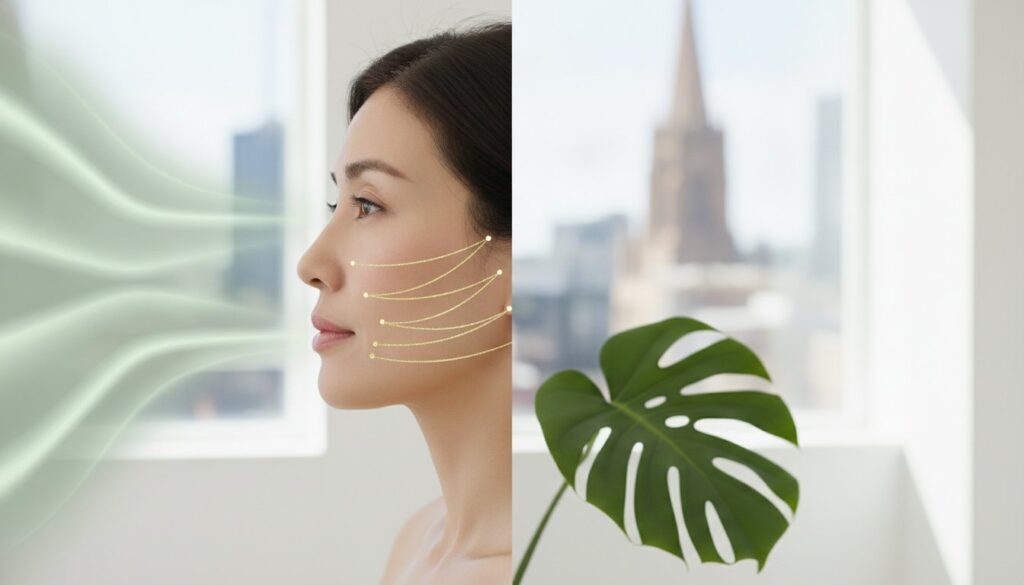
The pursuit of a defined mandibular profile often fails because patients treat skin laxity and tissue descent as the same physiological concern. When researching hifu vs thread lift for jawline melbourne, it’s easy to feel overwhelmed by the technical distinctions between energy-based tightening and mechanical repositioning. You’ve likely noticed your jawline losing its sharpness or the subtle emergence of jowls, yet you’re hesitant to commit to a procedure that might leave you looking over-treated or unnatural.
This article provides a clinical comparison of High Intensity Focused Ultrasound and PDO Thread Lifting to help you identify the optimal non-surgical path for your unique anatomy. We’ll examine how HIFU offers a biological lift by stimulating deep collagen production, while thread lifting provides an immediate, mechanical repositioning of sagging tissue. By the end of this analysis, you’ll understand the mechanics of each modality and how our 26 years of Melbourne-based expertise ensures a result that prioritises both structural integrity and long-term skin health.
Key Takeaways
- Identify whether your concerns stem from surface-level skin laxity or deep structural descent to ensure your treatment addresses the physiological cause of jowl formation.
- Understand the mechanism of HIFU, which employs thermal coagulation at specific anatomical depths to stimulate long-term collagen and elastin production.
- Assess the immediate mechanical lift provided by PDO threads, a medical-grade solution that physically repositions sagging tissue for a sharper mandibular profile.
- Review the clinical differences regarding downtime, cost, and longevity when deciding between hifu vs thread lift for jawline melbourne.
- Explore the advantages of multi-modality care, where regenerative treatments are used to enhance skin health alongside structural lifting procedures.
Understanding Jawline Sagging: Tissue Laxity vs. Mechanical Descent
The loss of a defined mandibular profile is rarely the result of a single biological factor. Instead, it occurs through a complex interplay of dermal thinning and the mechanical descent of deeper soft tissues. When evaluating hifu vs thread lift for jawline melbourne, it’s vital to distinguish between these two distinct ageing patterns. Skin laxity refers to the loss of elasticity within the dermis, resulting in a crepe-like texture. Structural sagging, however, involves the migration of fat and muscle, leading to the formation of jowls that obscure the jawbone.
Melbourne’s specific environmental conditions play a significant role in this process. The high UV index characteristic of the Australian climate accelerates the degradation of type I collagen and elastin fibres through chronic photoageing. This dermal thinning reduces the skin’s ability to “hold” the underlying structures in place, making the jawline particularly susceptible to the effects of gravity. A professional clinical assessment is required to determine whether your specific profile requires biological tightening of the skin or mechanical repositioning of the deeper layers.
The Role of the SMAS Layer in Facial Contouring
The Superficial Musculoaponeurotic System (SMAS) is a fibrous, organised layer of tissue that connects the facial muscles to the skin. In surgical procedures, this is the layer that practitioners manipulate to achieve a lasting lift. Non-surgical interventions like HIFU and a Thread lift are designed to target this specific depth to provide structural support without the need for invasive incisions. Precision is essential here; our 26 years of clinical experience allows us to navigate this anatomy safely, ensuring the treatment remains effective while protecting the delicate facial nerves located near the mandibular border.
Bone Resorption and Fat Pad Migration
As we age, the mandible (jawbone) undergoes a process of resorption, where the bone density and volume gradually decrease. This reduction in the skeletal foundation leaves the overlying skin with less structural support, contributing to a “softer” or more recessed profile. Simultaneously, the malar fat pads in the cheeks begin to descend toward the lower face. This migration adds volume to the jowl area, creating a heavy appearance that cannot always be corrected with dermal fillers. In fact, adding volume to an already heavy jawline can often lead to an unnatural, “over-filled” look. Understanding these anatomical shifts is critical when choosing between hifu vs thread lift for jawline melbourne, as the goal is to restore the original architecture of the face rather than simply masking the changes.
HIFU (High Intensity Focused Ultrasound): Deep Biological Tightening
High Intensity Focused Ultrasound (HIFU) operates as a non-invasive modality that induces thermal coagulation at precise depths within the soft tissue. Unlike topical treatments, HIFU bypasses the epidermis to deliver concentrated energy to the dermis and the Superficial Musculoaponeurotic System (SMAS). By creating micro-thermal zones at 1.5mm, 3.0mm, and 4.5mm, the technology triggers a natural wound-healing response. This response results in the immediate contraction of existing collagen fibres and the long-term synthesis of new structural proteins. This biological tightening creates a “shrink-wrap” effect, pulling the tissues tighter over the mandibular bone to restore definition.
When evaluating hifu vs thread lift for jawline melbourne, it’s essential to recognise that HIFU is a regenerative treatment rather than a mechanical one. While a thread lift offers immediate repositioning, HIFU relies on neocollagenesis and elastin production. This process typically unfolds over three to six months as the body gradually builds a firmer dermal matrix. Ideal candidates for this procedure are those with mild to moderate skin laxity who still possess good skin quality and dermal thickness. It is an excellent preventative measure for patients noticing the early signs of jowl formation.
The Clinical Advantage of Medical-Grade HIFU
Medical-grade ultrasound technology differs significantly from salon-grade devices in its ability to maintain consistent energy delivery and depth precision. Accurate targeting of the 4.5mm depth is critical for jawline definition, as this is the level where the SMAS layer resides. Inadequate depth leads to superficial results that fail to address structural sagging; conversely, excessive depth may reach the bone or interfere with facial nerves. A HIFU for Face Treatment conducted with clinical-grade equipment allows for a predictable and safe timeline of biological skin tightening.
What to Expect During a HIFU Procedure in Melbourne
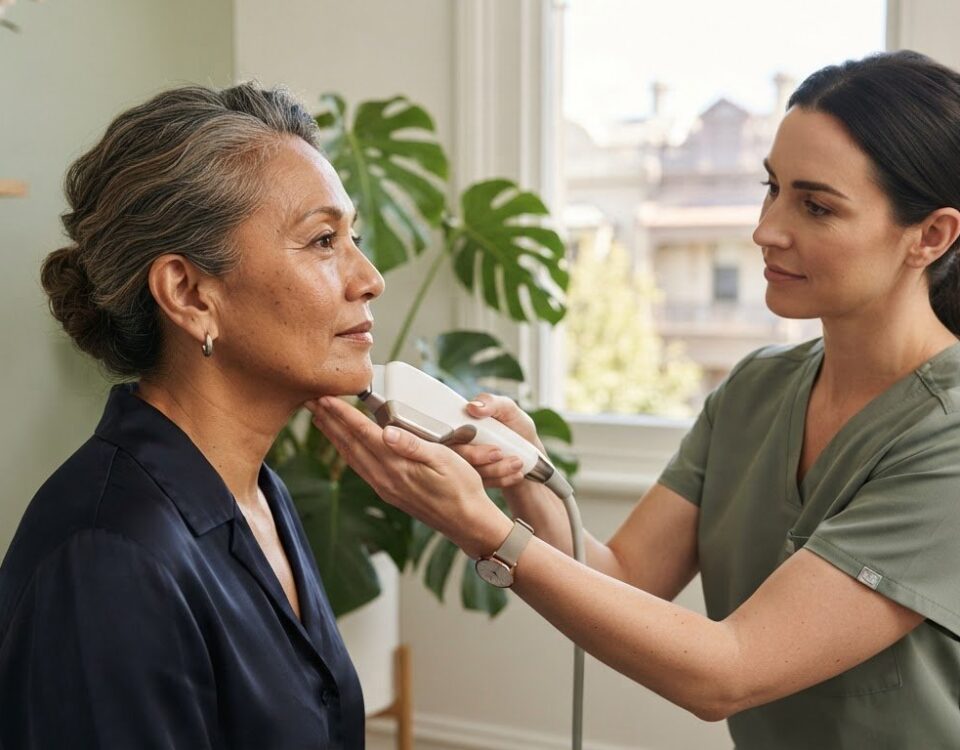
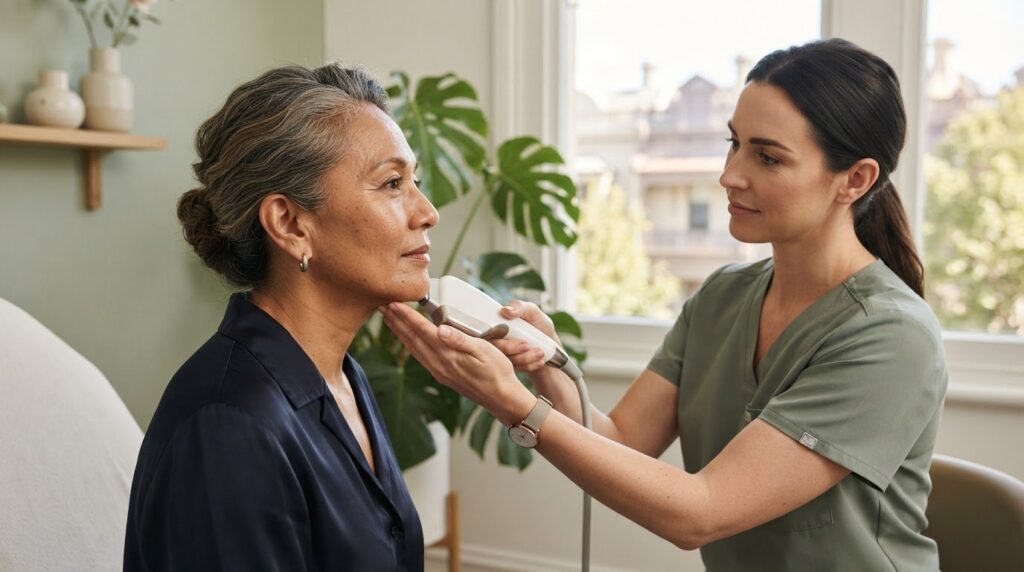
During the procedure, you will experience a sensation of deep, localised heat as the ultrasound energy reaches the target tissue. This thermal feedback signifies that the coagulation points are being successfully established within the SMAS and dermal layers. A standard session focusing on the jawline and submental area typically lasts between 45 and 60 minutes. One of the primary benefits of this technology is the absence of social downtime. You can return to your daily routine immediately, though some patients report a slight tenderness or “heavy” sensation along the jawline for several days post-treatment.
Maintaining internal skin health through proper hydration and nutrition supports the regenerative phase following the procedure. If you are unsure which technology best suits your ageing pattern, you can book a clinical assessment to discuss your goals with an experienced practitioner. This ensures your treatment plan is based on anatomical reality rather than generic protocols.
PDO Thread Lifting: Immediate Mechanical Repositioning
Polydioxanone (PDO) is a biocompatible polymer that has been utilised in medical settings, including cardiovascular surgery, for decades. When considering hifu vs thread lift for jawline melbourne, it’s important to understand that PDO threads provide a mechanical solution that energy-based devices cannot replicate. While HIFU stimulates biological contraction within the tissue, thread lifting involves the physical repositioning of sagging skin and fat. This process uses specialised “cog” or “barbed” threads. These sutures feature microscopic protrusions that anchor into the subcutaneous layers, allowing the practitioner to manually lift and secure the tissue in a more superior position.
The procedure offers a dual-phase benefit. The primary phase is the immediate mechanical elevation of the jowls. The secondary phase occurs as the threads gradually dissolve through hydrolysis over six to nine months. During this period, the body creates a “collagen scaffold” around the suture. This new structural network of collagen reinforces the dermis, providing continued support even after the PDO material is gone. Ideal candidates are those with visible structural descent where simple skin tightening would prove insufficient to restore a defined mandibular border.
The Science of Thread Anchoring and Vectoring
Determining the correct vector is essential for a natural result. A practitioner must calculate the precise angle of elevation to ensure the jawline is redefined without distorting the mid-face. What you need to know about thread lifts is that the threads must be anchored in stable facial fascia to remain effective. This requires deep anatomical knowledge to avoid the “pulled” look often associated with poorly executed treatments. Correct vectoring ensures that the lift follows the natural contours of your face. Mastery of these techniques is vital for patient safety.
Recovery and Longevity of Thread Lifts
Post-procedure recovery is generally straightforward. You may feel a “tight” sensation or experience minor bruising at the entry points. These effects typically resolve within five to seven days. While the mechanical lift is immediate, the results continue to refine as the initial swelling subsides. Our 26 years of clinical experience in Melbourne has demonstrated that results typically persist for 12 to 18 months. This longevity depends on your individual biological response and the number of threads used. For many patients evaluating hifu vs thread lift for jawline melbourne, the immediate gratification of a thread lift makes it a compelling choice for addressing significant tissue descent.
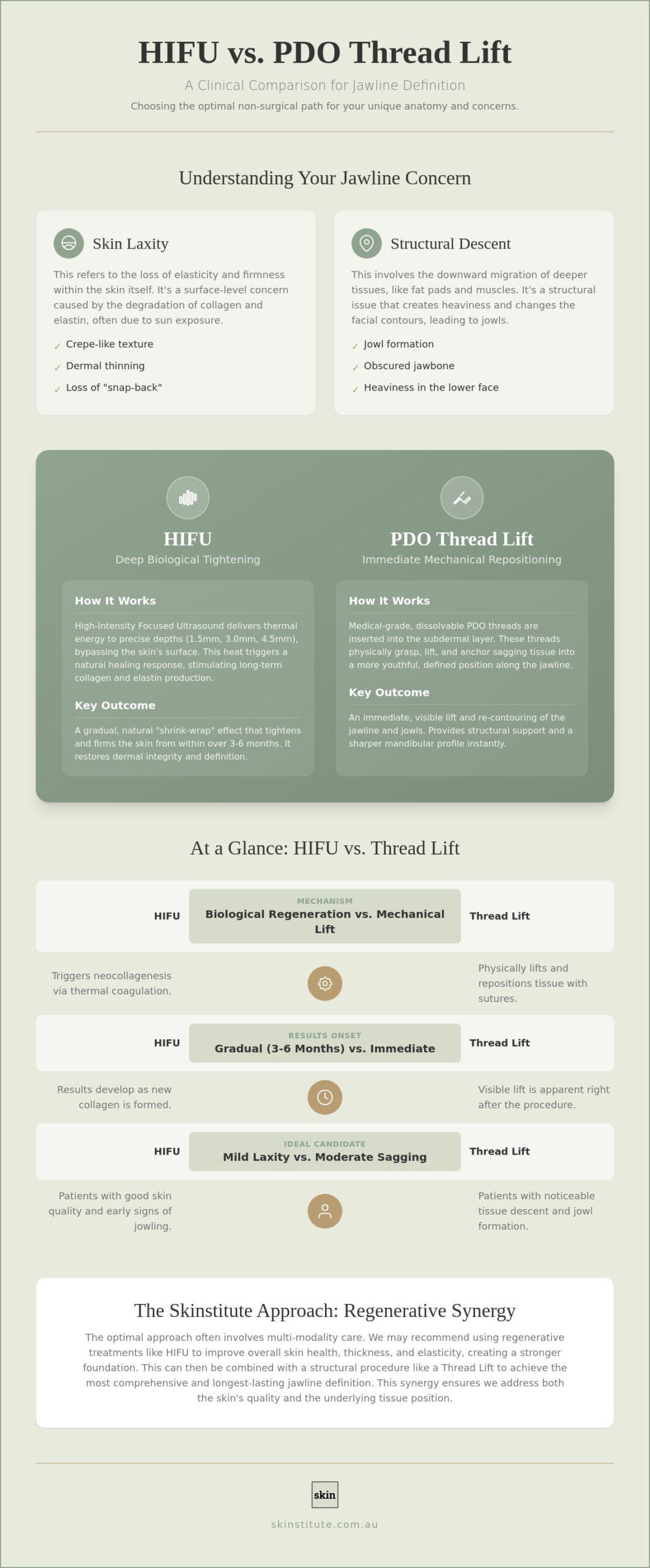
HIFU vs. Thread Lift: The Comparison Framework for Melbourne Patients
The decision between these two modalities depends on a clinical evaluation of your specific ageing phenotype. While both treatments aim to redefine the mandibular border, they address different biological requirements. Patients with significant tissue descent require a mechanical intervention that energy-based devices cannot provide. Conversely, those in the early stages of laxity may find that biological tightening offers a more sustainable, natural-looking progression. Understanding the clinical distinctions between hifu vs thread lift for jawline melbourne allows for a more targeted approach to facial rejuvenation.
| Feature | HIFU (Ultrasound) | PDO Thread Lift |
|---|---|---|
| Mechanism | Biological Neocollagenesis | Mechanical Repositioning |
| Primary Result | Gradual tightening (3-6 months) | Immediate structural lift |
| Downtime | Zero social downtime | Minimal (5-7 days) |
| Longevity | Approximately 12 months | 12 to 18 months |
| Tissue Suitability | Mild laxity; thicker dermis | Moderate sagging; thinner skin |
Tissue heaviness is a critical factor in this selection process. When the jawline is obscured by descending fat pads rather than just loose skin, the mechanical anchorage of threads is often necessary to achieve a visible change. HIFU is highly effective at “shrink-wrapping” the skin over the bone, but it lacks the tensile strength to physically move displaced fat. Your age and the thickness of your dermis will ultimately dictate which technology can safely and effectively support your facial architecture.
When to Choose HIFU for Your Jawline
HIFU is the preferred option for patients focused on prevention and the correction of early-stage skin laxity. It suits individuals who prefer a non-invasive route with zero downtime and a result that develops incrementally. This modality works best when integrated into a broader skin health regimen. You can learn more about how we categorise these interventions in our Skinstitute Melbourne: Clinical Guide. By stimulating the body’s own regenerative processes, HIFU ensures the skin remains resilient against future sagging.
When a Thread Lift is the Clinically Superior Option
A thread lift becomes the superior choice when jowls are established and the mandibular line has lost its continuity. It’s particularly effective for patients with thinner skin who require a mechanical scaffold to hold tissue in place. If you’re seeking an immediate structural change to your profile, threads provide the necessary vectoring to lift the tissue back to its youthful position. To determine which method aligns with your anatomical needs, you should request an anatomical jawline assessment with our clinical team. This ensures your treatment plan is based on objective medical criteria rather than a one-size-fits-all approach.
The Skinstitute Approach: Regenerative Synergy and Multi-Modality Care
Achieving a refined mandibular profile is rarely the result of a standalone procedure. While the clinical comparison of hifu vs thread lift for jawline melbourne often focuses on choosing between energy-based tightening and mechanical repositioning, optimal results usually require a combination of modalities. At Skinstitute, we prioritise regenerative synergy. This approach involves preparing the skin’s biological environment to ensure that any structural lifting is supported by a healthy, resilient dermal matrix. If the skin is thin or lacks internal hydration, the effects of a lift will be diminished by poor surface quality.
Integrating Rejuran in Melbourne allows us to improve skin elasticity and hydration through polynucleotide bio-stimulation before initiating a lift. This treatment prepares the “canvas” by repairing DNA and stimulating fibroblast activity. When the surface texture requires refinement, we may employ Fractional CO2 Laser to address chronic photoageing and fine lines. These modalities, when combined with the use of Exosomes and bio-stimulators, extend the longevity of your results by maintaining the structural integrity of the skin long after the initial procedure is complete.
The Value of 26 Years in Melbourne Aesthetics
The stability of your care is as important as the technology used. Our clinic has operated in Melbourne for over two decades, providing a consistent clinical roadmap for patients as their anatomical needs evolve. Choosing a medical-grade environment ensures that your treatment is dictated by evidence-based results rather than high-street trends. This commitment to safety and technical proficiency provides a sense of quiet confidence, where the focus remains on achieving natural, anatomically correct outcomes. You are not just a client for a single session; you’re a patient whose long-term skin health is managed by seasoned practitioners.
Your Clinical Consultation: The First Step
Every journey toward a sharper jawline begins with a professional anatomical assessment. During this consultation, we evaluate the degree of tissue laxity, the presence of bone resorption, and the specific vectors of fat migration. Identifying contraindications and setting realistic biological expectations is a fundamental part of our medical-grade standard. We don’t promise impossible transformations; instead, we provide a transparent overview of how different technologies will interact with your body. The final objective is to achieve the “Smiling” (Mosolygós) jawline, a term reflecting a lifted and rejuvenated mandibular profile that looks entirely natural. By understanding the nuances of hifu vs thread lift for jawline melbourne, we can select the precise intervention that aligns with your unique physiological profile.
Restoring Mandibular Definition Through Clinical Precision
Defining the jawline requires a sophisticated understanding of how dermal laxity and structural descent interact within the facial architecture. While High Intensity Focused Ultrasound provides a foundational biological tightening by stimulating neocollagenesis, PDO Thread Lifting offers the mechanical support necessary to reposition descending soft tissue. The choice between hifu vs thread lift for jawline melbourne isn’t merely a matter of preference; it’s a clinical decision based on your unique anatomical ageing pattern and skin quality. Achieving a balanced result requires moving beyond surface-level treatments to address the underlying physiological changes in the SMAS and deep tissue layers.
At Skinstitute, we leverage 26 years of industry-leading clinical experience to guide you through these complex modalities. Our specialised medical-grade protocols ensure that every intervention prioritises safety, stability, and natural results. Located in the heart of Melbourne, we provide the authoritative expert guidance required to navigate your aesthetic journey with confidence. We invite you to Book Your Clinical Jawline Assessment at Skinstitute Melbourne to develop a personalised roadmap for your facial rejuvenation. Taking the first step toward a more defined profile begins with an objective, medical-grade evaluation of your specific needs.
Frequently Asked Questions
Which is better for jowls: HIFU or a Thread Lift?
A thread lift is generally superior for established jowls because it provides immediate mechanical repositioning of descending tissue. While HIFU is highly effective for tightening the dermis and SMAS layer, it lacks the tensile strength to physically lift displaced fat pads. Patients with significant jowling typically require the structural support of threads to restore a clean mandibular line.
How long do the results of a jawline thread lift last?
The results of a jawline thread lift typically persist for 12 to 18 months. Although the PDO material dissolves through hydrolysis within six to nine months, the collagen scaffold created during the healing process provides continued structural support. Individual longevity depends on your biological response and the rate at which your body synthesises new structural proteins.
Is HIFU painful on the jawline area?
Patients usually experience a sensation of deep, localised heat as the ultrasound energy reaches the targeted depths. While the jawline can be more sensitive due to the proximity of the bone, the discomfort is generally manageable and signifies that the thermal coagulation points are being established. Any post-treatment tenderness or “heaviness” along the jaw typically resolves within several days.
Can I combine HIFU and PDO Threads in the same treatment plan?
Combining these modalities is often the most effective way to achieve a comprehensive result. When evaluating hifu vs thread lift for jawline melbourne, many patients find that initial HIFU sessions provide a tightened dermal foundation, which enhances the anchoring and longevity of subsequent PDO threads. This multi-modality approach addresses both skin laxity and structural descent.
What is the downtime for a jawline thread lift in Melbourne?
Social downtime for a jawline thread lift is typically between five and seven days. You may experience minor bruising at the entry points, subtle swelling, or a sensation of tightness when opening your mouth. Most patients return to their professional routines within a week, though we recommend avoiding high-impact exercise and facial massages for at least 14 days.
Will HIFU melt facial fat in my jaw area?
Medical-grade HIFU technology is designed for precision, targeting specific depths like the SMAS layer at 4.5mm without affecting the surrounding fat pads. When performed by an experienced practitioner, the energy is focused to avoid unwanted fat volume loss. This ensures the jawline is tightened without compromising the essential volume that maintains a youthful facial structure.
How many HIFU sessions are needed for a visible jawline lift?
Most patients observe a visible improvement in jawline tautness after a single medical-grade HIFU session. Because the treatment relies on the body’s natural production of collagen and elastin, the full results develop gradually over three to six months. Depending on your age and the degree of initial laxity, an annual maintenance session is often recommended to sustain the lifting effect.
Are the threads used in a thread lift permanent?
PDO threads are not permanent; they are composed of an absorbable, medical-grade polymer that has been used in surgery for decades. The body naturally breaks down the threads over a period of six to nine months. The lifting effect continues beyond this point because the threads stimulate a localised healing response that replaces the suture with a permanent network of your own collagen.