Collagen Stimulating Treatments in Melbourne: A Clinical Buying Guide
October 4, 2026
Best Treatment for Crepey Skin on Arms: Options Compared
October 6, 2026
A fixed number of Rejuran sessions cannot account for every patient’s skin or treatment goals. If you’re wondering how many rejuran treatments are needed, the answer depends on what your clinician finds during an assessment, not on a schedule that suits everyone.
It’s understandable to want clarity before committing to a course of treatment. Rejuran is a polynucleotide-based bio-stimulator, and its effects develop gradually. A clinician may therefore discuss an initial series rather than presenting one session as a complete plan. The number and spacing of treatments can vary according to your skin condition, the concern being treated and your response over time.
This guide explains why recommended session numbers differ, which factors a clinician considers and what to discuss before proceeding. It also covers realistic expectations, suitability, recovery and potential risks, so you can understand general guidance without mistaking it for individual medical advice. At Skinstitute, Rejuran plans are tailored through face-to-face consultation with medical professionals, drawing on more than 26 years of clinical experience in Melbourne.
Key Takeaways
- There isn’t one session count that suits everyone. How many rejuran treatments are needed depends on clinical assessment and individual treatment goals.
- Understanding Rejuran as a polynucleotide-based regenerative treatment helps explain why a clinician may plan it differently from a filler procedure.
- The concern being treated, treatment area, skin condition and medical suitability all inform the proposed plan.
- Before proceeding, understand why the sessions are recommended and how your response will be reviewed.
- Skinstitute’s face-to-face consultations and more than 26 years of clinical experience in Melbourne inform its tailored treatment planning.
How many Rejuran treatments are needed? The short clinical answer
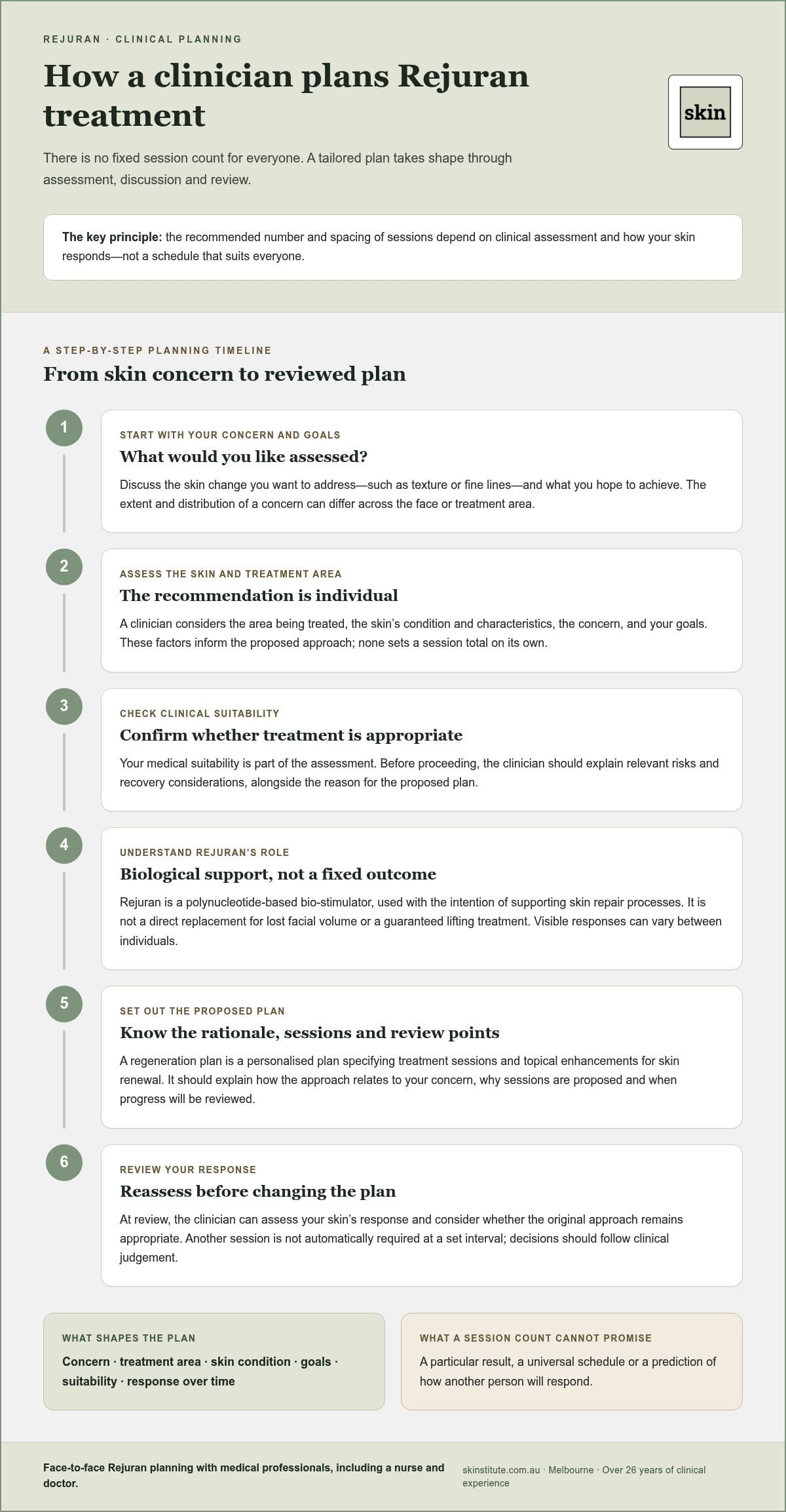
There is no single session count suitable for every patient. The answer to how many rejuran treatments are needed depends on the skin concern being assessed, the area being treated and your goals. A clinician can recommend an approach after considering these factors and assessing whether treatment is suitable.
General information about treatment schedules can help explain how Rejuran may be planned, but it isn’t an individual recommendation. A session count cannot guarantee a particular result. People can respond differently, and the plan may need review as the clinician assesses the skin and its response.
Why there is no universal Rejuran session number
Patients may seek treatment for different concerns, such as changes in skin texture or the appearance of fine lines. The extent and distribution of a concern can also differ across the face or treatment area. These differences affect what a clinician needs to assess and what you hope to address.
Individual responses vary too. Treat a standard course or interval described online as general information, not a schedule that automatically applies to everyone. Your clinician’s recommendation should reflect your assessment, rather than a fixed number.
What a treatment plan is designed to clarify
A treatment plan sets out the clinician’s proposed approach, the reason for it and when progress will be reviewed. A regeneration plan is a personalised plan specifying treatment sessions and topical enhancements for skin renewal. It should explain how the approach relates to your concern, rather than simply state a session total.
Reassessment matters. At review, the clinician can consider your skin’s response and discuss whether the original plan remains appropriate. The extracellular matrix is the structural environment that includes components such as collagen and elastin. This overview of the biological effects on the extracellular matrix provides context for why regenerative skin care involves more than counting sessions.
At Skinstitute, medical professionals, including a nurse and doctor, tailor Rejuran treatment plans following a face-to-face consultation. You can discuss the proposed session plan and review points in relation to your skin, goals and suitability, without treating a general schedule as a promise of outcome.
How Rejuran works and why its biological effects matter to treatment planning
Rejuran is a polynucleotide-based regenerative treatment. Polynucleotides are chains of nucleotide units, the basic building blocks of genetic material. In Rejuran treatment, they are used with the intention of supporting the skin’s repair processes. The term bio-stimulators describes agents intended to stimulate biological processes, rather than simply add volume to an area.
This distinction helps set realistic expectations. Rejuran is not a direct replacement for lost facial volume and should not be understood as a guaranteed lifting treatment. Its proposed role is to support skin quality through biological processes, while the visible response can vary between individuals. A clinician can explain how this approach relates to your concern and whether it is suitable.
What polynucleotides are and how they are discussed in Rejuran treatment
Polynucleotides are long chains made from linked nucleotide units. In discussions of Rejuran, they are associated with supporting skin repair. This does not mean a particular degree of collagen production or skin change is assured. The treatment rationale is biological support, not an immediate change in facial structure.
That distinction matters when considering timing. A biological response and a visible change are not necessarily simultaneous, and individual responses can differ. Any discussion of likely effects should reflect clinical evidence and your assessment, rather than promise a particular outcome.
Why biological response does not produce a fixed treatment count
A regenerative rationale does not establish one session number for all patients. Planning still depends on the concern being treated, the characteristics and condition of the skin, the treatment area, your goals and clinical suitability. Another person’s experience cannot predict your response.
Review allows the clinician to assess your response and reconsider the proposed approach. It does not mean another session is automatically required at a set interval. The decision should follow clinical judgement, with the rationale and relevant risks or recovery considerations explained as part of the discussion.
If you are considering Rejuran in Melbourne, a face-to-face assessment can clarify how its proposed biological role relates to your skin concern and goals. Read more about Rejuran treatment in Melbourne and discuss a tailored plan with Skinstitute’s medical professionals.
What factors influence how many Rejuran treatments a clinician may recommend?
A recommended plan reflects more than the name of a skin concern. A clinician considers what you want to address, the area being assessed, your skin’s condition and whether treatment is suitable. These factors shape a recommendation, but none on its own determines a set number of sessions.
Skin concerns, treatment area and patient goals
The consultation starts with why you are seeking treatment. You may be concerned about texture, fine lines or another visible change, and have particular expectations about what treatment could achieve. The clinician assesses the area and discusses whether those goals are realistic for Rejuran. A concern alone cannot establish a treatment schedule or predict an individual result.
For background on the treatment’s proposed mechanism and clinical context, read the Clinical Guide to Rejuran in Melbourne. General information can help you prepare for a consultation, but it cannot determine an individual plan.
Suitability, medical history and response to treatment
A medical professional assesses your suitability, considering relevant health and treatment history alongside the skin concern and intended treatment area. The discussion should also cover potential risks and recovery expectations, so you can weigh these factors before deciding how to proceed.
Your response is another consideration. At a review, the clinician can assess how your skin has responded and whether the proposed approach remains appropriate. A further treatment should not be assumed from someone else’s experience or treated as an automatic next step. The decision rests on individual clinical judgement.
Why online guidance has limits
Published schedules and personal accounts can describe general approaches, but they cannot account for your skin characteristics, health history or treatment goals. Even people seeking treatment for a similar concern may need different clinical advice. Use online information to prepare questions, not to decide how many sessions are appropriate.
If you’re considering Rejuran, useful questions for a face-to-face consultation include: What is the proposed plan intended to address? How will suitability be assessed? What risks and recovery considerations apply? When will your response be reviewed? These questions help you understand the recommendation without treating a session count as a guarantee of outcome.
How to assess a proposed Rejuran plan and set realistic expectations
A clear plan should explain the reasoning behind treatment. Start by describing your skin concern and what you hope to address. The clinician can then assess suitability, explain the proposed approach and outline how your response will be reviewed. This helps distinguish a personalised recommendation from a session count taken from general online guidance.
Before deciding how many rejuran treatments are needed, make sure you understand what the clinician is proposing and why. Outcomes and recovery can vary, so the discussion should not promise a particular result or timeline. Ask what changes are reasonable to monitor and when the clinician expects to reassess, rather than assuming progress will follow a fixed schedule.
Questions that help clarify a personalised treatment plan
Use the consultation to understand the rationale and the safeguards around treatment. You might ask:
- What specific concern is the recommended plan intended to address?
- Why is this session number and spacing being proposed for my skin and goals?
- How will you assess my response, and what would prompt a review of the plan?
- What risks, recovery considerations and suitability factors should I understand before proceeding?
- What aftercare instructions will apply to my treatment?
The clinician should explain the proposed approach in terms you can understand and discuss relevant risks and recovery expectations before treatment. Follow the aftercare advice provided for your individual treatment; generic instructions are not a substitute for clinical guidance.
Why review matters more than copying another person’s schedule
Another patient’s treatment history reflects their own skin, goals and clinical assessment. It isn’t evidence that the same number of sessions is right for you. Having more sessions does not automatically mean a better result. The decision to continue should be based on suitability and the response observed, not on matching someone else’s course.
A review gives you and the clinician an opportunity to consider what has changed, whether your goals remain the same and whether the original plan still makes sense. You can also raise concerns about recovery or unexpected changes before discussing further treatment. This measured reassessment supports informed decisions without making additional sessions automatic.
Skinstitute tailors Rejuran plans after face-to-face consultation with medical professionals. Discuss a personalised Rejuran treatment plan based on your skin, goals and clinical assessment.
Discussing Rejuran treatment in Melbourne: Skinstitute’s clinical approach
A face-to-face consultation connects a general question, such as how many rejuran treatments are needed, with an assessment of your skin and goals. At Skinstitute, medical professionals, including a nurse and doctor, tailor treatment plans following consultation. The discussion considers whether Rejuran is suitable for you and what approach, if any, is appropriate.
Skinstitute’s more than 26 years of clinical experience in Melbourne’s aesthetic sector informs this measured approach. Experience does not guarantee a particular outcome; it supports careful discussion of your concerns, treatment options, risks and realistic expectations.
What to expect from a face-to-face Rejuran assessment
The consultation focuses on the concern you want assessed, your goals and clinical suitability. The clinician can discuss the proposed treatment area, explain the rationale for a plan and describe how progress may be reviewed. Session numbers are considered individually rather than set by a default count, and any recommendation should be understood in the context of your assessment.
For broader clinic context, read the Skinstitute Melbourne guide to medical-grade aesthetic treatments. It provides background on the clinic’s approach, while your consultation is the place to discuss whether a specific treatment suits your circumstances.
Where to learn more about Rejuran’s clinical context
Learning about a treatment’s proposed role can help you prepare useful questions, but educational information cannot determine personal suitability. The clinical guide to Rejuran in Melbourne provides more information about its treatment context. A medical professional can relate that information to your skin, relevant history and expectations.
If you’re considering Rejuran, a face-to-face consultation is a considered way to discuss suitability, session planning, potential risks and recovery expectations before deciding how to proceed. The aim is an informed, individual plan, not a promised result or predetermined number of sessions.
Make an informed decision about your Rejuran plan
There’s no universal answer to how many rejuran treatments are needed. The recommended number depends on your skin, the concern being assessed, your goals and clinical suitability. Because Rejuran has a regenerative approach, treatment planning should also account for individual response. Review helps the clinician decide whether the plan remains appropriate.
A useful consultation should clarify why a particular approach is proposed, what risks and recovery considerations apply, and how your response will be assessed. Skinstitute tailors Rejuran plans following face-to-face consultation with medical professionals, drawing on over 26 years of clinical experience in Melbourne. This experience informs measured guidance, not a guaranteed outcome.
If you’re considering treatment, arrange a face-to-face consultation to discuss a personalised Rejuran plan. Explore your concerns, ask questions and consider the recommendation with the information you need to make an informed decision.
Frequently Asked Questions
How many Rejuran treatments are usually needed?
There isn’t a session count that applies to everyone. General protocols may describe an initial series of two to four treatments, but this is not a personalised recommendation or a universal standard. How many rejuran treatments are needed depends on clinical assessment of your skin, treatment area and goals. A medical professional can explain whether an initial series is appropriate and how your response will be reviewed.
Is one Rejuran treatment enough?
One treatment may be considered as part of an individual plan, but it cannot be assumed to address every concern or produce a particular result. Rejuran is discussed as a regenerative treatment, so changes may develop gradually rather than be immediately apparent. A clinician can explain what one session may reasonably be intended to achieve in your case, along with its limitations, risks and recovery considerations.
How far apart are Rejuran treatments?
Some general protocols describe intervals of around two to four weeks during an initial course, but this timing is not a schedule for every patient. The appropriate interval depends on the clinician’s assessment, your treatment plan and how your skin responds. Ask why a particular spacing is proposed and whether a review will take place before another session is considered.
How long does it take to see results from Rejuran?
The timing and degree of visible change can vary, so a specific result or timeline cannot be promised. Some people may notice changes earlier than others, while effects associated with a gradual skin response may take longer to assess. Your clinician can discuss what changes are realistic to monitor and when to review them. Follow the aftercare guidance provided for your individual treatment.
Can the number of Rejuran sessions change after treatment?
Yes. A clinician may revisit the proposed plan after assessing your response, ongoing suitability and goals. A review is an opportunity to discuss what has changed and whether the original approach remains appropriate; it does not mean another session is automatically required. Treatment decisions should be based on individual clinical judgement, not a fixed course or an assumption that additional sessions will improve the outcome.
What affects how many Rejuran treatments I may need?
The concern being assessed, the treatment area, your skin’s condition and your stated goals all inform the discussion. A medical professional also needs to consider relevant medical history and suitability. These factors do not determine a session count on their own, and one person’s treatment plan cannot predict another’s response. A face-to-face assessment helps the clinician explain the rationale for an individual recommendation.
Is Rejuran suitable for every patient?
No treatment is suitable for everyone. A medical professional needs to assess your concerns, relevant health and treatment history, and whether Rejuran is appropriate for your circumstances. The consultation should include a discussion of potential risks, expected recovery and realistic outcomes before you decide whether to proceed. General information online can help you prepare questions, but it cannot replace an individual clinical assessment.