Clinical Pre-Wedding Cosmetic Treatments in Melbourne: The 12-Month Aesthetic Timeline
July 5, 2026
Best Treatment for Tech Neck Melbourne: A Clinical Guide to Dermal Rejuvenation
July 7, 2026
Persistent facial fatigue is rarely a simple matter of insufficient sleep; it is frequently the visible manifestation of complex physiological shifts in bone density, subcutaneous fat distribution, and dermal integrity. You’ve likely noticed that even after a restorative weekend, the mirror still reflects sunken tear troughs or a dull, greyish complexion that doesn’t align with your internal energy levels. It’s a common frustration when topical skincare fails to address these deeper structural changes or the gradual loss of mid-face support. Understanding how to look less tired with cosmetic treatments requires a move beyond surface-level camouflage to address the biological causes of an exhausted appearance. This clinical guide explores medical-grade aesthetic interventions designed to restore lost volume, improve skin luminosity, and reinforce facial structure for a naturally refreshed result. We’ll examine the specific roles of prescription injectables, bio-stimulators like Rejuran, and advanced energy-based devices in revitalising the mid-face and jawline to help you achieve a more rested, authentic version of yourself.
Key Takeaways
- Understand that persistent facial fatigue is often caused by structural volume loss and anatomical shadows rather than simple lifestyle factors.
- Discover how to look less tired with cosmetic treatments by targeting the physiological causes of sunken tear troughs and mid-face sagging.
- Explore the role of regenerative aesthetics, such as Rejuran, in repairing dermal damage and thickening the delicate skin around the eyes for a refreshed appearance.
- Learn why medical-grade resurfacing methods like Fractional CO2 and Skin Needling are essential for restoring luminosity to a dull or greyish complexion.
- Recognise the importance of a professional clinical assessment to develop a bespoke restoration plan tailored to your unique facial anatomy and aesthetic goals.
The Clinical Anatomy of Facial Fatigue: Why You Look Tired
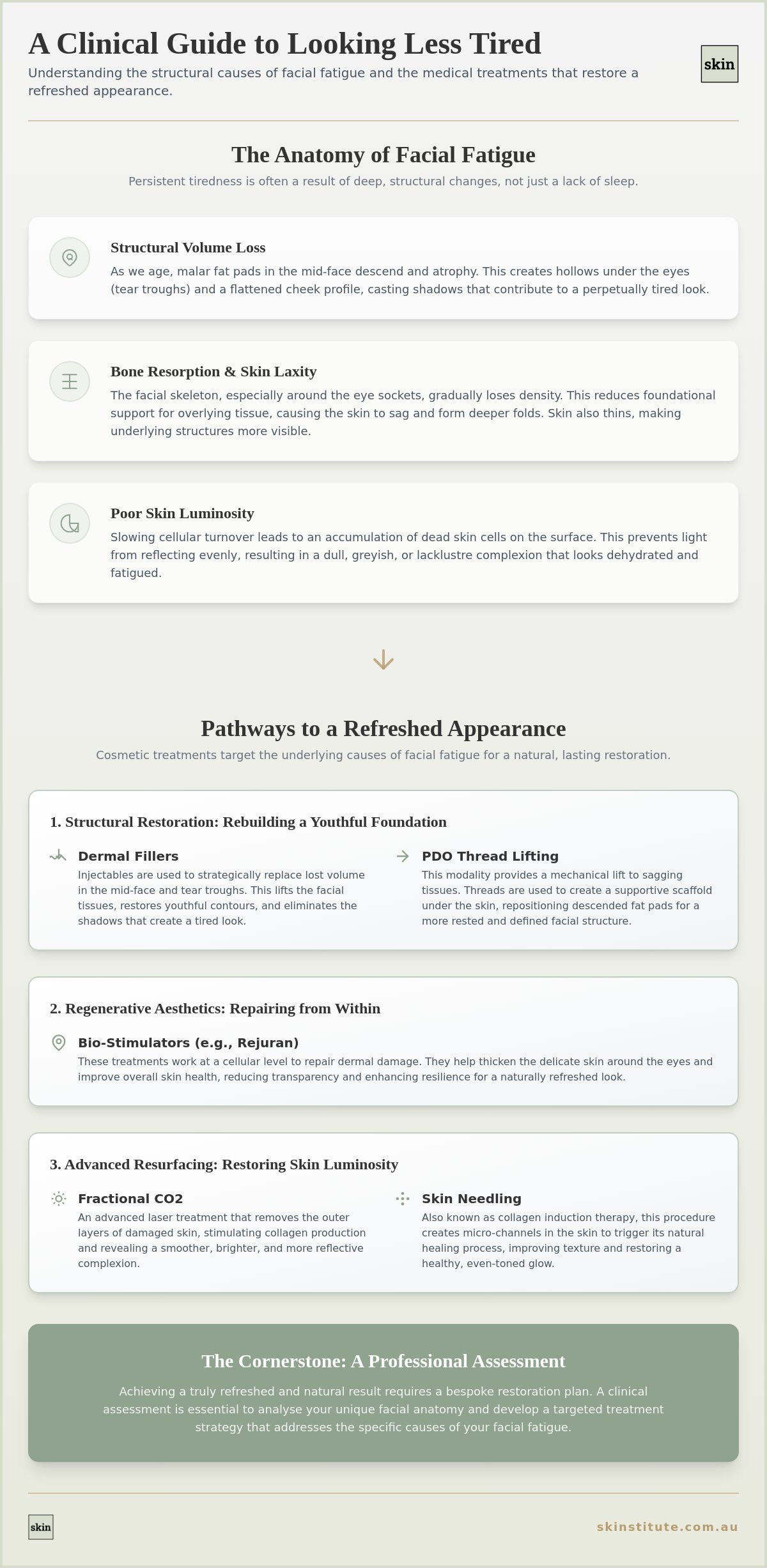
The perception of a “tired” face is rarely the result of a single factor. It’s a multifaceted clinical presentation involving the interplay of shadows, volume depletion, and altered skin light reflectivity. When patients enquire about how to look less tired with cosmetic treatments, they’re often describing a face that appears older or more exhausted than they feel internally. This phenomenon is a core focus within the field of Aesthetic medicine, which prioritises the structural and biological restoration of facial harmony through evidence-based techniques.
A primary contributor to this appearance is the tear trough deformity. This anatomical depression runs from the inner corner of the eye down toward the cheek. Because the skin in this region is the thinnest on the human body, the underlying musculature and vasculature become increasingly visible as we age, creating a persistent dark shadow. This effect is compounded by the descent of the malar fat pads in the mid-face. When these fat compartments shift downward due to gravity and ligamentous laxity, the cheek loses its youthful convexity. The resulting “flat” or hollowed appearance reinforces the look of chronic exhaustion.
Beyond volume loss, skin texture and luminosity significantly impact how rested a person appears. A healthy complexion reflects light evenly, giving the skin a natural glow. However, as cellular turnover slows, dead skin cells accumulate on the surface, creating a “grey” or dull cast. This lack of luminosity is a hallmark of the fatigued face, making the skin look thin, dehydrated, and lacklustre.
The Impact of Bone Resorption and Fat Migration
The facial skeleton provides the foundational scaffolding for all soft tissues. Over time, bone resorption occurs, particularly around the orbital rims and the mid-face. This reduction in skeletal support causes the overlying fat pads to migrate or atrophy. As these support structures fail, the skin begins to sag, creating deep shadows and folds. These are biological changes that require medical-grade intervention to address effectively; topical solutions simply cannot replace lost volume or alter bone structure. Clinical treatments work to restore this lost scaffolding, providing the lift necessary to eliminate shadows.
Environmental Factors in the Melbourne Climate
Melbourne’s unique environment also plays a significant role in facial fatigue. High UV exposure in Australia accelerates the degradation of collagen and elastin fibres, leading to premature skin laxity and a sallow complexion. This is often exacerbated by “urban skin” fatigue, where pollutants and solar damage combine to disrupt the skin’s barrier function. Because these issues originate in the deeper dermal layers, standard retail creams often fail to produce a visible change. Understanding how to look less tired with cosmetic treatments involves recognising that these environmental stressors require targeted clinical therapies to restore skin luminosity and dermal density from the inside out.
Structural Restoration: Addressing Volume Loss and Sagging
Addressing the underlying structural deficits is the essential first step in clinical restoration. When determining how to look less tired with cosmetic treatments, practitioners focus on the mid-face and infraorbital regions to neutralise the shadows caused by volume depletion. Clinical research highlights how dermal fillers can refresh your appearance by replacing the deep fat pads that have atrophied or shifted. This process, known as mid-face revolumetrisation, provides the necessary projection to lift the tissues of the lower face and reduce the appearance of exhaustion. By restoring this foundation, the clinician can soften the transition between the lower eyelid and the cheek, effectively “erasing” the physical hollows that create a fatigued look.
A comprehensive approach often involves a “Liquid Lift,” where multiple modalities are combined to address both volume and tension. While injectables replace lost mass, PDO Thread Lifting offers a mechanical vector of support. This combination ensures that the face is not merely “filled,” but strategically lifted to a more youthful and rested position. A thorough clinical consultation is required to map these structural requirements against your unique facial anatomy.
Precision Injectables for the Periorbital Area
The periorbital centre requires a meticulous technique due to the extreme thinness of the skin and the complex network of underlying vessels. Clinical application of dermal volumisers in the tear trough aims to bridge the gap between the eye and the cheekbone. Product choice is critical here; the material must have low hydrophilic properties to prevent the “puffy” or oedematous look that can occur with incorrect selection. An experienced practitioner ensures the product is placed deep beneath the muscle to provide a smooth, light-reflective surface that eliminates dark circles.
While aesthetic treatments address the external signs of fatigue, ensuring the underlying health of your eyes is a critical foundation for overall well-being. For comprehensive optometric care and diagnostic services, The Eye Centre provides expert eye examinations for patients of all ages.
PDO Threads for Non-Surgical Mid-Face Lifting
PDO (Polydioxanone) threads provide a sophisticated alternative for patients experiencing tissue laxity rather than simple volume loss. These medical-grade sutures provide immediate mechanical support to sagging tissues while simultaneously stimulating the body’s endogenous production of Type I and Type III collagen. Unlike injectables, which add mass, threads create a subtle tension that pulls the skin back into its original position. Over several months, the thread material is biologically integrated and safely absorbed, leaving behind a reinforced collagen matrix that maintains the refreshed appearance long after the procedure.
Regenerative Aesthetics: Refreshing Skin from the Cellular Level
While structural restoration addresses the shadows created by volume loss, the quality of the skin itself determines the overall luminosity of the face. A dull or greyish cast is often the result of cellular stagnation and DNA damage caused by environmental stressors. Understanding how to look less tired with cosmetic treatments in the modern clinical landscape involves a strategic shift from merely “filling” hollows to “healing” the dermal matrix. Regenerative aesthetics focuses on bio-stimulation, a process where medical-grade substances are used to trigger the body’s natural repair mechanisms, resulting in a skin texture that is denser, more resilient, and naturally light-reflective.
Healthy, rested skin has a specific biological profile characterised by high collagen density and efficient cellular turnover. When the skin is thin or damaged, it absorbs light rather than reflecting it, which reinforces the appearance of exhaustion. By utilising bio-stimulators, clinicians can improve the physiological health of the skin, ensuring it possesses the “rested glow” that topical cosmetics often fail to replicate. This approach prioritises long-term dermal integrity over temporary camouflage.
Rejuran: The Science of Polynucleotide Skin Healing
Rejuran represents a significant advancement in regenerative medicine, utilising polynucleotides (PN) derived from salmon DNA to facilitate deep tissue repair. This treatment is particularly effective for the delicate periorbital area, where the skin is most prone to thinning and fine lines. Unlike traditional volumisers, Rejuran works by stimulating the fibroblasts to produce fresh collagen while actively repairing damaged DNA within the skin cells. For a comprehensive overview of this technology, patients may refer to this Clinical Guide to Rejuran in Melbourne. The standardised protocol for chronically fatigued skin typically involves a series of targeted sessions to thicken the dermis and restore elasticity to the under-eye region.
Exosomes and Cellular Communication
Exosome therapy is another cornerstone of regenerative aesthetics, functioning through complex paracrine signalling. Exosomes are essentially microscopic messengers that carry proteins, lipids, and nucleic acids between cells to trigger specific biological responses. In the context of facial rejuvenation, these messengers instruct aged or fatigued skin cells to initiate rapid repair and collagen synthesis. This therapy is exceptionally effective at addressing the persistent dullness that characterises a tired appearance. When combined with treatments like Skin Needling, exosomes can penetrate deeper into the dermal layers, significantly accelerating the healing process and enhancing the skin’s overall luminosity. This synergy allows for a more profound revitalisation than single-modality treatments, providing a clearer path for those seeking how to look less tired with cosmetic treatments at a cellular level.
Advanced Resurfacing: Brightening a Fatigued Complexion
Even with restored volume and cellular health, the surface of the skin can still project a fatigued image if it remains clouded by accumulated photodamage and irregular texture. In the Australian climate, high UV exposure often results in a “muddiness” or uneven pigmentation that significantly contributes to an exhausted appearance. Understanding how to look less tired with cosmetic treatments involves addressing this epidermal layer through medical-grade resurfacing. These procedures are designed to remove damaged cellular debris and reorganise the dermal architecture, allowing light to penetrate and reflect more efficiently from the skin’s surface.
The elimination of dyschromia, or uneven skin tone, is a critical step in achieving a refreshed look. When the complexion is clear and the skin’s surface is smooth, the face naturally appears more vibrant. Clinical resurfacing doesn’t just mask these issues; it forces the skin to replace compromised cells with healthy, organised tissue, effectively removing the visual evidence of chronic environmental stress.
Fractional CO2 Laser for Total Skin Renewal
The Fractional CO2 laser is the clinical benchmark for deep skin regeneration. It operates by creating thousands of microscopic thermal treatment zones, leaving the surrounding tissue intact to facilitate rapid healing. This process triggers a profound inflammatory response that replaces aged, sallow skin with fresh, organised collagen fibres. For those seeking significant texture refinement, this Guide to Fractional CO2 Laser Resurfacing provides a detailed overview of the biological mechanics involved. By targeting both fine lines and the “grey” cast of chronic fatigue, this modality offers a level of brightening that non-medical treatments cannot achieve.
Medical-Grade Skin Needling and Texture Refinement
Medical-grade Skin Needling, or Collagen Induction Therapy, utilises automated micro-needling devices to create controlled micro-injuries in the dermis. This mechanical stimulation activates the body’s wound-healing cascade without the use of thermal energy. Professional-grade devices are essential for this process, as they ensure precise vertical penetration and adjustable depths, which are critical for safety and efficacy in delicate facial regions. As the skin heals, the increase in dermal density and improved surface regularity results in a visible transition from a dull, tired complexion to one that appears bright and energised.
Undergoing high-performance resurfacing requires a structured recovery phase. While patients can expect initial redness and mild peeling, these are indicators of the skin’s regenerative processes in action. Clinical oversight ensures that post-treatment barrier repair is managed effectively to maintain the results of your revitalisation. To begin your journey toward a more luminous complexion, you can book a clinical skin assessment at Skinstitute Melbourne.
Consultation and Care: Your Journey at Skinstitute Melbourne
Achieving a naturally refreshed appearance is a technical process that begins with a comprehensive diagnostic phase. While the preceding sections have detailed the biological causes of facial fatigue and the various medical-grade interventions available, the successful application of these treatments depends entirely on a precise understanding of your unique facial anatomy. When considering how to look less tired with cosmetic treatments, the most critical step is the initial clinical assessment, where the practitioner evaluates bone density, fat pad distribution, and dermal integrity to determine the most effective sequence of restoration.
At Skinstitute Melbourne, we develop a bespoke “Restoration Plan” for every patient. This plan moves beyond a reactionary approach to aging and instead focuses on a logical, multi-layered strategy. By mapping out the specific structural deficits and skin quality issues identified during your assessment, we can ensure that every procedure, whether it involves prescription injectables or regenerative bio-stimulators, contributes to a cohesive and rested result. This methodical approach ensures that the “rested” version of yourself is achieved safely and with technical precision.
Maintaining these results requires a commitment to medical-grade skincare that supports the skin’s barrier function and prolongs the effects of clinical sessions. High-performance topical agents, formulated with active ingredients at therapeutic concentrations, act as a bridge between treatments. These products help to sustain skin luminosity and dermal density, ensuring the “grey” cast of fatigue does not return prematurely. Our practitioners provide detailed guidance on the specific formulations required to protect your investment in your skin health.
The Value of Clinical Expertise
Skinstitute brings 26 years of experience to the Melbourne aesthetic industry, providing a foundation of stability and technical proficiency that is essential in a medical-grade environment. Navigating the options for facial revitalisation requires the guidance of seasoned practitioners who prioritise safety and evidence-based outcomes. For a deeper understanding of our professional standards, you may consult the Skinstitute Melbourne Clinical Guide. Operating within a prescription-only environment allows us to offer the high-performance treatments necessary for profound structural and regenerative changes that retail-grade services cannot provide.
Next Steps: Booking Your Professional Assessment
Moving from the research phase to a clinical consultation is the most effective way to address persistent facial exhaustion. Our assessments are conducted with transparency and objectivity, focusing on providing you with the technical insight needed to make informed decisions about your care. We invite you to organise your clinical skin analysis at Skinstitute today to begin the process of restoring your facial volume and skin luminosity. By partnering with an authoritative expert, you can ensure that your journey to how to look less tired with cosmetic treatments is grounded in scientific principles and professional integrity.
Restoring Your Natural Vitality Through Clinical Precision
Addressing the physiological causes of a fatigued appearance requires a strategic integration of structural restoration and regenerative dermal therapy. True revitalisation is achieved by neutralising the shadows caused by volume loss and repairing the skin’s light-reflective properties at a cellular level. This multi-layered approach ensures that the results are not merely a temporary mask but a genuine restoration of your facial harmony. Understanding how to look less tired with cosmetic treatments involves moving beyond retail-grade solutions toward medical interventions that address the root biological causes of exhaustion.
Skinstitute Melbourne provides a highly regulated, medical-grade environment with over 26 years of experience in the Australian aesthetic industry. As specialists in prescription-only injectables and PDO thread lifting, our practitioners prioritise safety and technical mastery in every procedure. We invite you to book your Melbourne clinical consultation to look less tired and receive a bespoke assessment tailored to your unique anatomy. Taking this professional step allows you to move forward with confidence, knowing your care is guided by clinical expertise and a commitment to natural, evidence-based results.
Frequently Asked Questions
Can cosmetic injectables really make me look less tired?
Yes, cosmetic injectables are highly effective at reducing the appearance of exhaustion by restoring lost volume in the mid-face and tear troughs. When patients ask how to look less tired with cosmetic treatments, we focus on neutralising the shadows created by fat pad atrophy. By smoothing the transition between the lower eyelid and the cheek, these medical-grade interventions eliminate the hollows that project a fatigued image.
What is the best treatment for dark circles under the eyes?
The optimal treatment for dark circles is determined by whether the cause is vascular, pigmented, or structural. If the darkness is caused by a hollow tear trough, dermal volumisers are used to lift the skin and reduce shadowing. If the issue is thin, translucent skin, bio-stimulators like Rejuran or Exosomes are employed to increase dermal density and improve light reflectivity for a more rested appearance.
Is there much downtime with non-surgical treatments for facial fatigue?
Downtime is modality-dependent and ranges from minimal to several days of clinical recovery. Injectable treatments typically involve minor swelling or bruising that resolves within 48 hours. More intensive resurfacing, such as Fractional CO2, requires a structured recovery period of five to seven days as the skin undergoes total renewal. We provide a detailed post-care protocol to manage this transition safely and ensure optimal healing.
How long do the results of a “rested look” treatment last?
Longevity varies based on the specific biological mechanism of the treatment and your individual metabolic rate. Structural volumisers in the mid-face can last between 12 and 18 months, while periorbital treatments may require more frequent maintenance. Regenerative treatments like Rejuran or Skin Needling typically involve an initial intensive phase followed by maintenance sessions every six to twelve months to sustain long-term dermal health and luminosity.
Should I choose dermal fillers or PDO threads for my tired eyes?
The choice between dermal fillers and PDO threads depends on whether your fatigue is caused by volume depletion or tissue laxity. Fillers are utilised to replace lost mass in hollow regions, whereas PDO threads provide a mechanical lift for sagging tissues. A clinical assessment is essential to determine if you require the structural support of an injectable or the mechanical lift of a thread.
Are these treatments suitable for men who want to look more energised?
Clinical treatments are increasingly sought by men to maintain an energised appearance in professional environments. The male market for aesthetic medicine is a growing segment, with procedures tailored to respect masculine bone structure and skin thickness. When treating men, we use specific injection vectors to ensure the result remains subtle and avoids the feminisation of facial features while still addressing signs of chronic exhaustion.
How many sessions of Rejuran are needed to see a difference in skin fatigue?
The standard clinical protocol for Rejuran involves three initial sessions to achieve a visible improvement in skin fatigue. These treatments are typically spaced three to four weeks apart to allow the polynucleotides to effectively stimulate cellular repair and collagen synthesis. Patients generally notice a gradual improvement in skin elasticity and hydration, with the full regenerative effects becoming apparent several weeks after the final session is completed.
Will I look “fake” or “overdone” after these procedures?
Clinical precision and a thorough understanding of facial anatomy prevent an overdone or unnatural result. Our practitioners prioritise anatomical restoration over excessive volumisation, ensuring that the face remains mobile and authentic. By targeting the specific physiological causes of fatigue rather than simply adding mass, we achieve a refreshed appearance that looks rested rather than altered. Precision and restraint are the hallmarks of professional medical-grade aesthetics.