CO2 Laser for Acne Scars in Melbourne: Clinical Guide
August 30, 2026
PDO Threads vs. HIFU: A Clinical Comparison for Non-Surgical Facial Lifting
September 1, 2026
The success of a PDO thread lift is determined less by the minutes spent in the procedure room and more by the complex biological integration occurring during the subsequent weeks. While the mechanical lift provides an immediate change, the long-term aesthetic outcome relies heavily on how your body responds to the presence of polydioxanone. Understanding the nuances of pdo thread lift recovery is essential for any patient who prioritises safety and precision over a hurried return to social activities. Leading practitioners, including the team at Bella Complexion, emphasise that patient education is the cornerstone of a successful aesthetic outcome. It’s natural to feel a sense of apprehension when encountering post-procedural tightness or minor swelling, as these physical sensations are often the first signs of the body’s inflammatory response.
We recognise that conflicting aftercare advice can lead to unnecessary confusion and anxiety regarding the stability of your threads. This clinical guide serves to clarify the physiological healing process, offering a predictable timeline for your return to professional life and clear protocols to optimise your results. We will outline the specific stages of tissue remodelling, providing you with the technical knowledge to distinguish between normal healing and symptoms that require a formal clinical assessment.
Key Takeaways
- Understand the clinical timeline of pdo thread lift recovery, which typically involves a short initial downtime of 24 to 48 hours followed by a four-week period for tissue stabilisation.
- Learn to distinguish between expected physiological responses, such as transient skin dimpling, and clinical complications that require professional intervention.
- Adopt professional aftercare protocols, including the prioritisation of soft foods to reduce masseter muscle activity and specific cleansing techniques to ensure thread integrity.
- Gain insight into the transition from an immediate mechanical lift to a sustained biological lift as the body synthesises Type I and Type III collagen during the thread absorption phase.
Understanding the Physiological Response to PDO Thread Placement
The insertion of polydioxanone sutures into the subcutaneous layers of the face triggers an immediate and sophisticated biological response. This reaction isn’t merely a side effect of the procedure; it’s a fundamental component of the pdo thread lift recovery process. The dermis reacts to the physical presence of the threads by initiating a controlled inflammatory cascade. While the immediate mechanical lift is achieved through the physical anchoring of the threads, the long-term structural improvement relies on the body’s ‘foreign body response’. This response stimulates fibroblasts to synthesise new collagen around the thread matrix, creating a scaffold of internal support that persists long after the material has been absorbed.
During the initial hours following the procedure, patients often experience localised numbness or a heavy sensation. This is typically attributed to the residual effects of the local anaesthetic, often a combination of lidocaine and adrenaline, which is used to ensure patient comfort during thread placement. A pronounced sense of facial tightness is a common clinical indicator that the threads have successfully anchored into the soft tissue. This sensation confirms that the barbs or cogs are providing the necessary tension to support the repositioned skin. It’s a sign of technical success, even if it feels restrictive during the first few days.
The Role of Polydioxanone in Tissue Healing
Polydioxanone (PDO) is a biocompatible, synthetic absorbable polymer that has been used in cardiovascular surgery for decades due to its high tensile strength and predictable degradation profile. Unlike permanent Contour threads, PDO is designed to be naturally metabolised. By the year 2026, the hydrolysis process is defined as the chemical decomposition of the PDO polymer into smaller monomers through the interaction with water molecules in the tissue, eventually resulting in complete absorption within six to nine months. This gradual degradation ensures that the tissue isn’t subjected to long-term stress, allowing for a natural-looking rejuvenation.
Immediate Post-Procedure Erythema and Oedema
In the first 24 hours of pdo thread lift recovery, erythema (redness) and oedema (swelling) are standard physiological markers of the wound-healing cascade. These symptoms are the body’s way of delivering essential nutrients and immune cells to the treatment site to begin the repair process. It’s common for the treated area to appear slightly ‘over-corrected’ or excessively lifted during this acute phase. This is largely due to the volume of the injected anaesthetic and the initial inflammatory swelling. Patients shouldn’t feel alarmed by this temporary aesthetic. The facial contours typically soften as the oedema subsides, revealing the intended clinical result.
The Clinical Recovery Timeline: Day 1 to Week 4
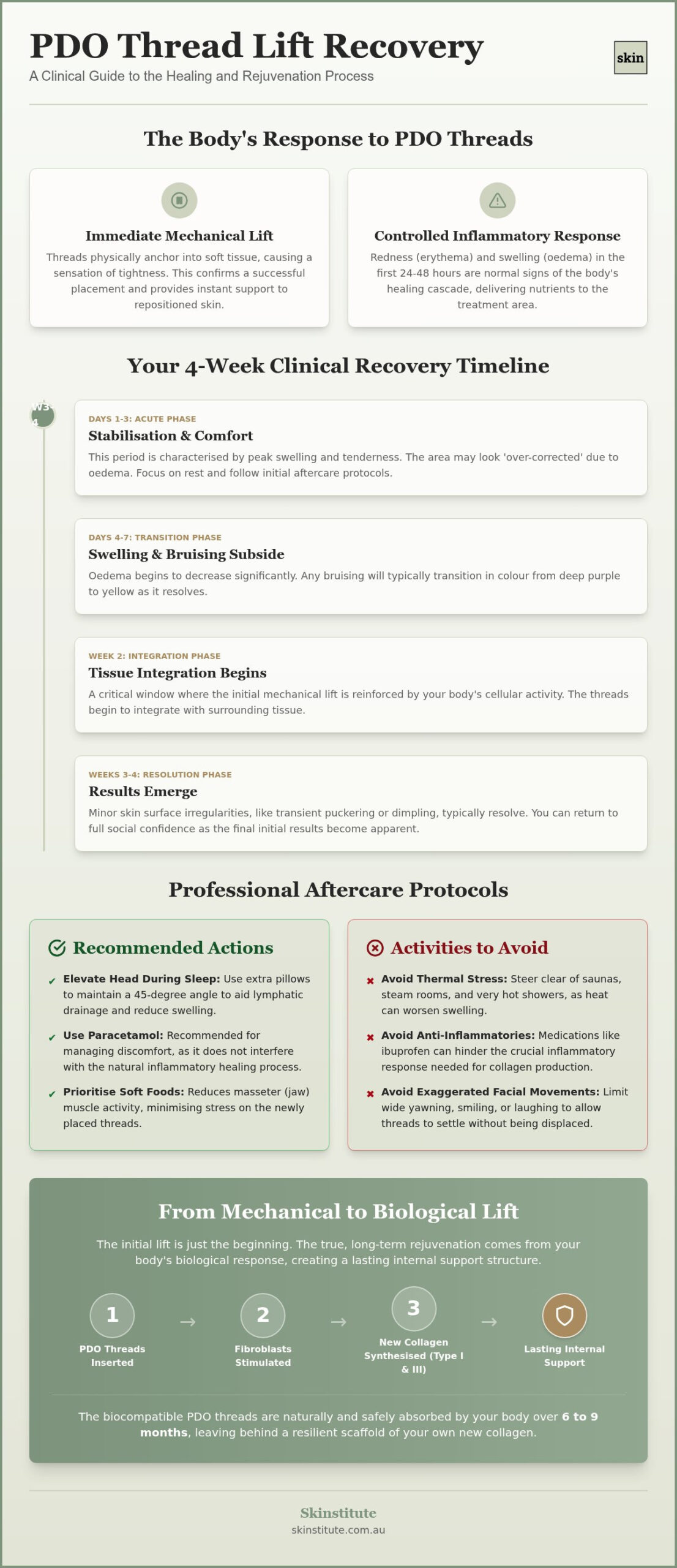
The progression of pdo thread lift recovery follows a predictable clinical trajectory, moving from an acute inflammatory response to structural tissue integration. Understanding this sequence allows patients to manage their expectations and adhere to necessary safety protocols. In the initial phase, the focus remains on stabilisation, while the subsequent weeks involve the biological consolidation of the lift.
- Day 1 to 3: This acute phase is characterised by peak oedema and tenderness as the body reacts to the mechanical insertion of the threads.
- Day 4 to 7: A transition period where bruising typically shifts from deep purple to yellow as the body resorbs extravasated blood.
- Week 2: A critical window for tissue integration where the initial mechanical stability begins to be reinforced by cellular activity.
- Week 3 to 4: Resolution of minor skin surface irregularities, such as transient puckering, and a return to full social confidence.
The First 72 Hours: Stabilisation and Comfort
Immediate post-procedural care prioritises the minimisation of vascular congestion. Patients should avoid thermal stress, such as saunas, steam rooms, or excessively hot showers, as heat induces vasodilation which can exacerbate swelling and prolong the acute phase. Clinical observations suggest that head elevation during sleep is paramount; using additional pillows to maintain a 45-degree angle facilitates lymphatic drainage and reduces morning puffiness. For managing discomfort, paracetamol is generally recommended over anti-inflammatory medications like ibuprofen, as the latter may interfere with the initial inflammatory cascade required for collagen synthesis.
Weeks 2 and 3: Internal Tissue Integration
During this window, the body initiates the formation of a collagenous ‘sleeve’ around each polydioxanone filament. This biological process is essential for long-term structural support, a concept explored in this thread lift overview provided by leading surgical organisations. It’s critical during this stage to limit extreme facial expressions, such as wide yawning or vigorous laughing. Excessive movement of the mimetic muscles can potentially dislodge the barbs from their soft tissue anchors, a phenomenon sometimes described by patients as a ‘pinging’ sensation.
By the third week, patients may gradually reintroduce light cardiovascular activities, such as brisk walking, which improves systemic circulation without the high-impact jarring of running. If you have concerns about your specific healing rate, a professional assessment can provide the necessary reassurance during this stabilisation period. By week four, the skin’s surface usually appears smooth and the underlying structure feels secure, allowing for a confident return to all social and professional engagements.
Professional Aftercare Protocols for Optimal Results
Adherence to a structured clinical protocol during pdo thread lift recovery is just as vital as the technical execution of the procedure itself. The first few weeks require a disciplined approach to hygiene and movement to ensure the polydioxanone filaments remain securely anchored. Cleansing the treated area must be performed with a gentle, non-abrasive cleanser and tepid water. Patients should avoid circular scrubbing or downward pressure; instead, use a light patting technique to dry the skin. This prevents the mechanical displacement of the newly placed sutures while the entry points are still sealing.
Dietary choices also play a significant role in early stabilisation. For the first seven days, a soft-food diet is recommended to minimise the activation of the masseter and temporalis muscles. Reducing the mechanical strain on these muscles prevents the threads from being subjected to excessive internal tension. Patients should avoid chewy meats, crunchy vegetables, or large food items that require an exaggerated mouth opening. Similarly, dental procedures must be postponed for at least four weeks. The lateral force and extreme stretching of the oral cavity required for dental work can compromise the integrity of the lift before the biological integration phase is complete.
Makeup and active skincare products require a phased reintroduction. While mineral makeup can often be applied after 48 hours, active ingredients such as Retinol, Alpha Hydroxy Acids (AHAs), or high-concentration Vitamin C should be avoided for at least 14 days. These substances can cause localised irritation or increase vascularity in the healing dermis, potentially prolonging the inflammatory phase of pdo thread lift recovery.
Facial Mobility and Expression Management
Conscious management of facial expressions is essential during the first fortnight. While normal conversation is fine, patients should attempt to limit wide yawning, intense laughing, or exaggerated chewing. Exaggerated facial movement is the primary risk factor for thread migration because the repeated contraction of mimetic muscles can overcome the mechanical resistance of the thread barbs before they’ve been encased in a collagenous sleeve. If you feel a minor ‘clicking’ or ‘pinging’ sensation, it’s often a sign that a barb is adjusting, but persistent movement should be minimised to maintain the intended lift.
Skincare and Environmental Protection
The healing tissue at the entry and exit points is particularly susceptible to ultraviolet damage and environmental stressors. Applying a broad-spectrum SPF 50+ daily is mandatory to prevent post-inflammatory hyperpigmentation. Once the initial stabilisation is achieved, many patients choose to enhance their results with complementary treatments like Fractional CO2 Laser Resurfacing Melbourne to address surface-level texture and solar damage. For managing any remaining bruising, topical applications containing Arnica or Vitamin K are recommended, provided they’re applied with a light touch that doesn’t disturb the underlying thread matrix.
Distinguishing Normal Healing from Clinical Complications
The visual progression of pdo thread lift recovery can be unsettling for patients who aren’t prepared for the skin’s transitional irregularities. During the initial weeks, the skin must adapt to the internal tension provided by the polydioxanone filaments. One of the most common observations is ‘dimpling’ or skin bunching. In a clinical context, this is usually a normal sign that the thread’s barbs have successfully engaged with the fibrous septa of the dermis. This puckering typically resolves as the tissue relaxes and the inflammatory swelling subsides. However, if the dimpling is severe, persistent beyond three weeks, or accompanied by sharp pain, it may indicate a thread placed in a plane that is too superficial.
Differentiating between expected post-procedure tenderness and a localised infection is paramount for patient safety. It’s normal for the treated area to feel sensitive to touch for several days. Conversely, a clinical infection is usually characterised by a triad of symptoms: escalating pain that worsens after the third day, spreading erythema (redness), and localised heat. If these symptoms occur alongside systemic signs like a fever, immediate intervention is required. Another rare but manageable issue is thread ‘protrusion’ or ‘spitting’, where the body attempts to push the suture end through the entry point. This requires a professional to sterilely trim the thread to prevent it from acting as a conduit for bacteria.
Managing Minor Irregularities and Asymmetry
Mild asymmetry is a frequent occurrence during the first 14 days of pdo thread lift recovery. This is rarely a reflection of the final result; instead, it’s usually the consequence of uneven oedema or bruising between the left and right sides of the face. As the swelling dissipates, the threads naturally settle into the superficial musculoaponeurotic system (SMAS), and the facial features typically harmonise. If minor lumps are palpable, they can often be ‘massaged out’ by your clinician. You shouldn’t attempt to manipulate these areas yourself, as improper pressure can dislodge the barbs before they’ve been biologically encased by collagen.
Recognising Red Flags: Infection and Migration
While the safety profile of PDO is well-established, patients must remain vigilant for signs of thread migration. This occurs when a thread moves from its original placement, potentially causing a visible ridge or a sharp sensation. Granulomas, which are small nodules formed by the immune system in response to a foreign body, are exceptionally rare and are managed through specific clinical protocols. If you notice any of these red flags or feel that your healing is not following the expected timeline, you should book a clinical review at Skinstitute for a professional assessment. Early intervention ensures that minor issues don’t compromise the final aesthetic outcome.
Beyond the Initial Recovery: The Biological Regeneration Phase
The conclusion of the first month marks a significant shift in the pdo thread lift recovery journey, moving from acute tissue stabilisation to the biological regeneration phase. While the immediate lifting effect is a result of mechanical tension provided by the barbs, the long-term success of the procedure is contingent upon the body’s ability to replace the synthetic polydioxanone with endogenous structural proteins. As the threads are gradually metabolised through hydrolysis over six to nine months, they act as a bio-stimulatory scaffold. This presence induces a controlled foreign body response that triggers the synthesis of both Type I and Type III collagen. Type III collagen typically appears early in the healing process to provide initial flexibility, while the more robust Type I collagen provides the long-term tensile strength required to maintain the lift.
Peak aesthetic results are typically observed between three and six months post-procedure. This delay is a direct reflection of the time required for cellular remodelling and the maturation of new collagen fibres. During this period, the skin’s density and elasticity improve, often resulting in a more refined and natural appearance than what was visible in the immediate post-operative phase. It’s during this window that the transition from a mechanical lift to a biological lift is completed, ensuring the results persist even after the initial threads have been fully resorbed by the body. To learn more about professional aesthetic standards and skincare maintenance, you can visit Skin Care Pro Group for expert guidance.
Fibroblasts are the primary cells responsible for this regenerative work, migrating to the thread matrix to deposit new extracellular matrix components. The longevity of these results varies based on individual factors, including age, metabolic rate, and baseline skin quality; however, most patients enjoy sustained improvement for 12 to 24 months. To enhance these biological outcomes, practitioners often integrate threads with other bio-stimulators. For instance, reviewing a Clinical Guide to Rejuran in Melbourne reveals how polynucleotides can support the cellular environment, potentially amplifying the regenerative signals sent to the fibroblasts during the pdo thread lift recovery period.
Maintaining Your Aesthetic Investment
Sustaining the benefits of a thread lift requires a proactive approach to skin health and professional oversight. Follow-up appointments at Skinstitute are essential for the clinical assessment of tissue integration and to ensure the regenerative phase is progressing optimally. Beyond clinical guidance, maintaining collagen density relies on medical-grade skincare and lifestyle choices that mitigate oxidative stress. Protecting the face from excessive UV exposure and avoiding habits that degrade collagen, such as smoking, will preserve the integrity of the new structural scaffold. Strategic planning for maintenance treatments, often scheduled 12 to 18 months after the initial procedure, ensures that the non-surgical lift remains consistent as the natural ageing process continues.
Optimising Long-Term Structural Integration
The successful outcome of a PDO thread lift is not merely a product of the procedure itself but is deeply rooted in the patient’s commitment to the recovery process. By understanding that pdo thread lift recovery involves a sequence of physiological events, from initial inflammation to long-term collagenesis, you can navigate the healing period with clinical confidence. Prioritising expression management and following professional hygiene protocols during the first month ensures that the mechanical lift is effectively replaced by a robust biological scaffold.
At Skinstitute, we combine 26 years of clinical expertise with advanced medical-grade aesthetic technologies to guide you through every stage of this journey. We provide tailored recovery protocols for every patient, ensuring that each individual’s regenerative response is monitored and optimised for the best possible aesthetic result. If you’re ready to explore the benefits of advanced tissue lifting and regeneration, we invite you to book a clinical consultation for PDO Thread Lifting at Skinstitute Melbourne. We look forward to partnering with you to achieve a refreshed and structurally supported appearance.
Frequently Asked Questions
How should I sleep after a PDO thread lift to avoid dislodging the threads?
You should sleep on your back with your head elevated for at least 14 nights following the procedure. This position prevents lateral pressure on the facial tissues which could displace the threads before they have integrated into the dermis. Using a travel pillow can help maintain this orientation and prevent accidental rolling onto your side. Head elevation also facilitates lymphatic drainage; this significantly reduces the duration of post-operative oedema during the early stages of recovery.
When can I resume my exercise routine and high-intensity workouts?
Light walking is encouraged from the first day, but you must wait at least two to three weeks before resuming high-intensity workouts. Vigorous cardiovascular exercise increases blood pressure and heart rate, which can exacerbate swelling and prolong the acute phase of pdo thread lift recovery. High-impact activities, such as running or HIIT, should be avoided for four weeks to prevent mechanical jarring of the threads while the collagenous scaffold is still forming.
Is it normal to feel a sharp ‘ping’ or ‘pop’ sensation in my face during recovery?
A transient ‘ping’ or ‘clicking’ sensation is common and usually indicates a barb or cog is adjusting within the soft tissue. This often occurs during involuntary facial movements or while eating. While it can be startling, it rarely signifies a clinical failure of the lift. However, if this sensation is followed by immediate asymmetry, visible thread protrusion, or sharp, persistent pain, you should contact our Melbourne clinic for a professional assessment.
How long do I need to wait before applying makeup or having a facial?
You can typically apply mineral makeup 48 hours after the procedure once the entry points have adequately sealed. However, professional facials and aggressive skin treatments must be postponed for at least four weeks. This waiting period ensures the threads are securely anchored within the SMAS layer before any deep manipulation or pressure is applied to the dermis. Active skincare ingredients like Retinol should also be avoided for the first 14 days to prevent irritation.
What should I do if I notice a small lump or dimple on my cheek after the procedure?
Minor skin irregularities like dimpling are often a normal part of the pdo thread lift recovery process and typically resolve within two weeks. These occur as the threads engage with the internal tissue and the initial swelling settles. You should avoid attempting to massage these areas yourself. If the irregularities persist beyond 21 days, a clinical review is recommended so our practitioners can safely assess the tissue integration and provide professional guidance.
Can I undergo dental work or see the hygienist shortly after a thread lift?
Routine dental procedures should be avoided for at least four weeks following a thread lift. The excessive mouth opening and lateral stretching required during dental work can put significant strain on the mid-face and jawline threads. This mechanical stress increases the risk of thread migration or dislodgement before the biological stabilisation phase is complete. If you have an emergency dental concern, please notify your practitioner before proceeding with any treatment.
Why does my face feel so tight and is this a permanent sensation?
Post-procedural tightness is a clinical indicator that the threads are providing the necessary tension to support the repositioned skin. This sensation is most pronounced during the first week as the body initiates an inflammatory response to the polydioxanone material. It is a temporary feeling that gradually softens as the tissue adapts and the acute swelling subsides. Most patients report that their facial mobility returns to a completely natural state within four weeks of the procedure.
When will the bruising and swelling be gone enough for social events?
Most patients feel confident attending social events within seven to ten days of the procedure. While acute swelling typically peaks at 48 hours, it begins to dissipate rapidly thereafter. Any residual bruising usually transitions to a yellow hue by day five and can be effectively concealed with mineral makeup. For significant events like weddings, we recommend scheduling your treatment at least four weeks in advance to ensure the tissue has fully stabilised.