
PDO Thread Lift for Jowls Melbourne: A Clinical Guide to Structural Contouring
July 13, 2026
Rejuran Under Eye Treatment in Melbourne: A Clinical Guide to Periorbital Regeneration
July 17, 2026
Achieving a youthful profile isn’t merely a matter of filling every line until the skin is taut; in fact, over-reliance on volume can often lead to the distorted, “puffy” appearance that many Melbourne patients are desperate to avoid. You’ve likely noticed that as facial contours change with age, the distinction between skin laxity and true volume loss becomes increasingly difficult to identify. It’s common to feel hesitant about which intervention will restore your natural features without compromising your unique facial character when comparing a pdo thread lift vs dermal fillers melbourne.
This clinical guide provides a transparent overview of these two distinct modalities, focusing on their biological mechanisms and structural outcomes. We’ll examine how PDO threads facilitate mechanical tissue repositioning and neocollagenesis, while dermal fillers address the depletion of deep fat pads and bone resorption. By understanding the functional details of each treatment, you can better appreciate how a tailored approach addresses the root causes of facial ageing for a more refined and enduring result.
Key Takeaways
- Distinguish between structural volume loss and gravitational tissue descent to determine whether your facial concerns require replenishment or repositioning.
- Explore the mechanical function of PDO threads, which utilise microscopic barbs to provide immediate elevation while initiating a secondary biostimulatory response.
- When comparing a pdo thread lift vs dermal fillers melbourne, recognise that fillers are designed for volumetric expansion rather than the physical lifting of sagging skin.
- Identify how a medical-grade assessment ensures that treatments target the anatomical root causes of ageing rather than merely camouflaging surface lines.
- Understand the clinical synergy achieved by combining these modalities to address the three-dimensional complexities of facial rejuvenation and collagen restoration.
Understanding Facial Ageing: Volume Loss vs. Tissue Laxity
Facial ageing is a multi-dimensional process that extends far beyond the surface of the skin. It involves a complex interplay between skeletal changes, fat pad migration, and the degradation of structural proteins. To achieve a natural result, a practitioner must distinguish between volume loss and tissue laxity. When evaluating the pdo thread lift vs dermal fillers melbourne patients often find that their concerns are a combination of both, yet each requires a distinct clinical approach. Treating gravitational sagging by simply adding more volume often results in the “overfilled” look that lacks anatomical harmony. True rejuvenation requires addressing the specific biological layer that has been compromised.
Structural changes begin with bone resorption, particularly around the eye sockets, temples, and jawline. This reduction in the skeletal scaffold means the overlying soft tissues have less support. Simultaneously, the deep fat pads that provide youthful projection begin to atrophy, while superficial fat pads may descend due to gravity. This shift is often exacerbated by the weakening of the Superficial Musculoaponeurotic System (SMAS), which is the fibrous envelope that connects facial muscles to the skin. A non-surgical Thread lift provides a mechanical means of engaging these deeper layers to reposition tissue that has migrated downwards over time.
When is Volume the Primary Concern?
Volume loss is typically identified by the appearance of hollows or “shadows” on the face. You might notice sunken temples, a loss of definition in the cheeks, or deep tear troughs that create a tired appearance. These issues are primarily driven by the depletion of hyaluronic acid and the thinning of the subcutaneous fat layer. Without adequate volume, the skin appears draped over the bone, leading to a skeletal or haggard look. Facial volumisation refers to the strategic restoration of lost dermal and subcutaneous mass through the administration of exogenous hyaluronic acid to emulate youthful facial contours. This process focuses on replenishment rather than elevation.
When is Laxity the Primary Concern?
Laxity is defined by the loss of skin elasticity and the failure of the internal support structures to resist gravity. This manifests as the formation of jowls along the jawline, the deepening of nasolabial folds as the mid-face descends, and a general “heaviness” in the lower face. In these instances, the skin and underlying connective tissues have lost their “snap” due to a decline in collagen and elastin integrity. When choosing between a pdo thread lift vs dermal fillers melbourne, it’s vital to recognise that adding volume to a sagging mid-face can actually worsen the appearance of jowls by adding weight to already descended tissue. Lifting the tissue mechanically is a clinically distinct objective that targets the structural foundation of the face.
Dermal Fillers: Restoring Contour and Structural Support
Dermal fillers are primarily composed of cross-linked hyaluronic acid (HA), which is a naturally occurring polysaccharide found within the human extracellular matrix. When injected into the dermal or supraperiosteal layers, HA molecules act as humectants, attracting up to 1,000 times their weight in water. This biological mechanism doesn’t just hydrate the tissue; it provides immediate mechanical support by replacing the volume lost through fat pad atrophy and bone resorption. In the context of a pdo thread lift vs dermal fillers melbourne, fillers serve as the structural foundations that restore the three-dimensional projection of the face.
Using FDA-approved dermal fillers ensures that the substances have undergone rigorous clinical testing for biocompatibility. These prescription-only injectables offer a crucial safety profile, as they can be rapidly dissolved with hyaluronidase if an adverse event occurs or if the aesthetic outcome requires adjustment. Most HA-based fillers maintain their structural integrity for 6-18 months. This duration depends on the cross-linking density of the product and the individual metabolic rate of the patient before the substance is naturally metabolised by the body’s enzymatic processes.
Precision Contouring with Cosmetic Injectables
Clinical application varies based on the rheology of the product selected. Thinner, more cohesive gels are suitable for fine line refinement, marionette lines, and nasolabial folds. Conversely, more robust, high-G-prime fillers are utilised for deep structural work, such as cheek augmentation or jawline definition. This precision extends to “liquid rhinoplasty” where filler is used to camouflage nasal dorsal humps. For patients researching cosmetic injectables Melbourne, the objective is always anatomical precision to ensure the filler integrates seamlessly with the surrounding tissue without migration.
The Risk of Over-Volumisation
A common concern for patients is the “pillow face” effect. This occurs when practitioners attempt to treat skin laxity solely by increasing volume. When the face experiences significant sagging, adding excessive filler can lead to an unnatural, heavy appearance that lacks definition. This is why a professional medical assessment is mandatory. We must determine if the patient requires volumetric restoration or if the primary issue is tissue descent. In many cases, the pdo thread lift vs dermal fillers melbourne choice isn’t binary; it’s about balance. If you’re unsure which approach suits your anatomy, a clinical assessment at Skinstitute can clarify your requirements and ensure a natural-looking restoration.
PDO Thread Lifts: Mechanical Elevation and Biostimulation
Polydioxanone (PDO) is a synthetic, bio-absorbable polymer that has been utilised in complex medical procedures, such as cardiothoracic surgery, for over three decades. Its transition into aesthetic medicine has provided a solution for tissue laxity that does not rely on volumetric expansion. When considering a pdo thread lift vs dermal fillers melbourne, it’s essential to understand that threads function through a dual mechanism: immediate mechanical elevation and delayed biological stimulation. Unlike the substances described in an injectable fillers guide, PDO threads don’t remain in the tissue indefinitely; instead, they’re slowly broken down through hydrolysis.
The mechanical component relies on microscopic barbs or cogs etched into the suture. These structures anchor into the subcutaneous fat, allowing the practitioner to physically reposition the skin and soft tissue. This is fundamentally different from fillers, which provide support by increasing mass. We categorise threads into two primary types: mono (smooth) threads, which are used to improve skin density and texture, and barbed threads, which are designed for structural lifting. The choice between these depends on whether the clinical objective is to tighten the skin surface or lift the underlying architecture.
The Structural Thread Lift Procedure
Precision in placement is critical for both safety and efficacy. Threads are inserted into the subcutaneous plane, where they can effectively engage the fibrous septa of the face to provide maximum mechanical advantage. This technique is particularly effective for elevating the brow, lifting the mid-face, and refining a heavy jawline. During the six-month absorption phase, the physical thread matrix acts as a scaffold that supports the skin while the body initiates its natural repair processes. This internal support ensures that the repositioned tissue remains stable as the biological transition occurs.
Longevity and the Collagen Legacy
While the physical PDO material typically resorbs within six months, the clinical benefits persist much longer. The presence of the thread triggers a controlled “foreign body response,” which stimulates fibroblasts to synthesise new Type I and Type III collagen. This neocollagenesis creates a biological framework that maintains the lift for 12 to 18 months. Because the treatment improves the internal architecture of the skin, it’s classified as a regenerative therapy. Patients should expect some initial swelling or bruising, but the structural recovery is generally predictable within a Melbourne clinical setting. Understanding the pdo thread lift vs dermal fillers melbourne distinction ensures that expectations for both immediate lifting and long-term skin health are met.
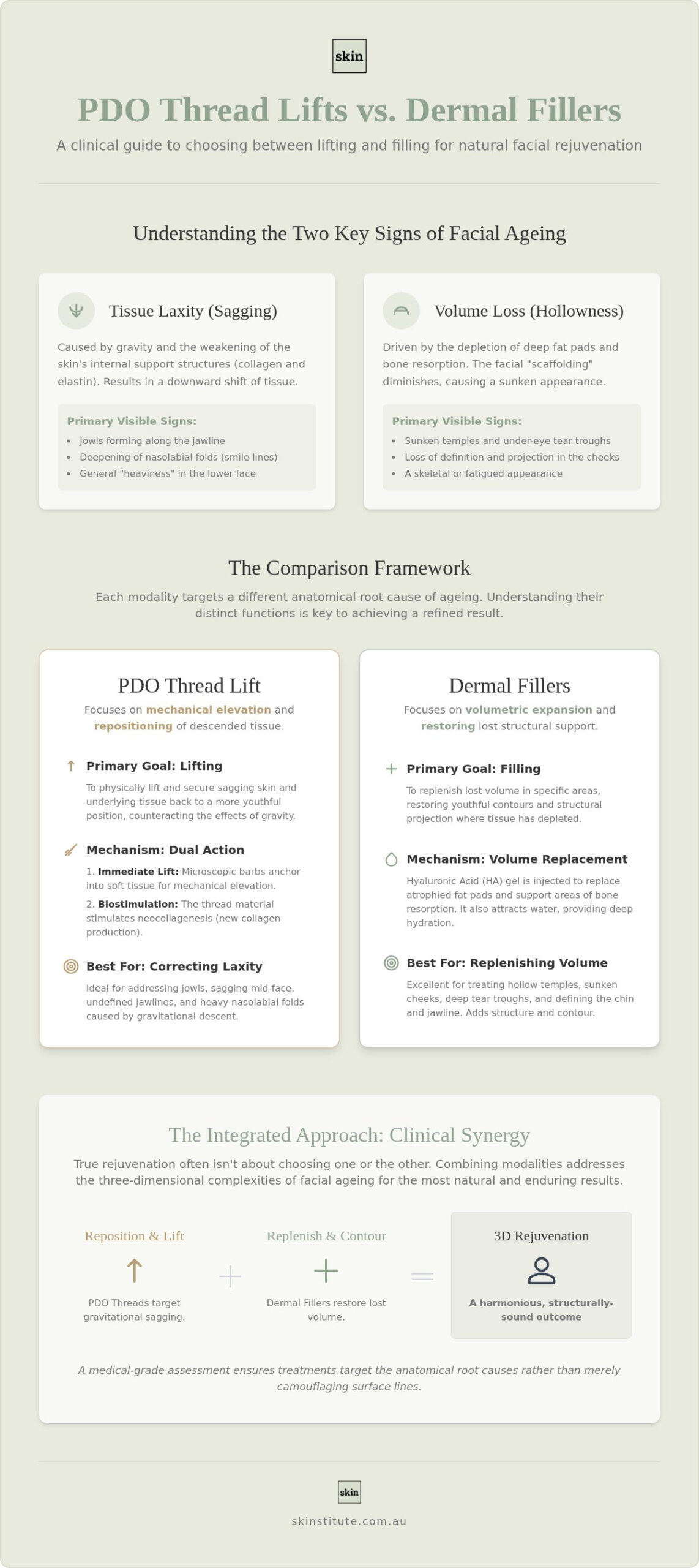
PDO Thread Lift vs Dermal Fillers: The Comparison Framework
Downtime also differs significantly between these two procedures. Dermal fillers typically involve minimal social downtime, with minor swelling or bruising often resolving within 48 hours. Conversely, PDO threads require a period of structural recovery. Because the threads are physically anchored into the subcutaneous plane, patients may experience a sensation of tightness or mild puckering as the tissue settles over the first week. This temporary discomfort is a trade-off for the “snatched” jawline and mid-face elevation that threads provide without adding unnecessary bulk to the face.
Which Treatment is Right for You?
- Scenario A: If you possess adequate facial volume but are concerned with heavy jowls or a softening jawline, PDO threads are typically the superior choice. They address laxity without widening the lower face.
- Scenario B: For patients with hollowed temples, sunken cheeks, or deep tear troughs but relatively firm skin, dermal fillers are ideal. They replenish the youthful “pillowness” that fat pad atrophy removes.
- Scenario C: Most patients experiencing advanced signs of ageing benefit from combination therapy. We use threads to lift the structural foundation and fillers to refine specific contours and restore lost volume.
Safety and Clinical Considerations in Melbourne
The safety profiles of these treatments are well-established but function through different biological paths. Hyaluronic acid fillers offer the reassurance of immediate dissolvability through the administration of hyaluronidase. PDO threads don’t require a dissolving agent; instead, they rely on predictable bio-absorption through hydrolysis over six months. Choosing a clinic with 26 years of specialised experience ensures that these procedures are performed with the technical proficiency required to minimise risks such as asymmetry or migration. For a detailed breakdown of these options, you can review our guide to Skinstitute Melbourne and our medical-grade standards.
Determining the root cause of your facial concerns is the first step toward a natural result. If you’re ready to move beyond surface-level treatments, you should organise a clinical consultation at Skinstitute to develop a bespoke rejuvenation plan tailored to your unique anatomy.
The Skinstitute Approach: Integrated Facial Rejuvenation
Clinical excellence in facial restoration is rarely achieved through a single modality. While the comparison of a pdo thread lift vs dermal fillers melbourne often suggests a binary choice, a sophisticated rejuvenation strategy frequently requires their strategic integration. We prioritise a medical-grade assessment over a menu-based approach to ensure that every intervention addresses a specific anatomical requirement. This three-dimensional perspective allows us to combine the lifting capabilities of PDO threads with the replenishing properties of dermal fillers, resulting in a balanced and harmonious profile.
To further enhance these structural results, we often incorporate High Intensity Focused Ultrasound (HIFU) to target the Superficial Musculoaponeurotic System (SMAS). By delivering thermal energy to this deep foundational layer, HIFU initiates a tightening effect that complements the mechanical elevation provided by PDO threads. This multi-layered approach ensures that the facial architecture is supported from the bone up to the dermis. Such synergy prevents the need for excessive filler use, maintaining natural facial mobility and avoiding the “over-treated” appearance common in less rigorous clinical settings.
Regenerative Aesthetics: Beyond the Surface
True rejuvenation extends beyond mechanical lifting to encompass cellular health and skin quality. We integrate regenerative therapies such as exosomes and polynucleotides to optimise the biological environment of the skin. For instance, our Clinical Guide to Rejuran in Melbourne details how these DNA-derived molecules repair damaged tissue and enhance the biostimulatory effects of threads. Once the internal structure is stabilised, fractional CO2 laser may be utilised to address surface texture, fine lines, and pigmentation, ensuring the skin surface matches the refreshed underlying contours.
Your Consultation at Skinstitute
A professional consultation at our Melbourne clinic involves a comprehensive skin analysis and a detailed review of your structural anatomy. We identify the specific interplay between volume loss and tissue laxity before proposing a sequential treatment plan. This methodical process is underpinned by 26 years of industry experience, ensuring that every pdo thread lift vs dermal fillers melbourne decision is based on evidence and anatomical precision. We focus on long-term outcomes that respect your natural features while addressing the biological root causes of ageing.
Achieving a refined and youthful appearance requires a partnership with an authoritative clinical guide. If you are seeking a bespoke rejuvenation strategy that prioritises safety and technical mastery, book a professional assessment at Skinstitute today to begin your journey toward natural-looking restoration.
Defining Your Clinical Rejuvenation Strategy
Determining the most effective path for facial restoration requires an objective understanding of how different treatments interact with your unique anatomy. We’ve examined how dermal fillers restore lost volume while PDO threads physically reposition descended tissue. By distinguishing between these biological mechanisms, you can avoid the common pitfalls of over-volumisation and achieve a more refined, natural-looking profile. When weighing a pdo thread lift vs dermal fillers melbourne, the most successful outcomes are almost always the result of a bespoke, integrated approach rather than a single-modality solution.
At Skinstitute, we leverage 26 years of Melbourne industry expertise to provide medical-grade regenerative protocols that prioritise structural integrity and long-term skin health. Our specialists focus on natural-looking structural rejuvenation, ensuring that every procedure respects the underlying anatomy of the face. We invite you to Book Your Clinical Consultation at Skinstitute Melbourne to develop a tailored rejuvenation strategy that addresses the specific root causes of your concerns. Taking the first step towards an evidence-based restoration plan ensures that your results are both safe and enduring.
Frequently Asked Questions
Is a PDO thread lift more painful than dermal fillers?
While both procedures involve the use of needles or cannulas, a thread lift is generally considered to involve more sensation due to the mechanical repositioning of tissue. We utilise local anaesthesia to numb the entry points and the treatment pathway, ensuring the procedure is tolerable. Most patients describe a feeling of pressure or tugging rather than acute pain, whereas dermal fillers typically involve minimal discomfort because the gel often contains integrated anaesthetic.
Can I have dermal fillers and PDO threads at the same appointment?
How long does a PDO thread lift last compared to fillers?
The physical PDO sutures are typically absorbed by the body through hydrolysis within six months, but the resulting collagen scaffold maintains the lift for 12 to 18 months. Hyaluronic acid fillers have a similar longevity, usually lasting between 6 and 18 months depending on the product’s cross-linking and the area treated. The primary difference lies in the biological legacy; threads focus on regenerative collagen production, while fillers provide a temporary volumetric replacement.
What is the “overfilled syndrome,” and how can I avoid it?
Overfilled syndrome occurs when excessive volumes of dermal filler are used to treat skin sagging, resulting in a distorted or “puffy” facial appearance. You can avoid this by using PDO threads to mechanically lift the skin rather than trying to “fill out” the laxity. By repositioning the tissue to its original anatomical location, we achieve a more youthful contour without adding unnecessary weight or bulk to the mid and lower face.
Is there significant downtime after a thread lift in Melbourne?
Structural recovery after a thread lift typically requires seven to ten days, which is longer than the social downtime associated with fillers. You may experience mild swelling, bruising, or a sensation of tightness as the barbs anchor into the subcutaneous plane. It’s essential to follow specific aftercare protocols, such as avoiding strenuous exercise and excessive facial expressions, to ensure the threads remain securely positioned during the initial healing phase.
Are PDO threads safe, and can they be removed if I don’t like the result?
PDO is a highly safe, bio-absorbable material with a long history of use in cardiothoracic surgery. Unlike hyaluronic acid fillers, which can be rapidly dissolved with an enzyme, PDO threads cannot be easily removed once they are integrated into the tissue. This highlights the importance of choosing an experienced practitioner for your pdo thread lift vs dermal fillers melbourne assessment, as the results rely on precise initial placement and anatomical knowledge.
Which treatment is better for a non-surgical brow lift?
PDO threads are generally superior for a non-surgical brow lift because they provide a direct mechanical elevation of the brow tissue. While fillers can be used to revolumise a hollow temple or a depleted brow bone, they don’t possess the tensile strength required to physically lift a heavy or hooded eyelid. Threads allow for a more precise repositioning of the lateral brow, creating a more “open” and refreshed appearance.
What is the average cost of a thread lift vs fillers in Melbourne?
The investment for these treatments varies significantly based on the complexity of the case and the volume of material required. A thread lift is often a more substantial initial investment because it involves specialised medical sutures and a more complex insertion technique. Dermal filler costs are determined by the number of syringes used and the specific rheology of the product. A thorough clinical assessment is required to provide an accurate quote based on your structural needs.