Can Spider Veins Return? Causes and Ways to Reduce Risk
November 19, 2026
Red flags for cosmetic clinics: how to assess your options
November 21, 2026
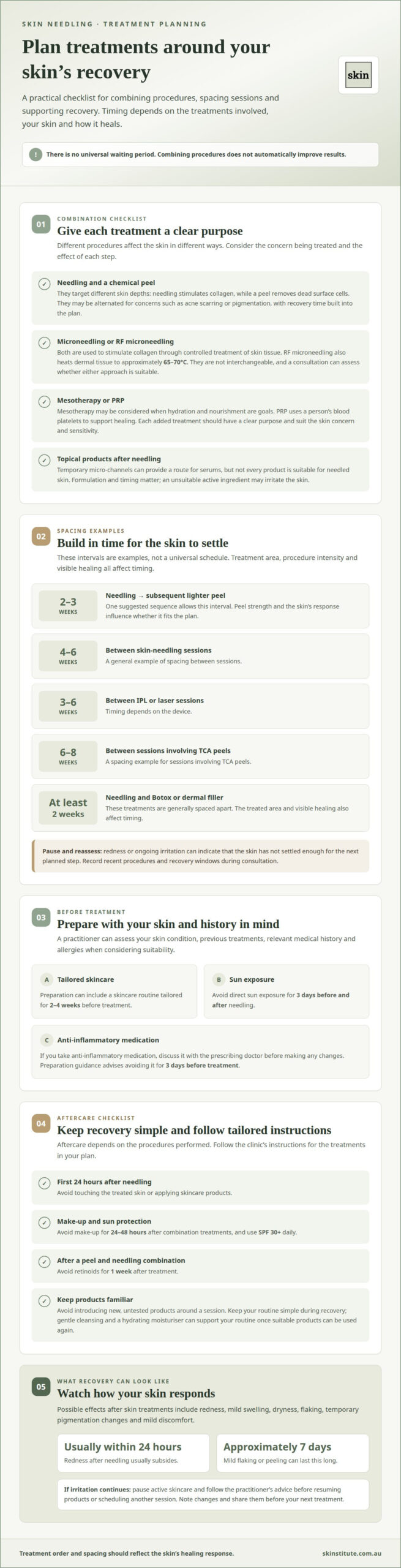
Combining skin needling and other treatments can be appropriate, but some procedures need to be scheduled separately rather than performed in the same appointment. There is no universal waiting period: the right interval depends on the treatments, your skin and how it heals. Combining procedures does not automatically improve results.
It is understandable to want a treatment plan that addresses several skin concerns while allowing time for recovery. The order and spacing matter because skin needling creates controlled micro-channels and starts a healing response, while other treatments can affect the skin differently.
This article explains how treatment timing and sequence are planned, which combinations may be considered, and how aftercare can support recovery. It also explains why a personalised assessment matters when planning skin needling with treatments such as laser, regenerative therapies or injectables.
Key Takeaways
- Combining procedures can address different skin concerns, but adding treatments does not automatically improve results.
- Plan the order and interval around the treatments involved, your skin’s healing response and the concern being treated.
- Alternating skin needling with a chemical peel may be considered for acne scarring or pigmentation, with recovery time built into the plan.
- Follow tailored aftercare and avoid introducing new active skincare products while your skin is recovering.
Can You Combine Skin Needling With Other Skin Treatments?
Skin needling uses small needles to create controlled micro-injuries and may address acne scarring, fine lines and uneven texture. Combining skin needling and other treatments means choosing procedures for distinct concerns. In Australia, the Therapeutic Goods Administration describes skin needling as generally lower risk when performed by a suitably trained provider.
Alternating Needling and Chemical Peels
Alternating skin needling and chemical peels means scheduling the procedures separately to address concerns such as acne scars and pigmentation. Needling stimulates collagen, while peels remove dead surface cells, so they target different skin depths. One suggested sequence allows 2-3 weeks between needling and a subsequent lighter peel. Peel strength and the skin’s response influence whether that interval fits the treatment plan.
Combining Collagen-Stimulating Treatments
Microneedling and radiofrequency (RF) microneedling are both used to stimulate collagen through controlled treatment of skin tissue. RF microneedling also heats dermal tissue to approximately 65-70°C, adding a distinct treatment effect. These approaches are not interchangeable. A consultation can assess the skin concern and treatment area, then determine whether either method is appropriate without assuming both are needed.
Adding Mesotherapy or PRP
Mesotherapy may be considered alongside microneedling when hydration and nourishment are treatment goals. Platelet-rich plasma (PRP) is another possible pairing, using a person’s blood platelets to support healing. Because these approaches add different components, each should have a clear purpose. An assessment can consider skin sensitivity, the concern being treated and whether the combination suits the treatment plan.
Using Micro-Channels for Topical Delivery
Microneedling creates temporary micro-channels that can provide a route for topical serums and active ingredients. However, not every skincare product is suitable for use on needled skin. Formulation and timing matter, as an unsuitable active ingredient may irritate the skin. Choose topical products for the treatment context and skin condition, rather than adding them without consideration.
Treatment spacing and sequencing
There is no universal order for every combination. When combining skin needling and other treatments, schedule each procedure with its effects on the skin and recovery in mind.
Choosing Treatment Order
The sequence should reflect each procedure’s purpose and its effect on the skin. Skin needling initiates a healing response, so adding another procedure simply to shorten the overall plan may not be appropriate. If needling and a peel are both planned, the peel’s strength and your skin’s condition help guide the order. Scheduling procedures separately can also reduce overlapping irritation across different skin layers.
For treatments that address separate concerns, the intended outcome helps determine the sequence. A plan for texture and pigmentation may alternate procedures, while treatments that could irritate recently treated skin need to be spaced apart. The plan should set out each procedure’s purpose and order, as well as the recovery period before the next step.
Allowing Recovery Intervals
Spacing gives the skin time to settle between procedures. A general example is 4-6 weeks between skin-needling sessions. Other examples include 3-6 weeks between IPL or laser sessions, depending on the device, and 6-8 weeks between sessions involving TCA peels.
Skin needling and Botox or dermal filler treatments are generally spaced by at least 2 weeks. These are examples, not a universal schedule. The treated area, procedure intensity and visible healing all affect timing. Redness or ongoing irritation can indicate that the skin has not settled enough for the next planned step.
Record planned procedures and recovery windows during consultation, including recent treatments. A skin needling treatment plan can account for the intended therapy and the skin’s response between appointments.
Aftercare following combination treatments
A current skin concern, relevant medical history or allergy that could affect healing should be assessed before treatment. A practitioner considers your skin condition, previous treatments and allergies when deciding whether needling or a combination is suitable.
Preparation can include a tailored skincare routine for 2 to 4 weeks before treatment. Avoid direct sun exposure for three days before and after needling. If taking anti-inflammatory medication, discuss it with the prescribing doctor before making any changes; preparation guidance advises avoiding it for 3 days before treatment.
Aftercare depends on the procedures performed, so the clinic’s instructions should reflect each treatment in your plan. Following skin needling:
- Avoid touching the treated skin or applying skincare products for 24 hours.
- Avoid makeup for 24-48 hours after combination treatments, and use SPF 30+ daily.
- After a chemical peel and needling combination, avoid retinoids for 1 week after treatment.
Redness, mild swelling, dryness, flaking, temporary pigmentation changes and mild discomfort can occur after skin treatments. Redness after needling usually subsides within 24 hours, while mild flaking or peeling can last approximately seven days. Ongoing irritation is a reason to pause active skincare and follow the practitioner’s advice before resuming products or scheduling another session.
Keep your skincare routine simple during recovery. Once suitable products can be used again, gentle cleansing and a hydrating moisturiser can support your routine. Avoid introducing new, untested products around a session: if a reaction develops, new ingredients can make its cause harder to identify. Note any changes and tell your practitioner before your next treatment, so the plan can account for your skin’s response.
If you have a current skin concern, relevant medical history or an allergy that could affect healing, wait until a practitioner has assessed whether needling or a combination treatment is suitable.
Combining skin needling with other treatments
A combined plan is most useful when each procedure has a distinct role in addressing a skin concern. More treatments do not automatically improve rejuvenation; choices should reflect the concern, skin condition and recovery involved. For example, skin needling may target uneven texture, while another modality may address a separate surface concern. Treating every concern at once can make recovery harder to manage.
Start with the treatment target. Fine lines, acne scarring and pigmentation do not all arise from the same skin changes. A clinician assesses which concern matters most, then selects procedures that complement rather than duplicate each other. If treatments affect similar skin layers or create overlapping irritation, scheduling them separately may be more appropriate than combining them in one appointment.
Some pairings focus on supportive care after a procedure. LED light therapy after microneedling is described as helping calm inflammation and support cell repair. Its intended effect differs from needling, so the plan should account for the device, skin response and timing. Choose topical products according to their ingredients and your skin’s recovery, not simply because they are marketed for rejuvenation.
Other combinations work through different mechanisms. Laser treatments can be paired with chemical peels for rejuvenation, but skin tolerance and the depth of each procedure influence whether they belong in the same plan. Prescription injectables address muscle activity or facial volume, rather than skin texture itself. Their role is different, so timing around needling needs consideration.
The practical takeaway is to define one primary target for each treatment and avoid adding a procedure without a clear purpose. During a personalised assessment, the practitioner can map concerns to treatment type, sequence and aftercare. To discuss a skin needling plan suited to your skin concerns, book a clinical assessment.
Skinstitute: Skin Needling
Skinstitute provides skin needling in Melbourne for people considering treatment for concerns such as acne scarring, uneven texture or visible signs of photo-ageing. A face-to-face consultation helps shape a plan around your skin, goals and recovery needs, including whether another procedure belongs in the same plan or should be scheduled separately.
Where concerns involve different treatment goals, the discussion may also consider options such as Fractional CO2 or prescription injectables. These treatments have different roles and are not automatically suitable to combine; selection and sequence depend on individual assessment. Skinstitute’s medical professionals can discuss the relevant approach and its aftercare.
If you would like to discuss whether skin needling suits your treatment goals, contact Skinstitute.
Plan your next step with clarity
A useful next step is to identify the skin concern that has the greatest effect on your day-to-day comfort or confidence. That priority can guide a discussion about whether one procedure is appropriate or a staged approach better fits your goals and recovery needs.
A plan for combining skin needling and other treatments should distinguish between procedures that address skin quality and those intended for different concerns. Skinstitute offers Fractional CO2, prescription injectables and PDO Thread Lifting; each has a different role, and suitability depends on individual assessment rather than the number of treatments involved. You can discuss how these options relate to your goals without assuming they need to be performed together.
Consider what you want to address, any previous procedures and how much recovery time you can accommodate. These details help focus the treatment discussion and support decisions tailored to your skin.
Contact Skinstitute to discuss your treatment. A considered plan is a constructive place to begin.
Frequently Asked Questions
Considering Getting Multiple Skin Treatments?
Yes, multiple treatments can be planned when each has a clear purpose. Start with the main concern, such as acne scarring or uneven pigmentation, then consider whether each proposed procedure addresses a different aspect of it. A useful consultation also covers active skincare ingredients you use and any reactions to previous treatments. This helps shape a coherent plan rather than adding procedures without a specific goal.
Does Combining Treatments Give Better Results?
Not automatically. A combination may address different concerns, but every procedure also brings treatment and recovery demands. For example, needling may target uneven texture while another treatment addresses pigmentation. The key question is whether each procedure has a distinct role. Assess progress against the original concern, such as changes in scar texture or the appearance of discolouration, rather than by the number of treatments performed.
How many treatments will I need?
The number of sessions depends on the skin concern, treatment approach and how your skin responds. An initial series of 4 to 6 skin needling treatments is one planning example, not a fixed requirement for every patient. A practitioner can review changes between sessions and adjust the plan if needed. More procedures are not automatically more appropriate; the treatment course should reflect progress and recovery.
Treatment order: before or after?
There is no single before-or-after order that suits every treatment pairing. The sequence should reflect each procedure’s purpose and effect on the skin. For example, a topical product intended for use with needling needs to be selected for that treatment context, rather than applied before or after by default. The plan should also distinguish products used in the clinic from those resumed at home.
Which treatments can be safely combined with skin needling?
Possible pairings include PRP, LED light therapy, chemical peels at separate appointments, and selected topical treatments. “Can be combined” does not mean every pairing suits every patient or should happen in one visit. Skin condition, treatment goals, product formulation and recovery all inform the plan. In Australia, exosomes are not approved by the TGA for delivery by injection; topical use is a different route.
Can skin needling be combined with PRP, LED therapy, or chemical peels?
These options can all be considered in combination plans, but the approach differs. PRP may be paired with needling, while LED light therapy may follow treatment. Chemical peels are generally planned as a separate step rather than automatically applied in the same appointment. The practitioner’s plan should specify each modality’s role and timing, including which products or procedures suit your skin during recovery.