Rejuran Healer Treatment Melbourne: A Clinical Buying Guide to Skin Bio-Stimulation
June 17, 2026
How Much Does Skin Needling Cost in Melbourne? A Clinical Guide to Value and Results
June 19, 2026
The stubborn nature of atrophic scarring often resists even the most rigorous topical skincare regimens because the structural damage resides deep within the dermal layers where creams cannot reach. You’ve likely felt frustrated by the lack of progress from over-the-counter serums or felt apprehensive about the significant downtime associated with aggressive ablative lasers. For those seeking skin needling for acne scars Melbourne practitioners provide a controlled, medical-grade solution that bridges the gap between topical applications and invasive surgery. It’s a process rooted in biological precision rather than marketing trends.
This clinical guide explains the precise science of percutaneous collagen induction and how professional protocols utilise the body’s natural wound-healing response to replace fibrotic tissue with a refined, organised collagen matrix. We’ll examine the biological mechanisms of dermal remodelling, the critical safety standards required under Victorian health regulations, and why clinical-grade devices offer results that home rollers simply cannot replicate. By the end of this article, you’ll understand how a strategic approach to skin penetration can restore the structural integrity of your complexion.
Key Takeaways
- Understand the biological origin of fibrotic scar tissue and how medical-grade needling initiates a controlled inflammatory response to remodel the dermis.
- Explore the two-phase proliferation process where micro-channels trigger platelet activation and the subsequent synthesis of Type III collagen and elastin.
- Compare the clinical efficacy of mechanical skin needling against Radiofrequency (RF) and Fractional CO2 laser treatments for addressing deep, tethered scarring.
- Learn why professional skin needling for acne scars Melbourne protocols require comprehensive digital skin analysis and barrier-strengthening priming for optimal outcomes.
- Identify the technical advantages of clinical-grade devices and established practitioner expertise in achieving precise dermal remodelling while maintaining patient safety.
Understanding Acne Scar Pathology and the Role of Collagen Induction Therapy
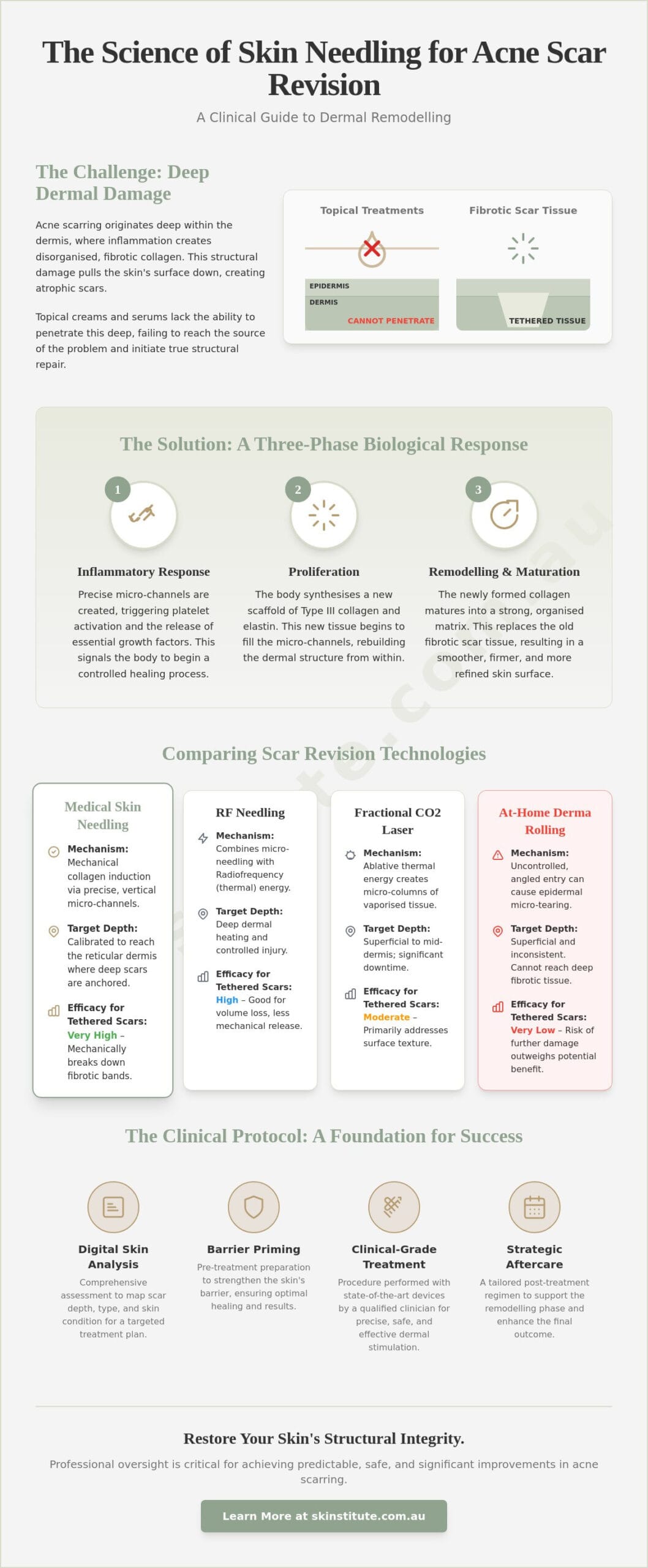
Acne scarring is a physiological consequence of intense inflammation that fundamentally alters the skin’s structural framework. When the body attempts to repair a follicular rupture, it often produces an irregular arrangement of collagen fibres known as fibrosis. This process results in two distinct categories of scarring: atrophic and hypertrophic. Atrophic scars, which include ice-pick, boxcar, and rolling varieties, occur when there is a net loss of dermal volume. Conversely, hypertrophic scars involve an excess of dense, unorganised tissue. Because this structural damage resides within the mid-to-deep dermis, traditional topical serums are physically incapable of reaching the depth required to initiate meaningful remodelling. They simply cannot penetrate the fibrotic barrier to effect change at a cellular level.
Percutaneous Collagen Induction (PCI), frequently termed Collagen induction therapy, has established itself as the clinical benchmark for non-surgical scar revision. Choosing professional skin needling for acne scars Melbourne clinicians perform ensures that the depth of penetration is calibrated to the specific morphology of the scar tissue. This medical-grade approach moves beyond the superficial reach of standard aesthetic treatments to address the underlying architectural damage.
The Limitations of Non-Medical Scar Treatments
At-home derma-rolling devices often lack the vertical precision and sterile integrity of medical-grade equipment. These rollers typically enter and exit the skin at an angle, which can cause lateral trauma and micro-tearing rather than creating clean, vertical micro-channels. For many Melbourne professionals, the psychological impact of persistent scarring is significant, often leading to a cycle of frustration with retail products that offer no structural repair. Clinical protocols prioritise controlled depth, ensuring the needles reach the reticular dermis where the most stubborn scar tissue is anchored. This precision is vital for safety and for achieving a predictable biological response.
The Clinical Objective: Replacing Fibrosis with Function
The primary objective of clinical needling is to mechanically disrupt the rigid, tethered collagen bands that pull the skin surface downward. By creating thousands of precise micro-injuries, the procedure signals the body to initiate a structured healing cascade. This process systematically replaces dysfunctional scar tissue with a more organised matrix of Type III collagen and elastin. The success of skin needling for acne scars Melbourne patients receive relies on this transition from fibrotic tissue to a functional dermal matrix. A professional assessment is essential to map scar depth and vascularity, as the treatment depth must be specifically adjusted to the unique topography of each patient’s scarring.
The Biological Mechanism: How Medical-Grade Needling Remodels the Dermis
Medical-grade skin needling is a sophisticated process that leverages the body’s innate wound-healing cascade to address structural irregularities. This biological response occurs in three distinct, overlapping phases. The initial phase, the inflammatory response, begins immediately after sterile micro-needles create vertical channels in the skin. These micro-channels trigger platelet activation and the release of essential growth factors that signal the start of the repair process. Unlike older techniques, modern clinical devices ensure vertical entry and exit, which minimises unnecessary epidermal trauma while maximising the dermal response.
The second phase, known as proliferation, involves the rapid generation of new tissue. During this stage, the body focuses on synthesising a temporary scaffold of Type III collagen and elastin. Clinical research, including an objective evaluation of microneedling for acne scars, demonstrates that this controlled injury leads to significant histological improvements in dermal density. It’s the precision of this mechanical stimulus that allows for such targeted results.
The final phase is remodelling, a maturation process that can continue for several months. During this period, the initially formed Type III collagen is gradually replaced by more robust, organised Type I collagen. This transition is what leads to the visible smoothing of the skin surface and the reduction of scar depth. For those considering skin needling for acne scars Melbourne practitioners offer, understanding this long-term maturation is key to managing expectations for progressive improvement.
Fibroblast Activation and the Extracellular Matrix
Fibroblasts are the primary cells responsible for collagen production in the dermal layer. The extracellular matrix (ECM) acts as the vital structural framework that maintains skin integrity and resilience. Clinical needling effectively re-organises the chaotic, bunched collagen fibres typically found in acne scars, encouraging a more uniform and functional dermal architecture.
Growth Factors and Cytokine Signalling
Complex chemical messengers, including cytokines, coordinate the intricate repair of micro-injuries. One critical messenger is the Vascular Endothelial Growth Factor (VEGF), which works to improve local blood supply and nutrient delivery to the treated area. Because medical-grade needling preserves the epidermis while targeting the deeper dermal layers, the skin’s barrier function remains largely intact during this intensive signalling process.
Comparative Analysis: Skin Needling vs. Fractional CO2 and RF Needling
Selecting the appropriate modality for scar revision requires a nuanced understanding of how different energies interact with dermal tissue. Mechanical skin needling, often referred to as “cold needling”, differs significantly from Radiofrequency (RF) needling and laser resurfacing because it doesn’t utilise thermal energy. While RF needling can provide additional skin tightening through heat-induced collagen contraction, the absence of heat in mechanical needling reduces the risk of post-inflammatory hyperpigmentation (PIH). This characteristic makes it an exceptionally safe option for patients with higher Fitzpatrick skin types who are traditionally more prone to pigmentation issues following thermal trauma.
When comparing clinical Fractional CO2 Laser Resurfacing with mechanical needling, the choice often depends on the severity of the scarring and the patient’s capacity for recovery. Fractional CO2 is highly effective for deep, tethered scars that require significant tissue ablation, yet it typically involves a more intensive recovery period involving several days of social downtime. In contrast, the recovery profile for skin needling for acne scars Melbourne clinicians perform is relatively brief, with most patients experiencing only mild erythema and slight swelling for 24 to 48 hours. This makes it a preferred choice for individuals with active professional lifestyles who can’t accommodate the extended downtime of ablative lasers but still require medical-grade results.
The Case for Mechanical Needling in Scar Revision
Mechanical needling allows for precise depth control, ranging from 0.5mm for superficial texture to 2.5mm for deep dermal remodelling. This versatility is essential for addressing varied scar topographies across different facial zones. To further enhance the regenerative response, we often integrate bio-stimulators such as Rejuran. These polynucleotides provide the necessary biological building blocks to accelerate tissue repair and improve the quality of the new collagen matrix. An Objective Evaluation of Microneedling for Acne Scars confirms that this mechanical approach leads to measurable histological improvements without the risks associated with high-heat devices.
Determining the Optimal Modality for Your Scars
The success of any scar revision protocol depends on a comprehensive assessment of scar depth, skin thickness, and historical response to previous therapies. Complex, mixed-type scarring often benefits from a multi-modality approach where mechanical needling is used in conjunction with other regenerative treatments to target different dermal layers simultaneously. Clinical experience remains the deciding factor in ensuring treatment safety, as the practitioner must determine the precise depth and density of the micro-channels to achieve optimal dermal remodelling while preserving skin health. This tailored approach ensures that each patient receives a protocol specifically designed for their unique scar morphology and skin characteristics.
The Treatment Protocol: Clinical Standards for Melbourne Patients
Clinical efficacy is contingent upon a structured, multi-stage protocol that begins long before the first micro-channel is created. For patients seeking skin needling for acne scars Melbourne clinics must adhere to rigorous aseptic standards while tailoring the treatment depth to individual scar morphology. This methodical approach ensures that the dermal response is both predictable and safe, moving beyond the superficial results of non-clinical treatments. A standard medical-grade protocol typically involves five critical stages:
- Clinical Consultation: Utilising digital skin analysis to map scar depth, vascularity, and underlying dermal health.
- Skin Priming: Integrating medical-grade topicals to strengthen the skin’s barrier and stabilise melanocyte activity before the procedure.
- The Procedure: Precision needling performed under sterile conditions, with depths adjusted dynamically for different facial zones.
- Acute Recovery: Managing initial erythema and protecting the micro-channels during the critical first 24 hours.
- Long-term Remodelling: A structured series of 3 to 6 treatments to allow for the progressive maturation of Type I collagen.
Adhering to these steps is vital for achieving the structural improvements discussed in previous sections. To begin your journey toward dermal restoration, you can book a clinical consultation at Skinstitute to receive a personalised scar mapping analysis.
Melbourne Environmental Factors and Healing
The high UV index in Victoria presents a unique challenge for post-needling recovery. Because the procedure creates temporary micro-channels, the skin is temporarily more vulnerable to UV-induced damage and PIH. Physical sun protection is mandatory during the healing phase. Additionally, Melbourne’s fluctuating humidity levels can impact the skin’s barrier function. We recommend supporting the proliferation phase with nutritional co-factors, specifically Vitamin C and amino acids, which are essential substrates for new collagen synthesis. Maintaining a stable dermal environment despite external Victorian weather patterns ensures the inflammatory response remains productive rather than destructive.
Clinical Aftercare and Maximising Results
The 72-hour window following treatment is known as the acute inflammatory phase. During this time, it’s vital to avoid active ingredients like Retinol or Alpha Hydroxy Acids (AHAs) that could over-stimulate the skin. We often utilise therapeutic LED light therapy immediately following the procedure to modulate inflammation and accelerate the proliferation of fibroblasts. Patients should expect a transition from initial redness to a refined skin texture over several weeks. While subtle changes appear early, the true structural remodelling occurs as the new collagen matrix matures deep within the dermis.
Why Professional Oversight Matters for Acne Scar Management at Skinstitute
Selecting a practitioner for skin needling for acne scars Melbourne requires a careful evaluation of technical proficiency and clinical history. At Skinstitute, we draw upon over 26 years of clinical experience in medical-grade aesthetic and regenerative therapies. This extensive legacy allows our practitioners to navigate the complexities of dermal remodelling with a level of precision that only decades of focused practice can provide. We maintain a serious and grounded approach to skin health, prioritising educational clarity and patient safety over traditional marketing trends.
Our facility utilises state-of-the-art needling technology designed for superior precision and patient comfort. These clinical-grade devices allow for exact vertical penetration, which is vital for reaching the mid-to-deep dermis where fibrotic scar tissue resides. By maintaining a medical-grade environment, we ensure that every procedure is performed under strict aseptic conditions. This environment is essential for minimising the risk of infection and preventing the secondary scarring that can occur from improper technique or substandard equipment.
We believe in a holistic approach to scar revision that moves beyond isolated treatments. By integrating advanced bio-stimulators, such as Rejuran or Exosomes, with our medical-grade aesthetic treatments, we provide the skin with the necessary biological signalling to optimise repair. Our commitment to objective, transparent consultations ensures that every patient receives a realistic assessment based on scientific principles rather than overpromised results.
The Skinstitute Difference: Authority and Experience
The technical mastery required for effective skin needling for acne scars Melbourne patients deserve involves an intimate understanding of facial anatomy. Our practitioners tailor treatment depth to the specific requirements of the face and neck, accounting for variations in skin thickness and vascularity. We value long-term patient partnerships, focusing on the progressive maturation of collagen over several months to achieve transformative and sustainable dermal results. This steady, methodical pace mirrors a professional consultation, ensuring you are informed at every stage of the remodelling process.
Booking Your Clinical Assessment in Melbourne
A thorough physical examination is a mandatory prerequisite for any regenerative procedure at our clinic. This assessment allows us to map scar morphology and evaluate your skin’s current structural integrity. To prepare for your clinical assessment, we recommend the following steps:
- Gather your full medical history, including any previous dermatological conditions.
- Compile records of previous aesthetic or medical skin treatments and their outcomes.
- Identify your primary concerns and specific goals for dermal restoration.
- Prepare to discuss your current skincare regimen to ensure barrier health is optimised for treatment.
The final step in this process is the development of a bespoke roadmap for your acne scar restoration journey. This sequential plan ensures that every intervention is timed to support the body’s natural healing phases, leading to a refined and more functional dermal matrix.
Advancing Toward Structural Dermal Repair
The journey toward refined skin texture is a biological process that demands patience and clinical precision. By moving beyond superficial interventions, you allow the body to systematically replace dysfunctional scar tissue with a resilient, organised collagen matrix. When choosing skin needling for acne scars Melbourne patients should prioritise facilities that adhere to the highest aseptic standards and utilise medical-grade technology. This ensures that the percutaneous collagen induction is both safe and effective, reaching the precise dermal depths required for structural change.
Skinstitute offers over 26 years of experience in regenerative therapies, providing a reassuring sense of technical proficiency and established authority. Our specialists remain dedicated to the science of dermal remodelling, ensuring that every protocol is tailored to your unique anatomical requirements. We invite you to Book a Clinical Consultation at Skinstitute Melbourne to discuss your bespoke restoration plan. Achieving structural improvement is a gradual process, but with expert clinical guidance, a smoother and more resilient complexion is a reachable objective.
Frequently Asked Questions
How many sessions of skin needling are typically required for acne scars?
Most patients require a series of 3 to 6 sessions to achieve significant structural improvement. These treatments are typically spaced 4 to 6 weeks apart to align with the natural biological maturation of the new collagen matrix. The exact number of sessions depends on the depth and type of scarring, as well as the skin’s individual regenerative capacity.
Is skin needling painful, and how do you manage patient comfort?
Discomfort is kept to a minimum through the application of high-strength topical anaesthetics before the procedure begins. Modern medical-grade devices utilise high-speed vertical needle entry, which significantly reduces the sensation of dragging or tearing compared to older technologies. Most patients describe the feeling as a vibrating or prickling sensation rather than acute pain.
What is the expected downtime after a medical-grade needling session in Melbourne?
Acute downtime typically lasts between 24 and 48 hours. During this period, the skin will exhibit mild erythema and slight swelling, similar to the appearance of a moderate sunburn. Because of the high UV index in Victoria, it’s vital to avoid direct sun exposure and apply physical protection while the micro-channels are in the initial stages of healing.
Can skin needling be performed on all skin tones and ethnicities?
Yes, mechanical skin needling is suitable for all Fitzpatrick skin types. Because the process doesn’t involve thermal energy, the risk of post-inflammatory hyperpigmentation is significantly lower than with certain laser treatments. This makes it a safe and effective option for patients with darker skin tones who are traditionally more prone to pigmentation issues.
How soon will I see improvements in my acne scarring after the first treatment?
Subtle improvements in skin texture can often be observed within 2 to 4 weeks, but structural remodelling is a gradual process. The synthesis and maturation of organised collagen fibres typically take 3 to 6 months to become fully visible. You’ll notice progressive smoothing of the skin surface as the treatment series continues and the dermal layers thicken.
Are the results of skin needling for acne scars permanent?
The structural changes achieved through professional skin needling for acne scars Melbourne clinicians perform are permanent. Once the fibrotic scar tissue is replaced by a functional collagen matrix, that new tissue remains a part of your skin’s architecture. While the results for the scars themselves don’t fade, the skin will continue to undergo the natural chronological ageing process over time.
Can I combine skin needling with other treatments like chemical peels or lasers?
Multi-modality protocols are often used to address complex, mixed-type scarring, but they must be staged appropriately. We frequently integrate bio-stimulators like Rejuran or therapeutic LED light to enhance the regenerative response. However, we don’t recommend combining needling with aggressive chemical peels or ablative lasers in the same session to ensure the skin’s barrier isn’t compromised.
Is skin needling safe for patients currently experiencing active acne breakouts?
Clinical needling is generally avoided in areas where active, inflammatory acne is present. Performing the procedure over pustules or cysts can spread bacteria across the face, increasing the risk of cross-contamination and secondary infection. Our protocol involves stabilising active acne through medical-grade skincare or other therapies before commencing a targeted scar revision programme.