Sclerotherapy Melbourne: A Clinical Guide to Leg Vein Removal
August 20, 2026
Non-Surgical Skin Tightening Melbourne: A Clinical Guide to Medical-Grade Rejuvenation
August 22, 2026
A surgical neck lift is no longer the only viable method for accessing the SMAS layer to remediate significant cervical skin laxity. For many patients, the gradual loss of jawline definition and the development of crepey skin texture on the neck present a complex aesthetic challenge that doesn’t always necessitate invasive theatre time. You’ve likely noticed that topical serums and superficial treatments often fail to address the deeper structural shifts occurring beneath the dermis. This clinical guide explores the precision of hifu for neck tightening melbourne, offering an authoritative look at how high-intensity focused ultrasound stimulates a biological healing response at specific depths. We’ll detail the mechanics of thermal coagulation, the role of TGA-listed devices in ensuring patient safety, and why this technology serves as a cornerstone for non-surgical structural rejuvenation in 2026. By understanding the physiological interaction between ultrasound energy and collagen synthesis, you can make an informed decision about restoring the integrity of your profile without the risks of scarring or prolonged recovery.
Key Takeaways
- Understand the clinical mechanism of High-Intensity Focused Ultrasound and how it targets the Superficial Musculoaponeurotic System (SMAS) to initiate a deep structural lift.
- Discover why medical-grade technology is essential when selecting hifu for neck tightening melbourne to ensure precise energy delivery and optimal patient safety.
- Learn to differentiate between the immediate mechanical repositioning of PDO threads and the gradual, biological collagen synthesis stimulated by ultrasound therapy.
- Explore the synergistic benefits of “Bioremediation” by combining HIFU with polynucleotide treatments like Rejuran to accelerate tissue remodelling.
- Gain insights into the professional assessment process and the typical 12 to 18-month duration of results following a medical-grade cervical rejuvenation protocol.
Understanding HIFU for Neck Tightening: A Clinical Overview
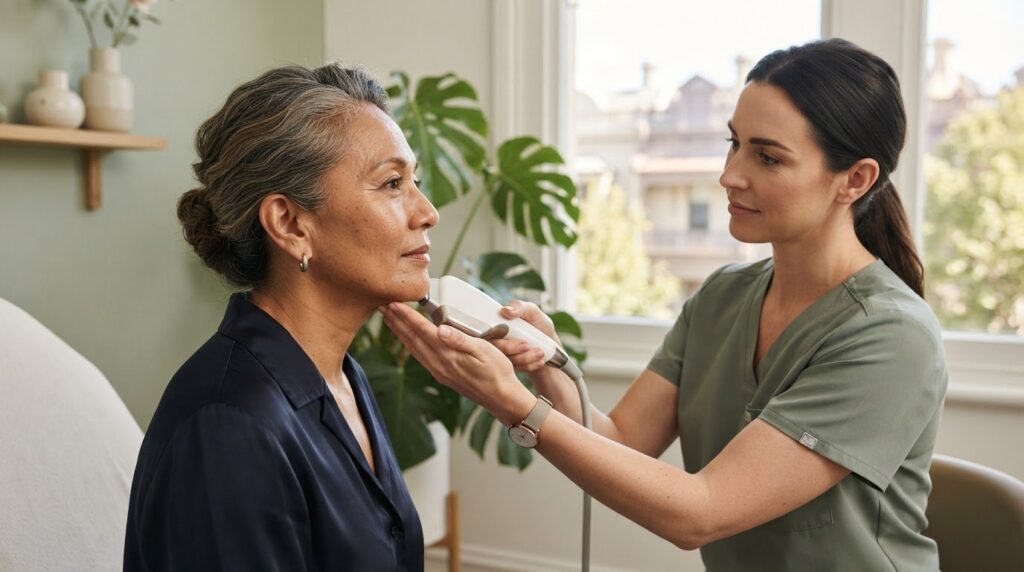
High-Intensity Focused Ultrasound (HIFU) represents a significant advancement in non-invasive therapeutic techniques. While the core principles of focused ultrasound technology were originally developed for diagnostic imaging and internal medical procedures, the technology has been refined for aesthetic tissue remodelling. In the clinical context of hifu for neck tightening melbourne, this modality provides a precise method for addressing submental laxity and platysmal banding without the requirement for surgical intervention. Medical-grade HIFU remains the preferred standard in Melbourne because it allows practitioners to deliver energy with microscopic accuracy to depths previously only accessible through invasive surgery.
The Biological Impact of Focused Ultrasound
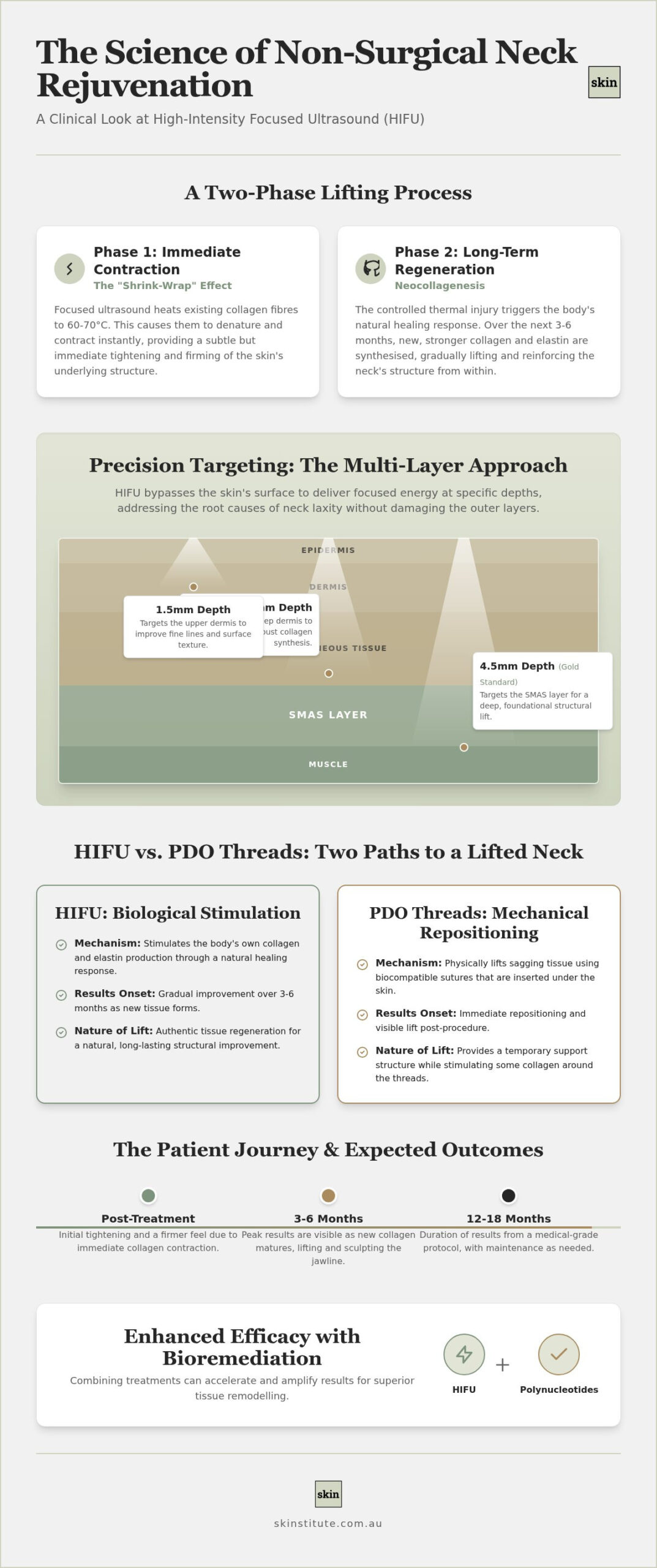
The efficacy of this treatment relies on the creation of thermal coagulation points (TCPs) at specific depths within the dermal and sub-dermal layers. When the ultrasound energy is concentrated, it generates localised heat that reaches approximately 60 to 70 degrees Celsius. This temperature is sufficient to cause the immediate denaturation of existing collagen fibres, which results in an initial visible contraction of the tissue. Following this acute phase, the body initiates a natural wound-healing response known as neocollagenesis. Over the subsequent three to six months, new collagen and elastin fibres are synthesised, providing a long-term structural lift and improved dermal density. To complement these biological shifts and maintain skin vitality at home, you can explore 5-in-1 Face Sculpting & Skin Care Device as part of a comprehensive beauty routine.
Neck Anatomy and Ageing: Why the Cervical Region is Unique
The cervical region presents distinct anatomical challenges that differ from facial skin. The dermis on the neck is significantly thinner and contains fewer sebaceous glands, making it more susceptible to structural failure and dehydration. A primary factor in the appearance of sagging is the platysma muscle, a thin superficial muscle that loses tone over time. Unlike other areas, the neck often shows age earlier due to this lack of underlying support.
Environmental factors in Melbourne also play a critical role in cervical ageing. High levels of UV exposure accelerate solar elastosis, a condition where elastic fibres in the neck become thick, tangled, and irregular. This damage compromises the skin’s ability to maintain its position, leading to the crepey texture many patients find concerning. By utilising hifu for neck tightening melbourne, clinicians can target these specific anatomical layers to reinforce the neck’s biological scaffold and mitigate the visible signs of photo-ageing. This approach ensures that the structural integrity of the submental area is addressed at a cellular level, rather than merely treating the surface.
The Mechanism of Action: Targeting the SMAS Layer for Structural Lift
The Superficial Musculoaponeurotic System, commonly referred to as the SMAS, is a fibromuscular layer that sits beneath the subcutaneous fat and above the muscle. It’s the foundational structure that plastic surgeons physically manipulate during a traditional neck lift. High-Intensity Focused Ultrasound operates by bypassing the epidermis entirely, delivering concentrated acoustic energy to specific depths. Unlike laser or radiofrequency, which can be limited by skin pigment or surface heat, HIFU focuses energy deep within the tissue to prevent surface damage. Patients seeking hifu for neck tightening melbourne often prioritise this deep-tissue approach because it addresses the root cause of sagging rather than just the surface texture.
Modern clinical devices utilise specialised transducers set to 1.5mm, 3.0mm, and 4.5mm depths. This allows for a multi-layered treatment strategy. The 1.5mm depth targets the upper dermis to improve fine lines, while the 3.0mm depth reaches the deep dermis to stimulate collagen synthesis. As the SMAS is heated to approximately 65 degrees Celsius at the 4.5mm depth, it undergoes immediate thermal contraction. This thermal energy creates a “shrink-wrap” effect, providing an immediate but subtle tightening that serves as the foundation for future biological lifting.
Depth Matters: Why 4.5mm is the Gold Standard for the Neck
Focusing on the 4.5mm focal depth is critical for treating submental laxity and addressing the underlying causes of a “double chin”. This is where the most significant structural lifting occurs. Clinical precision is paramount here, as the practitioner must avoid vital structures like the thyroid gland and major blood vessels. A medical-grade session using TGA-listed devices involves a constant clinical feedback loop, where the practitioner monitors the patient’s response and adjusts energy levels to ensure safety. For those seeking a detailed assessment of their cervical anatomy, a professional clinical consultation can determine the optimal treatment depth required for their specific concerns.
Collagen and Elastin Remodelling Timeline
The true structural remodelling following hifu for neck tightening melbourne occurs over a 90 to 180-day window. The treatment triggers a controlled inflammatory response, which is a necessary precursor to the production of new collagen and elastin. It’s vital to distinguish between minor post-procedural swelling and the gradual, long-term thickening of the dermal matrix. While temporary puffiness may be visible for a few days, the peak clinical results only emerge once the body has fully synthesised new structural proteins to reinforce the neck’s biological scaffold.
Comparing Non-Surgical Modalities: HIFU vs. PDO Threads for Cervical Laxity
Addressing cervical laxity requires a nuanced understanding of different non-invasive technologies. While both PDO threads and High-Intensity Focused Ultrasound aim to restore structural integrity, they operate through distinct physiological pathways. PDO thread lifting involves the insertion of absorbable polydioxanone sutures to provide immediate mechanical support and tissue repositioning. In contrast, hifu for neck tightening melbourne focuses on long-term biological regeneration. Ultrasound energy triggers a healing cascade that thickens the dermis over several months, whereas threads offer a more immediate, though temporary, physical lift. The downtime profiles also differ significantly. HIFU is often the preferred choice for patients with demanding schedules because it requires virtually no recovery time, while PDO threads typically involve several days of localised swelling or minor bruising.
A senior practitioner may recommend a combination approach to achieve a more comprehensive result. By utilising ultrasound to firm the underlying tissue foundation, the skin becomes more resilient. This provides a more robust environment for subsequent thread anchoring, potentially extending the longevity of the mechanical lift. This sequential strategy ensures that the neck is treated both at a structural, biological level and a positional, mechanical level.
HIFU for Global Tightening vs. Threads for Targeted Vectoring
The primary advantage of ultrasound therapy is its ability to treat the entire neck area uniformly. It provides consistent energy delivery across the submental and cervical regions to improve overall dermal density. Conversely, PDO threads are utilised for targeted vectoring. This means they are placed to create specific lifting forces, such as sharpening the mandibular line or addressing localised pockets of sagging. When hifu for neck tightening melbourne is performed as a precursor to thread insertion, the improved skin quality allows for better thread integration and a more natural-looking contour.
Clinical Suitability: Assessing Your Skin Grade
Determining the correct intervention begins with a professional assessment of skin grade. Mild laxity, characterised by early loss of elasticity and fine lines, typically responds exceptionally well to ultrasound alone. Moderate laxity, where sagging is more visible and platysmal bands begin to appear, often necessitates the dual approach of HIFU and PDO threads. However, it’s clinically responsible to acknowledge that severe skin redundancy may exceed the capabilities of non-surgical modalities. In such cases, a surgical referral is often the most appropriate path to ensure realistic patient outcomes. For a deeper understanding of these protocols, the Skinstitute Melbourne: A Clinical Guide to Medical-Grade Aesthetic Treatments provides an essential framework for patients evaluating medical-grade options.
The Patient Journey: Clinical Protocols and Expected Outcomes
The journey begins with a meticulous clinical assessment. During this phase, a practitioner evaluates the degree of cervical laxity and identifies specific anatomical landmarks for energy delivery. This diagnostic step is vital for hifu for neck tightening melbourne, as it ensures the treatment plan accounts for individual variations in dermal thickness and fat distribution. This level of clinical oversight mirrors the rigorous health standards found in other sectors; for instance, Persona Health specialises in comprehensive medical assessments for workplace safety and injury management. A thorough skin analysis also identifies potential contraindications, ensuring that the ultrasound energy is applied safely and effectively to the correct depths.
Successful outcomes depend heavily on pre-treatment preparation. Patients must discontinue the use of active skincare, particularly prescription retinoids and high-strength AHAs, at least five days prior to their session to prevent unnecessary surface sensitivity. Systemic conditions such as active skin infections or certain autoimmune disorders may preclude treatment. Additionally, systemic hydration is a critical factor; because ultrasound waves require a water-rich medium for optimal conduction, patients are advised to increase their fluid intake in the forty-eight hours leading up to their appointment.
Melbourne Aftercare: Protecting Your Investment
The Victorian climate presents specific challenges for post-treatment recovery. Strict UV protection is mandatory, as solar radiation can degrade the newly synthesised collagen and compromise the longevity of the lift. Utilising medical-grade skincare that contains antioxidants and growth factors will further support the dermal matrix during the remodelling phase. For patients who wish to address surface-level pigmentation or texture alongside their structural lift, Fractional CO2 Laser Resurfacing Melbourne may be recommended as a secondary protocol once the initial HIFU healing phase is complete. To begin this process, you may book a clinical assessment with our senior practitioners to develop a personalised rejuvenation strategy.
Integrating HIFU with Regenerative Aesthetic Medicine at Skinstitute
Bioremediation represents a sophisticated shift in aesthetic protocols, moving beyond singular modalities to create a more resilient biological environment. At Skinstitute, we utilise hifu for neck tightening melbourne as a structural foundation, which is then augmented through the strategic application of regenerative medicine. While the ultrasound energy provides the necessary thermal stimulus for collagen denaturation, the integration of polynucleotides and exosomes addresses the cellular requirements for optimal repair. This multifaceted approach ensures that the tissue isn’t just tightened, but fundamentally rejuvenated at a molecular level.
Rejuran, a polynucleotide-based injectable, plays a pivotal role in this regenerative cycle. It provides the essential building blocks for DNA synthesis and tissue repair, which enhances the healing response triggered by the initial ultrasound treatment. Additionally, the introduction of exosomes facilitates rapid cellular communication, helping to coordinate the body’s natural inflammatory response and potentially reducing the duration of post-procedural oedema. Skinstitute’s 26 years of experience serves as the foundation for these complex protocols, allowing us to combine these technologies with clinical precision.
The HIFU and Rejuran Synergy
The HIFU and Rejuran synergy is built upon a “double stimulation” protocol. The thermal energy from the ultrasound creates a macro-structural shift in the SMAS layer, while the biochemical properties of Rejuran promote micro-structural dermal thickening. Spacing these treatments is essential for maximum efficacy; we typically wait for the initial acute inflammatory phase to subside before introducing polynucleotides. For a more technical overview of this process, you may refer to our Clinical Guide to Rejuran in Melbourne.
Why Clinical Experience Matters in HIFU Delivery
Delivering hifu for neck tightening melbourne requires a high degree of technical proficiency to ensure patient safety. The cervical region contains several vital structures, including the marginal mandibular nerve, which must be avoided to prevent temporary motor weakness. This is often called a “nerve strike”, and it is a risk that only experienced practitioners can reliably mitigate through precise anatomical mapping. An expert clinician understands how to adjust energy levels based on tissue impedance, which varies significantly between individuals. To explore these medical-grade options further, you can book a clinical assessment at Skinstitute to receive a professional evaluation of your suitability for these regenerative techniques.
Advancing Cervical Rejuvenation Through Clinical Precision
Restoring the structural integrity of the neck requires a sophisticated understanding of cervical anatomy and the precise application of medical-grade technology. The effectiveness of hifu for neck tightening melbourne depends on its ability to reach the SMAS layer, initiating a biological remodelling process that continues for several months. By selecting a specialist Melbourne-based clinic that utilises TGA-listed devices, you ensure that energy is delivered with the necessary accuracy to avoid vital structures while maximising neocollagenesis.
Skinstitute brings over 26 years of aesthetic expertise to every protocol, integrating High-Intensity Focused Ultrasound with advanced regenerative treatments like Rejuran and Exosomes to enhance cellular repair. This comprehensive approach moves beyond surface-level aesthetics to provide long-term structural support without the requirement for invasive surgery. When you’re ready to address submental laxity with clinical rigour, we invite you to Book a Clinical Consultation at Skinstitute Melbourne. Our senior practitioners will conduct a thorough assessment to determine the most appropriate path for your unique physiological needs. We look forward to guiding you through your rejuvenation journey with professional integrity and technical mastery.
Frequently Asked Questions
Is HIFU for neck tightening painful?
Most patients describe the sensation as a series of prickling, thermal pulses rather than acute pain. This discomfort occurs as the ultrasound energy reaches the target depth to create thermal coagulation points within the tissue. While the intensity varies based on individual pain thresholds, it’s generally manageable without general anaesthesia. Practitioners can adjust energy levels or use topical cooling to ensure the experience remains tolerable throughout the clinical session.
How many HIFU sessions will I need for my neck?
The number of sessions required depends on the initial grade of skin laxity and the patient’s biological response to ultrasound energy. While some individuals achieve satisfactory results after a single session, those with moderate sagging often benefit from a series of two to three treatments spaced several months apart. This allows the body sufficient time to complete the neocollagenesis process between appointments, ensuring a more robust structural lift.
Can HIFU replace a surgical neck lift?
HIFU serves as a highly effective non-surgical alternative for patients with mild to moderate cervical laxity, but it’s not a direct replacement for invasive surgery in severe cases. While it targets the same SMAS layer manipulated during a surgical lift, it cannot physically excise redundant skin. Patients seeking hifu for neck tightening melbourne should have realistic expectations; it provides structural rejuvenation and lifting without the associated risks of scarring or surgical downtime.
Are there any side effects of HIFU on the neck area?
Clinical side effects are typically mild and transient, consisting primarily of localised erythema and oedema. Some patients may experience a slight tenderness or a tingling sensation along the jawline for several days following the procedure. These responses indicate that the thermal energy has successfully stimulated the healing cascade. More significant complications are rare when the treatment is performed by an experienced practitioner who understands the complex anatomy of the cervical region.
How long do the results of a HIFU neck treatment last?
The longevity of results generally ranges from 12 to 18 months, though this timeline is influenced by the patient’s age and lifestyle factors. Because the treatment stimulates the production of new, healthy collagen, the structural improvements are progressive. To maintain the integrity of the submental lift, many patients choose to schedule a maintenance session every year. Protecting the skin from UV radiation in the Victorian climate is essential for preserving these clinical outcomes.
Can I have HIFU if I already have dermal fillers in my jawline?
You can undergo ultrasound therapy if you have dermal fillers, provided the treatments are correctly sequenced. It’s generally recommended to wait at least four to six weeks after filler injections before having HIFU to ensure the filler has fully integrated into the tissue. Conversely, performing HIFU first can create a firmer foundation for subsequent injectables. A clinical assessment is necessary to determine the optimal timing for your specific rejuvenation protocol.
What is the difference between medical-grade HIFU and beauty-grade devices?
Medical-grade HIFU systems are TGA-listed therapeutic devices that deliver energy with significantly higher precision and power than beauty-grade alternatives. These clinical machines can reliably reach the 4.5mm depth required to target the SMAS layer, whereas lower-grade devices often only affect the superficial dermis. This distinction is critical for achieving a true structural lift. Using medical-grade technology ensures that the treatment is both safe and capable of producing measurable biological changes.
How soon can I return to work after a neck tightening treatment?
Most patients return to their professional and social activities immediately after a session of hifu for neck tightening melbourne. There is no requirement for clinical downtime, as the epidermis remains intact throughout the procedure. While minor redness or slight swelling may be visible for a few hours, these effects are easily managed and typically don’t interfere with daily routines. This lack of recovery time makes it an ideal option for those with demanding schedules.