2026 Clinical Guide: HIFU Neck Tightening in Melbourne
August 21, 2026
Melbourne CO2 Laser: Fractional Resurfacing Guide
August 23, 2026
Effective facial rejuvenation is not achieved through superficial tension, but through the precise biological re-engineering of the skin’s underlying structural architecture. Many patients feel a growing frustration as they observe the gradual descent of the jawline or the appearance of visible jowls, yet they remain understandably cautious about the risks and recovery times of invasive surgery when considering non surgical skin tightening melbourne. You’ve likely encountered a confusing landscape of competing technologies, making it difficult to discern which clinical intervention actually addresses the root cause of dermal laxity.
This clinical guide provides a comprehensive technical overview of the mechanisms and outcomes associated with medical-grade rejuvenation. By exploring the science behind High-Intensity Focused Ultrasound (HIFU), PDO threads, and bio-stimulators like Rejuran, you’ll gain a deeper understanding of how these treatments stimulate long-term collagen synthesis. We’ll examine the physiological processes that restore skin elasticity and contour, providing a clear roadmap for achieving professional results while prioritising patient safety and minimal downtime.
Key Takeaways
- Understand the biological mechanisms whereby controlled thermal and mechanical stimuli trigger the body’s natural healing response to restore dermal structural integrity.
- Differentiate between the clinical applications of High-Intensity Focused Ultrasound (HIFU) for deep structural lifting and PDO threads for immediate mechanical support.
- Learn how integrating bio-stimulators like Rejuran with non surgical skin tightening melbourne treatments creates a synergistic effect that enhances the skin’s internal environment.
- Recognise why a rigorous clinical assessment of skin thickness and underlying anatomy is essential for developing a safe and personalised treatment plan.
- Appreciate how 26 years of professional experience and the use of medical-grade technology contribute to more predictable and durable rejuvenation results.
Understanding Skin Laxity and the Mechanism of Non-Surgical Tightening
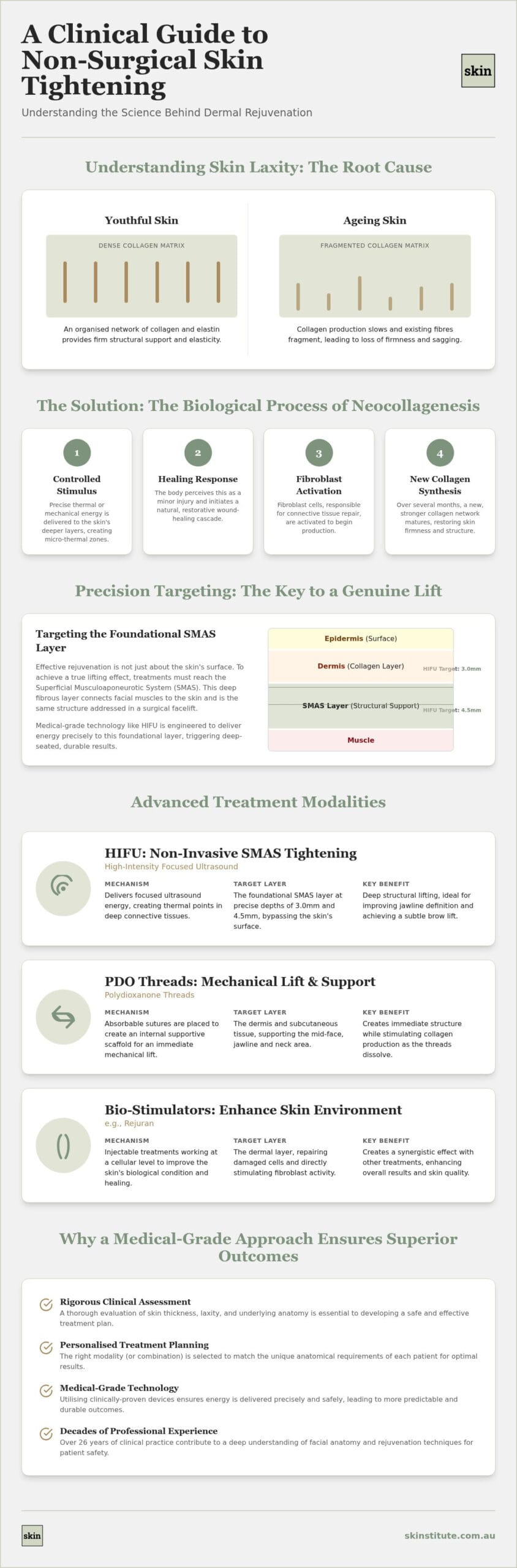
Non-surgical skin tightening is a sophisticated clinical intervention that relies on delivering a controlled thermal or mechanical stimulus to the dermis. This process isn’t merely a surface-level cosmetic enhancement; it’s a targeted biological trigger. By inducing a precise amount of energy into the skin’s deeper layers, we initiate a restorative cascade that addresses the underlying causes of sagging and volume loss. It’s a method that prioritises long-term physiological change over temporary fixes.
The structural integrity of the face depends heavily on the extracellular matrix, a complex network of proteins where collagen and elastin reside. Collagen provides the tensile strength that keeps skin firm, while elastin allows the tissues to recoil after stretching. As we age, the body’s natural production of these proteins slows, and the existing fibres begin to fragment. This depletion leads to the visible signs of ageing, such as jowls and fine lines. Understanding Skin Laxity and the Mechanism of Non-Surgical Tightening requires a clear distinction between superficial texture refinement and deep structural lifting. While many treatments focus on the skin’s surface, effective non surgical skin tightening melbourne must target the foundational layers to achieve a visible change in facial contour.
The Biological Process of Neocollagenesis
When medical-grade devices apply controlled heat to the dermis, they create micro-thermal zones that the body perceives as a minor injury. This triggers a wound-healing response without damaging the skin’s surface. Fibroblasts, the primary cells responsible for connective tissue repair, are activated to synthesise new Type I and Type III collagen. This cellular activity doesn’t happen overnight; it unfolds over several months as the new protein network matures and strengthens. Neocollagenesis is the long-term biological process of new collagen formation.
Dermis vs. SMAS: Where Tightening Occurs
To achieve a genuine lifting effect, treatments must reach the Superficial Musculoaponeurotic System, or SMAS. This is the deep fibrous layer that connects facial muscles to the skin, and it’s the same layer surgeons manipulate during a traditional facelift. Different technologies are designed to target specific depths, ranging from the superficial dermis to the SMAS layer itself. Precise depth control is essential in medical-grade tightening to ensure energy is delivered exactly where it can provide the most structural support. By focusing energy at depths of 3.0mm or 4.5mm, we can address the root of facial sagging rather than just treating the skin’s exterior. This targeted approach is a hallmark of professional non surgical skin tightening melbourne, ensuring that the rejuvenation is both deep-seated and durable.
Advanced Modalities: HIFU, PDO Threads, and Laser Resurfacing
The landscape of non surgical skin tightening melbourne is diverse, encompassing technologies that interact with human tissue at varying depths and through different physical mechanisms. Rather than relying on a single device, a medical-grade approach involves selecting the specific modality that aligns with the patient’s degree of laxity, dermal thickness, and anatomical requirements. This strategic selection ensures that energy is delivered to the precise layer where it can most effectively trigger structural change.
HIFU: Non-Invasive SMAS Tightening
High-Intensity Focused Ultrasound (HIFU) represents a significant advancement in non-invasive lifting by targeting the Superficial Musculoaponeurotic System (SMAS). By delivering focused ultrasound energy to depths of 3.0mm and 4.5mm, this technology bypasses the epidermis to create thermal coagulation points in the deeper connective tissues. This makes it an ideal choice for patients seeking improved jawline definition or a subtle brow lift without surface-level disruption. For a deeper understanding of clinical standards in these procedures, you may review the Skinstitute Melbourne guide regarding medical-grade aesthetic treatments.
PDO Threads: Mechanical Lift and Support
PDO thread lifting utilises absorbable polydioxanone sutures to create a supportive scaffold within the mid-face and neck area. These threads provide an immediate mechanical lift to sagging tissues, which is later reinforced by a biological response. As the threads are gradually metabolised by the body, they stimulate a localised wound-healing cascade that deposits new collagen along the thread path. This dual action provides both structural repositioning and a long-term improvement in skin density.
Fractional CO2 Laser: Surface and Deep Regeneration
While ultrasound and threads target deeper structures, the Fractional CO2 laser addresses both the skin’s surface and the deep dermis. This modality functions by creating thousands of microscopic, ablative columns in the skin, leaving the surrounding tissue intact to accelerate healing. It is particularly effective for patients who require tightening alongside the correction of sun damage, pigmentation, or scarring. Technical details on this regenerative process can be found in our Fractional CO2 Laser guide. Determining the most suitable modality for your unique facial structure is best achieved through a professional clinical assessment.
Selecting the appropriate technology is contingent upon the patient’s biological age and the specific quality of their skin. Younger patients often benefit from the preventative collagen stimulation of HIFU, whereas patients with more pronounced tissue descent may require the combined mechanical and biological intervention of PDO threads or laser resurfacing.
The Biological Synergy: Enhancing Results with Bio-stimulators
In modern medical aesthetics, the focus has shifted from isolated mechanical interventions to a more holistic, biological approach. While energy-based devices provide the necessary structural stimulus, the ultimate success of non surgical skin tightening melbourne depends heavily on the skin’s internal regenerative capacity. Bio-stimulation addresses this by optimising the dermal environment, ensuring that the body possesses the biochemical resources required to respond effectively to clinical treatments. This approach moves beyond simple tightening to true tissue regeneration.
Rejuran and Polynucleotide Therapy
Rejuran is a specialised bio-stimulator composed of polynucleotides (PN), which are DNA fragments that work at a cellular level to repair damaged skin. Unlike traditional dermal fillers that provide immediate volume, Rejuran focuses on improving the skin’s physiological health. As detailed in our Clinical Guide to Rejuran, these molecules stimulate fibroblast activity and enhance the production of the extracellular matrix. When integrated with thermal tightening procedures, Rejuran creates a synergistic effect; the device provides the stimulus, while the polynucleotides provide the repair mechanism. This combination is particularly effective for restoring elasticity in the delicate periorbital region and improving overall skin density.
Exosomes: Cellular Communication for Regeneration
Exosomes represent the next frontier in regenerative medicine, functioning as nano-sized messenger vesicles that facilitate communication between cells. These vesicles carry a concentrated cargo of growth factors, lipids, and signalling proteins that instruct aged or dormant cells to initiate repair processes. In a clinical setting, exosome therapy is often utilised immediately following Fractional CO2 laser or skin needling to accelerate the healing cascade. By delivering these potent signalling molecules directly into the micro-channels created by the treatment, we can significantly reduce post-procedural downtime and enhance the quality of new collagen formation. Ensuring the use of high-purity, medical-grade exosomes is vital for maintaining the safety and efficacy of this advanced intervention.
Adopting a multi-modal strategy ensures that results are not only more visible but also more durable. By combining mechanical lifting with biological enhancement, we address both the structural descent of the face and the underlying cellular exhaustion that contributes to ageing. This integrated methodology results in a more natural appearance, as the rejuvenation is driven by the body’s own enhanced healing responses rather than external tension alone. It’s this commitment to evidence-based synergy that defines high-level non surgical skin tightening melbourne.
Clinical Assessment and Personalised Treatment Planning in Melbourne
A successful outcome for non surgical skin tightening melbourne is predicated on a rigorous clinical assessment. This professional consultation serves as the foundation for a bespoke treatment plan, moving beyond standardised protocols to address the specific biological needs of each patient. During this evaluation, practitioners meticulously examine the patient’s skin thickness and the precise degree of dermal laxity using established clinical scales. Understanding the underlying facial structure, including the state of fat pads and bone resorption, is critical for determining which modality will yield the most effective structural support. It’s a technical process that ensures the chosen intervention aligns with the patient’s unique anatomy.
While non-surgical interventions offer remarkable benefits, it’s vital to manage expectations regarding the difference between biological rejuvenation and invasive surgery. Non-surgical methods focus on tissue contraction and collagen synthesis rather than the physical excision of skin. In many instances, the integration of prescription injectables is recommended to address volume loss or dynamic wrinkles. This provides a comprehensive approach that complements the tightening effects of energy-based devices, ensuring the facial profile remains balanced and natural. To ensure your plan is tailored to your specific needs, you can book a clinical assessment with our experienced team.
Developing Your Treatment Timeline
Effective neocollagenesis is a physiological process that requires patience and precise timing. While some immediate tissue contraction may be visible due to collagen fibre shrinkage, the primary results of non-surgical tightening typically manifest between three and six months post-procedure. This delay reflects the time needed for fibroblasts to synthesise and mature new collagen networks. Depending on the clinical assessment, sessions are usually spaced at intervals that allow the skin’s internal environment to stabilise and respond. To preserve these long-term gains, maintenance treatments are often integrated into a multi-year skin health strategy. This comprehensive approach to aesthetics can also extend to hair restoration; for those looking to address a receding hairline, Ogzy Skin & Scalp Tattoo provides expert scalp micropigmentation.
Beyond cosmetic tattooing, patients exploring therapeutic or surgical options for hair density may find that The Hair Clinic offers comprehensive hair loss solutions tailored to their specific biological needs.
Maximising the efficacy of clinical tightening requires strict adherence to specific pre-treatment preparation. This often involves the use of medical-grade skincare to optimise the skin barrier and ensure the dermis is sufficiently hydrated, which improves the conductivity of energy-based devices. Following the procedure, clinical aftercare is focused on managing transient responses such as mild erythema or oedema. The consistent application of high-SPF sun protection is non-negotiable; UV exposure can degrade newly formed collagen and undermine the treatment’s longevity. This disciplined approach to aftercare is essential for protecting the patient’s investment in their skin health.
Why a Medical-Grade Approach at Skinstitute Ensures Superior Outcomes
Skinstitute has operated for over 26 years within the aesthetic medicine sector. This longevity is more than a metric of time; it’s a testament to clinical consistency and a commitment to patient safety. Unlike standard beauty clinics that often prioritise aesthetic trends or loyalty rewards, our practice is built on a foundation of evidence-based protocols and TGA-approved, medical-grade technology. In the competitive landscape of non surgical skin tightening melbourne, this distinction is vital. It ensures that every procedure is conducted with a sophisticated understanding of histological responses and long-term tissue health, rather than just surface-level improvement.
Technical Proficiency and Safety Standards
Safety in medical aesthetics is the direct result of rigorous clinical standards and deep anatomical expertise. Our practitioners possess a comprehensive understanding of facial anatomy, including the complex location of major nerves, vascular networks, and the varying depths of the SMAS layer. This knowledge is essential for the precise application of energy-based devices like HIFU or Fractional CO2, as it allows us to deliver energy to the exact depth required without compromising surrounding structures. Our commitment to providing the most advanced non surgical skin tightening melbourne residents can access is reflected in our ongoing investment in clinical training. A medical-grade approach means we don’t just operate machinery; we manage complex biological systems. This technical proficiency ensures that treatments are both safe and effective, providing results that are structurally sound and naturally balanced.
Your Journey at Our Melbourne Centre
Your experience at our Melbourne centre is characterised by a methodical and instructional approach, mirroring a professional medical consultation. The process begins with an exhaustive clinical assessment, where your skin’s unique characteristics, such as dermal thickness and structural laxity, are mapped against your long-term goals. We don’t believe in standardised treatment packages. Instead, we integrate regenerative therapies like Rejuran and Exosomes to optimise your skin’s internal healing environment. This holistic strategy ensures that the body has the biochemical resources to respond to the mechanical or thermal stimulus provided. Throughout your journey, from the initial assessment to the final review, our focus remains on precision, safety, and professional integrity. We provide personalised care that considers the specific environmental factors affecting Melbourne residents, ensuring your results are durable. To begin your path toward medical-grade rejuvenation, you can organise a clinical consultation at Skinstitute today.
Advancing Your Clinical Rejuvenation Strategy
Achieving a visible and durable lift in the facial profile requires a sophisticated understanding of dermal biology and the precise application of medical-grade technology. This guide has outlined how the synergy between deep-tissue modalities like HIFU, the mechanical support of PDO threads, and the regenerative power of bio-stimulators produces superior outcomes. By addressing both the structural descent of the SMAS layer and the cellular health of the dermis, you can achieve a more contoured appearance without the necessity of invasive surgery.
Success in non surgical skin tightening melbourne is always built upon a rigorous clinical assessment and a personalised treatment timeline. With over 26 years of experience specialising in Fractional CO2 and other advanced therapies, our clinic provides a stable, medical-grade environment where your safety and results are the primary focus. It’s an approach that values scientific integrity over temporary trends. We invite you to Book a Clinical Consultation at Skinstitute Melbourne to begin your professional rejuvenation journey. We look forward to helping you restore your skin’s natural elasticity and structural definition.
Frequently Asked Questions
How long do the results of non-surgical skin tightening typically last?
Results generally persist for 12 to 24 months, depending on the specific technology utilised and the patient’s biological response. While the new collagen formed during neocollagenesis is permanent, the natural ageing process continues to affect dermal density over time. We typically recommend annual maintenance sessions to preserve the structural integrity of the face. This ensures that the foundational support provided by treatments like HIFU remains effective against the gradual effects of gravity.
Is non-surgical skin tightening painful or uncomfortable?
Most patients describe the sensation as a manageable level of discomfort rather than acute pain. During HIFU, you may feel a deep thermal tingling as energy reaches the SMAS layer. For PDO thread lifting, we utilise local anaesthetic to ensure the procedure is comfortable. Our clinical protocols prioritise patient ease, and we adjust energy levels based on individual sensitivity to ensure a professional and tolerable experience throughout the session.
HIFU vs PDO threads: which is better for jowl reduction?
PDO threads are often more effective for the immediate mechanical repositioning of visible jowls, whereas HIFU provides deep, foundational tightening of the SMAS layer. For many patients in search of non surgical skin tightening melbourne, a combination of both modalities yields the most comprehensive result. Threads offer a physical lift, while ultrasound energy stimulates the long-term collagen production necessary to maintain that new contour and improve overall skin thickness.
Can I combine skin tightening treatments with prescription injectables?
Combining tightening treatments with prescription injectables is a standard clinical strategy for achieving a balanced facial rejuvenation. While energy-based devices address skin laxity and structural descent, injectables are utilised to restore lost volume or relax dynamic muscle activity. This multi-modal approach ensures that all aspects of facial ageing are addressed simultaneously. In accordance with Australian medical guidelines, a real-time consultation is required to develop this personalised and integrated treatment plan.
What is the expected downtime for laser skin tightening in Melbourne?
Social downtime following Fractional CO2 laser typically lasts between five and seven days. During the first 48 hours, patients usually experience redness and minor swelling similar to a sunburn. This is followed by a period where the skin feels dry and begins a fine peeling process as new tissue emerges. We often integrate exosome therapy into the post-treatment protocol to accelerate cellular repair and reduce the overall duration of this recovery phase.
Am I a suitable candidate for non-surgical skin lifting?
Ideal candidates are individuals with mild to moderate tissue laxity who prefer a medical-grade alternative to invasive surgery. Factors such as skin thickness, age, and the degree of underlying structural descent influence your suitability for specific modalities. A comprehensive clinical assessment is necessary to evaluate these variables. This allows us to determine if your skin possesses the regenerative capacity required to respond effectively to thermal or mechanical tightening stimuli.
How many sessions are generally required to see a significant difference?
Significant clinical outcomes are typically achieved within one to three sessions, depending on the chosen technology and the severity of the laxity. High-Intensity Focused Ultrasound is frequently performed as a single annual treatment. In contrast, modalities like skin needling or bio-stimulator injections often require a structured course of three sessions spaced several weeks apart. This interval allows for the maturation of new collagen fibres, which is essential for visible non surgical skin tightening melbourne.
Is non-surgical skin tightening safe for all skin types?
Many advanced tightening technologies are safe for a broad range of skin types when administered using appropriate clinical parameters. HIFU is particularly versatile because the ultrasound energy bypasses the pigmented layers of the epidermis to target deeper tissues. However, certain laser treatments require specific precautions for darker skin tones to prevent post-inflammatory hyperpigmentation. A professional skin analysis ensures that the selected modality and energy settings are safe for your specific Fitzpatrick skin type.