How to Choose a Cosmetic Clinic in Melbourne: A Clinical Selection Guide for 2026
June 1, 2026
Acne Scar Treatment Melbourne: The Clinical Checklist for Skin Regeneration
June 2, 2026
True facial rejuvenation relies less on the external tensioning of skin and more on the precise restoration of the underlying structural architecture. For those exploring a non-surgical facelift Melbourne practitioners often observe that concerns regarding jowls or mid-face volume loss are compounded by a valid anxiety toward the risks and recovery periods of invasive surgery. It’s understandable to seek a path that prioritises safety and biological integrity while demanding measurable, evidence-based results.
You likely recognise that your skin’s elasticity has changed over time, leading to a softer jawline or more pronounced nasolabial folds that don’t necessarily reflect your internal vitality. This guide provides a technical overview of the clinical modalities and biological mechanisms, such as collagen induction and tissue repositioning, required to achieve a refreshed appearance without theatre-based intervention. We’ll examine the selection criteria for a medically-led rejuvenation plan and how specific treatments like PDO thread lifting or high intensity focused ultrasound interact with the dermis to restore structural contours.
Key Takeaways
- Understand the anatomical significance of the SMAS layer and how modern clinical modalities provide structural support to addressing facial descent.
- Evaluate the technical differences between PDO thread lifting and high intensity focused ultrasound to determine the most appropriate intervention for your specific concerns.
- Learn how to navigate the selection criteria for a non-surgical facelift Melbourne by prioritising clinics that adhere to the latest Australian regulatory standards and medical guidelines.
- Discover the biological process of neocollagenesis and how stimulating the body’s natural repair mechanisms leads to sustained improvements in skin thickness and elasticity.
- Identify the importance of a bespoke, medically-led rejuvenation plan that integrates technical proficiency with a thorough understanding of facial ageing.
Understanding Facial Ageing and the Non-Surgical Facelift in Melbourne
Facial ageing is a complex, multi-layered physiological process that extends far beyond the development of fine lines. When considering a non-surgical facelift Melbourne patients are often seeking a clinical solution that addresses the structural descent of the lower and mid-face. Unlike traditional rhytidectomy, which involves the surgical excision of skin, non-surgical protocols utilise a combination of minimally invasive medical procedures to reposition tissue and stimulate the body’s internal repair mechanisms.
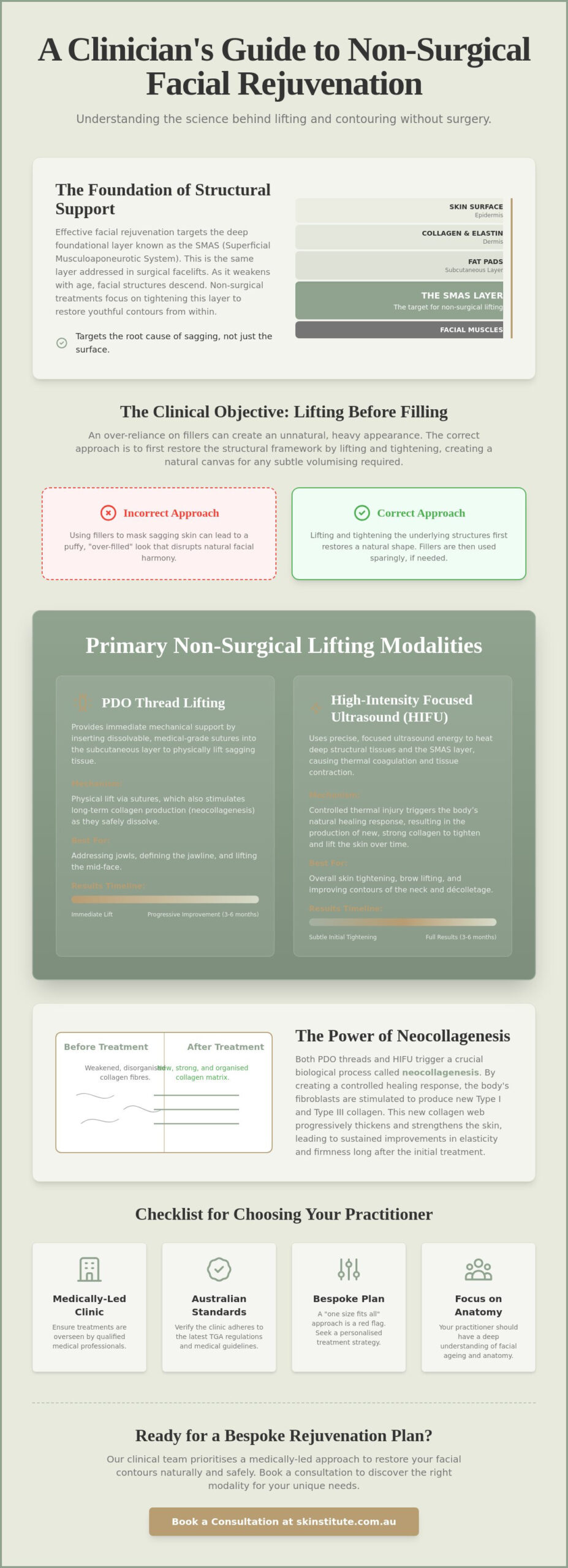
The foundation of any effective lifting procedure is the Superficial Musculoaponeurotic System (SMAS). This fibromuscular layer connects the facial muscles to the skin; it’s the same layer targeted during invasive surgery. As biological triggers such as collagen depletion and elastin degradation take hold, the SMAS loses its tension, leading to what is colloquially known as “the sag.” By Understanding Facial Rejuvenation through a clinical lens, we can apply medical-grade technologies to contract this layer without the need for a scalpel. Many Melbourne residents are pivoting toward these clinical aesthetics to avoid the prolonged downtime and general anaesthesia associated with theatre-based surgery, prioritising a more controlled and incremental approach to their appearance.
The Anatomy of Structural Descent
Differentiating between surface-level rhytids and deep-tissue laxity is essential for an accurate treatment plan. While wrinkles occur in the epidermis and upper dermis, structural descent is caused by the migration of subcutaneous fat pads. Over time, the malar fat pads in the cheeks move inferiorly, contributing to the formation of nasolabial folds and jowls. The Melbourne climate also plays a significant role in this transition. High UV exposure accelerates dermal atrophy, weakening the skin’s ability to hold these deeper structures in place. This results in a loss of jawline definition that cannot be resolved through topical skincare alone.
The Clinical Objective: Lifting vs. Filling
A common error in aesthetic medicine is the over-reliance on dermal fillers to mask sagging skin. While volumising treatments are effective for replacing lost fat, using them to pull skin upwards often leads to an unnatural, heavy appearance. The clinical objective should always be to restore structural support first. By tightening the SMAS and improving skin elasticity through neocollagenesis, we create a firmer canvas for any subsequent volumisation. Skinstitute’s philosophy centres on achieving a refreshed rather than an altered result, ensuring that facial contours remain harmonious and anatomically correct. This prioritisation of lifting over filling is essential for maintaining the natural movement and expression of the face.
Primary Modalities for Non-Surgical Facial Contouring
A successful non-surgical facelift melbourne relies on a synergy of medical-grade technologies rather than a single device. While some clinics position one treatment as a “gold standard,” clinical efficacy is usually found in combining mechanical lifting with biological skin thickening. Central to this is neocollagenesis, the process where the body is stimulated to produce new collagen fibres. By triggering a controlled wound-healing response, we can encourage fibroblasts to synthesise type I and type III collagen, which reinforces the skin’s internal scaffold.
The effectiveness of these clinical modalities is often supported by the use of precision tools and targeted formulations. Professionals in the field frequently look to Mesoskinline Australia for advanced aesthetic products, including the Mesopowerpen and high-performance serums, which are designed to enhance the outcomes of non-surgical rejuvenation procedures.
Prescription-only injectables remain a foundational component, particularly for modulating dynamic muscle movement and restoring lost volume in the mid-face. However, modern rejuvenation also incorporates biostimulators like Rejuran. This polynucleotide treatment works at a cellular level to repair damaged DNA and improve skin thickness, providing a holistic result that addresses both structure and surface texture. Researching various Non-Surgical Face Lift Options highlights the importance of this multi-layered approach to a non-surgical facelift Melbourne.
PDO Thread Lifting Melbourne: Mechanical Support
Polydioxanone (PDO) threads represent a significant advancement in non-surgical tissue repositioning. These medical-grade sutures are inserted into the subcutaneous layer to provide an immediate mechanical lift, physically elevating sagging tissue in the jawline and mid-face. The threads are eventually metabolised by the body, but as they dissolve, they leave behind a matrix of new collagen. This secondary biological benefit ensures that the lifting effect persists well after the physical thread has been absorbed. It’s a precise method for defining the jawline and restoring the “V-shape” of the lower face without invasive measures.
HIFU Treatment Melbourne: Thermal Tightening
High Intensity Focused Ultrasound (HIFU) offers a non-invasive method for thermal tightening. Unlike laser treatments that target the epidermis, HIFU delivers focused energy to the SMAS layer, creating discrete points of thermal coagulation. This process causes immediate contraction of the collagen fibres and initiates a long-term synthesis of new structural proteins. Because the energy bypasses the surface, there’s no epidermal damage, making it a preferred option for those requiring zero downtime. Results are not instantaneous; the biological maturation of new collagen typically takes three to six months to manifest fully. For those seeking a comprehensive clinical strategy, a bespoke consultation can help determine the ideal sequence of these modalities.
Buying Guide: Comparing Non-Surgical Lift Options
Selecting the appropriate clinical pathway for a non-surgical facelift Melbourne requires an objective assessment of tissue quality and the specific vectors of facial descent. A clinical framework for this decision prioritises the depth of intervention and the primary mechanism of action. While some patients require immediate mechanical repositioning of the skin, others benefit more from the gradual thermal contraction of the SMAS layer. Understanding these distinctions ensures that expectations align with biological realities.
The primary comparison often lies between PDO Thread Lifting and High Intensity Focused Ultrasound (HIFU). PDO threads are inserted into the subcutaneous layer to provide an immediate physical lift, making them ideal for correcting visible jowls or mid-face sagging. Conversely, HIFU utilises focused ultrasound energy to create thermal coagulation points at depths of up to 4.5mm. This triggers a contraction of the structural layers over several months. According to the American Society of Plastic Surgeons on Non-Surgical Facelifts, these procedures are most effective when they address the specific anatomical needs of the patient rather than following a generic protocol.
Bio-stimulators, such as Rejuran or Exosomes, serve as essential adjuncts in this process. They don’t provide a physical lift but instead improve the “bioregenerative capacity” of the skin. By enhancing the health of the extracellular matrix, these treatments ensure that the results of a thread lift or HIFU treatment are supported by thicker, more resilient dermal tissue. When evaluating the long-term value of these clinical treatments, patients should consider the cumulative benefit of biological repair alongside the immediate aesthetic improvement.
In addition to these clinical options, you can discover Zhong Centre to learn how their specialised cosmetic acupuncture and Traditional Chinese Medicine consultations support your skin’s natural vitality.
Which Treatment is Right for Your Skin Type?
Patients in their late 20s or 30s experiencing mild laxity often find success with “pre-juvenation” strategies. These typically involve HIFU or skin needling combined with Rejuran to maintain dermal density. For moderate sagging, particularly around the jawline, PDO thread lifting becomes the preferred modality due to its ability to mechanically reposition tissue. A combination approach is frequently the most effective strategy for a non-surgical facelift Melbourne, where HIFU provides the foundational tightening and prescription injectables address specific volume deficits or dynamic lines.
Assessing Suitability and Expected Outcomes
Suitability for non-surgical intervention depends heavily on skin thickness and underlying bone structure. Patients with significant solar elastosis or very thin skin may require a more intensive course of bio-stimulation before a mechanical lift can be successfully performed. It’s also vital to identify when a patient has surpassed the threshold where non-surgical methods can provide a satisfactory result. A patient’s suitability for a non-surgical facelift Melbourne is primarily determined by the degree of soft tissue ptosis, where mild to moderate descent yields the most predictable clinical outcomes. Those with severe skin redundancy may be better served by a surgical referral, as non-invasive technologies cannot excise excess tissue.
Clinical Considerations: Safety, Recovery, and Longevity
Safety and efficacy in clinical aesthetics are inextricably linked to the regulatory environment and the technical proficiency of the practitioner. For any patient pursuing a non-surgical facelift Melbourne standards of care mandate a thorough understanding of both the procedure and the subsequent recovery phase. Since the introduction of new Medical Board of Australia guidelines on July 1, 2023, practitioners must conduct real-time consultations for all injectable treatments, ensuring a high level of clinical oversight. This regulatory framework protects patients by requiring a formal medical assessment before any prescription-based intervention is initiated.
Technical mastery is particularly critical when performing PDO thread lifting, where the depth and vector of placement determine the success of the mechanical lift. A seasoned practitioner understands the delicate interplay between the subcutaneous fat pads and the SMAS layer, ensuring threads are anchored securely without causing surface irregularities. During the recovery phase, patients might experience mild swelling or bruising, which typically resolves within several days. Adhering to post-clinical instructions, such as avoiding strenuous exercise or facial massages for a specified period, is essential to prevent thread displacement and ensure optimal tissue integration.
The Clinical Journey: From Consultation to Aftercare
The process begins with a comprehensive medical skin analysis to assess dermal thickness and the degree of soft tissue ptosis. This data informs a customised treatment plan, where the practitioner outlines the expected biological response and obtains informed consent. Following the procedure, post-treatment monitoring and a scheduled clinical review allow the practitioner to evaluate the progress of neocollagenesis and ensure the patient’s recovery is proceeding as expected. This methodical approach ensures that every step of the non-surgical facelift Melbourne journey is grounded in clinical safety.
Longevity and Result Maintenance
The duration of clinical outcomes varies between modalities. PDO threads generally provide structural support for 12 to 18 months as the polydioxanone is gradually metabolised and replaced by a collagen matrix. In contrast, the thermal tightening effects of HIFU typically peak around the six-month mark, with many patients opting for annual maintenance sessions to sustain the tension within the SMAS layer. Supporting these results with medical-grade skincare that contains active retinoids or growth factors can further enhance dermal density. To begin your journey toward evidence-based results, you can book a clinical assessment with our experienced team.
The Skinstitute Approach to Non-Surgical Rejuvenation
Skinstitute has maintained a presence in Melbourne’s aesthetic industry for 26 years, prioritising a stable and evidence-based approach to patient care. This longevity reflects a commitment to medical-grade technology and protocols that have been refined through decades of clinical observation. A non-surgical facelift Melbourne at our clinic isn’t a pre-packaged service; it’s a organised, multi-layered intervention designed to address the specific biological needs of the individual. By integrating advanced therapies such as Rejuran, we ensure that structural lifting is supported by polynucleotide-driven skin repair, leading to results that are both durable and natural in appearance.
Our commitment to clinical excellence means we rely on established scientific principles rather than fleeting industry trends. Every treatment, from PDO thread lifting to high intensity focused ultrasound, is administered with a focus on technical proficiency and anatomical accuracy. We believe that a successful outcome is the result of a knowledgeable partnership between the practitioner and the patient, where transparency and educational clarity are valued above all else.
Why Clinical Expertise Matters in Facial Contouring
Precision is paramount. While high intensity focused ultrasound targets the SMAS layer at specific depths, the efficacy of the treatment depends entirely on the practitioner’s ability to identify the correct anatomical landmarks. Similarly, the vectors used in PDO thread placement must be calculated to ensure natural-looking symmetry and effective tissue repositioning. Our Melbourne clinic serves as a centre for advanced aesthetic excellence, where patient safety and the preservation of natural facial movement are our highest priorities. We avoid the “over-treated” look by focusing on subtle, structural improvements that respect your unique anatomy.
Booking Your Clinical Assessment
A comprehensive facial analysis is the essential first step for any structural lifting programme. During this clinical assessment, we examine dermal thickness, tissue laxity, and bone structure to develop your bespoke “lifting” roadmap. This diagnostic phase ensures that the recommended modalities, whether they involve prescription injectables or thermal tightening, are appropriate for your degree of soft tissue ptosis. We invite you to take the next step toward professional facial rejuvenation by scheduling a consultation, where we can provide an honest representation of the results achievable through our specialised non-surgical protocols.
Advancing Your Clinical Rejuvenation Strategy
Achieving a successful non-surgical facelift Melbourne requires a shift from surface-level corrections to deep-tissue structural restoration. This guide has detailed how the interaction between the SMAS layer and clinical modalities like PDO Thread Lifting and HIFU creates a foundation for natural facial contours. By prioritising neocollagenesis and precise tissue repositioning, it’s possible to address the physiological causes of sagging without the requirement for invasive theatre-based procedures.
Skinstitute brings over 26 years of clinical experience to every treatment plan, utilising medical-grade aesthetic technology to ensure safety and precision. As specialists in both mechanical lifting and thermal tightening, we provide a stable and evidence-based environment for your aesthetic journey. We invite you to Book Your Clinical Consultation at Skinstitute Melbourne to receive a comprehensive analysis and a bespoke roadmap for your rejuvenation. We look forward to partnering with you to achieve a refreshed and anatomically harmonious result.
Frequently Asked Questions
How long does a non-surgical facelift last?
The longevity of a non-surgical facelift Melbourne varies according to the specific clinical modality utilised. PDO thread lifting typically provides structural support for approximately 12 to 18 months as the sutures are metabolised and replaced by a collagen matrix. High Intensity Focused Ultrasound (HIFU) results usually peak at the six-month mark; however, annual maintenance is often recommended to sustain the tension within the SMAS layer against the ongoing biological ageing process.
Is a non-surgical facelift painful?
Discomfort is systematically managed through the application of topical numbing agents or local anaesthetic injections depending on the procedure. During a thread lift, local anaesthetic ensures the insertion process is well-tolerated, while HIFU involves a sensation of deep thermal pulses that most patients manage without significant distress. We prioritise clinical comfort to ensure the procedure remains a controlled and professional experience.
What is the difference between a thread lift and HIFU?
The primary distinction lies in the mechanism of action and the immediacy of the results. PDO threads provide an immediate mechanical lift by physically repositioning sagging tissue, whereas HIFU utilises focused ultrasound energy to induce thermal contraction of the SMAS layer over several months. These treatments are often used in tandem to provide both immediate structural support and long-term biological tightening of the facial architecture.
How much does a non-surgical facelift cost in Melbourne?
Treatment costs for a non-surgical facelift Melbourne are determined by the complexity of the clinical plan and the specific combination of technologies required. Because every face presents unique anatomical challenges, a bespoke consultation is necessary to outline the necessary vectors and modalities. This professional assessment allows for a transparent overview of the investment required to achieve your specific rejuvenation goals without the use of generic, one-size-fits-all pricing.
Are there any side effects to non-surgical lifting treatments?
Common clinical side effects include localised swelling, bruising, and mild tenderness at the treatment sites, which typically resolve within several days. While more significant complications are rare, our adherence to strict medical protocols and sterile environments minimises the risk of infection or asymmetry. Patients receive comprehensive aftercare instructions to manage these temporary physiological responses and ensure optimal healing.
Can I combine a non-surgical facelift with other treatments like Rejuran?
Integrating bio-stimulators like Rejuran is a highly effective strategy for enhancing the results of a structural lift. While threads and HIFU address the underlying architecture, Rejuran utilises polynucleotides to improve the thickness and elasticity of the dermis itself. This combination ensures that the lifted tissue is supported by a healthy, resilient skin matrix, leading to a more comprehensive and natural-looking rejuvenation.
Who is the ideal candidate for a non-surgical facelift?
The ideal candidate is an individual experiencing mild to moderate skin laxity and soft tissue descent who possesses sufficient dermal thickness. Those with realistic expectations and a preference for avoiding the risks associated with general anaesthesia and invasive surgery often achieve the most satisfying results. A clinical assessment is essential to confirm that the degree of ptosis can be effectively managed through non-surgical means.
What is the downtime associated with PDO threads?
Downtime for PDO thread lifting is significantly less than surgical alternatives, typically involving two to five days of social downtime. Patients may experience minor swelling or bruising, which can be managed with standard clinical aftercare. It’s recommended to avoid strenuous physical activity or dental work for approximately two weeks following the procedure to ensure the threads remain securely anchored during the initial integration phase.