Laser Skin Resurfacing Melbourne: A Clinical Guide to Fractional CO2 Technology
June 15, 2026
Rejuran Healer Treatment Melbourne: A Clinical Buying Guide to Skin Bio-Stimulation
June 17, 2026
Achieving anatomical harmony in the lips is a matter of precise medical science rather than a simple cosmetic enhancement. Most patients seeking lip filler in Melbourne share a common hesitation; the fear of results that appear artificial or disproportionate to their unique facial structure. It is understandable to feel anxious about the transition from a desired aesthetic to a reality that might feel overdone or medically unsound, especially given the prevalence of poorly executed procedures in the public eye. You deserve a treatment plan that respects your biological architecture and prioritises safety above all else.
This clinical guide provides a comprehensive medical perspective on how anatomical precision and stringent safety protocols ensure natural looking volume restoration. We will examine the physiological interactions of prescription injectables with the labial tissues and the importance of practitioner qualifications under the latest AHPRA guidelines. By moving beyond surface level descriptions, this article explores the technical methodology required to achieve symmetrical, subtle results that enhance your natural features. You will gain a deeper understanding of how evidence based practice and a thorough knowledge of facial anatomy are the only reliable paths to aesthetic success.
Key Takeaways
- Understand the biological role of prescription-grade Hyaluronic Acid in providing structural support and enhancing hydration within the labial tissues.
- Discover how the application of the Golden Ratio (Phi) ensures anatomical harmony, preventing the disproportionate appearance often associated with non-clinical procedures.
- Identify the essential safety protocols and medical-grade antiseptic standards required during a professional consultation for lip filler in Melbourne.
- Gain insight into the physiological timeline of recovery, including the management of post-treatment oedema and the factors affecting product longevity.
- Recognise the clinical advantages of seeking treatment from practitioners with extensive expertise in aesthetic medicine to ensure precise, evidence-based outcomes.
Understanding Lip Filler: The Science of Dermal Enhancements
Lip fillers are sophisticated medical devices. They are predominantly composed of Hyaluronic Acid (HA), a glycosaminoglycan naturally found within the human extracellular matrix. When administered as The Science of Dermal Enhancements, these gels act as a hydrophilic scaffold, providing immediate structural augmentation while integrating with the soft tissues of the lips. For those considering lip filler in Melbourne, it’s vital to understand that these substances are classified as prescription-only medicines, requiring a high level of clinical expertise for safe and effective delivery.
The Role of Hyaluronic Acid in Lip Anatomy
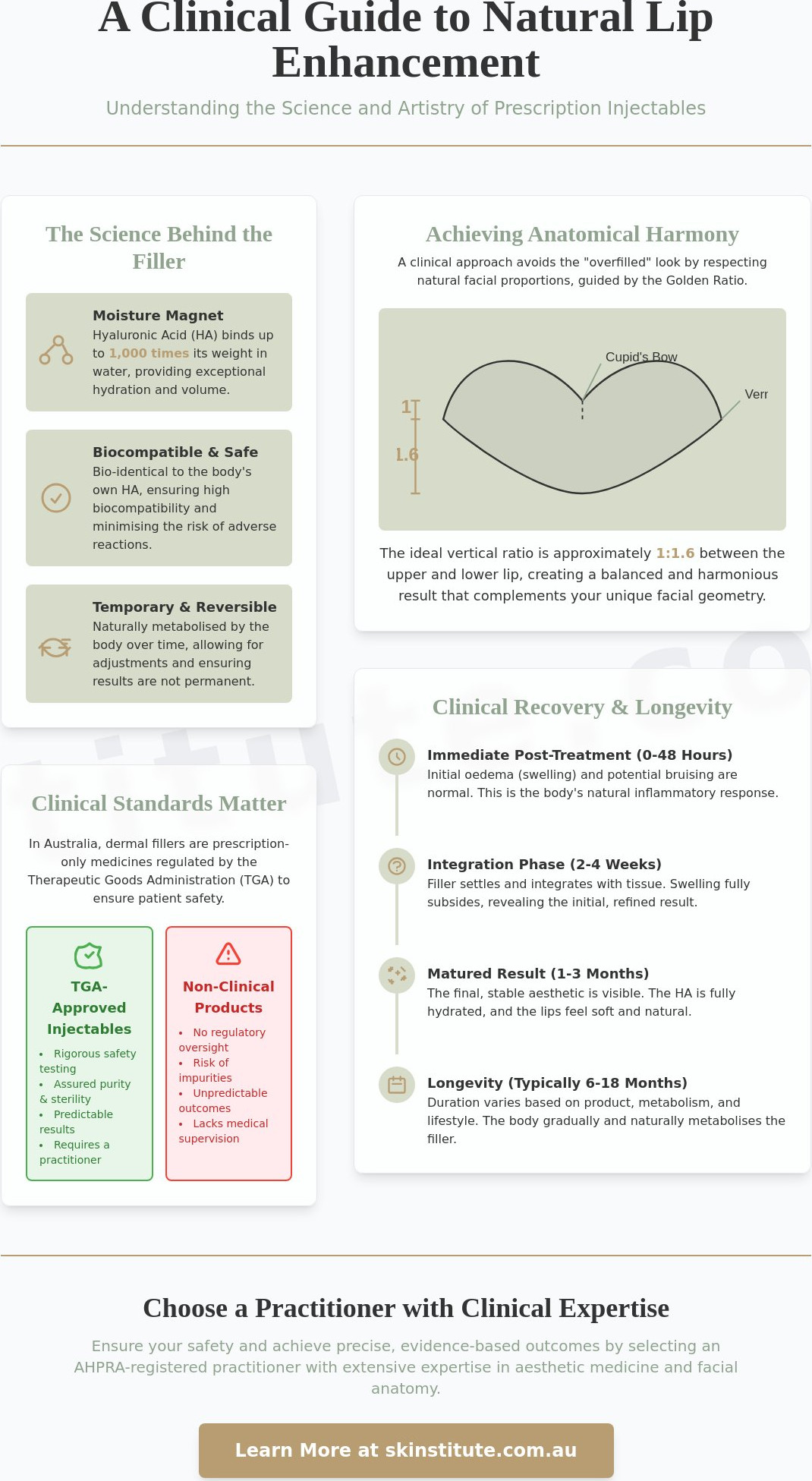
Hyaluronic Acid possesses an extraordinary capacity to retain moisture. It’s capable of binding up to 1,000 times its weight in water. This physiological property is essential for maintaining the suppleness and turgor of the labial mucosa. Because modern fillers are bio-identical to the HA produced by the body, they offer high levels of biocompatibility. This minimises the risk of adverse immunological responses or inflammatory reactions.
The body naturally metabolises these gels over time. This occurs through the enzymatic action of endogenous hyaluronidase. This gradual breakdown ensures that the results are temporary and can be adjusted or reversed if clinically necessary. The integration of the gel into the existing tissue ensures a seamless feel; the lips remain soft and move naturally during speech or facial expressions.
Prescription-Only Injectables vs. Cosmetic Grade
In the Australian regulatory environment, the Therapeutic Goods Administration (TGA) maintains strict oversight over the substances used in aesthetic medicine. Unlike over-the-counter cosmetic products, prescription injectables undergo rigorous testing to ensure purity, sterility, and predictable rheological properties. This legal requirement for medical oversight ensures that only high-purity, medical-grade products are utilised in a clinical setting.
Utilising TGA-approved products provides a significant clinical advantage. These formulations are designed to be stable and predictable. Practitioners select specific filler viscosities based on the desired anatomical outcome. Low-viscosity gels are ideal for fine lines and hydration, while high-viscosity gels provide structural lift to the vermillion border. This tailored approach prevents the overfilled appearance by respecting the natural resistance of the tissue when seeking lip filler in Melbourne. Clinicians must balance these technical factors to achieve a result that is both safe and aesthetically harmonious.
Achieving Natural Results: The Clinical Approach to Lip Proportion
The primary concern for patients seeking lip filler in Melbourne is the avoidance of a disproportionate or overfilled aesthetic, colloquially described as the ‘trout pout’. This undesirable outcome typically results from a failure to respect the underlying anatomical boundaries and ratios that define a balanced human face. Professional practitioners avoid generic augmentation by adhering to established aesthetic principles rooted in mathematics and biology, ensuring that the lips remain in harmony with the chin, nose, and cheeks.
Central to this clinical methodology is the Golden Ratio, or Phi (1.618), a mathematical proportion found throughout nature and human anatomy. In the context of labial aesthetics, clinical research suggests an ideal vertical ratio of approximately 1:1.6 between the upper and lower lips. Maintaining this balance prevents the upper lip from appearing top-heavy or artificial. While individual variations exist based on ethnicity and age, using these ratios as a baseline allows for a result that complements the patient’s existing facial geometry rather than overwhelming it. Understanding Clinical Recovery and Longevity is also essential, as the way a product integrates into these proportions determines the final aesthetic success over several months.
Defining the Vermillion Border and Cupid’s Bow
Structural definition often takes precedence over sheer volume when aiming for a refined result. The vermillion border serves as the critical transition zone between the skin and the mucous membrane; its preservation ensures that the filler remains within the lip’s anatomical compartment and does not migrate. Enhancing the Cupid’s bow requires technical precision to avoid flattening the philtrum, which can lead to a flattened, ‘duck-like’ profile in the lateral view. The philtrum columns provide the essential three-dimensional scaffolding that creates a natural and youthful profile.
Correcting Asymmetry Through Anatomical Assessment
True anatomical harmony requires a thorough assessment of skeletal and muscular asymmetry before any product is administered. Many patients present with subtle imbalances between the left and right planes, often caused by dental alignment, bone resorption, or habitual muscle use. By utilising micro-injections of prescription injectables, a clinician can carefully recalibrate these planes to achieve better symmetry. For first-time patients, a conservative ‘less is more’ methodology is preferred to allow the tissue to integrate the product gradually. This staged approach is a hallmark of professional aesthetic medicine, ensuring that enhancements remain undetectable yet effective while respecting the biological limits of the skin.
The Lip Filler Procedure: What to Expect at a Melbourne Clinic
The clinical procedure for lip filler in Melbourne follows a structured medical protocol designed to mitigate risk and ensure anatomical precision. Every stage of the process, from the initial assessment to the post-procedural briefing, occurs within a sterile environment that prioritises patient safety over retail convenience. This methodical approach ensures that each injection is placed with the accuracy required to achieve a balanced and medically sound result.
The Clinical Consultation and Scripting Process
A mandatory comprehensive consultation serves as the foundation of any treatment plan. During this phase, the practitioner conducts a thorough review of the patient’s medical history to identify potential contraindications, such as active infections, specific autoimmune conditions, or previous adverse reactions to prescription injectables. Under the Australian medical model, a prescribing doctor must oversee the consultation process, ensuring that the proposed treatment is physiologically appropriate for the individual. This stage is also where the practitioner assesses tissue capacity; injecting beyond the natural limits of the labial skin can lead to product migration or vascular compromise.
Once the clinical plan is finalised, the treatment area is prepared using medical-grade antiseptic protocols to eliminate surface pathogens and minimise the risk of infection. Patient comfort is managed through various clinical options based on the complexity of the procedure and individual sensitivity. Topical anaesthesia is frequently applied to desensitise the mucosal surface, while dental blocks may be utilised for more intensive structural work. These measures allow the patient to remain still and comfortable, which is essential for the practitioner to maintain the high level of technical precision required for symmetrical results.
Injection Techniques: Needle vs. Cannula
The delivery method is a critical technical decision that influences both the safety and the aesthetic outcome of the procedure. Blunt-tipped cannulas are often the preferred tool for volumisation because they are designed to navigate through tissue layers with minimal trauma to blood vessels and nerves. This technique significantly reduces the incidence of post-procedural bruising and oedema. Conversely, fine needles are employed when high-definition work is required along the vermillion border or for the precise correction of fine perioral lines. The choice between a needle and a cannula is determined entirely by the specific anatomical goal and the depth of the target tissue layer.
Clinical Recovery and Longevity of Lip Fillers
The post-procedural phase is a critical period where the administered Hyaluronic Acid gel integrates into the labial matrix. This biological process involves a predictable timeline of tissue response and stabilisation. For patients receiving lip filler in Melbourne, understanding this recovery window is essential for distinguishing between normal physiological responses and potential clinical concerns. Initial results are often obscured by localised oedema, which typically resolves as the product settles into its final anatomical position over the course of two weeks.
Managing Post-Treatment Swelling and Bruising
Swelling is a natural inflammatory response to both the physical injection process and the hydrophilic nature of the filler itself. This oedema generally peaks within 24 to 48 hours post-procedure before gradually subsiding. To manage this response, the application of cold compresses is recommended in short intervals during the first day. Patients should avoid strenuous exercise for at least 24 hours, as increased blood flow can exacerbate swelling and bruising. While minor bruising is common, it is vital to recognise the signs of rare complications like vascular compromise. If you experience mottled skin discolouration, significant blanching, or increasing pain, you must contact the clinic immediately for a medical review.
Maximising the Lifespan of Your Dermal Fillers
The longevity of a treatment depends on several biological and environmental factors. Most high-quality gels maintain their structural integrity for 6 to 12 months, though this varies based on individual metabolic rates. Lifestyle choices play a significant role in product degradation. For instance, excessive UV exposure and frequent use of high-intensity heat, such as saunas or steam rooms, can accelerate the thermal breakdown of HA chains. Maintaining systemic hydration is equally important, as HA relies on water binding to preserve its volumising effect. Integrating your aesthetic plan with fractional CO2 laser resurfacing melbourne can further enhance the perioral area by improving skin texture and collagen density around the lips.
Regular follow-up appointments are a cornerstone of professional clinical care. These sessions allow the practitioner to assess the symmetry and integration of the filler once the initial swelling has completely dissipated. A scheduled review ensures that any minor adjustments can be made with precision, maintaining the anatomical harmony discussed in previous sections. To ensure your results are monitored by an experienced professional, you can book a clinical review to discuss your long-term maintenance plan and ensure optimal tissue health.
Choosing a Medical-Grade Clinic for Lip Filler in Melbourne
Selecting a provider for lip filler in Melbourne requires a level of discernment that extends beyond social media portfolios or promotional discounts. The administration of prescription injectables is a significant medical intervention that demands a profound understanding of facial vascularity, nerve distribution, and soft tissue dynamics. A clinical environment, as opposed to a retail or spa setting, provides the essential infrastructure for maintaining sterile conditions and managing potential complications with professional rigour. Prioritising a facility that focuses on medical-grade aesthetic treatments ensures that your care is grounded in evidence-based medicine rather than fleeting commercial trends.
The Skinstitute Difference: Expertise and Stability
With over 26 years of industry experience in aesthetic medicine, the clinical team possesses a level of anatomical intuition that’s only refined through decades of dedicated practice. This longevity in the field allows for a nuanced understanding of how different tissue types respond to various Hyaluronic Acid viscosities over time. A commitment to ongoing professional development ensures that all practitioners remain at the forefront of cosmetic science, adhering to the most current safety standards and injection methodologies. This stability offers patients a consistent point of contact, which is vital for long-term aesthetic monitoring and the maintenance of the anatomical harmony discussed in previous sections.
Safety Protocols and Emergency Preparedness
Safety is the non-negotiable foundation of professional practice. A medical-grade clinic maintains theatre-grade sterile protocols for every procedure to prevent biofilm formation and late-onset inflammatory responses. Beyond the technical precision of the injection itself, emergency preparedness is a critical differentiator in a clinical setting. This includes the immediate availability of reversal agents, such as hyaluronidase, which can dissolve HA fillers in the rare event of a vascular emergency or if a patient’s aesthetic requirements change. Transparency regarding these protocols allows for an honest and ethical relationship between the practitioner and the patient, ensuring you’re fully informed at every stage of your journey.
When you’re ready to proceed with a treatment plan that values precision and clinical excellence, the first step is a professional assessment. You may book a clinical consultation for lip filler melbourne to discuss your specific aesthetic goals and undergo a comprehensive anatomical review. By choosing a partner with an established history of medical proficiency, you ensure that your results are both safe and naturally sophisticated.
Prioritising Clinical Integrity in Aesthetic Enhancement
Achieving a balanced result requires more than just volumisation; it demands a rigorous adherence to anatomical principles and the use of high-purity, medical-grade prescription injectables. We’ve explored how the integration of Hyaluronic Acid gels within the labial tissues follows a specific biological timeline and why maintaining the 1:1.6 ratio is essential for natural looking outcomes. By understanding the science behind dermal enhancements and the importance of professional oversight, you can approach your treatment with confidence in both safety and efficacy.
When seeking lip filler melbourne, the expertise of your practitioner is the most significant factor in ensuring long-term success. With over 26 years of clinical experience, our team focuses on specialised anatomical assessments to deliver results that respect your unique facial architecture. This medical-grade approach ensures that every procedure is conducted with technical mastery and a commitment to evidence-based outcomes. You are invited to Book Your Clinical Consultation at Skinstitute Melbourne to begin a professional dialogue regarding your aesthetic journey. We look forward to partnering with you to achieve a result that is both subtle and medically sound.
Frequently Asked Questions
How long does lip filler typically last?
Lip fillers typically maintain their structural integrity for six to 12 months. The precise duration depends on the specific rheology of the Hyaluronic Acid gel used and your individual metabolic rate. Factors such as frequent UV exposure or high-intensity cardiovascular exercise can accelerate the enzymatic breakdown of the product. Regular maintenance treatments are usually required once the initial volume begins to diminish through natural physiological processes.
Is the lip filler procedure painful?
Discomfort is minimised through the application of medical-grade topical anaesthesia or dental blocks. Most modern prescription injectables also contain lidocaine, a local anaesthetic that provides immediate numbing as the product is administered. While you may experience a sensation of pressure during the injection process, the procedure is generally well-tolerated within a clinical setting. Practitioners prioritise patient comfort to ensure technical precision during the anatomical assessment.
How much swelling should I expect after the treatment?
You should anticipate localised oedema for approximately 24 to 48 hours following your treatment. This swelling is a natural physiological response to the injection process and the hydrophilic properties of the filler. While the most visible swelling subsides within the first few days, the product requires up to two weeks to fully integrate into the labial tissues. We recommend planning your treatment at least a fortnight before significant social engagements.
Can lip filler be reversed if I am unhappy with the results?
Hyaluronic Acid fillers can be successfully reversed using a specialised enzyme called hyaluronidase. This agent is injected into the treatment area to facilitate the rapid enzymatic breakdown of the synthetic HA gel. This capability is a fundamental safety feature of the prescription injectables used for lip filler in Melbourne. Having reversal agents on hand is a non-negotiable safety standard for any reputable medical-grade clinic.
What is the difference between lip filler and a lip flip?
Lip fillers utilise dermal gels to physically add volume and structural definition to the labial compartments. In contrast, a lip flip involves the use of muscle-relaxing injections to temporarily weaken the orbicularis oris muscle, allowing the upper lip to roll slightly outward. While a lip flip creates the illusion of more height without adding volume, fillers are required to correct asymmetry or restore lost tissue turgor.
How do I avoid getting “duck lips” from my filler?
Avoiding a disproportionate appearance requires a strict adherence to anatomical ratios and precise product placement. The undesirable effect often occurs when filler is injected too superficially or in excessive quantities, causing it to migrate beyond the vermillion border. By respecting the 1:1.6 ratio between the upper and lower lips and choosing a gel with the appropriate viscosity, a clinical practitioner ensures that the enhancement remains harmonious with your facial profile.
Are there any long-term side effects of lip fillers?
Long-term adverse effects are rare when treatments are performed using sterile, theatre-grade protocols. Potential issues may include product migration or the formation of small nodules if the filler does not integrate correctly into the tissue. Choosing a clinic with extensive experience in aesthetic medicine significantly reduces these risks. Regular follow-up appointments allow your practitioner to monitor the tissue health and the structural stability of the filler over several months.
Can I get lip fillers if I have a history of cold sores?
You can safely receive lip filler in Melbourne with a history of cold sores, provided you follow a prophylactic antiviral protocol. The physical trauma of the injection can trigger a viral flare-up of the herpes simplex virus in susceptible individuals. It’s essential to disclose your history during the clinical consultation so your practitioner can provide the necessary guidance to be taken before and after the procedure to prevent an outbreak.