Cheek Filler for a Subtle Lift in Melbourne: A Clinical Guide to Midface Restoration
June 30, 2026
Liquid Facelift Melbourne Price: A Clinical Guide to Non-Surgical Rejuvenation
July 2, 2026
Achieving a balanced facial profile is less about the dimensions of a single feature and more about the mathematical relationship between the chin, nose, and jawline. It’s common to feel that a receding chin or a softened jawline detracts from your overall facial symmetry, but the prospect of invasive surgery often brings unnecessary anxiety regarding general anaesthesia and recovery times. You may also harbour concerns about the potential for an overfilled or unnatural result that fails to respect your unique anatomy. This article outlines the clinical pathway to achieving a more defined silhouette through chin augmentation non-surgical melbourne, focusing on evidence-based methods that prioritise safety, technical precision, and anatomical harmony.
We’ll examine the medical-grade alternatives to traditional surgical implants, including the role of prescription injectables and advanced lifting technologies. By understanding the biological interactions of these treatments and the importance of a thorough clinical assessment, you can make an informed decision about enhancing your profile through a structured, professional process. This guide provides the technical insight required to understand how modern aesthetic science can refine your appearance while maintaining a natural and grounded aesthetic result.
Key Takeaways
- Understand the anatomical significance of the Ricketts’ E-Plane and how it serves as a clinical benchmark for evaluating facial profile harmony.
- Explore the biological mechanisms of prescription injectables and PDO threads, focusing on how they provide structural support and dermal projection.
- Compare the longevity and adaptability of chin augmentation non-surgical melbourne against traditional surgical implants to determine which approach suits your long-term goals.
- Learn what to expect during a mandatory clinical assessment, including the evaluation of mentalis muscle activity and specific skin laxity requirements.
- Gain insight into the professional standards required for medical-grade enhancements, drawing on over two decades of clinical experience in the local industry.
Understanding Facial Proportions: The Role of the Chin in Profile Harmony
Facial aesthetics are defined by the precise structural relationship between the upper, middle, and lower thirds of the face. While the nose often receives the most attention during profile assessments, the chin acts as the anatomical foundation of the lower face. It provides the necessary projection to balance the midface and forehead. When the chin lacks sufficient prominence, the visual flow of the jawline is disrupted, which often makes the neck appear shorter and the nose appear disproportionately larger. This interconnectedness is why clinical practitioners view the face as a single, cohesive unit rather than a collection of isolated features.
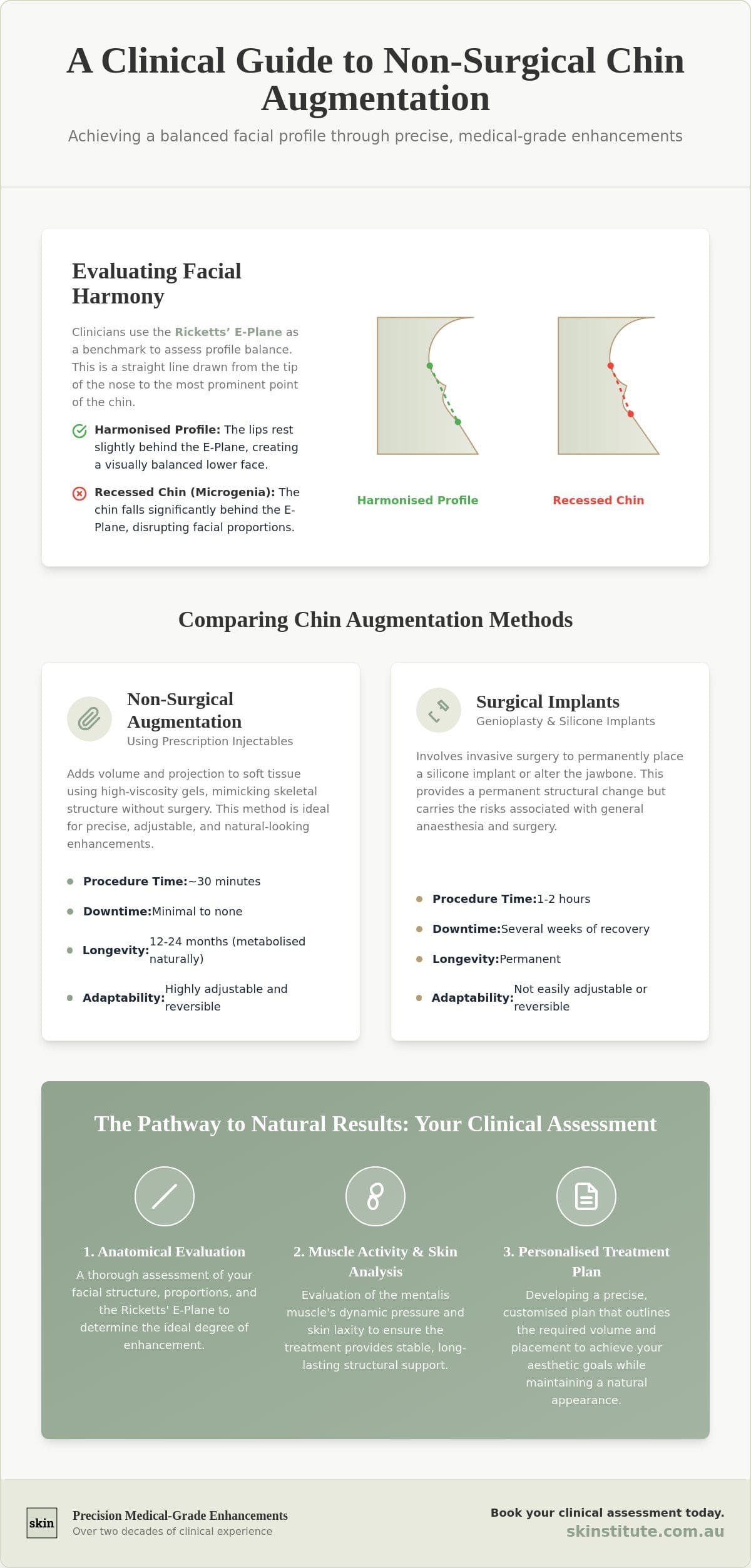
To assess this balance objectively, clinicians utilise the Ricketts’ E-Plane, or Esthetic Plane. This diagnostic tool involves drawing a line from the tip of the nose to the most anterior point of the chin. In a harmonised profile, the lips should sit slightly behind this line. If the chin is recessed, a condition medically known as microgenia, it falls significantly behind the E-Plane. Many patients seeking chin augmentation non-surgical melbourne do so to restore this balance. The E-Plane serves as a reliable clinical guide for determining the degree of retrusion, allowing the practitioner to calculate the volume of product required to bring the lower face into a more favourable alignment.
The Anatomy of a Receding Chin
The mentalis region is a complex layering of the mandibular bone, deep fat pads, and the mentalis muscle. A receding chin isn’t always a purely genetic trait. It’s often exacerbated by the natural progression of ageing. As we age, bone resorption occurs within the mandible, meaning the skeletal support for the lower face physically diminishes. This structural retreat causes the overlying soft tissues to lose their anchor, which contributes to the appearance of a softened jawline and increased submental fullness. It’s this loss of bone density that often creates the illusion of a “double chin,” even in individuals with a low body fat percentage.
Non-Surgical vs. Surgical Objectives
Traditional chin augmentation has historically relied on surgical genioplasty or the permanent placement of silicone implants. These invasive procedures require significant recovery periods and carry the risks inherent to general anaesthesia. In contrast, non-surgical modalities focus on soft tissue augmentation to achieve similar aesthetic goals. By using high-viscosity prescription injectables, practitioners can add volume that mimics the projection of a stronger skeletal structure. This provides a highly adaptable solution for chin augmentation non-surgical melbourne, allowing for incremental adjustments that respect the patient’s changing anatomy over time. The absence of downtime makes this a preferred clinical option for those who require a professional result without interrupting their daily commitments.
Non-Surgical Modalities: Prescription Injectables and Structural Support
The clinical success of chin augmentation non-surgical melbourne is heavily dependent on the rheological properties of the materials selected for the procedure. Unlike treatments designed for superficial fine lines, structural projection requires substances with a high G-Prime, or elastic modulus. This technical specification measures the material’s ability to retain its shape and provide mechanical lift when subjected to the dynamic pressures of the mentalis muscle. By placing these high-viscosity gels into the deep supraperiosteal plane, practitioners can mimic the presence of bone, effectively extending the mandibular profile without the need for permanent surgical hardware.
The Science of Dermal Volumisers
Modern prescription-only injectables are comprised of biocompatible gels that integrate into the dermal and sub-dermal layers. These materials act as a temporary matrix, providing immediate volume while maintaining a soft, natural feel that moves in synchrony with facial expressions. According to FDA information on Dermal Fillers, these substances are eventually metabolised by the body through natural enzymatic pathways. This metabolic process ensures that the enhancement isn’t static; it allows for gradual adjustments as the patient’s underlying bone density and fat distribution change over time. This adaptability is a primary reason why many clinical professionals prefer injectable modalities for long-term profile management.
Combining Modalities for Enhanced Definition
While injectables provide the necessary anterior projection, achieving a truly sharpened jawline often requires the integration of secondary treatments. PDO threads offer a unique clinical advantage by creating a structural scaffolding within the soft tissue. These polydioxanone sutures are inserted into the subcutaneous layer, where they provide a mechanical lift and trigger a biological healing response known as neocollagenesis. As the threads are absorbed, the body replaces them with a network of new collagen fibres, which strengthens the dermal matrix and provides a firmer foundation for the chin enhancement.
For patients requiring deeper tissue tightening, the synergy between volume replacement and HIFU (High Intensity Focused Ultrasound) is particularly effective. HIFU targets the SMAS layer, the same foundation addressed in surgical facelifts, to induce thermal coagulation and subsequent lifting. When layered with chin augmentation non-surgical melbourne, these multi-modal protocols deliver a medical-grade result that addresses both structural volume and skin laxity. If you’re interested in a comprehensive assessment of how these advanced technologies can be tailored to your anatomy, a consultation at Skinstitute provides the instructional guidance needed to develop a precise treatment plan.
Clinical Comparison: Fillers, PDO Threads, and Surgical Implants
Choosing between surgical and non-surgical pathways requires a pragmatic evaluation of long-term goals versus clinical flexibility. Surgical implants offer a “set-and-forget” solution, but they lack the ability to adapt to the physiological changes of the face. As we age, the underlying bone and fat pads shift; this can sometimes lead to a surgical implant appearing disconnected from the surrounding soft tissue over time. In contrast, chin augmentation non-surgical melbourne provides a modular approach. This allows the practitioner to adjust volume and placement in response to the patient’s evolving anatomy, ensuring the result remains natural-looking and balanced throughout different life stages.
For many younger patients in Melbourne, the reversibility of non-surgical treatments is a primary advantage. Committing to a permanent alteration of the skeletal structure can be a significant psychological and physical hurdle. Utilising Dermal Fillers or PDO threads allows an individual to test a new profile before committing to a life-long change. If the aesthetic outcome isn’t perfectly aligned with their expectations, certain injectable materials can be dissolved using specific enzymes, providing a level of safety and control that surgery simply cannot match.
Longevity and Maintenance
High-viscosity prescription injectables typically maintain their structural integrity for 12 to 24 months. This duration depends on the patient’s metabolic rate and the specific rheological properties of the product used. To preserve the sharpened jawline and projected profile, a maintenance schedule is usually recommended every 18 months. These follow-up appointments aren’t just about adding volume. They’re clinical opportunities to refine the contour as the skin’s elasticity and fat distribution naturally change, ensuring the “tweak” remains invisible to the untrained eye.
Risk Profile and Safety Standards
Transparency regarding clinical risks is essential for informed patient consent. While surgical genioplasty or implants carry risks of infection, nerve damage, or implant displacement, non-surgical options have their own set of considerations. The most significant concern in non-surgical treatments is vascular safety. Ensuring the material isn’t inadvertently injected into a blood vessel requires a practitioner with a deep understanding of facial anatomy. This is why seeking a clinic with over two decades of experience is vital. A seasoned practitioner uses precise, evidence-based techniques to mitigate these rare but serious risks, ensuring that the procedure remains a safe, medical-grade experience.
The Assessment Process: Anatomical Considerations for Natural Results
Every clinical journey begins with a comprehensive consultation, which serves as a mandatory prerequisite for any prescription-only treatment in Australia. This initial meeting is not merely a formality; it’s a critical diagnostic phase where your unique facial architecture is mapped and analysed. A thorough assessment for chin augmentation non-surgical melbourne involves more than just identifying a lack of volume. It requires a professional understanding of how the soft tissue, musculature, and underlying bone structure interact to create your current profile. By establishing a structured treatment plan, patients often feel a significant reduction in the anxiety associated with aesthetic changes, as the process becomes a collaborative effort based on objective clinical data.
During this evaluation, the practitioner applies the principles of the “Golden Ratio” to determine the ideal proportions for your face. This mathematical framework suggests that for a profile to appear balanced, the face should be divisible into equal thirds. The lower third, which encompasses the area from the base of the nose to the tip of the chin, is often where the most significant structural improvements can be made. Achieving facial symmetry isn’t about creating a “perfect” feature, but rather ensuring that the chin provides enough support to allow the other features to sit in harmony. This methodical approach ensures that the final result feels like an extension of your natural self rather than an artificial addition.
Mapping the Mentalis and Jawline
A vital part of the clinical assessment is observing the chin in both static and dynamic states. The practitioner must evaluate the mentalis muscle while you are talking and smiling to ensure the augmentation doesn’t interfere with natural expression. An overactive mentalis muscle can create a dimpled appearance, often referred to as peau d’orange, which may require specific clinical intervention before volume is added. Additionally, the depth of the mentolabial fold, the horizontal crease between the lower lip and the chin, is measured. This measurement dictates the volume and placement required to ensure the chin augmentation non-surgical melbourne integrates smoothly with the surrounding tissue.
Customising the Treatment Plan
Generic, “one-size-fits-all” approaches are avoided in a professional setting because they frequently lead to the “overfilled” look that many patients fear. A customised plan addresses specific asymmetries caused by genetics, dental alignment, or previous trauma. For some individuals, improving the chin is only one part of the solution. If skin quality or fine lines are also a concern, the practitioner might suggest integrating therapies like a CO2 laser to refine the skin texture and enhance the overall result. To begin your own profile assessment and discover a personalised pathway to balance, you can book a consultation with the experienced team at Skinstitute.
Achieving Precision with Skinstitute’s Medical-Grade Enhancements
Skinstitute has maintained a dedicated presence in the Melbourne aesthetic industry for 26 years, fostering a clinical environment where technical proficiency meets anatomical precision. Our commitment to chin augmentation non-surgical melbourne is underpinned by the exclusive use of medical-grade, prescription-only products. We prioritise the biological compatibility of every treatment, ensuring that the substances introduced to the dermal layers interact harmoniously with your existing physiology. This long-standing experience allows us to move beyond superficial enhancements; we focus instead on sophisticated profile balancing that respects the natural contours of the face. It’s a process of technical refinement.
The Skinstitute Clinical Difference
In our practice, we distinguish between simple volume replacement and true structural rejuvenation. While many providers focus on the immediate “filling” of a recession, our approach considers the long-term regenerative potential of the tissues. We utilise advanced injectables and PDO threads to stimulate the body’s own collagen production, ensuring that the results provide lasting support rather than a temporary aesthetic change. Our practitioners undergo continuous education to stay at the forefront of technical advancements. This ensures we maintain the high standards required for complex vascular safety and precision placement. This dedication to clinical excellence is delivered within a discreet, professional setting, providing patients with a sense of stability throughout their journey.
Your Journey to Profile Balance
The path to a refined profile begins with a detailed 30 to 45 minute clinical consultation. During this time, we conduct a thorough analysis of your facial proportions, skin laxity, and muscle activity. This diagnostic phase is essential for creating a bespoke treatment plan that avoids a generic, “overdone” appearance. We provide clear preparation protocols to minimise the potential for bruising and swelling. This often involves avoiding specific supplements or medications that may increase vascular sensitivity in the days leading up to your appointment. Precision requires careful preparation.
Following your procedure, we provide comprehensive post-treatment clinical support and follow-up care. This includes a structured schedule to monitor the integration of the product and ensure the desired projection is maintained. Our focus remains on achieving a subtle, sophisticated result that enhances your natural silhouette without appearing artificial. If you’re ready to explore how a medical-grade approach can redefine your profile, the next step is a professional assessment. By choosing a clinic with a deep-rooted history in Melbourne, you’re partnering with practitioners who value evidence-based results and patient safety above all else.
Refining Your Profile Through Clinical Expertise
Achieving facial harmony is an anatomical balancing act that requires a deep understanding of structural proportions and the interaction between soft tissue and skeletal support. By utilising high-viscosity prescription injectables and medical-grade technologies like PDO Threads, it’s possible to enhance your silhouette without the downtime associated with invasive surgery. The success of chin augmentation non-surgical melbourne relies on a methodical assessment process that respects the Golden Ratio and your unique muscular dynamics. This clinical approach ensures that every refinement provides a natural, sophisticated result that remains balanced as your anatomy evolves over time.
Skinstitute offers over 26 years of specialised aesthetic experience, providing a stable and professional environment for your journey. Our practitioners utilise evidence-based protocols and prescription-only treatments, including Rejuran and PDO Thread lifting, to achieve precise outcomes. Book Your Clinical Facial Assessment at Skinstitute Melbourne to discuss your specific goals with an established authority in profile balancing. We look forward to helping you achieve a more confident and harmonised appearance through technical mastery and clinical care.
Frequently Asked Questions
How long does non-surgical chin augmentation last?
Results typically persist for a duration of 12 to 24 months. The longevity of the effect depends on the rheology of the specific prescription injectable used and the individual’s metabolic rate. High-viscosity gels designed for structural projection tend to degrade more slowly than those used for superficial fine lines. Regular maintenance appointments are generally scheduled every 18 months to ensure the profile remains balanced as natural bone resorption occurs.
Is the procedure for non-surgical chin enhancement painful?
Most patients report only minimal discomfort during the clinical application process. The high-viscosity gels used in chin augmentation non-surgical melbourne often incorporate a local anaesthetic to ensure the procedure is well-tolerated. Additionally, a topical numbing agent can be applied to the mentalis region prior to the treatment to further desensitise the area. Any post-treatment tenderness usually resolves within 24 to 48 hours.
Can non-surgical chin augmentation fix a “double chin”?
While this procedure doesn’t physically remove submental fat, it can significantly improve the visual appearance of a “double chin” by providing anterior projection. By extending the chin forward, the soft tissue under the jawline is pulled tighter, creating a more defined transition between the neck and the face. For patients with significant submental fullness, a multi-modal approach incorporating HIFU may be recommended to address both structural projection and tissue laxity.
What is the difference between a chin implant and chin filler?
The primary difference lies in the permanence and the nature of the material used to achieve projection. A chin implant is a synthetic device surgically placed onto the mandible, requiring a significant recovery period and general anaesthesia. Conversely, non-surgical methods use biocompatible gels that are injected into the deep tissue layers. These injectables are adaptable, allowing the practitioner to adjust the volume as the face ages, whereas an implant remains static.
Are there any side effects to non-surgical chin augmentation?
Common side effects are generally mild and temporary, including localised swelling, bruising, or redness at the injection site. These physiological responses typically subside within a few days and don’t interfere with daily activities. More serious risks, such as vascular occlusion, are rare in a clinical setting but highlight the importance of choosing a practitioner with extensive anatomical knowledge. Professional clinics prioritise safety protocols to mitigate these risks and ensure a medical-grade outcome.
How much downtime is required after chin injectables in Melbourne?
There is virtually no clinical downtime required following the procedure, allowing most patients to return to their normal professional or social activities immediately. You may experience some minor swelling or a sense of “tightness” in the mentalis region for two to three days post-treatment. It’s recommended to avoid strenuous exercise or excessive heat exposure for the first 24 hours to ensure the material settles correctly and to minimise the risk of bruising.
Can I combine chin augmentation with other facial treatments?
Combining treatments is a common clinical strategy to achieve comprehensive profile balancing. For instance, PDO threads can be utilised alongside injectables to provide additional scaffolding for the jawline, while HIFU can be used to tighten the deeper SMAS layers. This multi-layered approach addresses volume loss, skin laxity, and structural definition simultaneously. Such combinations are often discussed during the initial consultation to ensure all aspects of facial harmony are addressed.
Is non-surgical chin augmentation reversible if I don’t like the result?
Reversibility is a key advantage of choosing chin augmentation non-surgical melbourne over permanent surgical options. If the aesthetic result isn’t aligned with your expectations, the injectable material can be safely dissolved using a specific enzyme called hyaluronidase. This enzyme breaks down the biocompatible gel within hours, returning the chin to its original state. This provides a significant safety net for patients who are cautious about making permanent changes to their facial structure.