
Tear Trough Filler Melbourne Cost: A Clinical Guide to Under-Eye Rejuvenation
June 29, 2026
Non-Surgical Chin Augmentation Melbourne: A Clinical Guide to Profile Balancing
July 1, 2026
The structural integrity of the midface serves as the primary anchor for the entire facial profile, yet it is often the first area to succumb to age-related volume depletion. When the malar fat pads descend, the resulting laxity frequently manifests as deepening nasolabial folds and a perceived heaviness in the lower face. You likely recognise that surface-level concerns are often symptoms of deeper anatomical changes. By utilising cheek filler for a subtle lift in Melbourne, practitioners can address these biomechanical shifts at their source. This approach focuses on architectural restoration rather than mere inflation, ensuring the face remains balanced and naturally contoured.
This clinical guide explores the precise mechanics of how strategic volume replacement in the midface provides a secondary elevation to the lower facial tissues. We will examine the anatomical principles behind supraperiosteal placement and how specific product rheology influences the final outcome. You’ll gain a deeper understanding of how to achieve a rested, refreshed appearance while avoiding the common pitfalls of over-correction. By prioritising technical precision and biological harmony, it’s possible to restore a youthful light reflex to the cheeks and subtly lift the jowls without altering your fundamental facial character.
Key Takeaways
- Understand how high-G-prime fillers act as a biological scaffold to replace lost bone density and deep fat, providing a stable foundation for the midface.
- Learn how strategic vectoring techniques using cheek filler for a subtle lift in Melbourne can reposition descending tissues and soften the appearance of the lower face.
- Gain insight into the TGA regulatory framework and why a formal medical consultation is mandatory for the safe administration of prescription injectables.
- Discover the importance of a bespoke treatment plan that prioritises anatomical precision to ensure results remain natural and avoid an over-filled appearance.
- Explore how integrating structural augmentation with therapies like PDO Thread Lifting creates a synergistic effect for comprehensive facial rejuvenation.
Understanding Midface Volume Loss and Facial Descent
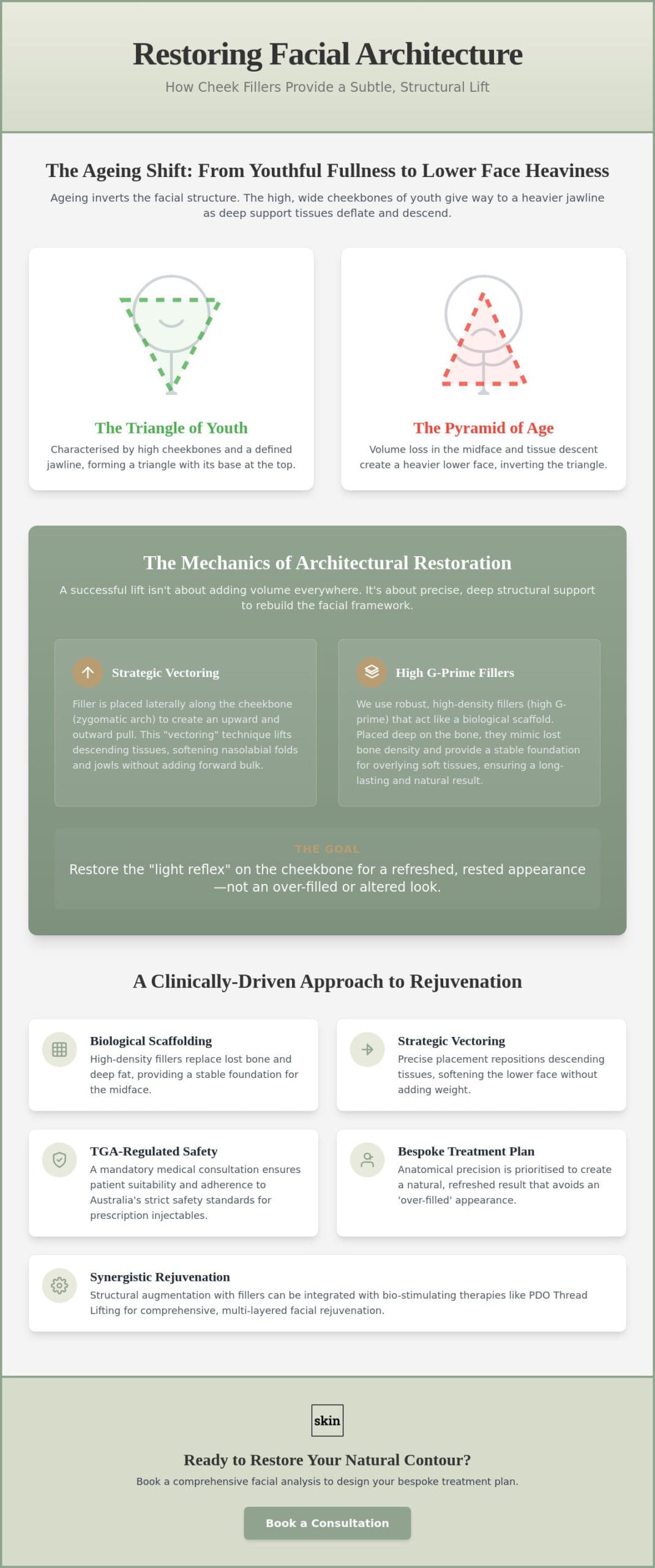
Facial ageing is a multi-dimensional process that involves the gradual degradation of bone, muscle, and adipose tissue. In youth, the facial structure is often described as the “Triangle of Youth”, where the widest point of the face resides across the malar region, tapering down to a defined chin. As we age, this geometry begins to invert. The depletion of deep fat compartments and the subsequent descent of superficial tissues create the “Pyramid of Age”, characterised by a heavier lower face and a hollowed midsection. Seeking cheek filler for a subtle lift in Melbourne is a clinical decision aimed at restoring this architectural foundation rather than simply masking surface wrinkles.
The Role of the Malar Fat Pads
The midface is composed of several distinct fat compartments, known as the malar fat pads. These compartments don’t age at a uniform rate. When the deep medial cheek fat pad loses volume, the overlying superficial fat pads lose their primary support. This separation often manifests as a visible “tear trough” or a distinct line across the midface. Compounding this issue is the natural resorption of the zygomatic bone, which reduces the projection of the cheekbone. A foundational understanding of injectable fillers reveals that these products can be utilised to mimic the lost bone density, providing a stable base for the remaining soft tissues.
Distinguishing Between Volume and Lift
A common clinical misconception is that adding volume to the anterior cheek, often referred to as the “apple”, will automatically lift the face. In reality, excessive volume in this area can lead to a heavy, unnatural appearance often termed “pillow face”. True structural elevation requires a focus on the lateral cheek and the zygomatic arch. The zygomatic-cutaneous ligaments act as anchor points for the facial skin. By placing product strategically at these “lifting points”, a practitioner can create a subtle upward tension. This lateral placement provides the necessary support to soften the nasolabial folds and reduce the appearance of jowls. Utilising cheek filler for a subtle lift in Melbourne ensures that the face remains elongated and contoured, avoiding the unnatural width associated with poorly planned treatments.
Effective midface restoration is not about total volume replacement. It’s about precision. By identifying where the structural scaffold has weakened, practitioners can use small, targeted amounts of product to achieve a significant physiological shift. This method respects the natural anatomy and prioritises a refreshed, rested look over an obvious cosmetic change.
The Mechanics of a Subtle Lift: Architectural Restoration
Achieving a refined aesthetic outcome requires a shift in perspective from filling a void to reconstructing a scaffold. When administering cheek filler for a subtle lift in Melbourne, practitioners select products based on their rheology, specifically focusing on high-G-prime values. G-prime refers to the elastic modulus of a gel, which dictates its ability to resist deformation and provide structural support. By utilising these robust FDA-approved dermal fillers, it’s possible to mimic the projection of the zygomatic bone, effectively lifting the overlying soft tissues. This deep-tissue integration ensures that the material remains stationary during dynamic facial movements, preserving the natural cadence of your expressions.
The clinical success of this procedure relies heavily on the principle of vectoring. Vectoring is the strategic placement of filler to create upward tension. By focusing the majority of the product on the lateral aspects of the cheek, we create a superior-lateral pull on the skin and the underlying Superficial Muscular Aponeurotic System (SMAS). This mechanical shift addresses the nasolabial fold at its source. Rather than adding weight to the fold itself, which can lead to a bloated appearance, reinforcing the lateral cheek tension naturally smooths the transition from the nose to the mouth. A comprehensive facial analysis helps identify the specific vectors required to harmonise your unique proportions.
Structural Support of the Zygomatic Arch
Restoring the zygomatic arch involves deep supraperiosteal injections, where the filler is placed directly above the bone. This technique provides a firm foundation that supports the malar fat pads and prevents further descent. Because the product is situated beneath the musculature, it provides a stable contour that enhances the existing bone structure without adding unnecessary bulk to the superficial layers. This approach is fundamental to achieving a result that appears inherent rather than applied.
Softening the Transition Zones
A sophisticated midface restoration must account for the transition zones between the cheek, the temple, and the lower eyelid. Abrupt changes in volume can create visible “steps” that signal cosmetic intervention. By blending the filler into the pre-auricular area and the lateral temple, we create a seamless, continuous contour. This integration reduces the hollowed look often associated with ageing and ensures that the light reflects evenly across the midface. Addressing these junctions is critical for maintaining a cohesive and refreshed appearance that stands up to scrutiny from every angle.
Clinical Safety and Melbourne Standards for Prescription Injectables
The regulatory environment in Australia ensures that medical aesthetic procedures are conducted under stringent safety protocols. The Therapeutic Goods Administration (TGA) classifies the substances used for midface restoration as prescription-only medications. This classification necessitates a comprehensive medical consultation before any treatment can commence. During this process, a practitioner evaluates your medical history, current medications, and aesthetic goals to ensure the procedure is clinically appropriate. When considering cheek filler for a subtle lift in Melbourne, it’s vital to recognise that patient safety is predicated on this initial medical assessment rather than the treatment itself.
Managing expectations is a cornerstone of clinical practice. While strategic volume replacement offers significant structural support, it’s distinct from invasive plastic surgery. A subtle lift refers to the repositioning of soft tissues through architectural reinforcement, which differs from the physical removal of skin. Patients should understand that while injectables can soften jowls and nasolabial folds, they don’t replicate the results of a surgical facelift. Addressing potential complications, such as vascular occlusion or filler migration, requires a practitioner with deep anatomical knowledge. Vascular occlusion occurs if product enters a blood vessel, a rare but serious event that demands immediate clinical intervention. Migration is often the result of poor product choice or incorrect depth of placement, highlighting the need for technical mastery.
Identifying a Qualified Cosmetic Injector in Melbourne
Selecting a practitioner involves more than reviewing aesthetic portfolios. It requires verifying clinical experience and anatomical proficiency. Skinstitute prioritises patient safety through over 26 years of industry expertise, ensuring that every procedure is informed by a deep understanding of facial vasculature and musculature. New AHPRA guidelines, effective from September 2025, further reinforce these standards by requiring registered health practitioners to follow strict protocols for non-surgical cosmetic procedures. This includes a mandatory real-time consultation to ensure the prescribing medical professional has personally assessed the patient’s suitability for cheek filler for a subtle lift in Melbourne.
Managing Potential Side Effects
Post-treatment responses such as localised swelling, bruising, and tenderness are common and typically resolve within a few days. Our clinical protocols focus on ensuring the product integrates harmoniously with the surrounding tissue. This involves precise placement and, in some cases, specific post-care instructions to facilitate optimal settling. Follow-up appointments in a medical-grade setting are essential. They allow the practitioner to monitor the integration process and ensure the intended anatomical correction has been achieved without complications. This methodical approach values long-term results and professional integrity over immediate, surface-level changes.
The Consultation Process: Designing Your Bespoke Treatment Plan
A successful clinical outcome begins with a rigorous diagnostic phase that extends beyond surface-level aesthetics. Every face presents a unique anatomical landscape, requiring a tailored approach to identify the specific vectors of volume loss. We must determine if the primary driver of facial descent is bone resorption, fat pad depletion, or a combination of both. When planning cheek filler for a subtle lift in Melbourne, a formal consultation allows for a meticulous assessment of skin quality and tissue thickness. This data is essential because the condition of the dermis directly impacts the structural efficacy of the filler and its ability to provide a visible lift.
Step 1: Dynamic Facial Assessment
Evaluating the face at rest provides only a partial understanding of the ageing process. During your assessment, we examine the midface during various expressions to observe how the musculature interacts with the fat compartments. This dynamic analysis ensures that the product is placed in a manner that remains natural during speech and laughter. We also identify inherent asymmetries, which are present in nearly every individual. By varying the depth and volume of placement on each side, we can harmonise the facial proportions. Analysing skin laxity is also vital. If the skin has lost significant elasticity, we must carefully calibrate the treatment plan to ensure the degree of lift is realistic and biologically supported.
Step 2: Product Selection Based on Rheology
The choice of injectable is a technical decision based on rheology, the science of how materials flow and deform under pressure. Not all hyaluronic acid formulations are suitable for every area of the face. For architectural restoration, we select high-G-prime fillers. These products possess the elastic modulus required to mimic bone and provide the “push” needed to elevate descending tissues. For more superficial layers or transition zones, a more cohesive and flexible gel is preferred to ensure seamless integration. Tailoring the product selection to your specific skin type and age ensures that the cheek filler for a subtle lift in Melbourne behaves predictably and remains undetectable to the naked eye.
A sophisticated restoration often benefits from a staged treatment plan rather than a single high-volume session. This allows the filler to integrate fully with the surrounding tissue, providing a foundation that can be refined in subsequent visits. You can book a clinical consultation to begin the process of designing a bespoke plan tailored to your unique anatomical requirements. This methodical progression prioritises long-term facial maintenance and professional integrity, ensuring your results remain refreshed and age-appropriate without ever appearing over-filled.
The Skinstitute Approach: Integrating Cheek Fillers with Bio-Stimulation
While cheek filler for a subtle lift in Melbourne provides the necessary architectural foundation, the final aesthetic outcome is often limited by the quality of the overlying skin. If the dermis is thin or lacks elasticity, even the most precise structural augmentation may not achieve its full potential. We advocate for a multi-layered approach where volume restoration is integrated with bio-stimulatory therapies. For instance, combining fillers with PDO Thread Lifting provides a dual-action result. The filler addresses deep volume deficits while the threads provide mechanical suspension and stimulate long-term collagen production. This synergy ensures that the midface is not only supported from beneath but also physically lifted through the subcutaneous layers.
Effective rejuvenation requires moving beyond the concept of “one-off” appointments. By establishing a routine that incorporates both structural support and cellular stimulation, we can manage the ageing process more effectively. This proactive methodology values professional integrity and evidence-based results, allowing for a refreshed appearance that evolves gracefully. Integrating cheek filler for a subtle lift in Melbourne into a wider, more comprehensive plan ensures the results remain natural and sustainable over the long term.
Complementing Fillers with Rejuran and Exosomes
To enhance the biological environment of the midface, we often utilise Rejuran in Melbourne alongside structural injectables. Rejuran consists of polynucleotides that work at a cellular level to repair damaged skin and increase dermal thickness. This bio-stimulation creates a more robust “envelope” for the filler, ensuring a smoother transition and more natural light reflection across the zygomatic arch. Additionally, exosome therapy can be employed to accelerate the healing response and facilitate rapid tissue integration. This multi-layered strategy ensures that we aren’t just masking volume loss but actively improving the health and resilience of the facial tissues.
Advanced Resurfacing for Final Refinement
Structural restoration addresses the descent of fat pads, but surface irregularities like fine lines and pigmentation require a different modality. Integrating Fractional CO2 Laser resurfacing allows us to refine the skin’s texture once the underlying scaffold has been established. This laser technology creates micro-channels of thermal injury that trigger a significant regenerative response, smoothing the surface and tightening the skin. For patients seeking a non-invasive finalisation of the lift, medical-grade skin needling or High Intensity Focused Ultrasound (HIFU) can be used to further contract the tissue. This comprehensive focus on both structure and surface ensures a cohesive aesthetic result that treats the face as a functional, biological whole.
Restoring Midface Architecture with Clinical Precision
The restoration of the midface is a technical endeavour that requires a deep understanding of facial anatomy and product rheology. By moving beyond the simplistic addition of volume, we focus on architectural reinforcement to counteract the natural descent of facial tissues. This clinical approach ensures that the use of cheek filler for a subtle lift in Melbourne remains a sophisticated tool for rejuvenation rather than a means of radical alteration. Integrating these treatments with bio-stimulatory therapies further enhances the structural result by improving the biological health of the dermis.
Skinstitute brings over 26 years of clinical aesthetic experience to every procedure, specialising in medical-grade prescription injectables that prioritise safety and professional integrity. Our practitioners develop bespoke treatment plans tailored to your specific anatomical requirements. It’s this commitment to evidence-based care that ensures your results remain natural and refreshed. We invite you to take the next step in your aesthetic journey by engaging with a team that values technical mastery and long-term facial health.
Book a Clinical Consultation with our Melbourne Experts and discover how a personalised restoration plan can harmonise your facial profile.
Frequently Asked Questions
How long does cheek filler for a subtle lift typically last?
The longevity of the result depends on the specific rheology of the high-G-prime gel and your individual metabolic rate. Most structural products utilised for midface restoration last between 12 and 24 months. Over time, the hyaluronic acid is naturally metabolised by the body, necessitating a maintenance programme to preserve the architectural support provided by the treatment.
Will cheek fillers make my face look wider or “puffy”?
Strategic placement of cheek filler for a subtle lift in Melbourne focuses on the lateral zygomatic arch rather than the anterior cheek. This technique ensures that the face is elongated and lifted rather than widened. The “puffy” or “pillow face” appearance is typically the result of over-filling the medial fat pads, a pitfall we avoid by prioritising structural restoration over simple volume addition.
Can cheek fillers actually help reduce the appearance of jowls?
Yes, by restoring volume in the midface, we create a superior-lateral pull that can soften the appearance of jowls. This mechanical shift addresses the source of the sag in the upper face, which reduces the weight descending onto the jawline. It’s a foundational step in non-surgical lower face rejuvenation, providing a secondary elevation to the tissues of the lower face.
What is the difference between cheek fillers and a PDO thread lift?
Cheek fillers provide a biological scaffold by replacing lost volume and bone density, essentially addressing the “deflation” aspect of ageing. In contrast, a PDO thread lift uses dissolvable sutures to provide immediate mechanical suspension and stimulate long-term collagen production. While fillers restore the foundation, threads address the “descent” or laxity of the skin, and they are often used together for a synergistic result.
Is there any downtime required after a cheek filler treatment in Melbourne?
Most patients experience minimal downtime and can return to their daily activities immediately after the procedure. You may observe mild swelling, tenderness, or bruising at the injection sites for 24 to 48 hours. We recommend avoiding strenuous exercise and excessive heat for the first two days to allow the product to integrate correctly with the surrounding tissue.
How many ml of filler are usually required for a subtle midface lift?
The volume required is determined during your clinical assessment and varies based on the degree of malar fat pad depletion. Generally, 1 to 2 ml per side is sufficient to achieve a refreshed and natural appearance. Our clinical philosophy is to use the minimum amount of product necessary to provide a visible structural correction, ensuring the result remains subtle and age-appropriate.
Are cheek fillers painful, and what clinical numbing options are available?
Discomfort is typically minimal as the prescription injectables contain lidocaine, a local anaesthetic that numbs the area during the procedure. We also utilise topical anaesthetic creams and ice to further manage sensation and ensure patient comfort. Most individuals describe the sensation as a mild pressure rather than significant pain, making the treatment well-tolerated.
When will I see the final results of my cheek augmentation?
You’ll notice an immediate improvement in facial contour, but the final result is usually visible after 2 to 4 weeks. This timeframe allows any minor swelling to resolve and the filler to fully integrate with the surrounding anatomical structures. A follow-up appointment is typically scheduled to monitor this integration and ensure that the desired level of restoration has been achieved.