Double Chin Removal Treatment Melbourne: A Clinical Guide to Submental Contouring
July 10, 2026
HIFU vs Thread Lift for Jawline Melbourne: A Clinical Comparison
July 12, 2026
Selecting a skin tightening procedure based primarily on the lowest available quote often results in a complete loss of investment rather than a financial saving. You’ve likely encountered a significant disparity when researching the cost of hifu for face and neck australia, where prices fluctuate between entry-level beauty salon offerings and specialist clinical protocols. This price variance isn’t arbitrary; it reflects the fundamental difference between superficial thermal applications and the precise targeting of the Superficial Musculoaponeurotic System (SMAS) layer.
It’s understandable to feel hesitant when faced with such a wide range of pricing models and technology grades. This clinical guide provides the clarity you require to distinguish between high-intensity focused ultrasound (HIFU) devices that are TGA-listed and those that lack medical-grade credentials. We’ll examine how anatomical factors, device sophistication, and the biological synergy between face and neck treatments influence the overall investment. By the end of this analysis, you’ll understand how to evaluate the cost-to-result ratio to ensure your choice yields a visible, long-term lift.
Key Takeaways
- Understand the physiological distinction between medical-grade technology and generic salon devices to ensure your investment targets the SMAS layer effectively.
- Evaluate the cost of hifu for face and neck australia by considering the total number of energy lines delivered rather than focusing solely on the base session fee.
- Recognise that while initial tightening may occur, the definitive clinical lift typically manifests between three to six months as the process of neocollagenesis progresses.
- Discover why treating the face and neck as a single anatomical unit provides superior structural support and more cohesive aesthetic results compared to isolated treatments.
- Learn why a professional clinical assessment is the most critical step in avoiding ineffective treatments and determining your biological suitability for the procedure.
Understanding HIFU and the Clinical Value of Non-Surgical Lifting
High-Intensity Focused Ultrasound (HIFU) represents a significant advancement in non-invasive aesthetic medicine. Unlike surface-level laser treatments, this technology bypasses the epidermis to deliver concentrated acoustic energy into the deep structural tissues. The primary target is the Superficial Muscular Aponeurotic System (SMAS). This fibromuscular layer is the same tissue surgeons manipulate during a traditional rhytidectomy. By targeting this depth, clinicians can achieve a structural lift that was previously only possible through invasive surgery. Australians are increasingly choosing this method because it offers a predictable physiological response without the associated downtime of a theatre procedure.
The Biological Mechanism: How HIFU Stimulates Collagen
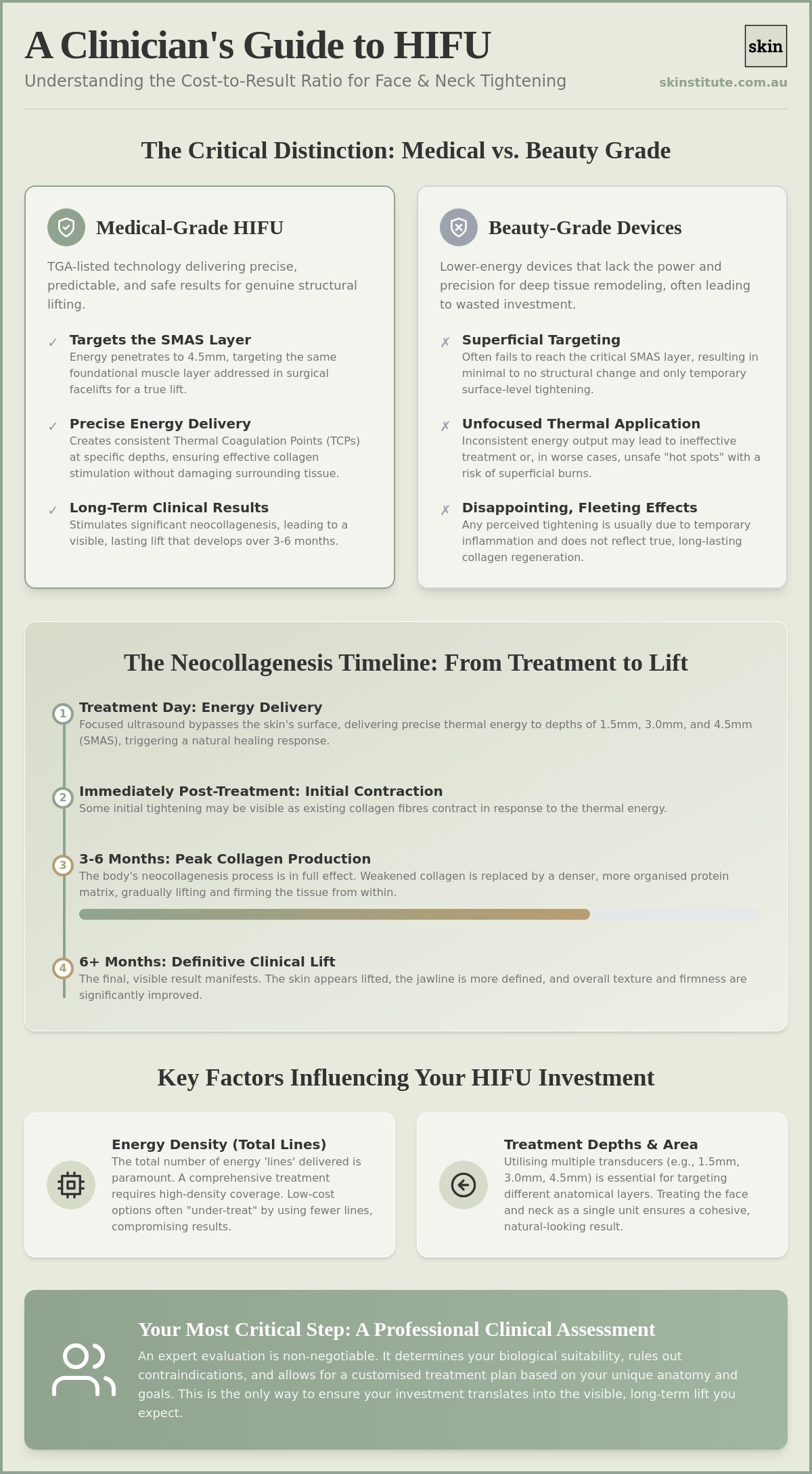
The efficacy of this treatment relies on the precise creation of thermal coagulation points (TCPs) at specific depths. A medical-grade device utilises transducers to focus energy at 1.5mm, 3.0mm, and 4.5mm below the skin surface. These micro-injuries trigger a robust wound-healing response within the dermis and SMAS. Neocollagenesis is the natural process of new collagen formation triggered by controlled thermal energy. Over the subsequent months, the body replaces weakened collagen fibres with a denser, more organised protein matrix. This biological restructuring is a key driver when evaluating the cost of hifu for face and neck australia, as the quality of the device determines the precision and safety of these thermal points.
Why Face and Neck Synergy Matters
Factors Influencing the Cost of HIFU for Face and Neck in Australia
Pricing for advanced aesthetic treatments isn’t always static. When investigating the cost of hifu for face and neck australia, patients often encounter a broad spectrum of quotes. This variation primarily reflects the distinction between TGA-listed medical devices and lower-energy beauty-grade equipment. Medical-grade systems provide consistent energy stability and depth precision, ensuring the thermal coagulation points reach the SMAS layer without causing superficial burns or ineffective results.
The density of energy delivery, measured in “shots” or lines, is a major component of the cost of hifu for face and neck australia. A comprehensive face and neck protocol requires a high volume of lines to ensure adequate coverage and tissue contraction. Clinics that offer suspiciously low prices may be “under-treating” the area by delivering fewer lines, which ultimately compromises the longevity of the results. Additionally, geographic location and clinic overheads in major metropolitan hubs like Melbourne or Sydney often correlate with the standard of technology and safety protocols maintained by the facility.
Anatomical Complexity and Treatment Depth
Achieving a natural lift requires the use of multiple specialised transducers. For instance, the delicate periorbital region requires a shallow 1.5mm cartridge, while the thicker dermal layers of the neck and the underlying platysma muscle necessitate 3.0mm and 4.5mm depths. The total investment accounts for the consumption of these varied cartridges. Individual skin laxity also dictates the duration of the clinical protocol; more advanced sagging requires a more intensive delivery of energy to stimulate sufficient neocollagenesis. This tailored approach ensures that the energy is deposited exactly where it’s needed for structural support.
The Role of Practitioner Expertise
While many providers offer cosmetic procedures with HIFU, the technical proficiency of the operator is a primary cost driver. Medical-led clinics often maintain higher overheads due to rigorous safety standards and continuous staff training. A seasoned practitioner uses precise anatomical mapping to avoid major facial nerves and vascular structures while maximising the lifting effect. This level of safety and precision is only available through a professional clinical assessment, which ensures the treatment is tailored to your specific facial architecture. Choosing a clinic with decades of experience, such as Skinstitute, ensures that your investment is backed by clinical mastery rather than marketing trends.
Comparing HIFU Costs: Medical-Grade vs. Beauty-Grade Technology
The significant variance in the cost of hifu for face and neck australia is primarily a reflection of the hardware’s engineering and energy stability. Medical-grade systems are designed to produce a consistent thermal effect at precise depths. In contrast, generic beauty-grade machines often exhibit fluctuating energy outputs. These fluctuations can lead to sub-therapeutic results; even worse, they can cause superficial burns if energy is deposited too close to the skin’s surface. Choosing a clinical provider ensures the technology is calibrated to deliver the exact joules required for tissue contraction. It protects the integrity of your epidermis while ensuring the energy reaches the intended structural layers.
The Ultraformer III Advantage
As an industry leader in Australia, the Ultraformer III employs Micro and Macro Focused Ultrasound (MMFU) technology. This system allows for high-peak power delivery, creating thermal coagulation points more efficiently than lower-grade alternatives. By delivering energy rapidly, the device minimises “heat soak” into surrounding sensory nerves. This significantly improves patient comfort during the procedure. Clinical evidence consistently supports the efficacy of these branded devices. Unbranded machines often lack the peer-reviewed data necessary to guarantee a predictable biological response. Patients receive a more uniform treatment profile with medical-grade hardware, ensuring the cost of hifu for face and neck australia results in a tangible clinical outcome.
Safety Standards in Australian Cosmetic Clinics
The regulatory oversight provided by the Australian government ensures that TGA-registered HIFU devices meet stringent manufacturing and safety benchmarks. These are classified as Class IIb medical devices, reflecting their complexity and potential impact on human tissue. In a professional medical setting, practitioners perform meticulous anatomical mapping. They avoid critical nerves and vascular structures. A significant risk of budget HIFU is the potential for unintended fat atrophy, often referred to as fat melting. This occurs when energy is incorrectly focused on subcutaneous adipose tissue rather than the SMAS. It leads to a hollowed, aged appearance rather than a lifted one. Professional clinics mitigate this risk through regular device calibration and advanced clinical training. This level of oversight justifies the investment required for a medical-grade procedure.
Budgeting for Results: Sessions, Maintenance, and Longevity
The financial commitment involved in high-intensity focused ultrasound is best viewed through a long-term lens. While a subtle, immediate contraction of existing collagen fibres is often visible post-procedure, the definitive structural lift manifests between three and six months. This delay corresponds with the biological timeline of neocollagenesis. When calculating the cost of hifu for face and neck australia, patients should consider the amortised value over a 12 to 18-month period. Viewing the investment as a monthly maintenance cost often reveals that HIFU is more cost-effective than frequent surface-level treatments that fail to address the SMAS layer.
Clinical requirements vary based on the degree of tissue laxity. For patients with mild to moderate sagging, a single high-density session is typically sufficient to trigger significant rejuvenation. However, severe laxity or advanced chronological ageing may necessitate a secondary “booster” session performed three months after the initial treatment. This staged approach ensures the thermal energy reaches the necessary threshold to support heavier tissue. When evaluating the cost of hifu for face and neck australia, budgeting for a potential second session ensures that the clinical goal of a visible lift is achieved without compromise.
Maximising Your Investment with Combined Therapies
Strategic combination protocols often yield superior outcomes compared to monotherapy. Integrating Rejuran for skin quality alongside HIFU addresses both structural sagging and cellular repair. While the ultrasound energy provides the lift, polynucleotides enhance the skin’s hydration and texture from within. For patients concerned with photodamage, a Fractional CO2 laser treatment can be scheduled to refine the skin’s surface. In cases where specific vectors require additional tension, PDO threads provide immediate mechanical support that complements the gradual biological lift of ultrasound.
The Longevity Factor: How Long Do Results Last?
Clinical results from a medical-grade HIFU session typically persist for 12 to 24 months. The endurance of this lift depends heavily on individual biological factors and lifestyle choices. High levels of UV exposure, a common factor in the Australian climate, can accelerate the degradation of newly formed collagen. Smoking and poor nutrition also diminish the body’s ability to maintain the protein matrix. To preserve the structural integrity of the SMAS, we recommend a maintenance treatment every 12 to 18 months. This proactive timing ensures the collagen bank remains replenished before significant laxity recurs. To establish a personalised timeline for your rejuvenation, we invite you to book a clinical consultation with Skinstitute.
Why Professional Clinical Assessment is Essential for Your HIFU Investment
The transition from digital research to clinical application requires a discerning approach. While online resources provide a foundational understanding, the cost of hifu for face and neck australia is ultimately determined by your specific biological profile. High-intensity focused ultrasound is a potent medical intervention, and its success depends on the patient’s suitability for the technology. Not every individual with skin laxity is an ideal candidate. For example, those with excessive submental fat or extreme tissue depletion may require alternative or combined modalities to see a measurable result. A professional screening ensures that your financial investment is directed toward a procedure that will actually yield a visible biological response.
Efficiency in treatment planning is another critical factor. A generic, “one-size-fits-all” approach often leads to patients paying for a high volume of ultrasound lines in areas where they aren’t required. Conversely, under-treating a high-laxity zone to meet a specific price point results in patient dissatisfaction. At Skinstitute, we leverage 26 years of industry experience in the Melbourne clinical landscape to customise every protocol. By precisely mapping the treatment area, we ensure that energy is deposited only where it will effectively stimulate the SMAS and dermal layers. This methodical precision ensures you aren’t paying for “shots” that don’t contribute to the final lifting effect.
What to Expect During a Clinical Consultation
A thorough consultation is the cornerstone of a successful aesthetic outcome. During this session, a practitioner performs a detailed analysis of your skin thickness and current degree of laxity. We also evaluate underlying fat distribution, as ultrasound energy must be carefully directed to avoid unintended volume loss in the mid-face. Establishing realistic expectations is a vital part of this process; we provide a transparent breakdown of the projected cost of hifu for face and neck australia based on your unique requirements. Finally, we conduct a comprehensive review of your medical history to identify any contraindications, such as active skin infections or certain systemic conditions, ensuring your safety remains the absolute priority.
Choosing a Clinic in Melbourne
Selecting a provider with a permanent, physical presence in Melbourne is essential for long-term care and accountability. Clinical expertise isn’t merely about operating a device; it’s about understanding the complex interplay of facial anatomy and the ageing process. Practitioners who specialise in the full spectrum of medical-grade aesthetic medicine can offer a more nuanced perspective on how HIFU fits into your broader rejuvenation journey. Local expertise also ensures that you have access to professional aftercare and follow-up assessments as your results develop over several months. To move beyond surface-level research and begin your structural lifting journey, we invite you to Book a clinical assessment at Skinstitute to determine your personalised HIFU protocol.
Securing Your Aesthetic Future Through Clinical Precision
The decision to undergo structural skin tightening is best viewed as a calculated investment in your long-term dermal health. Evaluating the cost of hifu for face and neck australia involves more than a simple price comparison; it requires an appreciation for medical-grade hardware and the anatomical expertise of the provider. By focusing on the biological depth of the treatment and the synergy between facial and cervical lifting, patients achieve results that are both visible and durable. This clinical approach ensures that every thermal coagulation point contributes to a cohesive, natural lift that respects your unique facial architecture.
Skinstitute applies 26 years of clinical expertise in Melbourne to guide you through this process with transparency and technical mastery. Our reliance on specialised medical-grade ultrasound technology ensures that every energy line is delivered with precision to the SMAS layer. Every protocol begins with a comprehensive anatomical assessment, ensuring your treatment is scientifically justified and safely executed. When you are ready to move beyond the research phase, the next step is a professional evaluation of your specific needs. We encourage you to Book a Clinical Consultation at Skinstitute Melbourne to establish your personalised rejuvenation pathway. We look forward to partnering with you to achieve a refreshed and structurally supported appearance.
Frequently Asked Questions
How much does HIFU for the face and neck typically cost in Australia?
The industry average for a facial HIFU treatment typically ranges from $800 to $3,000 across the country. When specifically considering the cost of hifu for face and neck australia, the final quote depends on the anatomical surface area and the total energy lines required for tissue contraction. Smaller, targeted regions may start from lower price points, while a comprehensive medical-grade lift involves a higher investment due to the complexity of the procedure.
Is HIFU for the neck worth the extra cost compared to just the face?
Integrating the neck into a facial lifting plan is clinically advisable to ensure a cohesive aesthetic result. The neck’s platysma muscle provides the structural foundation for the jawline; neglecting this area often leads to an unnatural contrast between a firm mid-face and a sagging submental region. This additional investment ensures that the upward tension is uniform across the entire lower face and neck unit.
How many sessions of HIFU are needed for a visible face and neck lift?
Most patients achieve a visible lift with a single session of medical-grade HIFU. While initial contraction occurs immediately, the definitive results manifest between three and six months as neocollagenesis progresses. Individuals with advanced skin laxity or significant chronological ageing may benefit from a secondary session performed several months later to maximise the structural support.
Why is there such a large price difference between HIFU clinics in Melbourne?
The price disparity in Melbourne is primarily driven by the grade of technology and the level of clinical oversight. TGA-listed medical devices require significant capital investment and regular calibration, which is reflected in the session fee. Beauty salons often utilise generic, non-medical devices that lack the energy stability and depth precision required for a predictable SMAS lift.
Does a higher price for HIFU guarantee better results?
A higher price point typically reflects the use of TGA-registered medical hardware and the involvement of experienced clinical practitioners. While price alone isn’t a guarantee, it often correlates with higher safety standards and more sophisticated energy delivery systems. Choosing a clinic based on clinical mastery rather than the lowest cost reduces the risk of ineffective treatments or adverse reactions.
Can I combine HIFU with other treatments to save on long-term costs?
Combining HIFU with other modalities like Rejuran or PDO threads can improve the total value of your investment. These combined protocols address both deep structural lifting and surface skin quality simultaneously. By enhancing the biological response through multiple pathways, you often achieve a more durable result that requires less frequent maintenance over the long term.
Is HIFU painful, and does this affect the price of the treatment?
Patients usually experience a mild prickling or heat sensation during the delivery of ultrasound energy. Advanced medical-grade devices utilise high-peak power to deliver energy rapidly, which often minimises discomfort compared to older, slower systems. The price of the treatment reflects this superior technology, which prioritises both patient comfort and clinical efficacy.
What happens if I choose a cheap HIFU treatment?
Opting for budget-grade HIFU increases the risk of inconsistent energy delivery and potential tissue damage. Unstable devices can cause superficial burns or unintended fat atrophy, which leads to a hollowed facial appearance. Additionally, cheap treatments often use fewer energy lines, resulting in a negligible lift that fails to justify even the lower initial expenditure.