Nasolabial Fold Injectables Melbourne: Clinical Guide
July 29, 2026
PDO Mono Threads for Face Rejuvenation in Melbourne
July 31, 2026
The lowest quote for skin resurfacing often carries the highest biological cost. If you have been researching fractional co2 laser cost melbourne, you have likely encountered a confusing spectrum of pricing that ranges from budget beauty clinics to high-end medical suites. It is natural to feel uncertain about why these figures fluctuate so dramatically or whether a lower price point compromises your safety and the physiological integrity of your skin.
We understand that choosing a laser treatment is a significant clinical decision that requires transparency regarding both the financial investment and the technical proficiency of the practitioner. This guide provides a comprehensive overview of the 2026 clinical pricing landscape in Melbourne, ensuring you can recognise the difference between superficial beauty treatments and rigorous medical-grade interventions. By examining the variables that influence pricing, from the intensity of the ablation to the expertise of the clinician, you’ll gain a clear understanding of the necessary investment for safe, evidence-based results. We will also detail the essential aftercare protocols and session requirements that define the true cost of a successful regenerative journey.
Key Takeaways
- Understand how the technical calibre of medical-grade lasers and the required intensity of dermal ablation dictate the professional pricing structure.
- Evaluate the specific variables of fractional co2 laser cost melbourne to distinguish between high-value clinical results and the inherent risks of budget-tier alternatives.
- Learn why the precision of a medical-grade beam is the most critical factor in mitigating thermal complications and ensuring a safe, predictable recovery.
- Identify the essential auxiliary requirements, such as specialised post-procedure serums and sun protection, that contribute to the total investment for skin regeneration.
- Discover why a professional skin analysis is the only accurate method to establish a treatment plan and cost estimate tailored to your unique biological needs.
Factors Influencing Fractional CO2 Laser Cost in Melbourne
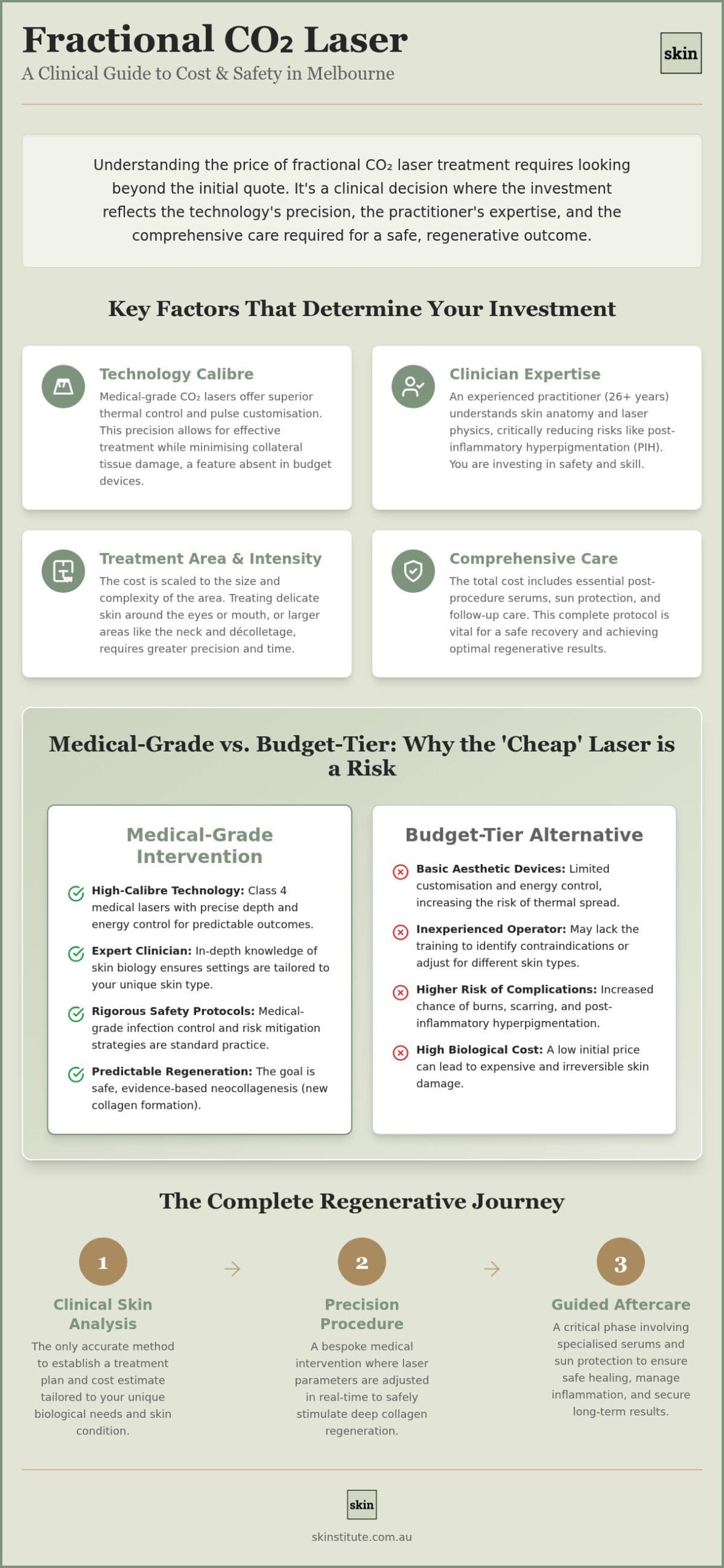
The financial commitment associated with skin rejuvenation is rarely a fixed figure. When evaluating fractional co2 laser cost melbourne, patients must understand that the final quote reflects a complex intersection of technological precision, clinical safety protocols, and the practitioner’s technical mastery. A clinical environment prioritises predictable biological outcomes over high-volume throughput, which naturally influences the pricing structure. It’s not merely about the duration of the appointment; it’s about the medical resources deployed to ensure your skin regenerates safely.
Technology Grades and Pricing
The calibre of the laser system is a primary driver of cost. High-end medical-grade CO2 lasers require significant capital investment because they offer superior thermal control and pulse customisation. Unlike entry-level aesthetic devices, these systems allow the clinician to manipulate the depth of ablation and the percentage of skin surface treated with extreme accuracy. This precision is vital for Laser resurfacing, as it ensures that the thermal energy penetrates deep enough to stimulate neocollagenesis without causing unnecessary collateral damage to the surrounding tissue.
Price variations often stem from the device’s ability to switch between different energy delivery modes. Ablative treatments, which vaporise the epidermal layer to trigger intensive regeneration, require more sophisticated cooling mechanisms and safety features than non-ablative alternatives. Consequently, a medical-grade system that provides these advanced, customisable settings will always command a higher fee than a generic device found in a standard beauty salon. The investment covers the technology’s ability to deliver high energy with a reduced risk of thermal spread.
Clinician Expertise and Professional Fees
The qualifications of your practitioner are as important as the laser itself. Operating a high-energy device requires an intimate understanding of skin anatomy and laser physics. At a specialised skinstitute, you’re paying for the security of 26+ years of industry experience. This level of expertise is critical for identifying potential contraindications and adjusting parameters in real-time to suit your specific Fitzpatrick skin type. It’s the difference between a standard procedure and a bespoke medical intervention.
Clinician skill directly correlates with risk mitigation. An inexperienced operator might use incorrect settings that lead to post-inflammatory hyperpigmentation (PIH) or persistent erythema. Professional fees for a fractional co2 laser cost melbourne reflect the cost of maintaining a safe clinical environment, including:
- Rigorous clinical standards and medical-grade infection control.
- Ongoing professional development to master the latest regenerative techniques.
- Advanced diagnostic tools used to assess skin health before the first pulse is delivered.
- Comprehensive safety protocols that protect the patient throughout the inflammatory phase.
While a lower price point might seem attractive initially, it often excludes the safety net provided by a seasoned medical professional in a regulated clinical setting. Choosing a practitioner based on experience rather than the lowest quote is the most effective way to ensure a successful aesthetic outcome; for example, Skin Project Clinics serves as a benchmark for doctor-led care, ensuring that every procedure is backed by medical rigour and extensive clinical experience.
Treatment Areas and Pricing Variations
The geographical extent of the treatment area is a primary factor in determining the final quote. While a full face resurfacing is the clinical standard for global dermal regeneration, many patients require targeted interventions for localised concerns. The complexity of treating specific anatomical regions, such as the perioral area or the delicate infraorbital skin, requires higher precision and often a different energy profile. This variability is why a fixed fractional co2 laser cost melbourne is difficult to establish without a physical assessment of the skin’s thickness and underlying structural integrity.
High-power devices utilised in these procedures often fall under the Safe Work Australia laser classifications as Class 4 lasers. This classification signifies that the equipment is capable of significant biological impact, necessitating strict clinical control. Treating the neck and décolletage, for instance, involves navigating skin that has fewer sebaceous glands and a thinner dermis compared to the face. This increased sensitivity mandates a more cautious approach and specialised settings to avoid complications, which is reflected in the clinical fee.
Common Treatment Zones in Melbourne
Full face treatments remain the most requested option for patients seeking to address cumulative sun damage and age-related textural changes. However, specialised ‘laser blepharoplasty’ alternatives are increasingly popular for those focusing on the eye area. These targeted treatments require specialised ocular protection and extreme clinician precision to safely tighten the skin around the eyelids. Patients often choose to bundle the face, neck, and décolletage to ensure a uniform aesthetic result across all visible areas, which typically offers a more efficient allocation of clinical resources than treating zones in isolation.
Scarring and Texture Correction
Deep acne scar revision is technically more demanding than treating fine lines. It often involves multiple passes at varying depths to break down fibrotic tissue and stimulate the synthesis of new collagen fibres. Because these cases are highly individualised, surgical scar treatments usually require a bespoke quote based on the scar’s age, depth, and vascularity. The total fractional co2 laser cost melbourne for scar revision is frequently influenced by the necessity of multiple sessions to achieve a significant reduction in depth and texture.
Treatment intensity also plays a decisive role in the final investment. A superficial ‘laser refresh’ focuses on the epidermal layer to improve luminosity with minimal downtime. In contrast, deep dermal remodelling targets structural imperfections and requires higher energy densities along with more comprehensive post-operative monitoring. For patients requiring a series of treatments, clinical packages are often available to provide a structured pathway toward long-term skin health. Understanding your unique skin profile through a professional clinical consultation ensures that the proposed treatment plan aligns with both your aesthetic goals and biological requirements.
Medical-Grade vs. Beauty-Grade: Why the ‘Cheap’ Laser is a Risk
The discrepancy in fractional co2 laser cost melbourne often reflects the fundamental difference between a high-precision medical instrument and a generic aesthetic device. While budget clinics may offer enticingly low rates, these prices are frequently achieved by using equipment with inferior beam stability and limited thermal management systems. In a clinical setting, the focus remains on the physics of the laser pulse to ensure that the energy delivered is exactly what the tissue requires for regeneration without causing unnecessary trauma. A medical-grade approach prioritises biological safety over high-volume turnover.
Precision and Skin Safety
Medical-grade fractional CO2 lasers are engineered to produce a consistent and uniform beam profile. This precision allows for the creation of microscopic treatment zones (MTZs) that are surrounded by healthy, untouched tissue. This bridge of healthy skin is essential for rapid re-epithelialisation and reduced downtime. Cheaper machines often suffer from beam scatter or inconsistent energy spikes, which can lead to excessive heat accumulation in the dermis. This uncontrolled thermal spread is a primary cause of prolonged redness and, in severe cases, permanent scarring.
Clinical devices also feature adjustable spot sizes and shapes. This flexibility allows the practitioner to tailor the treatment to specific facial contours, such as the nasal bridge or the perioral area. Without this level of control, the risk of overlapping pulses increases, which can lead to hot spots and uneven results. When you consider the social cost of extended recovery or the potential for permanent skin damage, the perceived savings of a beauty-grade treatment quickly dissipate. Precision is the most critical factor in ensuring a predictable aesthetic outcome.
The True Cost of Laser Complications
Choosing a clinic with 26 years of experience provides a level of security that cannot be found in unregulated beauty environments. High-energy lasers are powerful tools that require medical-grade supervision to manage the skin’s inflammatory response effectively. Professional clinics operate under strict Australian safety standards and carry comprehensive insurance, providing a medical backup that budget establishments often lack. This clinical infrastructure is a vital component of the overall fractional co2 laser cost melbourne, ensuring that patient safety is never compromised.
If you are ever in a position where you require a broader network of medical and legal experts due to personal injury, you can check out The Injury Specialists to see how they facilitate connections between victims and qualified professionals.
The true cost of a cheap laser treatment often reveals itself weeks later in the form of post-inflammatory hyperpigmentation (PIH) or hypopigmentation. Correcting these complications is a lengthy and expensive process that far exceeds the initial investment at a reputable clinic. By selecting a medical-grade facility, you are investing in a safe pair of hands. A clinical environment ensures that safety is never sacrificed for speed, providing:
- Advanced diagnostic assessments to determine skin suitability and Fitzpatrick scale ranking.
- Practitioners who understand the complex biological interactions between laser energy and dermal proteins.
- Rigorous post-treatment monitoring to ensure the healing process remains on track.
- Access to medical-grade topical interventions if the skin shows signs of distress during the inflammatory phase.
Ultimately, the expertise of the clinician and the quality of the technology are your best insurance policies for skin health. A professional skin analysis ensures that your treatment plan is based on evidence and clinical necessity rather than marketing promises.
The Complete Investment: Aftercare and Maintenance
The initial procedure fee represents only the first phase of a successful dermal intervention. When calculating the total fractional co2 laser cost melbourne, patients must account for the medical-grade aftercare protocols required to support the skin’s inflammatory and proliferative phases. Neglecting the post-operative environment can lead to suboptimal collagen synthesis or prolonged erythema, which diminishes the value of the primary treatment. A clinical approach ensures that every dollar spent on the procedure is protected by a rigorous recovery strategy designed to maximise biological regeneration.
Essential Recovery Kits
A comprehensive recovery regimen is non-negotiable for protecting the newly ablated skin surface. During the first 7 to 14 days, the skin’s barrier is compromised, necessitating specialised products to prevent transepidermal water loss and environmental contamination. Patients should budget for a clinical recovery kit that typically includes thermal spring water, which costs approximately $21 to $25, and a high-performance barrier balm ranging from $15 to $30. These products are essential for maintaining a sterile, hydrated environment that facilitates efficient re-epithelialisation.
Additionally, the integration of a broad-spectrum SPF 50+, averaging between $20 and $33, is a critical requirement to prevent post-inflammatory hyperpigmentation. In some cases, practitioners may also recommend antihistamines, which cost approximately $10.99 for a standard pack, to manage transient swelling during the first 48 hours. While these individual costs are modest, they are essential components of the total investment. These products ensure that the high-energy stimulus provided by the laser translates into smooth, resilient tissue rather than complications that require expensive corrective work.
Enhancing Results with Bio-Stimulators
Advanced clinical practices in Melbourne often integrate complementary therapies to accelerate the healing timeline and enhance the final structural outcome. Combining fractional co2 laser resurfacing melbourne with polynucleotide treatments like rejuran melbourne or exosome therapy can significantly improve the price-benefit ratio. These bio-stimulators provide the vital cellular signals required for faster tissue repair, potentially reducing the total number of sessions needed to achieve significant dermal remodelling.
While the addition of these regenerative agents increases the immediate session cost, it often leads to more profound long-term results and reduced social downtime. Investing in a comprehensive plan that includes professional skin analysis and scheduled follow-up assessments ensures that your progress is monitored by a practitioner with over 26 years of experience. This holistic approach protects your financial investment by ensuring the skin responds correctly to the treatment at every stage. To establish a complete and accurate treatment plan tailored to your skin’s unique requirements, we recommend booking a professional clinical assessment at our Melbourne centre.
Booking Your Clinical Assessment at Skinstitute
A formal consultation is the foundational step in any medical-grade laser protocol. While clinical guides provide a necessary baseline, the definitive fractional co2 laser cost melbourne can only be established through a physical examination of your skin’s unique architecture. Our Melbourne centre prioritises a diagnostic approach. This ensures that the proposed energy settings and session frequency align with your skin’s specific regenerative capacity. This process eliminates the ambiguity often associated with entry-level quotes and provides a transparent, evidence-based roadmap for your treatment.
During your assessment, we move beyond surface-level observations to conduct a detailed clinical skin analysis. We examine factors such as dermal thickness, existing photo-damage, and vascular health. This rigour is essential for high-energy procedures. It allows us to mitigate risks while maximising the potential for neocollagenesis. By choosing a facility with over 26 years of industry experience, you’re engaging with a safe pair of hands that values technical mastery over marketing hype. We provide a professional environment where biological facts dictate the treatment path.
Personalised Treatment Mapping
Central to our assessment is the classification of your skin on the Fitzpatrick scale. This determines the safe thermal threshold for your skin type and directly influences the complexity of the treatment plan. We match your clinical goals, whether they involve deep scar revision or global rejuvenation, with a realistic budget and timeline. This mapping ensures you understand the total investment required before any pulses are delivered. Establishing a long-term relationship with an established practitioner provides the continuity of care necessary for maintaining results as the skin continues to age. It’s a partnership based on professional integrity and measurable outcomes.
Next Steps for Your Skin Journey
To begin your journey, you can organise a consultation at our Melbourne clinic by contacting our clinical team directly. For your first appointment, it’s helpful to bring a list of your current skincare products and any relevant medical history regarding previous laser treatments or light-sensitising medications. This allows us to provide the most accurate assessment possible. We encourage patients to reach out for current 2026 pricing enquiries to understand the foundational rates before their in-depth analysis.
Preparing your skin correctly is a clinical requirement that we’ll discuss during your initial contact. This often involves avoiding direct sun exposure and certain active ingredients for a specified period. Proper preparation ensures your skin is in the optimal state for regeneration. This ultimately protects the value of your fractional co2 laser cost melbourne and ensures the healing process remains on a predictable trajectory. Our clinical guide is designed to move you from uncertainty to a position of informed confidence.
Securing Your Dermal Health Through Clinical Precision
Understanding the specific variables that influence fractional co2 laser cost melbourne allows you to move beyond price-based comparisons and focus on biological efficacy. We have established that the technical calibre of the laser system and the clinical expertise of the practitioner are the primary drivers of both safety and results. It’s clear that a successful outcome requires a commitment to medical-grade standards, encompassing the initial procedure, rigorous aftercare, and the professional diagnostic tools used to map your progress. High-energy skin resurfacing is a significant medical intervention that demands a safe and experienced pair of hands.
Our Melbourne-based clinical team relies on medical-grade technology and 26+ years of industry experience to deliver predictable, evidence-based regeneration. By prioritising technical mastery and transparent communication, we ensure that your investment in your skin is protected by the highest professional standards. To receive a personalised treatment plan and an accurate quote tailored to your unique dermal requirements, you can Book a Clinical Skin Analysis at Skinstitute Melbourne. Taking this diagnostic step is the most effective way to ensure your skin journey is grounded in clinical integrity and long-term health.
Frequently Asked Questions
How much does a single session of fractional CO2 laser cost in Melbourne?
The fee for an individual session is determined by the total surface area treated and the clinical level of the practitioner performing the procedure. Full-face resurfacing involves a more significant investment than targeted spot treatments for isolated acne scarring or perioral lines. Clinical guidelines in Melbourne typically distinguish between treatments performed by dermal clinicians and those requiring a doctor’s oversight for high-risk zones, such as the infraorbital region.
Is the cost of numbing cream included in the treatment price?
In most medical-grade environments, the application of high-strength topical anaesthesia is included as a standard component of the procedure protocol. This ensures patient comfort during the delivery of high-energy pulses and allows the clinician to reach the required dermal depth. You should confirm this during your initial assessment to understand if there are any auxiliary pharmacy costs for specific prescription-strength formulations required for your skin type.
Why do some Melbourne clinics charge significantly less for laser resurfacing?
Lower pricing structures in some clinics often reflect the use of aesthetic-grade devices with less stable beam profiles or a reliance on less experienced operators. Clinical safety protocols and the ability to manage potential thermal complications require significant operational investment. A lower fractional co2 laser cost melbourne often signifies a reduction in these critical safety barriers, potentially increasing the risk of post-inflammatory hyperpigmentation.
Does Medicare or private health insurance cover the cost of CO2 laser for acne scars?
Medicare and private health insurance providers generally categorise fractional CO2 laser as a cosmetic procedure, which means it’s typically not eligible for rebates. While certain intensive treatments for severe, functional scarring may occasionally qualify for a medical rebate under specific clinical conditions, most patients should budget for the full cost of the treatment as a private investment in their long-term skin health.
How many sessions will I need to see a return on my investment?
The number of sessions required is dictated by the depth of the dermal concern and the skin’s individual biological response to the laser stimulus. For general rejuvenation and fine line reduction, many patients achieve their desired outcome in one to three sessions. Deep acne scarring or significant textural irregularities may require a more extensive series of treatments to reach the desired level of dermal remodelling and collagen synthesis.
Are there any hidden costs I should be aware of before booking?
Beyond the primary procedure fee, patients should account for the cost of a formal clinical consultation and essential medical-grade aftercare products. These specialised serums and sun protections are vital for preventing infection and ensuring an even skin tone during the healing phase. Understanding the complete fractional co2 laser cost melbourne involves factoring in these auxiliary requirements to ensure the safety and success of the regenerative process.
What is the price difference between fractional CO2 and traditional fully ablative laser?
Traditional fully ablative lasers involve the complete removal of the epidermal layer, whereas fractional technology creates microscopic channels while leaving surrounding tissue intact. This difference in technical intensity results in fractional treatments being more accessible with significantly reduced downtime. Fully ablative procedures are often performed in surgical settings and command a higher fee due to the increased complexity of the intra-operative care and the recovery period.
Can I combine the cost of laser with other treatments like HIFU or injectables?
Integrating fractional CO2 with other modalities like HIFU or bio-stimulators is a common clinical practice for enhancing regenerative outcomes. While this increases the immediate session cost, combination therapy can often reduce the total number of appointments required to achieve a specific aesthetic goal. This strategic approach targets different layers of the skin simultaneously, providing a more comprehensive structural improvement than a single-modality treatment plan.