CO2 Laser vs Skin Needling for Acne Scars: A Clinical Comparison
August 29, 2026
PDO Thread Lift Recovery: A Clinical Guide to Timeline and Aftercare
August 31, 2026
The most effective method for resolving deep dermal indentations isn’t found in surface-level skincare, but through a precise, biological reconstruction of the skin’s architecture. For many individuals, persistent texture irregularities represent a long-term psychological burden that standard aesthetic treatments fail to address. If you’ve been researching co2 laser for acne scars melbourne, you likely understand that achieving significant structural change requires a sophisticated clinical approach. We recognise that the prospect of intensive laser resurfacing often brings a mixture of hope and apprehension, particularly regarding the complexities of downtime and the physiological mechanics of healing.
This clinical guide provides a comprehensive, medical-grade overview of how fractional technology interacts with compromised tissue to stimulate profound collagen synthesis. You’ll gain a clear understanding of the professional assessment process, the technical stages of the procedure, and the structured recovery protocols necessary to achieve a smoother, more resilient complexion. By moving beyond surface-level descriptions, we’ll explain the specific biological pathways that allow medical-grade lasers to remodel scar tissue safely and effectively within a professional clinical environment.
Key Takeaways
- Understand the biological process of thermal dehydration and collagen fibre shrinkage that initiates the remodelling of deep acne scar tissue.
- Learn how fractional technology delivers 10,600nm wavelength energy to create microscopic treatment zones, making co2 laser for acne scars melbourne a gold-standard clinical option for texture improvement.
- Evaluate the efficacy of ablative laser resurfacing compared to bio-stimulators like Rejuran or mechanical methods such as skin needling.
- Discover the essential steps of the clinical journey, from the critical skin-priming phase to the structured post-treatment recovery protocols.
- Recognise why a medical-grade approach and over 26 years of industry experience are vital for customising laser parameters and mitigating physiological risks.
Understanding Fractional CO2 Laser for Acne Scars
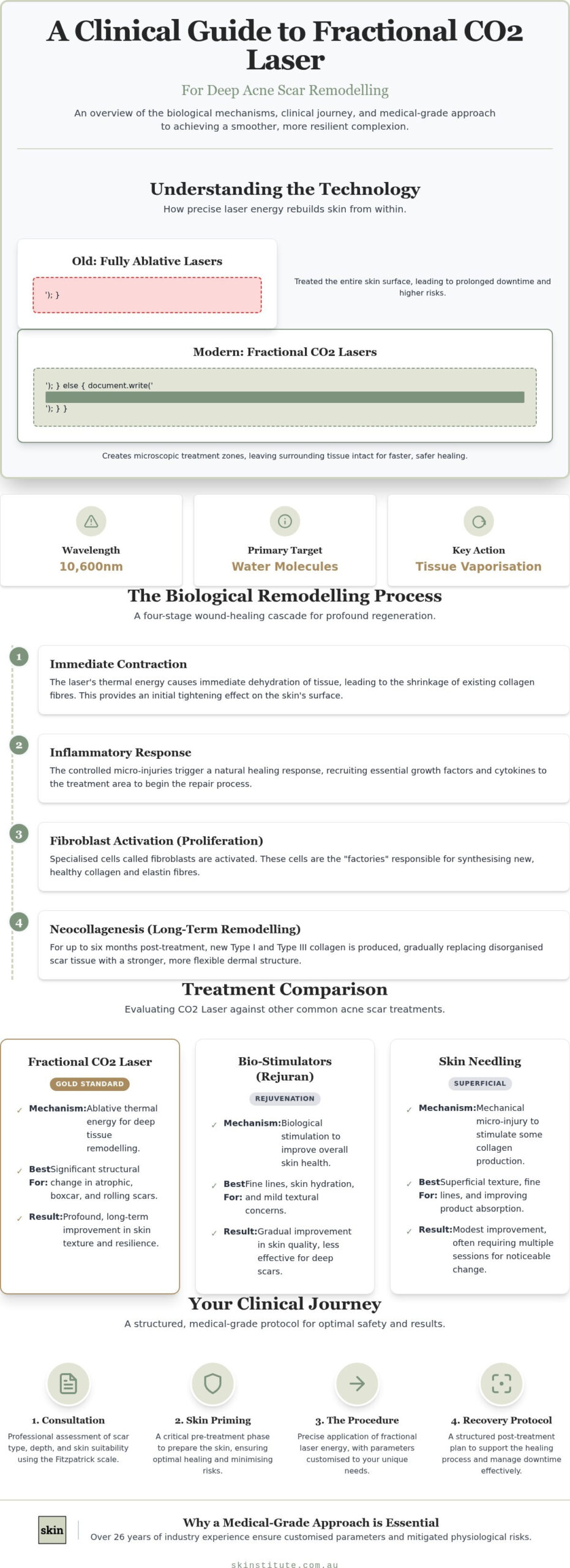
The Fractional CO2 laser is a sophisticated ablative technology that utilises a precise 10,600nm wavelength to address structural skin concerns. By specifically targeting the water molecules within the dermal tissue, the laser causes rapid heating and vaporisation of the targeted area. This process is fundamental to modern skin rejuvenation techniques, as it allows for the controlled removal of damaged tissue while initiating a robust regenerative response. Unlike older, fully ablative lasers that treated the entire skin surface in a single pass, fractional systems deliver energy in a pixelated pattern. This creates microscopic thermal treatment zones (MTZs) surrounded by bridges of untreated skin, which significantly accelerates the healing process and reduces the risk of complications.
For patients seeking co2 laser for acne scars melbourne, this technology is particularly effective for atrophic, boxcar, and rolling scars. These conditions are characterised by a loss of collagen and the presence of tethered fibrous bands that pull the skin surface downwards. The fractional approach allows for deeper penetration into the dermis to break down these bands without the extended downtime associated with traditional resurfacing methods. It represents a clinical shift from simply smoothing the surface to fundamentally rebuilding the skin’s internal support structure.
How Laser Resurfacing Targets Scar Architecture
The clinical efficacy of the CO2 laser lies in its dual-action mechanism. First, it performs precise ablation of the epidermis, which removes surface irregularities and helps to normalise pigmentation. Simultaneously, the thermal energy causes coagulation in the deeper dermis. This heat induces immediate contraction of existing collagen fibres, providing a visible tightening effect. By creating precision-controlled thermal injury, the practitioner can effectively reboot the skin’s architecture, replacing rigid scar tissue with more organised, flexible collagen structures over several months.
Suitability and Clinical Assessment
While the CO2 laser is often considered the gold standard for deep texture issues, patient suitability depends on a range of physiological factors. The Fitzpatrick scale is used to assess skin type and determine the appropriate laser parameters; this is crucial for managing the risk of post-inflammatory hyperpigmentation, especially in darker complexions. A professional consultation at a Melbourne clinic is a mandatory prerequisite for anyone considering co2 laser for acne scars melbourne. During this assessment, the practitioner evaluates scar depth, skin thickness, and healing capacity to ensure a safe clinical outcome. This bespoke approach ensures that the energy levels and density of the MTZs are tailored to the individual’s specific scar profile and recovery requirements.
The Biological Mechanism: How CO2 Lasers Remodel Scar Tissue
The biological effectiveness of a co2 laser for acne scars melbourne relies on a precisely orchestrated wound-healing cascade. Upon contact with the skin, the laser energy causes immediate thermal dehydration of the target tissue, resulting in the rapid shrinkage of existing collagen fibres. This initial phase provides an immediate, albeit temporary, tightening of the skin surface. However, the true regenerative value lies in the subsequent physiological response. The micro-injuries created by the fractional pulses trigger an acute inflammatory response, recruiting essential cytokines and growth factors to the treatment site to begin the repair process.
Research into the Fractional Carbon Dioxide Laser in Treatment of Acne Scars confirms that this controlled injury is the catalyst for dermal restructuring. Following the inflammatory phase, the skin enters a proliferative stage where specialised cells called fibroblasts are activated. These cells are responsible for synthesising new Type I and Type III collagen, which gradually replaces the dense, disorganised fibrous tissue that characterises acne scarring. This remodelling process is not instantaneous; it continues for up to six months post-treatment as the skin’s architecture is progressively refined and strengthened.
Fibroblast Activation and Neocollagenesis
The activation of fibroblasts represents a cellular ‘reset’ for the dermis. In mature acne scars, collagen fibres are typically rigid and clumped together, which prevents a smooth skin surface. By delivering controlled thermal pulses, the laser breaks down these dysfunctional structures. The resulting neocollagenesis improves both dermal thickness and elasticity. This biological renewal ensures that indentations are lifted from within, creating a more uniform and refined texture. Because of the technical nature of this process, a professional clinical assessment is vital to determine the precise parameters required for your skin’s unique healing profile.
Thermal Injury vs. Tissue Regeneration
Achieving optimal results requires a precise balance between energy depth and density. If the thermal spread is too broad, the risk of collateral damage increases; if it is too shallow, the scar remodelling remains insufficient. Medical-grade precision ensures the injury reaches the base of atrophic scars while preserving healthy tissue to support regeneration. This controlled downtime is a necessary component of the clinical journey, allowing the body to focus its resources on structural synthesis. Managing these variables effectively is why co2 laser for acne scars melbourne should always be performed in a dedicated clinical setting.
Comparing CO2 Laser with Other Acne Scar Treatments
In the clinical management of acne scarring, selecting the appropriate modality requires a nuanced understanding of tissue interaction. While co2 laser for acne scars melbourne remains the most potent tool for structural revision, practitioners often integrate other medical-grade treatments to address specific skin requirements or to enhance the overall regenerative outcome. A multi-modal approach allows for a more comprehensive treatment plan that targets different layers of the skin’s architecture, ensuring that both surface irregularities and deeper dermal deficiencies are addressed.
CO2 Laser vs. Skin Needling (Microneedling)
Skin needling, or microneedling, relies on mechanical injury to stimulate a healing response. While effective for minor texture issues and pore refinement, it lacks the thermal component essential for breaking down deep, tethered fibrous bands. In contrast, fractional CO2 laser delivers thermal energy that vaporises columns of tissue, providing a more aggressive remodelling effect. The clinical intensity of laser resurfacing necessitates longer downtime, but it’s typically the preferred choice for significant atrophic or boxcar scarring where mechanical needling may yield limited results.
The Role of Bio-Stimulators like Rejuran
Rejuran utilises polynucleotides to promote cellular repair and improve skin elasticity from within. Unlike the ablative nature of CO2, Rejuran is a bio-stimulatory treatment that focuses on physiological regeneration without removing tissue. Many Melbourne practitioners use Rejuran as a priming treatment to enhance the skin’s baseline health before a laser session. This creates a more resilient dermal environment, potentially improving the speed and quality of the post-laser recovery phase by providing the biological building blocks necessary for rapid tissue synthesis.
High Intensity Focused Ultrasound (HIFU) serves a distinct purpose by targeting the deeper structural layers, such as the SMAS, to provide skin tightening and lifting. While HIFU doesn’t address surface texture or scar depth as effectively as CO2, it can be utilised in a plan to improve overall facial contour. Additionally, the application of exosomes immediately following a fractional CO2 treatment has emerged as a powerful synergistic approach. Exosomes provide concentrated signalling molecules that can significantly reduce post-procedural inflammation and accelerate the synthesis of new tissue, helping patients manage their clinical journey more efficiently.
The Clinical Journey: Preparation and Recovery in Melbourne
The clinical success of co2 laser for acne scars melbourne depends as much on the physiological preparation of the skin as it does on the precision of the laser delivery. Because this is a medical-grade ablative procedure, the journey is divided into distinct stages designed to maximise safety and enhance the regenerative response. Many leading international providers follow similar rigorous protocols; for example, you can visit Arden Clinic to see how they structure their clinical skincare journeys. Patients must view the treatment not as a single event, but as a structured programme that begins several weeks before the actual clinical session. This methodical approach ensures the skin’s barrier is resilient and its pigment-producing cells are stable before undergoing controlled thermal injury.
A professional clinical assessment typically initiates a 2 to 4 week priming phase. During this window, the use of tyrosinase inhibitors is often mandatory to suppress melanin activity. This step is a critical safety measure to prevent post-inflammatory hyperpigmentation, particularly for patients with higher Fitzpatrick skin types. It’s also necessary to cease the use of potent active ingredients, such as retinol and alpha hydroxy acids (AHAs), at least seven days prior to the procedure. Ensuring the skin is deeply hydrated and the barrier is intact serves as a primary predictor of how efficiently the tissue will transition through the initial inflammatory phase.
Managing Downtime and Aftercare
The immediate post-treatment period is characterised by significant erythema and oedema, reflecting the body’s acute inflammatory response to the thermal zones. Within the first 24 to 48 hours, the skin begins the repair process. By day three, patients typically notice a ‘sandpaper’ texture as the microscopic treatment zones move toward the surface to be shed. This phase usually lasts until day seven. During this window, strict adherence to a medical-grade aftercare protocol is vital. This includes the application of occlusive balms and, in many cases, exosomes to facilitate rapid cellular communication and tissue synthesis.
Melbourne’s environmental conditions require specific vigilance. The high UV index in Victoria poses a significant risk to healing skin, which remains hypersensitive to light for several months. Absolute UV avoidance is required during the first ten days, followed by the rigorous application of broad-spectrum SPF 50+. Incidental sun exposure during the recovery phase can lead to persistent redness or irregular pigmentation. To ensure your skin is adequately prepared for this intensive resurfacing, we recommend a comprehensive clinical consultation to establish a bespoke priming and protection plan. Long-term results are preserved through this commitment to UV protection and ongoing barrier support.
Why a Medical-Grade Approach to Laser Resurfacing is Essential
Selecting a provider for co2 laser for acne scars melbourne involves more than choosing a specific device; it requires a clinical environment where technical proficiency is prioritised over aesthetic trends. Fractional CO2 is a high-intensity ablative technology that carries significant physiological responsibility. When performed in non-medical settings with standardised settings, the risks of adverse outcomes, such as hypertrophic scarring or persistent post-inflammatory hyperpigmentation, increase substantially. At Skinstitute Melbourne, we operate with over 26 years of industry experience, ensuring that every treatment is grounded in a deep understanding of dermal optics and wound-healing biology.
Integrated clinical care is the cornerstone of successful scar revision. This journey begins with an objective assessment of the skin’s current state and continues through a structured follow-up protocol that monitors the remodelling phase for several months. A seasoned practitioner doesn’t just deliver energy; they manage the skin’s regenerative capacity from the initial consultation to the final long-term review. This level of professional accountability is what distinguishes a medical-grade clinic from a standard aesthetic centre.
Customising Laser Parameters for Individual Scars
Acne scar revision is never a one-size-fits-all process because scar tissue varies in density, depth, and tethering. A clinical expert must precisely adjust pulse duration and energy density to match the specific requirements of atrophic, boxcar, or rolling scars. The skill lies in identifying the threshold where energy is high enough to trigger neocollagenesis but low enough to preserve the skin’s ability to heal without complications. Pulse durations that are too long can cause excessive thermal spread, while insufficient energy density fails to reach the base of deep indentations. Customising these parameters requires years of clinical observation and technical mastery, a standard of care also upheld by international facilities like Organic Skin & Body Med Spa.
Our Melbourne clinic adheres to rigorous safety standards and protocols that align with Australian medical aesthetic guidelines. This commitment to safety ensures that complex skin regeneration is managed in a controlled, sterile, and professional environment. We prioritise evidence-based results and patient safety above all else, using established scientific principles to guide every clinical decision. The next step in your journey toward improved skin texture is a professional assessment. Booking a clinical skin analysis allows us to evaluate your scar profile and develop a bespoke strategy for co2 laser for acne scars melbourne, ensuring your skin receives the precise care it requires for long-term improvement.
Advancing Your Clinical Journey Toward Dermal Reconstruction
Achieving a refined skin profile requires a transition from surface-level skincare to deep-tissue remodelling. We’ve explored how fractional technology initiates a biological ‘reboot’, replacing rigid scar tissue with organised collagen. Success with co2 laser for acne scars melbourne isn’t just about the procedure itself; it’s about the clinical rigour applied throughout the process. This includes precise parameter customisation and strict adherence to pre- and post-treatment protocols that ensure safe, medical-grade results. Our foundation of over 26 years of industry experience provides the stability required for these intensive treatments.
Whether you’re managing atrophic indentations or complex boxcar scarring, a structured clinical approach is essential for regeneration. We invite you to book a clinical consultation for CO2 laser at Skinstitute Melbourne to begin your skin analysis. Our team specialises in medical-grade fractional CO2 technology, providing a professional and authoritative environment for your skin’s transformation. You don’t have to manage persistent texture irregularities alone. Professional expertise is the most reliable path to a smoother, more resilient complexion.
Frequently Asked Questions
How much downtime is required after fractional CO2 laser in Melbourne?
Patients should plan for a 7 to 10 day recovery window when undergoing co2 laser for acne scars melbourne. During the first 48 hours, the skin exhibits significant erythema and oedema. Between days 3 and 7, the microscopic treatment zones rise to the surface, creating a sandpaper-like texture before naturally shedding. While social downtime typically concludes by day 10, residual pinkness may remain for several weeks. Adhering to our clinical aftercare protocols ensures the healing process remains efficient.
Is the CO2 laser treatment painful for acne scars?
Discomfort is effectively managed through the application of high-strength topical anaesthesia. We allow the numbing agent to take effect for approximately 60 minutes before starting the procedure. Most patients describe the sensation as a series of sharp, hot pulses across the skin surface. Following the session, a cooling mask or cold air is often used to soothe the heat sensation, which typically subsides within a few hours. This ensures the clinical experience remains tolerable.
How many sessions of CO2 laser are typically needed for significant scar improvement?
Most patients require between 1 and 3 sessions to achieve significant structural improvement. The frequency of treatments depends on the severity and type of scarring present. Deeply tethered or atrophic scars usually necessitate multiple sessions to build sufficient dermal volume. We typically space these treatments 3 to 6 months apart to align with the body’s natural collagen maturation cycle, ensuring each session builds upon the regenerative progress achieved in the previous clinical appointment.
Can CO2 laser be safely used on darker skin tones (Fitzpatrick IV-VI)?
Fractional CO2 laser can be safely performed on Fitzpatrick IV-VI skin types when managed with medical-grade precision. Safety is prioritised through a mandatory 4-week priming phase using tyrosinase inhibitors to suppress melanin production. We also adjust the laser’s density and pulse duration to prevent excessive thermal spread. This cautious approach, backed by 26 years of experience, allows us to treat darker complexions in Melbourne while significantly reducing the risk of post-inflammatory hyperpigmentation or scarring.
What is the difference between CO2 laser and microneedling for acne scars?
The primary difference lies in the mechanism of injury. Skin needling uses mechanical needles to create micro-channels, whereas CO2 laser uses 10,600nm thermal energy to vaporise columns of tissue. The thermal component of the laser is far more effective at breaking down the rigid, fibrous bands found in deep acne scars. While needling is excellent for general rejuvenation, the co2 laser for acne scars melbourne remains the clinical standard for significant structural remodelling and scar revision.
When will I see the final results of my laser resurfacing treatment?
Final outcomes are typically assessed 3 to 6 months after the procedure. While the surface of the skin appears healed within 10 days, the biological process of neocollagenesis takes much longer. Fibroblasts continue to synthesise new collagen and elastin fibres well after the initial inflammatory phase has passed. This gradual improvement ensures that the skin’s texture becomes smoother and more resilient as the new dermal architecture matures and strengthens over several months of regeneration.
How should I protect my skin from the Melbourne sun after laser treatment?
Melbourne’s high UV index necessitates a rigorous protection strategy. We advise absolute sun avoidance for the first 10 days post-treatment. Once the initial healing is complete, you must apply a broad-spectrum SPF 50+ sunscreen every two hours when outdoors. Wearing wide-brimmed hats and seeking shade is also essential. Because the new skin is highly susceptible to UV-induced pigment changes, this protection protocol is vital for maintaining the integrity and safety of your clinical results.
Are the results of CO2 laser resurfacing for acne scars long-term?
The results achieved through fractional CO2 resurfacing are considered long-term improvements. Because the laser triggers a fundamental remodelling of the dermal structure, the new collagen produced stays within the skin’s architecture. Unlike temporary fillers, this is a biological change to the tissue itself. While the skin will continue to age naturally, the reduction in scar depth and the improvement in overall texture provide a lasting enhancement to the appearance and health of the skin.