Medical-Grade Skin Treatments in Melbourne: A Clinical Buying Guide
October 2, 2026
Collagen Stimulating Treatments in Melbourne: A Clinical Buying Guide
October 4, 2026
The most advanced device isn’t necessarily the right treatment for your concern. When comparing advanced aesthetic treatments victoria, start by identifying whether the concern relates to skin quality, collagen, tissue laxity, facial volume or visible veins. Then consider which treatment targets that tissue and what recovery may involve.
Treatment names can be difficult to compare when descriptions don’t explain how a procedure interacts with different tissue layers or who it may suit. This guide compares treatment categories by concern and tissue target, including fractional CO2 laser resurfacing, HIFU, Rejuran, exosome treatments, skin needling, PDO thread lifting and sclerotherapy. It also explains why suitability, possible risks and recovery need to be discussed before proceeding.
A face-to-face clinical assessment helps connect a visible concern with the underlying anatomy and your individual circumstances. At Skinstitute in Melbourne, treatment planning is informed by consultations with medical professionals, including a nurse and doctor, and more than 26 years of aesthetic industry experience. You’ll gain a clearer understanding of what an assessment should establish, which options may be relevant and how to approach treatment with measured expectations.
Key Takeaways
- Match the treatment category to the concern and tissue involved, rather than choosing by device name or popularity.
- Compare fractional CO2 resurfacing and skin needling as distinct approaches to skin renewal, with suitability and recovery considered individually.
- Use a clinical assessment to clarify your goals, medical history, relevant anatomy and potentially appropriate options.
- When considering advanced aesthetic treatments victoria, weigh potential benefits alongside limitations, risks and recovery requirements.
- At a Melbourne consultation, expect treatment planning to reflect your assessed concern, with realistic expectations rather than guaranteed outcomes.
Advanced aesthetic treatments in Victoria: match the approach to the concern
Advanced aesthetic treatments are clinician-led procedures selected to address defined skin or facial concerns. The field of Aesthetic medicine includes different approaches, but a treatment’s name alone doesn’t show which tissue it targets or whether it suits a particular person. At Skinstitute in Melbourne, treatment planning starts with a face-to-face assessment of the concern and relevant anatomy.
Choose by concern and tissue target, not by device name or trend. Similar visible changes can arise from different tissues and call for different clinical approaches. Skin texture, facial laxity, reduced support and visible leg veins are distinct concerns, even when someone describes them broadly as “ageing” or “uneven skin”.
Which concerns may lead someone to consider treatment?
Texture changes, acne scarring and photo-ageing may prompt discussion of fractional CO2 resurfacing or skin needling. Both relate to skin renewal, but they are different procedures, not interchangeable options. An assessment helps determine which approach, if any, may suit the skin concern and individual circumstances.
Facial laxity or reduced support may lead to discussion of High Intensity Focused Ultrasound (HIFU) or a thread lift. These approaches differ in method and anatomical target. An assessment should establish what is contributing to the appearance and what a non-surgical option may reasonably address. Visible leg veins are a separate concern. Sclerotherapy may be considered after assessment of the veins and relevant health factors.
Why one treatment is not right for every concern
Procedures act on different structures and use different treatment mechanisms. Skin needling is considered in relation to skin renewal, while HIFU and PDO thread lifting may be discussed for concerns involving facial laxity or support. Sclerotherapy addresses visible veins rather than skin texture or facial structure. Similarly, addressing unwanted facial or body hair requires follicle-targeted modalities like electrolysis, detailed by practices such as northbayelectrology.com. These categories are a starting point for discussion, not a diagnosis or a promise of a particular result.
Suitability depends on more than the visible feature. Skin characteristics, medical history and personal goals all inform clinical planning, as do the limitations of each approach. A consultation can explain relevant options, potential risks, recovery considerations and likely limitations before you decide.
For people comparing advanced aesthetic treatments victoria, this concern-led framework makes treatment descriptions easier to interpret. Skinstitute brings over 26 years of aesthetic industry experience in Melbourne, with consultations conducted by medical professionals, including a nurse and doctor. The aim is to relate the proposed approach to the concern and anatomy assessed, rather than treat a procedure as a universal solution.
How advanced aesthetic treatments work: compare the clinical approach
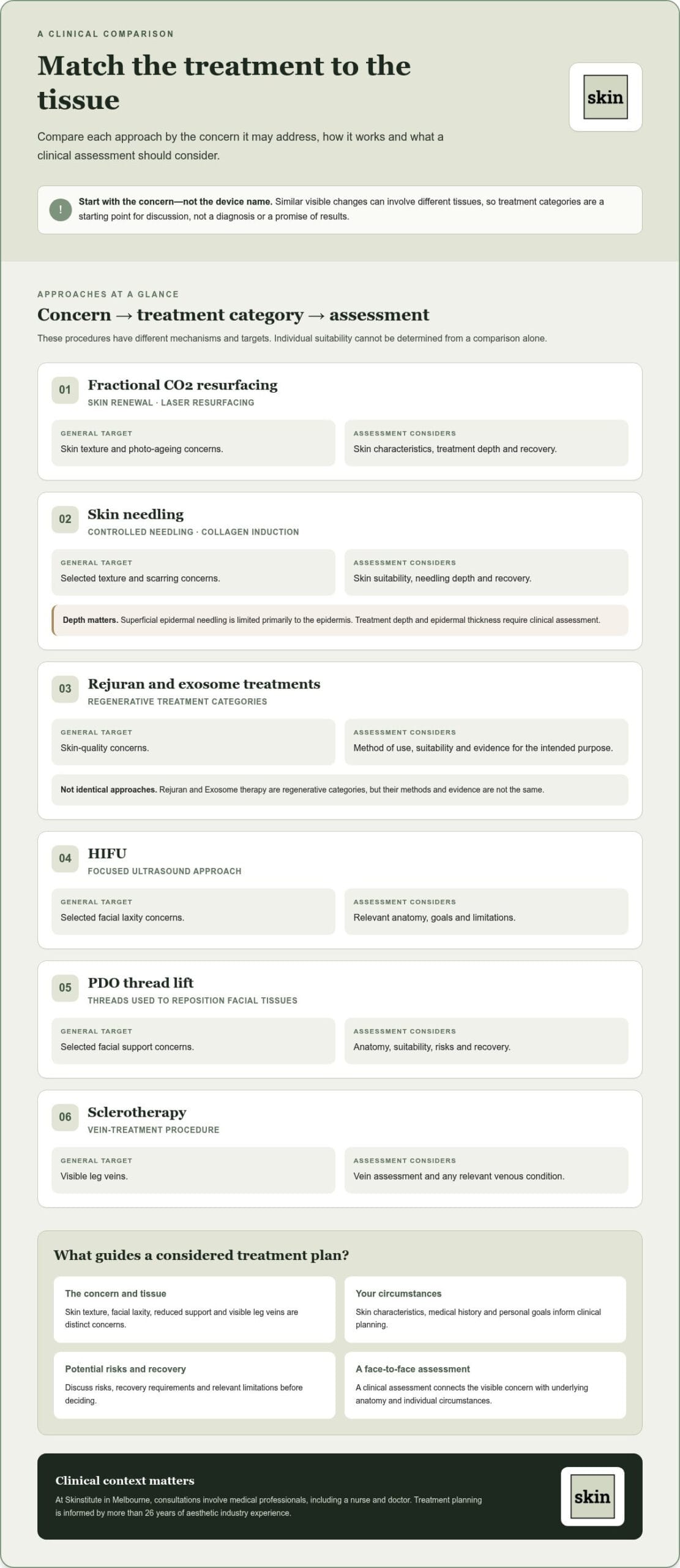
Procedure names describe different methods and tissue targets. A useful comparison considers the concern, mechanism and assessment involved. The table is a general guide; it can’t determine individual suitability or predict an outcome.
| Treatment | General target | Mechanism category | Assessment considerations |
|---|---|---|---|
| Fractional CO2 resurfacing | Skin texture and photo-ageing concerns | Fractional laser resurfacing | Skin characteristics, treatment depth and recovery |
| Skin needling | Selected texture and scarring concerns | Controlled needling and collagen induction | Skin suitability, needling depth and recovery |
| Rejuran and exosome treatments | Skin-quality concerns | Regenerative treatment categories | Method of use, suitability and evidence for the intended purpose |
| HIFU | Selected laxity concerns | Focused ultrasound approach | Relevant anatomy, goals and limitations |
| PDO thread lift | Selected facial support concerns | Threads used to reposition facial tissues | Anatomy, suitability, risks and recovery |
| Sclerotherapy | Visible leg veins | Vein-treatment procedure | Vein assessment and any relevant venous condition |
Procedures aren’t interchangeable. Each works through a different mechanism and is selected according to the tissue involved, the clinical concern and the person’s circumstances.
Skin resurfacing and collagen induction approaches
Fractional CO2 is a laser resurfacing approach used for selected skin concerns. Skin needling is a separate procedure that creates controlled skin injury to stimulate collagen induction, the body’s production of new collagen. The suitable approach depends on the concern and assessed skin, not the treatment name alone.
Superficial epidermal needling is limited primarily to the epidermis and differs from needling directed at deeper skin layers. Treatment depth, epidermal thickness, skin suitability and recovery needs require clinical assessment before a plan is made.
Regenerative, lifting and vein-treatment approaches
Rejuran and Exosome therapy are regenerative treatment categories, but their methods and evidence are not identical. Exosome treatments should be considered in the context of how they are used. Topical application after a procedure is distinct from injectable use. A clinician can explain what is appropriate for the intended concern without implying a guaranteed effect.
HIFU and a thread lift are different approaches to selected laxity or facial support concerns, rather than treatments primarily directed at surface texture. Sclerotherapy is assessed separately for visible leg veins and relevant venous condition concerns. For information about professional standards in cosmetic medicine, see the Cosmetic Physicians College of Australasia (CPCA).
For a personalised discussion of advanced aesthetic treatments victoria, Skinstitute’s Melbourne consultations consider your concern and relevant anatomy. Explore Skinstitute’s aesthetic treatments as part of that clinical discussion.
Compare treatment options by concern, suitability and recovery
A useful comparison considers what each procedure is intended to address, how its approach relates to the tissue involved and what recovery planning may require. There is no universally preferred option. The same treatment may suit one person and be inappropriate for another, depending on their skin, health history and goals.
- Texture, scarring or photo-ageing: Fractional CO2 resurfacing and skin needling may be discussed after assessment. Their methods differ, so treatment depth, skin suitability, aftercare and anticipated downtime need individual consideration.
- Selected laxity or facial support concerns: HIFU and PDO thread lifting are distinct approaches. The relevant anatomy and the limitations of each method help determine whether either is appropriate.
- Skin-quality goals: Rejuran and exosome treatments are separate regenerative categories, not interchangeable options. Their intended use, suitability and evidence should be discussed in relation to the individual concern.
When resurfacing or skin needling may be discussed
For assessed texture changes, acne scarring or photo-ageing, a clinician may discuss fractional CO2 resurfacing or skin needling. Potential benefits need to be weighed against limitations and recovery requirements. Neither procedure guarantees a particular result. Skin type, medical history and treatment goals all affect suitability.
Before deciding, clarify the expected aftercare, possible skin response and how much downtime the proposed plan may involve. Recovery requirements differ according to the procedure and individual factors, so a generic timeline may not reflect your circumstances.
When lifting, regenerative or injectable approaches may be discussed
HIFU and PDO thread lifting involve different clinical considerations. HIFU may be considered for selected laxity concerns, while a thread lift uses threads to reposition facial tissues. Prescription injectables are another distinct category, assessed according to the clinical concern and individual suitability. They should be discussed as a medical treatment, not as a routine cosmetic purchase.
Rejuran and Exosome therapy should also be considered separately, with the clinician explaining the proposed approach and its limitations. For every option, ask which risks are relevant, what recovery may involve and what outcomes are realistic. A sound plan should make clear when a treatment is unsuitable or when its likely benefits may not align with your goals. The principle of matching procedures to specific anatomical concerns extends across other areas of aesthetic medicine as well, such as dedicated hair restoration protocols offered by DHI South Africa.
Combining or staging procedures isn’t automatically preferable. The sequence, suitability and recovery implications require individual clinical planning, including consideration of how the proposed treatments relate to one another. This concern-led approach helps people comparing advanced aesthetic treatments victoria focus on suitable options rather than popularity or assumptions about results.
What to discuss at an aesthetic treatment consultation in Melbourne
A consultation should establish whether a proposed procedure relates to your concern and suits your circumstances. Non-surgical doesn’t mean risk-free, and an option that may suit one person may not be appropriate for another. A considered discussion gives you the information needed to make an informed decision, including the option to defer treatment.
How clinical assessment shapes a treatment plan
At Skinstitute, treatment plans are tailored through face-to-face consultations with medical professionals, including a nurse and doctor. The discussion can follow a clear sequence:
- Concerns and goals: Describe what you would like assessed and the change you hope to address.
- Medical history: Share relevant health information, previous procedures and other factors that may affect suitability.
- Clinical assessment: The clinician relates your concern to the relevant anatomy and skin characteristics.
- Options and consent: Discuss suitable approaches, alternatives, limitations, risks and likely recovery before deciding whether to proceed.
- Planning: Agree on an individual plan, including any relevant preparation, aftercare or follow-up considerations.
This process considers the underlying anatomy rather than relying on a treatment label alone. Skinstitute’s fully medically supervised treatment environment supports this clinical approach. The consultation helps set realistic expectations about what a procedure may and may not address.
Questions to resolve before proceeding
Use the consultation to clarify the purpose of the proposed treatment and how it relates to your assessed concern. Useful questions include:
- Which tissue or feature is this approach intended to address?
- Why is this option being considered for my goals, and what are its limitations?
- What risks and recovery requirements should I understand?
- What aftercare may be needed, and how could it affect my usual routine?
- Is a staged approach being proposed, and what informs the timing?
The answers depend on the procedure and individual assessment. Treatment timing and suitability are clinical decisions, not a standard schedule. If the explanation is unclear, ask for more information before giving consent. A responsible plan should allow you time to understand the options and make a considered choice.
For people exploring advanced aesthetic treatments victoria, a face-to-face assessment can connect the concern with relevant treatment categories and individual considerations. Arrange a clinical aesthetic consultation to discuss your goals and a personalised treatment plan with Skinstitute’s Melbourne team.
Explore advanced aesthetic treatments with Skinstitute in Melbourne
Choosing a treatment starts with the concern you want assessed, followed by consideration of the relevant tissue, your health history and what recovery may involve. At Skinstitute, this assessment informs discussion of options such as fractional CO2 resurfacing or skin needling for selected skin concerns, HIFU or PDO thread lifting for certain laxity or support concerns, and regenerative therapies or prescription injectables where clinically appropriate. These categories are considered according to individual suitability, not as a standard package or a promise of a particular result.
Skinstitute brings over 26 years of aesthetic industry experience in Melbourne. That experience informs a consultation-led approach but doesn’t guarantee an outcome. For broader clinic context, the clinical guide to medical-grade aesthetic treatments can help explain the principles behind treatment planning.
How Skinstitute approaches personalised treatment planning
Face-to-face consultation is the basis for tailoring a plan. Consultations involve medical professionals, including a nurse and doctor, who consider your stated concern alongside relevant anatomy, skin characteristics and medical history. This allows treatment options to be discussed in relation to their intended target, potential limitations, risks and recovery considerations.
Patient safety and anatomical precision are central to that discussion. Where a procedure is considered suitable, the plan should set out what it is intended to address and what to expect, without presenting results as certain. Evidence-based results depend on medically supported methods and individual clinical judgement, not a device name alone.
Choose an informed next step
Before your consultation, consider noting your main concern, relevant medical history, previous treatments and any recovery requirements that may affect your planning. You can also identify questions about the proposed treatment target, alternatives, risks and aftercare. This helps keep the conversation focused on your priorities and the clinical factors that shape suitability.
People comparing advanced aesthetic treatments victoria can use a consultation to move from general descriptions to an individual discussion of appropriate options. There is no need to decide on a procedure in advance. Arrange a consultation with Skinstitute in Melbourne to discuss your concern and a tailored treatment plan with the medical team.
Take a considered next step for your aesthetic goals
Choosing among advanced aesthetic treatments victoria is clearer when you start with the concern and tissue involved, then compare each approach’s suitability, limitations and recovery considerations. Treatments that appear to address similar changes can work differently, so a personalised assessment is essential before deciding whether an option is appropriate.
At Skinstitute, face-to-face treatment planning is informed by consultations with medical professionals, including a nurse and doctor. The clinic’s more than 26 years of clinical experience in Melbourne informs this measured approach, while your anatomy, medical history and goals guide the discussion. Expected outcomes, risks and aftercare should be considered as part of the plan, without assuming a particular result is guaranteed.
If you’re ready to discuss your concern and possible options, arrange a consultation with Skinstitute. Bring your questions and recovery considerations, then take time to understand the recommendations. A well-informed next step can begin with a calm, individual conversation.
Frequently Asked Questions
What are advanced aesthetic treatments?
Advanced aesthetic treatments are clinician-led procedures selected to address specific skin or facial concerns. They include approaches such as fractional CO2 resurfacing, skin needling, HIFU, PDO thread lifting, regenerative therapies and prescription injectables. These procedures differ in method and tissue target. A clinical assessment considers the concern, relevant anatomy, skin characteristics and medical history to determine which options may be suitable and what risks or recovery requirements need discussion.
Which aesthetic treatment is best for sun damage or uneven skin texture?
There isn’t one best treatment for everyone with sun damage or uneven texture. Fractional CO2 resurfacing or skin needling may be discussed for assessed texture, scarring or photo-ageing concerns, but they are distinct approaches. Skin characteristics, medical history and goals affect suitability. A consultation should also cover treatment depth, limitations, potential risks, aftercare and expected downtime, so the option is considered in the context of your circumstances rather than chosen by name alone.
Are HIFU and a thread lift the same treatment?
No. HIFU and a thread lift are different approaches that may be discussed for selected laxity or facial support concerns. HIFU uses focused ultrasound, while a thread lift uses threads to reposition facial tissues. Their mechanisms, anatomical considerations, suitability and recovery requirements differ. A clinician can assess the concern and explain the potential limitations and risks of each approach. Neither should be assumed to suit every person or produce a guaranteed result.
Can regenerative treatments replace laser resurfacing?
Regenerative treatments and fractional CO2 laser resurfacing are distinct categories, so one shouldn’t be assumed to replace the other. Rejuran and exosome treatments may be discussed in relation to skin-quality goals, while fractional CO2 is a resurfacing approach for selected skin concerns. The appropriate option depends on the concern, suitability and evidence for the intended use. A consultation can clarify differences, limitations, risks and recovery considerations before a treatment plan is considered.
What happens during an aesthetic treatment consultation in Melbourne?
A consultation typically begins with your concerns and goals, followed by discussion of relevant medical history and assessment of the concern and anatomy. Suitable options, alternatives, limitations, risks, recovery and consent should then be considered before planning. At Skinstitute in Melbourne, treatment plans are tailored through face-to-face consultations with medical professionals, including a nurse and doctor. The purpose is to support an informed decision, not to assume that treatment is required.
Are non-surgical aesthetic treatments risk-free?
No. Non-surgical procedures can still involve risks, and suitability varies between individuals and treatments. Potential risks and recovery requirements depend on the procedure and personal circumstances, including relevant medical history. Before proceeding, discuss possible complications, expected aftercare, limitations and what to do if you have concerns during recovery. A clinician should explain these considerations as part of informed consent, without promising a particular outcome.
How do I choose an advanced aesthetic treatment in Victoria?
Choose by the concern and tissue target, not by popularity or device name. For advanced aesthetic treatments victoria, a clinical assessment can help clarify whether the concern relates to skin texture, laxity, facial support or another factor, and which options may be appropriate. Discuss your goals, medical history, potential risks, limitations and recovery needs. Skinstitute’s Melbourne team uses face-to-face consultation to inform personalised treatment planning, with no assumption that one procedure suits everyone.