
Best Treatment for Crepey Skin on Arms: Options Compared
October 6, 2026
Rejuran Side Effects and Risks: What Melbourne Patients Should Know
October 8, 2026
Temple hollowing alone doesn’t determine whether treatment is appropriate. A consultation about temple hollows filler melbourne should consider what may be contributing to the contour, how it relates to your facial structure and the sensitive anatomy of the temple before any treatment is planned.
A loss of fullness can be one explanation, but changes in skin laxity, facial proportions or the position of nearby tissues may create a similar appearance. The temple also contains important blood vessels. If an injectable enters a vessel, serious complications can occur, including tissue damage and, rarely, vision loss.
This guide explains how a clinician assesses temple hollowing and suitability for cosmetic injectables, and what to discuss about risks, recovery and alternatives. At Skinstitute, Melbourne consultations are conducted by medical professionals, including a nurse and doctor, with treatment plans tailored to face-to-face assessment. The clinic brings over 26 years of clinical experience in Melbourne to an approach centred on facial anatomy, patient safety and realistic expectations.
Key Takeaways
- Temple hollowing describes a visible contour change. Its cause can vary with facial structure and soft tissue.
- A clinician assesses the whole face, your goals, medical history and previous procedures before considering treatment.
- Hollowing alone doesn’t establish suitability. Volume loss, skin laxity and skin quality may call for different approaches.
- For temple hollows filler melbourne, discuss the proposed plan, possible complications, limitations and recovery expectations during your consultation.
- Bring details of your health history and previous cosmetic procedures to support a personalised, face-to-face assessment.
Temple hollows filler in Melbourne: what can cause hollowing?
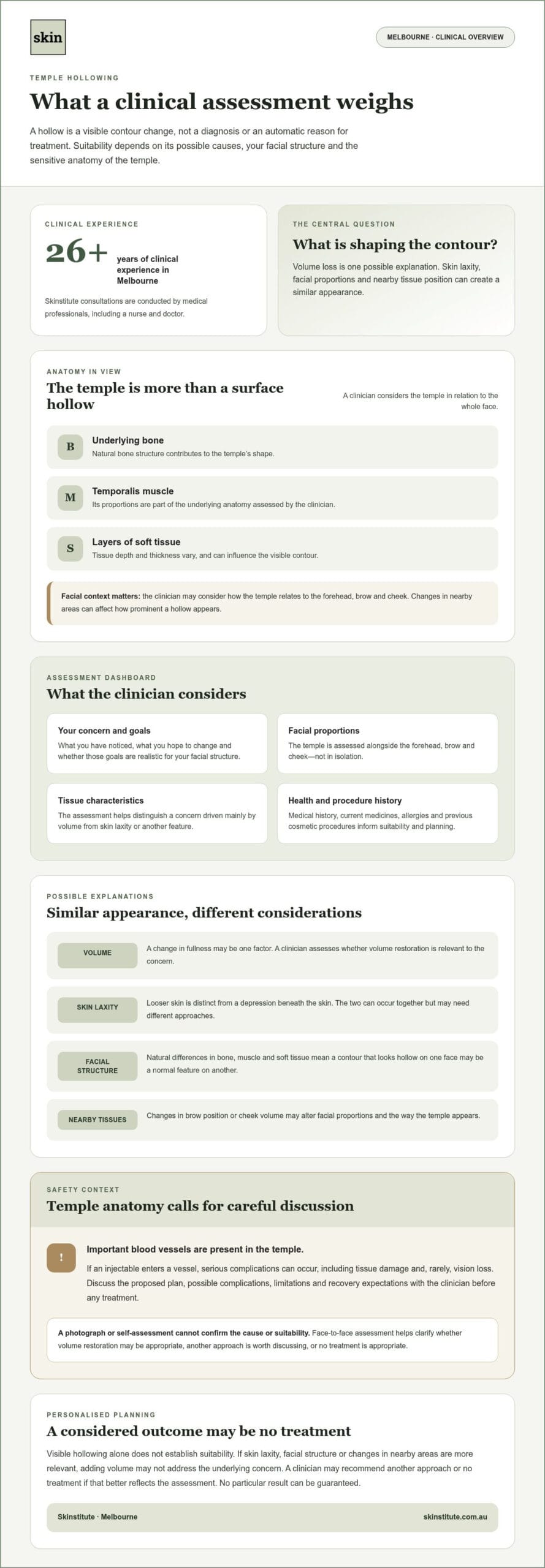
Temple hollowing is a visible change in contour at the sides of the forehead, between the outer brow and the hairline. It describes an appearance, not a medical diagnosis or an automatic reason to consider filler. It is also distinct from general skin laxity. Laxity refers to looser skin, while a hollow is a depression or reduced fullness beneath the skin. The two can occur together, but they may have different causes and need different approaches.
The temple’s shape reflects several structures, including underlying bone, the temporalis muscle and layers of soft tissue. Their proportions vary naturally, so a contour that appears hollow on one face may be a normal feature on another. Temporal fossa anatomy provides further context for the bony region beneath the temple. A clinician also considers how the temple relates to the forehead, brow and cheek, rather than assessing the area in isolation.
Which facial changes can contribute to temple hollowing?
Facial volume and contour vary between individuals and may change over time. Changes in soft tissue, muscle and underlying facial structure can alter the transition between the forehead, temple and cheek. Fat pad migration, the downward movement of facial fat compartments, is one possible contributor to changes in facial volume and contour. It cannot be identified from appearance alone and won’t explain every person’s temple hollowing.
Changes in nearby areas can affect how prominent the temple looks. For example, a change in brow position or cheek volume may alter facial proportions, making the temple seem more or less hollow by comparison. A perceived hollow may therefore reflect more than isolated volume loss in the temple.
Why does temple anatomy matter before considering filler?
The temple is anatomically complex, with important structures and variation in tissue depth and thickness. Before considering an injectable treatment, a clinician assesses these features alongside overall facial proportions. Planning needs to reflect the individual’s anatomy and concern, rather than follow a standard approach to a visible depression.
A photograph or self-assessment may help you describe what you’ve noticed, but it cannot establish the cause or confirm suitability for treatment. In a discussion about temple hollows filler melbourne, a face-to-face clinical assessment helps distinguish volume changes from skin laxity, nearby contour changes or naturally occurring facial structure. That distinction informs whether volume restoration is relevant, another approach is worth discussing, or no treatment is appropriate.
How clinicians assess temple hollows before considering filler
A clinical assessment considers the whole face, not just the visible temple contour. The clinician discusses what you’ve noticed and what you hope to change, then considers whether those goals are realistic for your facial structure. They also review your medical history, current medicines, allergies and previous cosmetic procedures, as these details may affect suitability and treatment planning.
Facial proportions and tissue characteristics help distinguish a concern driven mainly by volume from one associated with skin laxity or another feature. The clinician may also assess how the temple relates to the brow, forehead and cheek. An overview of causes and treatment of temple hollowing provides further clinical context, but individual suitability still requires assessment.
What happens during a temple filler consultation?
The consultation is a chance to explain your concerns, discuss your goals and share relevant health and procedure history. The clinician assesses your facial proportions and tissue characteristics, then explains whether volume restoration may be appropriate and what it can and cannot address. Before any treatment, discuss the proposed plan, potential side effects, recovery and serious risks, including rare but severe complications if an injectable affects a blood vessel.
Who may need a different approach to temple hollowing?
Visible hollowing alone doesn’t establish that treatment is suitable. If your main concern relates to skin laxity, facial structure or changes in nearby areas, adding volume may not address the underlying issue. A clinician may recommend another approach or no treatment if that better reflects the assessment. No particular result can be guaranteed.
The clinician considers your goals, health history, previous procedures, facial proportions, tissue characteristics and risk factors before recommending an approach. At Skinstitute, consultations are conducted by medical professionals, including a nurse and doctor, and treatment plans are tailored following assessment. The clinic brings over 26 years of clinical experience in Melbourne to this measured process.
If you’re considering temple hollows filler melbourne, a personalised Melbourne consultation can help clarify whether your concern is suitable for treatment and what options may align with your goals.
Temple filler suitability, alternatives and the risks to weigh
Temple hollowing doesn’t automatically mean filler is suitable. First, the clinician considers whether the contour reflects volume loss that could reasonably be addressed through volume restoration, or whether skin laxity, skin quality, facial structure or changes in nearby areas are more relevant. If loose skin is the main concern, adding volume may not address it and could create an unbalanced appearance.
Hyaluronic acid dermal filler may be discussed for some volume-related concerns, but it isn’t appropriate for every temple or person. Suitability and planning depend on an in-person clinical assessment, including facial anatomy, medical history and individual risks. The temple has important blood vessels and layered structures. This anatomical review of temple filler injections helps explain why precise assessment matters.
How do concerns guide the clinical discussion?
The table outlines different concerns a clinician may explore. It isn’t a diagnostic tool or treatment recommendation. The same visible feature can have different contributing factors from one person to another.
| Concern noticed | Assessment focus | Possible clinical discussion |
|---|---|---|
| Temple appears less full | Whether local volume change fits the overall facial proportions and tissue characteristics | Whether volume restoration is appropriate, including its limits |
| Skin appears loose | Degree of laxity and whether it is the main source of the contour concern | Whether a volume-based approach is unlikely to address the primary concern |
| Temple looks different alongside the brow or cheek | How neighbouring features affect the perceived contour | Whether the concern is local or part of a broader change in facial balance |
| Skin quality is the main concern | Texture and skin characteristics rather than a depression beneath the skin | Whether a separate discussion about skin-focused care is more relevant |
What risks and limitations should patients understand?
Temporary effects can include swelling, bruising and redness. Some people may also experience jaw soreness or stiffness. Effects and recovery vary. The temple is considered a high-risk injection area because of its blood vessels, including the superficial temporal artery. If injectable material enters a blood vessel, serious complications can include skin necrosis, or tissue death, and, rarely, blindness. Careful anatomical assessment is essential, but it cannot eliminate these risks.
Seek urgent medical assessment for severe or worsening pain, unusual skin colour changes, or any change in vision after treatment. A consultation about temple hollows filler melbourne should include a clear discussion of suitability, expected limitations, potential complications and what to do if concerning symptoms occur. No treatment can guarantee a particular outcome.
What to expect before and after a temple filler appointment in Melbourne
Preparing for a consultation helps the clinician understand your concern and assess whether treatment is appropriate. Bring an accurate account of your medical history, current medicines and allergies, along with details of previous cosmetic procedures. Approximate dates can be useful if you know them. This information can inform clinical decisions and help identify factors that may affect suitability.
Use the consultation to explain what you hope to change and what you want to avoid. Assessment findings guide whether a treatment plan is appropriate; a visible hollow alone doesn’t determine the next step. Skinstitute’s face-to-face consultations are conducted by medical professionals, including a nurse and doctor, and plans are tailored to the individual assessment.
How can patients prepare for a clinical consultation?
Consider writing down your main concerns and questions before attending. You might ask whether the change appears related to volume, skin laxity or another feature; what alternatives could be considered; and what limitations, risks and follow-up may apply. Share previous procedures and relevant health information openly. The clinician can then discuss suitability based on your assessment, rather than assuming a particular approach will be recommended.
What should patients know about recovery and follow-up?
If treatment is considered appropriate, the clinician should explain the proposed plan, possible side effects, recovery expectations and aftercare instructions before proceeding. Recovery differs between individuals, so a generic timeline shouldn’t replace advice tailored to your treatment and circumstances. Follow the treating clinician’s instructions, and contact the clinic if you’re uncertain about a symptom or an aspect of aftercare.
Follow-up provides an opportunity to review recovery and raise concerns. Your clinician can advise whether further review is appropriate for your plan. Seek urgent medical assessment if you experience concerning symptoms after treatment, particularly sudden changes in vision, severe pain or unusual changes in skin colour.
For a considered discussion about temple hollows filler melbourne, arrange a face-to-face consultation to review your concerns, health history and suitability with Skinstitute’s medical professionals.
Choosing a Melbourne clinic for temple hollows filler: a considered next step
A useful consultation should assess the concern rather than assume that a visible hollow calls for treatment. Consider whether the discussion covers your facial anatomy, health history and expectations, and whether you receive a clear explanation of potential risks, limitations and alternatives. You should leave with a better understanding of the clinical reasoning, even if the recommendation is to defer treatment or consider another approach.
Personalised planning considers how an individual’s features and tissues relate to one another, rather than applying a standard treatment approach. Skinstitute’s Melbourne consultations are conducted face to face by medical professionals, including a nurse and doctor. Treatment plans are tailored following assessment within a fully medically supervised environment. The clinic’s over 26 years of clinical experience in Melbourne informs this measured approach, but experience cannot guarantee a particular outcome.
What makes a consultation clinically useful?
A clinically useful discussion covers why the temple appears hollow, whether volume restoration is relevant to your concern, and how your medical history or previous procedures may affect suitability. It should also set realistic expectations and explain the risks of treatment in this anatomically sensitive area. A plan tailored to your assessment is more appropriate than applying the same approach to every face.
For further context on Skinstitute’s clinical approach, read the Skinstitute Melbourne guide to medical-grade aesthetic treatments. It explains how consultation and individual assessment fit within medical-grade aesthetic care.
When should you book a temple hollow assessment?
If temple hollowing concerns you and you want clinical guidance, an assessment can help clarify what may be contributing to the contour and whether treatment is suitable. A consultation lets you discuss your concerns and options without committing to proceed. Explain your goals, share relevant health information and consider the clinician’s recommendations before making a decision.
If you’re considering temple hollows filler melbourne, arrange a consultation with Skinstitute to discuss your concerns and receive a personalised, face-to-face assessment.
Make your next step an informed one
Temple hollowing is a visible contour change, not a diagnosis or automatic indication for treatment. Its appearance may relate to volume, skin laxity, facial structure or changes in nearby areas, so a clinician needs to assess the whole face before discussing suitable options. The temple’s sensitive anatomy also makes a clear conversation about risks, limitations and recovery essential.
If you’re considering temple hollows filler melbourne, use a consultation to explain your concerns, goals, health history and previous procedures. Skinstitute’s Melbourne consultations are conducted by medical professionals, including a nurse and doctor, with treatment plans tailored following face-to-face assessment. The clinic brings over 26 years of clinical experience in Melbourne to this personalised process, without assuming one approach suits everyone.
Arrange a personalised consultation with Skinstitute to discuss your concerns and understand your options. A thoughtful assessment can help you make an informed decision that is appropriate for you.
Frequently Asked Questions
What causes temple hollows, and do they always need treatment?
Temple hollows can reflect natural facial structure or changes in soft tissue, muscle and bone over time. Fat pad migration may contribute for some people, but it isn’t the explanation for every hollow. Changes in the brow or cheek can also affect how the temple appears. Hollowing is a visible contour, not a diagnosis, and it doesn’t automatically require treatment. A clinician can assess its likely contributors if it concerns you.
Is temple filler suitable for everyone with hollow temples?
No. The appearance of hollowing alone can’t establish suitability. A clinician considers the cause of the contour, facial proportions, tissue characteristics, medical history and previous procedures before discussing treatment. If skin laxity or another feature is the main concern, volume restoration may not address it. The consultation should explain potential risks, limitations and alternatives, and may conclude that treatment isn’t appropriate for your circumstances.
How does a clinician assess temple hollows before considering filler?
A clinician assesses the temple in relation to the whole face, including the brow, forehead and cheek, rather than judging the hollow in isolation. They’ll discuss your concerns and goals, review your medical history, medicines, allergies and previous cosmetic procedures, and consider tissue characteristics and facial proportions. This assessment helps distinguish volume-related concerns from skin laxity or other contour changes. A photograph or self-assessment can’t determine suitability.
What are the risks of hyaluronic acid filler in the temple area?
Temporary effects may include swelling, bruising, redness and jaw soreness or stiffness. More serious complications are possible because important blood vessels run through this anatomically sensitive area. If injectable material enters a blood vessel, it can cause tissue damage, including skin necrosis, and, rarely, vision loss. Ask the clinician to explain the risks and which symptoms need urgent assessment. Sudden vision changes, severe pain or unusual skin colour changes require urgent medical assessment.
How long does recovery from temple filler take?
There isn’t one recovery period that applies to everyone. Swelling, bruising, redness or jaw discomfort may occur, and their duration and severity vary between individuals. Before treatment, ask the clinician what recovery may involve in your case and what to expect as the area settles. Follow your treating clinician’s personalised aftercare instructions rather than relying on generic timelines. Seek urgent medical assessment for severe pain, vision changes or unusual skin colour.
Can temple filler address skin laxity as well as volume loss?
Temple filler is discussed as a form of volume restoration, so it may not address a concern driven mainly by loose skin or skin quality. Hollowing and laxity can appear together, which is why assessment needs to identify the main contributors before a plan is considered. A clinician can explain whether volume restoration is relevant, discuss its limitations and outline other appropriate considerations without promising a particular result.
What should I ask during a temple filler consultation in Melbourne?
Ask what may be contributing to the hollow, whether volume restoration suits your anatomy, and what alternatives, risks, limitations and recovery expectations apply. Share your medical history and previous cosmetic procedures. For temple hollows filler melbourne, Skinstitute offers face-to-face consultations with medical professionals, including a nurse and doctor, and tailors plans to individual assessment. The clinic has over 26 years of clinical experience in Melbourne. Use the consultation to make an informed decision, not as a commitment to treatment.