
Temple Hollows Filler in Melbourne: A Clinical Guide to Your Options
October 7, 2026
How Often Should You Get Skin Needling? A Clinical Guide
October 9, 2026
Could the small raised bumps that appear after Rejuran be an expected reaction rather than a complication? Redness, swelling, bruising and injection-site papules can occur after treatment. Understanding rejuran side effects and risks, including how reactions may change and which symptoms need clinical review, can make recovery less uncertain.
It’s reasonable to have questions about discomfort, visible injection marks and individual suitability. This guide explains common short-term reactions, less common concerns and warning signs that warrant prompt clinical assessment. It also outlines how medical history, allergies, previous filler treatments and injection technique can inform a personalised treatment plan. At Skinstitute in Melbourne, medical professionals including a nurse and doctor assess patients face to face, drawing on more than 26 years of clinical experience to discuss suitability, recovery and potential risks before treatment.
Key Takeaways
- Rejuran side effects and risks can relate to both the injectable product and the injection procedure. They don’t predict an individual’s outcome.
- A clinical assessment can identify health history, allergy or previous-treatment factors that may affect suitability.
- Rejuran’s injectable approach differs from skin needling, and treatment choice depends on the concern being addressed.
- Follow your treating clinician’s instructions for preparation, aftercare and follow-up rather than relying on generic online schedules.
- At Skinstitute, face-to-face assessment supports a tailored plan and an informed discussion of potential reactions, uncertainties and suitability.
Rejuran side effects: which reactions may occur after treatment?
It’s reasonable to ask about safety before an injectable treatment. A side effect is a possible reaction, not a prediction that a particular person will experience it. Rejuran treatment can cause local responses at injection sites, and the type and degree of reaction vary between people. There are no established Australian incidence figures in the information available here, so a precise individual likelihood cannot be stated.
Understanding rejuran side effects and risks means considering both the injections and the product. The term polynucleotide refers to molecules made from chains of nucleotides. Rejuran is a polynucleotide-based injectable. The reference explains the general term, rather than providing guidance about an individual’s treatment or recovery.
What local reactions may follow Rejuran injections?
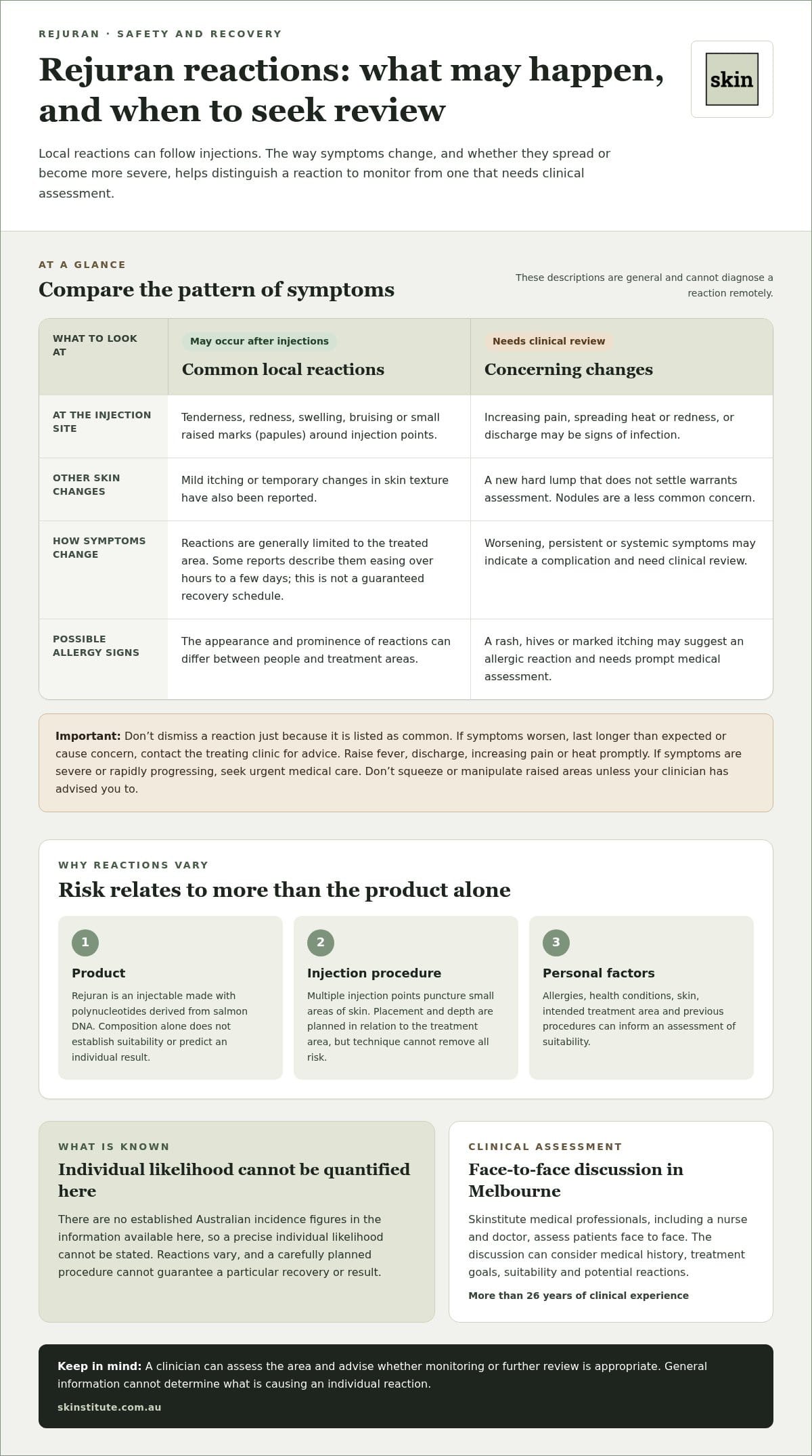
Commonly reported local reactions include tenderness, redness, swelling, bruising and small raised marks, sometimes called papules, around injection points. Mild itching or temporary changes in skin texture have also been reported. These reactions may relate to the injection process and the skin’s local response. Their appearance, prominence and duration differ between people and may vary by treatment area.
Small raised marks may be visible soon after treatment and can settle as the skin recovers. Some reports describe local reactions easing over hours to a few days, but this is not a guaranteed recovery schedule. Bruising, for example, may be more noticeable in one person than another. Don’t dismiss a reaction solely because it is listed as common. How it progresses and whether other symptoms occur also matter.
How do expected reactions differ from symptoms needing review?
Common local reactions are generally limited to the treated area. Worsening, persistent or systemic symptoms may indicate a complication and need clinical review. Mild tenderness or swelling at injection points differs from increasing pain, spreading heat or redness, fever, or discharge, which can be signs of infection. A new hard lump that does not settle also warrants assessment, as nodules are a less common concern.
Seek prompt advice from the treating clinic if symptoms are worsening, last longer than expected or cause concern. Raise fever, discharge, increasing pain or heat promptly rather than watching without guidance. A rash, hives or marked itching may suggest an allergic reaction and also needs prompt medical assessment. If symptoms are severe or rapidly progressing, seek urgent medical care. Don’t squeeze or manipulate raised areas unless your clinician has advised you to do so.
These descriptions are general and cannot diagnose a reaction remotely. Your treating clinician can assess the area and advise whether monitoring or further review is appropriate.
How Rejuran treatment and polynucleotides relate to risk
Understanding the treatment’s composition and delivery helps explain why risk is not determined by the product alone. Rejuran is a polynucleotide-based injectable treatment, so relevant considerations include the product, the injection procedure and how treatment is planned around a person’s skin and medical history. This context can inform a discussion, but it cannot predict an individual response.
Polynucleotides are chains of nucleotide units, the building blocks of DNA and RNA. Rejuran is an injectable product made with polynucleotides derived from salmon DNA. Its composition should be distinguished from claims about what it will achieve in the skin. The biological rationale for treatment does not, by itself, prove a particular clinical outcome or guarantee tissue repair or skin improvement.
What are polynucleotides in Rejuran?
In patient-friendly terms, polynucleotides are long molecular chains formed from nucleotides. Rejuran uses them in an injectable formulation. Product composition describes what the treatment contains; proposed biological effects describe how it is intended to act. These points are related but separate. An explanation of the rationale does not establish the extent of benefit for every patient.
Describing a product as polynucleotide-based does not establish that it is suitable for everyone or universally compatible with skin. A clinician should consider relevant allergies, health conditions, the intended treatment area and previous procedures when assessing suitability. These details help determine whether Rejuran is appropriate for the individual, rather than relying on broad claims about the ingredient.
Why can injection technique affect the experience?
Rejuran is administered through injections, so technique contributes to the experience as well as the product itself. The practitioner’s anatomical judgement informs placement and depth in relation to the treatment area. Facial regions have different tissue characteristics, so planning needs to be specific to the area and the patient.
Multiple injection points mean several small areas of skin are punctured. This can influence temporary local responses, including visible marks, tenderness or bruising. Reactions may vary across the treatment area, and not every injection point will respond in the same way. Technique cannot remove all risk, and a carefully planned procedure cannot guarantee a particular recovery or result.
For these reasons, rejuran side effects and risks should be discussed in the context of both product information and how treatment is delivered. A face-to-face assessment allows the clinician to consider your skin, relevant medical history and treatment goals before deciding whether Rejuran is suitable. If you’re considering treatment, a Rejuran consultation gives you the opportunity to discuss these factors and the uncertainties involved.
Rejuran risks, suitability and how it compares with other skin treatments
Rejuran isn’t suitable for every patient, and its risk profile depends on the person’s circumstances and intended treatment area. The same skin concern may have several treatment options, each with a different delivery method and considerations. A clinical assessment helps determine whether the proposed approach is appropriate or whether an alternative or deferral should be considered.
Which health and treatment-history details matter?
Before deciding, provide a clear account of relevant health conditions, allergies, medicines and supplements, previous cosmetic procedures and any past reactions. Pregnancy or breastfeeding, autoimmune conditions, and bleeding or clotting disorders may also affect suitability and should be disclosed. A known fish or salmon-product allergy is particularly relevant because Rejuran is derived from salmon DNA.
Previous filler treatment is another detail to raise. There is a potential concern about nodule formation if Rejuran is injected into the same skin layer as existing cross-linked dermal filler. If you know which areas were treated, share that information. If you’re unsure, say so rather than guessing. The treating professional can decide whether more information or assessment is needed before recommending a course of action.
How does Rejuran differ from skin needling and fillers?
These treatments differ in delivery and purpose, so they aren’t interchangeable. Rejuran is an injectable polynucleotide treatment. Skin needling uses controlled needle contact with the skin to create a wound-healing response, while hyaluronic acid dermal filler is used to add or restore volume in selected areas. The appropriate option depends on the concern, treatment area and clinical assessment.
Treatment type | Delivery method | Questions for clinical discussion
Rejuran | Polynucleotide-based injectable | What factors could affect suitability for my intended treatment area?
Skin needling | Needles create controlled skin injury | Is collagen induction relevant to the skin concern I want addressed?
Hyaluronic acid dermal filler | Injectable gel used to add or restore volume | Is volume restoration relevant, and how might previous filler affect planning?
These distinctions can help frame a discussion, but they don’t establish that one option is safer or more effective for everyone. Consider how each treatment’s purpose aligns with your concern, and ask how uncertainty and potential risks apply to your circumstances. The guide Clinical Guide to Rejuran in Melbourne: The Science of Polynucleotide Skin Bio-Stimulation provides further context on Rejuran’s treatment rationale.
Before and after Rejuran: practical steps for managing risk
Preparation and follow-up are part of planning for an injectable treatment. Follow the instructions provided for your procedure rather than applying a schedule from a general online source. Before treatment, make sure you know how to raise a concern and what information will help the clinical team understand any changes afterwards.
Consultation: prepare for a useful discussion
Before your appointment, note your current medicines and supplements, relevant health conditions, allergies, previous aesthetic treatments and any reactions you have experienced. If you have details or records about earlier filler or injectable treatments, bring them or explain what you know. A clear history helps the treating professional consider relevant factors rather than relying on memory during the discussion.
Use the consultation to clarify which areas are being considered, what reactions may occur, what uncertainties remain and how follow-up will work. If you’re unsure whether a past condition or treatment matters, mention it. Your clinician can decide whether it changes the plan or calls for further assessment.
Treatment day: confirm your understanding
Before the procedure begins, confirm that you understand the intended treatment area and the aftercare instructions. Raise any new health changes or concerns that have come up since your assessment. If any part of the plan is unclear, pause to ask for an explanation before proceeding. Don’t alter prescribed medicines or start preventive medicines on your own. Discuss medication questions with the treating professional.
Aftercare: follow your individual instructions
Follow the written or verbal aftercare directions provided for your treatment. Don’t substitute advice from online forums or apply additional products or measures your clinician hasn’t recommended. If you’re uncertain whether an activity or skin-care product is appropriate, ask the treating clinic before making a change. This keeps your aftercare aligned with the treatment you received.
Observe the treated area in ordinary lighting and note any changes that concern you. A brief record of when a symptom began and how it has changed can help you explain the situation if you seek advice. Contact the treating clinic about persistent, worsening or concerning symptoms. Don’t rely on a generic recovery timetable to decide whether a change needs review.
Follow-up: know how to seek advice
Before leaving, make sure you understand any follow-up arrangements and how to contact the treating clinic with a concern. If symptoms are severe or rapidly progressing, seek urgent medical care. For other changes, describe what you noticed and when it started so the clinical team can advise on the next step. Clear communication supports considered management of rejuran side effects and risks.
Discuss Rejuran preparation and follow-up with Skinstitute as part of planning treatment around your individual circumstances.
Discussing Rejuran side effects with Skinstitute in Melbourne
A considered decision about Rejuran involves more than reviewing a list of possible reactions. Informed consent means discussing what is known, what remains uncertain, whether treatment may suit you and how follow-up will be managed. A consultation supports that discussion, but it cannot guarantee suitability or a particular outcome.
What a personalised Rejuran assessment can cover
Skinstitute’s medical professionals, including a nurse and doctor, conduct face-to-face assessments and tailor treatment planning to each individual. The discussion can cover your skin concerns, relevant health history, allergies, medicines, previous aesthetic treatments and expectations. These details help the team consider potential benefits, risks and alternatives in relation to your circumstances, rather than treating general information as a personal recommendation.
To make the conversation useful, consider bringing or noting:
- Relevant medical conditions, allergies and medicines or supplements.
- Previous cosmetic treatments and any reactions you experienced.
- The skin concerns you want addressed and the outcomes you consider realistic.
- Questions about possible reactions, uncertainties and follow-up arrangements.
Sharing this information gives the treating team context for assessing individual factors. If your history or expectations raise questions, the clinician can discuss whether further assessment or an alternative approach should be considered before you decide.
Making an informed decision about Rejuran
Take time to consider the information provided and ask questions if any part of the proposed plan is unclear. You may wish to clarify what reactions could occur, how concerns would be reviewed and what alternatives may be relevant to your skin goals. Understanding these points helps you weigh potential advantages against the limitations and uncertainties of treatment.
The consultation is a decision-making step, not a promise that treatment will proceed or that results can be assured. Skinstitute draws on over 26 years of clinical experience in Melbourne, with treatment planning informed by face-to-face assessment. Discussion of rejuran side effects and risks should reflect your health and treatment history, rather than relying only on general descriptions.
For wider context on the clinic’s approach, the guide Skinstitute Melbourne: A Clinical Guide to Medical-Grade Aesthetic Treatments addresses assessment and planning across aesthetic treatments. Use your consultation to raise personal concerns that may affect your decision, including uncertainty about suitability or recovery.
If you’d like to discuss whether Rejuran may be appropriate for your circumstances, discuss Rejuran treatment with Skinstitute.
Make your next step an informed one
A useful next step is to consider what you want to understand before deciding, rather than feeling obliged to proceed because you have explored the treatment. Write down your main concern, what you hope to address and any uncertainty that could affect your decision. This gives the consultation a clear focus and helps you assess whether the proposed approach fits your priorities.
The phrase rejuran side effects and risks describes possibilities, not a prediction of how treatment will affect you. Your decision can take account of the information discussed, your personal circumstances and the time you need to consider them. It’s reasonable to ask for clarification before choosing a treatment plan.
Skinstitute’s Melbourne medical team can discuss your questions and whether Rejuran may be suitable for you. Discuss Rejuran treatment with Skinstitute as a considered next step towards an informed decision that reflects your circumstances.
Frequently Asked Questions
What are the most common side effects of Rejuran?
Commonly reported Rejuran side effects are usually local to the injection sites. Their appearance and intensity can differ across the treated area, so don’t judge your recovery by someone else’s experience or online photographs. If you’re monitoring a change, note when you first noticed it and whether it is settling or becoming more pronounced. These observations can help your clinician give advice specific to your treatment.
How long do Rejuran side effects usually last?
There is no single duration that applies to every person or reaction. Rather than relying on a fixed timeline from an online account, ask your clinician what recovery may look like for your planned treatment area and when they would want an update. If you’re unsure whether a change is following the expected course, contact the treating clinic for individual guidance instead of waiting for a particular day.
Is Rejuran safe for everyone?
No injectable treatment can be assumed suitable for everyone. A consultation is needed to consider your circumstances and intended treatment area before a decision is made. If your health or medicines change between assessment and treatment, tell the clinic before proceeding. The original assessment may no longer reflect your current situation, and a clinician can decide whether the plan remains appropriate or needs to be reconsidered.
Can Rejuran cause an allergic reaction?
An allergic reaction is possible. Before treatment, tell your clinician about any previous allergy diagnosis and what happened, including whether medical care was needed. This detail is more useful than describing yourself only as “allergic” because it helps the clinician assess your history and discuss precautions. Don’t apply or inject a product yourself to test for a reaction. Leave assessment and treatment decisions to a qualified professional.
What should I do if swelling or redness worsens after Rejuran?
Contact the treating clinic promptly and describe the change rather than trying to manage it without advice. If practical, take a clear photograph in consistent lighting and note when the change began. This can help communicate how it is progressing. Avoid squeezing, rubbing or applying unadvised products to the area. If symptoms are severe or rapidly progressing, seek urgent medical care, and call 000 in an emergency.
Can I have Rejuran if I have sensitive skin or a medical condition?
Sensitive skin alone doesn’t establish whether Rejuran is suitable, and a diagnosis doesn’t automatically determine the answer either. Describe how your skin behaves, whether it is currently flaring, and which treatments or products have caused problems before. If you have a medical condition, explain how it is managed and whether anything has changed recently. The treating clinician can assess these details alongside the proposed treatment area before advising you.