
Getting Rid of Turkey Neck Without Surgery: A Clinical Guide
October 12, 2026
Long-Term Benefits of HIFU for Facial Lifting and Wrinkles
October 14, 2026
HIFU body contouring is not a weight-loss treatment, and suitability depends on more than the area you hope to change. If you’re considering hifu body contouring melbourne, start by understanding what focused ultrasound may address and where its limits lie. It is a clinical decision, not a promise of targeted fat loss.
Descriptions of body contouring, skin tightening and weight reduction can blur together, but these are different concerns. HIFU uses focused ultrasound energy to create a controlled response in targeted tissue. The appropriate use and expected effect depend on the device, the treatment plan and individual assessment. That distinction matters when deciding whether your concern relates to localised contour, skin laxity or excess skin.
This article explains HIFU in clinical terms, outlines realistic expectations and discusses suitability, risks and recovery. At Skinstitute, face-to-face consultations with a nurse and doctor inform personalised treatment planning. The clinic brings over 26 years of clinical experience in Melbourne to this assessment-led approach. Understanding what a consultation can clarify helps you make a decision that reflects your goals, health and the treatment’s scope.
Key Takeaways
- Learn what hifu body contouring melbourne is intended to address, and why it should not be viewed as a weight-loss method.
- Understand how focused ultrasound works in broad terms, while recognising that treatment responses vary between individuals.
- Separate a localised aesthetic concern from a broader weight-management goal before considering treatment.
- Prepare for a clinical consultation by considering your goals, health history, suitability, risks and recovery expectations.
- See how Skinstitute’s face-to-face assessment and personalised planning can help determine whether HIFU aligns with your goals.
What HIFU body contouring in Melbourne is designed to address
High intensity focused ultrasound, or HIFU, directs ultrasound energy towards a selected area of tissue. The term describes how energy is focused; it does not, by itself, specify the treatment outcome. HIFU is used in different medical and aesthetic contexts, and its intended effect depends on the device and treatment plan. This overview of high-intensity focused ultrasound (HIFU) explains the technology’s broader medical uses, but it should not be taken as a prediction of an individual body-contouring result.
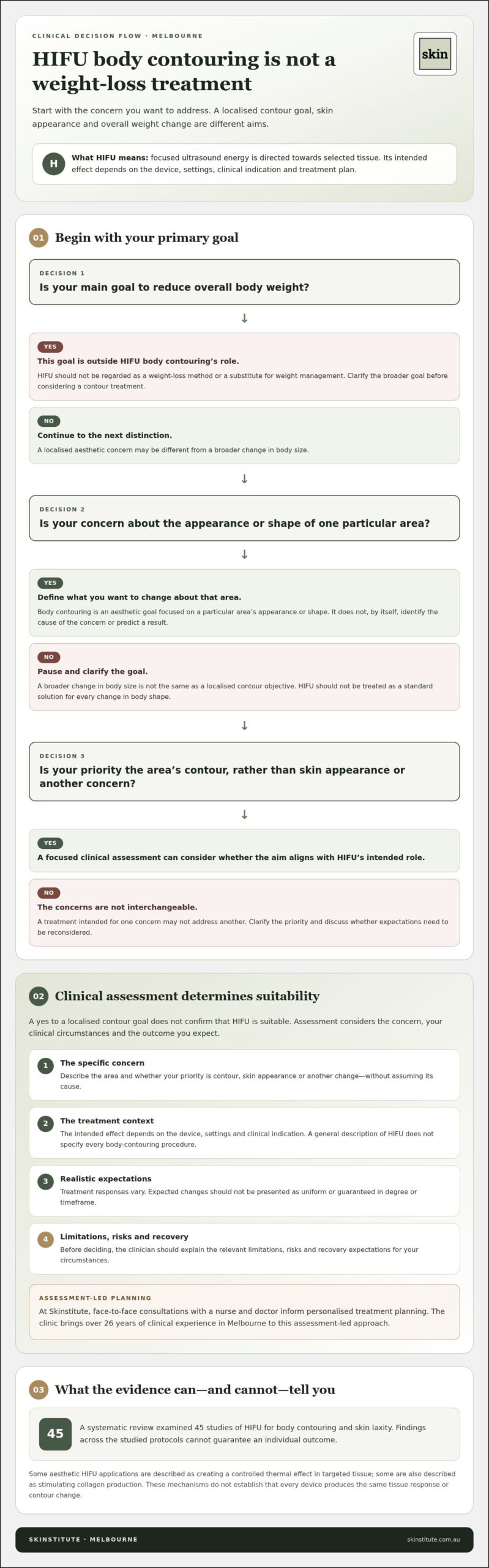
In an aesthetic setting, body contouring refers to addressing a localised concern about an area’s appearance or shape. It differs from weight loss, which involves changes in overall body weight and may relate to broader health and lifestyle considerations. HIFU body contouring Melbourne patients consider should be assessed against a specific concern and realistic treatment aim, not presented as a way to lose weight or achieve a particular body shape.
The same area can raise different concerns. You may be interested in its outline, the appearance of the skin or another change. These goals are not interchangeable, and a treatment intended for one concern may not address another. Assessment helps clarify whether your desired outcome aligns with HIFU’s intended role, or whether expectations need to be reconsidered.
How body contouring differs from weight loss
Body contouring is an aesthetic goal focused on the appearance or shape of a particular area. It is not a measure of overall health, and a contour treatment should not be regarded as a substitute for weight management. HIFU does not promise a particular change in body weight. Before recommending a treatment, a clinician considers your concern and intended outcome.
What a Melbourne patient should clarify first
Before an assessment, describe the area that concerns you and what you hope to change. For example, explain whether your priority is contour, skin appearance or another concern, without assuming its cause. A face-to-face clinical assessment gives the practitioner an opportunity to consider your goals and circumstances, then develop a plan based on that discussion rather than a standardised promise.
It helps to define what a satisfactory outcome would mean to you. Is your aim a subtle change in the outline of one area, or a broader change in body size? The answer can distinguish a localised aesthetic objective from a weight-management goal. If your desired result falls outside the treatment’s intended scope, discuss that before making a decision.
Suitability is not determined by location or the treatment name alone. In Melbourne, as elsewhere, the relevant question is whether your concern, clinical circumstances and expected outcome align. HIFU body contouring should be approached as an assessment-led option, not a standard solution for weight loss, skin concerns or every change in body shape.
How HIFU works and what the treatment response depends on
High intensity focused ultrasound (HIFU) concentrates ultrasound energy towards a selected target. The term describes how the energy is focused; it does not, by itself, specify the treatment outcome. The effect depends on the device, its settings and the clinical indication. A broad description of HIFU should not be treated as a specification for every body-contouring procedure.
In aesthetic applications, the proposed response involves a controlled thermal effect in targeted tissue. Some HIFU applications are also described as stimulating collagen production. These mechanisms do not establish that every device produces the same tissue response or contour change. A 2025 systematic review of 45 studies published between 2010 and 2024 examined HIFU for body contouring and skin laxity. Findings across the studied protocols cannot guarantee an individual outcome.
What focused ultrasound means in an aesthetic treatment
“Focused” means ultrasound energy is directed towards a target, rather than being described simply as sound passing through tissue. In general terms, HIFU can create a localised thermal effect at the intended target, but the precise tissue interaction depends on the technology and its clinical use. Device-specific details cannot be assumed from the acronym alone.
This distinction matters when interpreting treatment claims. A mechanism described for one HIFU application does not automatically apply to another device or treatment area. If you’re considering hifu body contouring melbourne, the clinician’s explanation should relate the proposed treatment to its specific purpose, without presenting general descriptions of the technology as a promise of fat loss or skin change.
Why individual treatment responses can differ
Anatomy, treatment concerns and clinical circumstances differ between people. These factors can influence whether HIFU is suitable and how a practitioner plans treatment. Assessment helps distinguish a concern that may align with the treatment aim from one that needs a different discussion. General information explains the principle, but it cannot predict your individual response.
Expected changes should not be described as uniform or assigned a guaranteed timeframe or degree. Before you decide, the clinician should explain what can reasonably be discussed for your circumstances, along with relevant limitations, risks and recovery expectations. Treatment planning is informed by assessment, not by a standard result applied to everyone.
At Skinstitute, a face-to-face consultation with medical professionals informs personalised HIFU treatment planning, connecting the proposed approach to your individual assessment and clinical discussion.
HIFU body contouring compared with other approaches and treatment goals
Choosing an approach starts with identifying the concern. A localised contour goal, a skin concern and a weight-management goal are different objectives. The appropriate approach depends on the concern being assessed, your circumstances and what an intervention is intended to address. HIFU should not be presented as a general solution for changes in weight or every difference in body shape.
The comparison below is about treatment goals, not a ranking of options. Weight management can involve non-procedural goals related to overall health and body weight, while HIFU is assessed as an aesthetic procedure for a defined concern.
| Consideration | HIFU assessment | Non-procedural weight-management goal |
|---|---|---|
| Main focus | Whether a specific aesthetic concern aligns with the intended use of HIFU | Changes in overall body weight or broader health-related aims |
| What informs the plan | Individual assessment of the concern, clinical factors and expectations | Personal goals and relevant health or lifestyle considerations |
| What not to assume | A particular contour change or weight reduction | That a localised aesthetic procedure addresses the broader goal |
This distinction can help frame a consultation. If you’re seeking a change in the outline of one area, your objective may differ from that of someone whose main aim is to change overall body weight. If your primary concern is skin appearance, raise that separately rather than assuming contouring will address it.
Is HIFU the right match for the concern?
A clinical assessment considers whether HIFU aligns with your stated goal and circumstances. Keep expectations measured: an assessment can clarify the treatment’s intended role, but it cannot promise a particular change. If your main objective concerns skin appearance or another issue, discuss it on its own terms and ask whether HIFU is relevant.
When a non-surgical approach may not meet expectations
Non-surgical treatments have limits and should not be presented as equivalent to procedures involving surgery. Skin redundancy means excess or loose skin that cannot be removed by non-surgical modalities. Whether HIFU is appropriate depends on clinical assessment; the presence of loose skin alone does not establish suitability or predict a response.
For people considering hifu body contouring melbourne, a useful consultation should clarify what the proposed treatment aims to address, what it cannot be expected to do and whether that scope matches the concern. If your expectations extend beyond that scope, the clinician should explain the limitation before you decide. This keeps the discussion focused on an appropriate goal rather than an assumed result.
Suitability, risks and consultation questions for HIFU in Melbourne
A consultation helps determine whether a proposed treatment fits your concern, circumstances and expectations. It should give you enough information to make a considered decision, including an explanation of relevant risks and likely recovery expectations before you proceed. A discussion is not a promise of eligibility or a particular result.
Preparing a few points in advance can make the conversation more useful:
- Define your goal. Describe the area of concern and the change you hope to achieve. Be clear whether your priority is contour, skin appearance or another objective.
- Discuss your history. Share relevant medical history and information about previous or current treatments that may help the clinician assess your circumstances.
- Review suitability. Ask how the clinical assessment relates to your concern and whether HIFU’s intended role aligns with your expectations.
- Understand risks and recovery. Ask the clinician to explain the risks relevant to the proposed plan and what recovery may involve before you decide.
What a clinical suitability assessment should cover
A suitability discussion should connect your stated goal with relevant clinical considerations, rather than rely on a standard treatment plan. At Skinstitute, face-to-face consultations with a nurse and doctor inform individualised planning. You can raise relevant history, discuss the intended outcome and understand how those details shape the recommendation. Assessment supports informed decision-making; it does not establish that every person is suitable.
Questions to discuss before deciding
Ask what outcomes are realistic for your concern and how the proposed plan is intended to address it. You can also ask which risks apply to your circumstances, what recovery the clinician anticipates, and whether another treatment objective calls for a different discussion. These questions help separate general information about HIFU from advice specific to you.
Clarify what follow-up, if any, is part of the plan and how to seek clinical advice if you have a concern after treatment. The clinician should explain the appropriate pathway for your circumstances. Do not rely on general online descriptions to interpret an individual symptom or decide what care is needed.
With hifu body contouring melbourne, the value of consultation lies in individual assessment, not in securing a predetermined treatment. It lets you weigh the expected scope, limitations, risks and recovery information against your priorities. If any part of the plan is unclear, ask for further explanation before deciding.
Discuss your goals and suitability in a face-to-face clinical consultation with Skinstitute.
Considering HIFU body contouring at Skinstitute in Melbourne
Skinstitute offers High Intensity Focused Ultrasound (HIFU) as part of its medical aesthetic services in Melbourne. Whether HIFU aligns with your body-contouring goal is a matter for individual clinical assessment, not an assumption based on a general description of the technology. A face-to-face discussion allows your intended outcome and relevant clinical considerations to inform the next step.
Skinstitute’s experience in Melbourne informs this clinical approach, but experience cannot guarantee an individual result. Recommendations and expected outcomes need to be considered in relation to your circumstances, the concern being assessed and the intended purpose of HIFU.
A personalised pathway from concern to treatment plan
Start by describing what you hope to address and what a meaningful, realistic outcome would look like to you. In a face-to-face consultation, medical professionals can discuss those goals and consider relevant clinical factors before recommending a tailored plan. This keeps the conversation specific to your concern, rather than assuming the same approach or response applies to everyone.
If HIFU is considered in relation to your goals, the clinician can explain its proposed role, limitations and relevant considerations. A treatment plan should reflect individual assessment and evidence-informed clinical judgement, not a promise of a particular change.
How to take the next step
If you’re considering hifu body contouring melbourne, a clinical consultation can clarify the purpose of treatment and whether it may be a reasonable fit for your concern. Note your priorities and questions about the proposed plan, potential risks or recovery before attending. The aim is to leave with a clearer understanding of the relevant information, not pressure to proceed.
For further context about Skinstitute’s clinical approach, read the Skinstitute Melbourne clinical guide. It provides background on the clinic’s medical aesthetic care. Your suitability and treatment plan still require individual discussion.
Make your next step an informed one
Deciding whether to proceed with hifu body contouring melbourne starts with a clear understanding of what you want to address and what the treatment can reasonably be expected to do. A clinical discussion can put your goals, individual circumstances, potential risks and recovery expectations into context. Take time to consider the information and ask questions if any part of the proposed plan is unclear.
Rather than focusing only on a desired change, consider what information would help you make a confident decision. This may include understanding why a plan has been recommended, what its limits are and how your concern will be assessed. The aim is a considered choice that reflects your priorities, not pressure to pursue treatment.
Arrange a face-to-face clinical consultation with Skinstitute to discuss your goals and whether HIFU may be appropriate for you.
Frequently Asked Questions
Is HIFU body contouring the same as weight loss?
No. The goals differ, so be precise about what you want to change when discussing treatment. For example, describe a particular area’s appearance as your concern rather than using a change in clothing size or scale weight as the only measure of success. This gives the clinician a clearer basis for discussing your aesthetic goal.
Can HIFU body contouring treat loose skin?
Whether HIFU is relevant to loose skin requires individual assessment. During the consultation, describe when the looseness is most noticeable and what change you hope to see. Ask how the clinician will assess the concern and what outcomes would be reasonable to discuss. This helps clarify whether your expectations relate to the treatment being considered, without assuming that a contouring procedure will remove excess skin.
How many HIFU body contouring sessions will I need?
The number of sessions should be discussed as part of your individual plan, not taken from a generic schedule. Ask the clinician to explain the proposed sequence, what would inform any decision about further treatment and how progress will be reviewed. Clarifying these points helps you understand the plan without assuming additional sessions are automatic or that a set number guarantees a particular outcome.
When might I see results from HIFU body contouring?
Ask the clinician how and when your progress would be reviewed for the specific concern being treated. Before treatment, discuss how change will be assessed against the original concern and treatment goal recorded in your plan. For hifu body contouring melbourne, this keeps follow-up individual and avoids treating a general timeline as a prediction of your personal response.
What risks and recovery should I expect after HIFU?
Before deciding, ask the clinician to explain the risks relevant to your proposed treatment and the recovery guidance that applies to you. Clarify which effects are anticipated, which concerns should prompt clinical advice and how to access that advice after treatment. This discussion helps distinguish expected recovery information from an issue that needs individual attention. Do not rely on generic online descriptions to assess a symptom.
Can I combine HIFU body contouring with another aesthetic treatment?
Discuss other aesthetic treatments you’re considering, including their timing, during your clinical consultation. Bring a brief record of recent or planned procedures so the clinician can consider the overall sequence and any relevant recovery considerations. Ask whether treatments should be spaced or assessed separately. A combined plan should reflect your circumstances, not an assumption that more than one treatment will improve the result.
How do I know whether HIFU is suitable for me?
Use the consultation to understand the reasoning behind the recommendation. Before attending, write down your main concern, the outcome you hope for and any questions that may affect your decision. Ask the clinician to explain how these points relate to the proposed plan and what alternatives or limitations are relevant. This preparation can support a considered choice, but an online checklist cannot replace personal assessment.