
How Long Does Exosome Therapy Last? A Clinical Guide
October 11, 2026
HIFU Body Contouring in Melbourne: Suitability, Results and Clinical Guidance
October 13, 2026
The contour beneath the chin can change for several reasons, and loose skin is not always the only factor. If you’re considering getting rid of turkey neck without surgery, it helps to understand whether skin laxity, fullness beneath the chin or visible platysmal bands may be contributing. Similar changes in appearance can have different anatomical causes, so one approach won’t suit everyone.
Non-surgical options differ in how they work, what they aim to address and what recovery may involve. This guide explains the main factors that influence neck appearance and compares approaches such as HIFU and PDO thread lifting. It also outlines what a personalised clinical assessment should consider, including skin quality, the degree of skin redundancy, suitability, potential risks and recovery. For people in Melbourne, a face-to-face consultation with medical professionals can help clarify which concerns may be addressed non-surgically and set realistic expectations.
Key Takeaways
- Understand why “turkey neck” can describe different visible changes, and what to raise during an assessment.
- Learn why getting rid of turkey neck without surgery depends on matching a treatment’s mechanism to the tissue concern.
- Compare HIFU, thread lifting and clinician-directed injectable approaches by their intended focus, considerations and limitations.
- Prepare for a consultation by noting previous procedures, relevant medical conditions and current medicines, then discussing realistic expectations.
- See how a face-to-face assessment at Skinstitute in Melbourne can inform a personalised plan, drawing on over 26 years of aesthetic industry experience.
Getting rid of turkey neck without surgery: what causes the appearance?
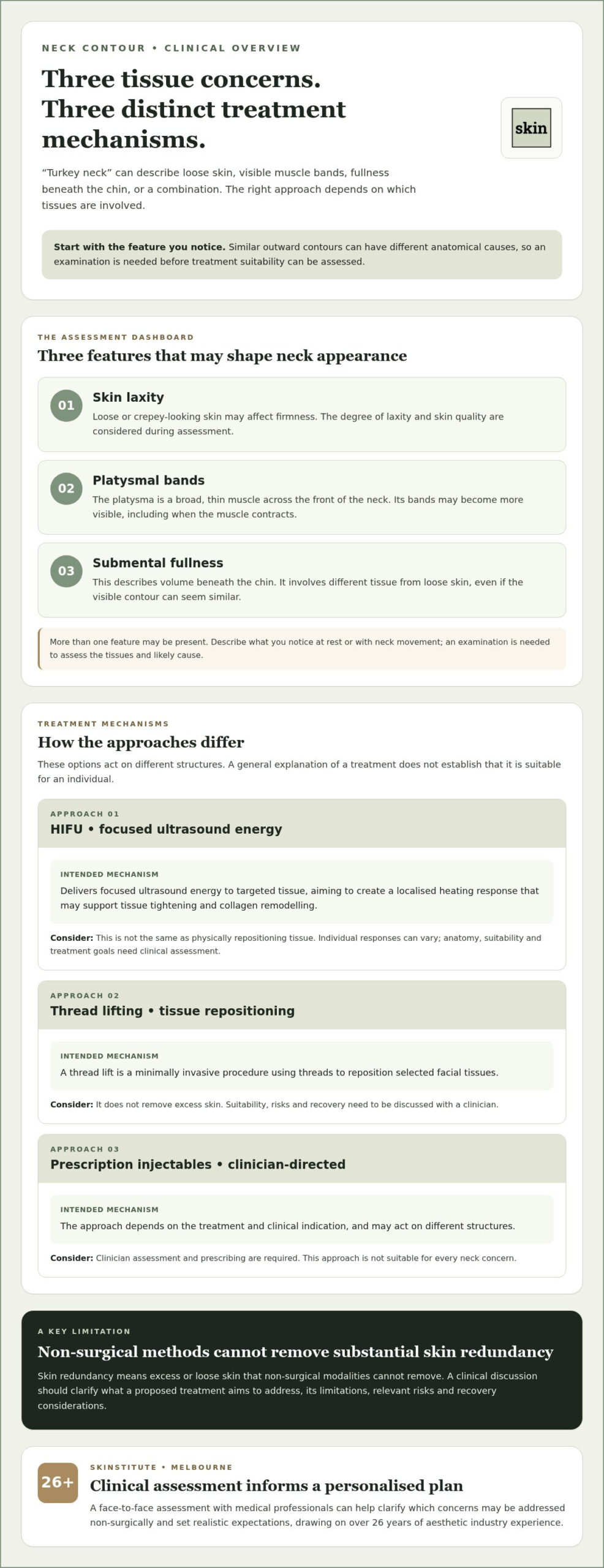
“Turkey neck” is a descriptive term for changes in the contour or skin of the neck, not a diagnosis or a treatment recommendation. The appearance may involve loose skin, vertical muscle bands, fullness beneath the chin, or a combination. If you’re considering getting rid of turkey neck without surgery, identifying the feature you’re concerned about is a more useful starting point than assuming it has one cause.
Which anatomical changes can contribute to a turkey neck?
The platysma is a broad, thin muscle that extends across the front of the neck. Its edges or bands may become more visible in some people, including when the muscle contracts. The Platysma Muscle helps explain why the neck’s appearance can change with movement as well as at rest. Visible bands alone, however, don’t establish their cause.
Loose or crepey-looking skin differs from submental fullness, which describes volume beneath the chin. These features may look similar in some positions, but involve different tissues. Age, individual anatomy and skin quality can influence how they appear. Changes in collagen and elastin, proteins that contribute to skin structure and flexibility, may also affect firmness over time. Their contribution varies between individuals and should not be treated as a diagnosis.
Why does the right approach depend on the concern?
Assessment considers whether the main feature is skin laxity, muscle banding or fullness, as each involves a different anatomical area. More than one factor may be present. For example, someone may notice both skin laxity and bands, while another person may be more concerned about fullness beneath the chin. Similar outward contours don’t necessarily call for the same treatment approach.
Describe what you notice rather than trying to identify the cause yourself. You might mention whether the change is visible at rest or with neck movement, and whether it seems to involve skin, bands or fullness. These observations provide useful context, but an examination is needed to assess the tissues and treatment suitability.
Non-surgical options have limits. They may be considered for selected concerns, but cannot remove substantial skin redundancy, meaning excess or loose skin that non-surgical modalities cannot remove. A clinical discussion should clarify what a proposed approach aims to address, its limitations, and relevant risks and recovery considerations. This helps set realistic expectations before comparing treatments.
How non-surgical neck treatments work: skin, muscle and tissue
Non-surgical approaches don’t all act on the same structures. Some aim to create a tightening response in tissue, some support collagen induction, and others reposition selected facial tissues. Collagen induction means stimulating the body to produce new collagen through a controlled treatment response. It describes a biological process, not a guaranteed degree of tightening. These mechanisms are distinct, so treatments aren’t interchangeable simply because they may be used for concerns around the neck or jawline.
Skin quality, muscle activity and tissue position can each influence treatment planning. A general description of a procedure explains its intended mechanism, but cannot determine whether it is suitable for an individual. The Causes of Turkey Neck include changes in skin and underlying structures, which helps explain why assessment of the relevant tissues matters before considering an approach.
What does energy-based skin tightening aim to address?
High Intensity Focused Ultrasound (HIFU) is a non-surgical treatment offered by Skinstitute. It delivers focused ultrasound energy to targeted tissue, aiming to produce a localised heating response that may support tissue tightening and collagen remodelling. This is not the same as physically repositioning tissue, and individual responses can vary. A clinician should assess anatomy, suitability and treatment goals before recommending it.
How do thread lifting and injectable approaches differ?
A thread lift is a minimally invasive lifting procedure that uses threads to reposition facial tissues. Prescription injectables are clinician-directed and may act on different structures depending on the treatment and clinical indication. Neither approach is suitable for every neck concern, and neither should be presented as a way to remove substantial skin redundancy. Suitability, risks and recovery need to be discussed clinically.
In practical terms, these approaches have different intended targets:
- Energy-based treatment: aims to create a response within targeted tissue rather than mechanically repositioning it.
- Thread lifting: uses threads to reposition selected tissues; it doesn’t remove excess skin.
- Prescription injectables: require clinician assessment and prescribing, with the specific approach depending on the concern and clinical indication.
These categories may address different aspects of appearance, but a treatment’s general mechanism cannot predict an individual outcome. The degree of tissue laxity, the position and movement of underlying structures, health factors and treatment history can all affect suitability. A face-to-face assessment helps determine whether a theoretical option may be appropriate for a particular person.
Before proceeding, the clinician should explain the intended treatment area, likely limitations, relevant risks and recovery considerations. If the concern is primarily substantial loose skin, non-surgical methods cannot remove that excess. Being clear about this limit is part of setting realistic expectations, rather than trying to compensate with a treatment aimed at a different tissue.
For people considering getting rid of turkey neck without surgery, a personalised discussion can clarify which tissue a proposed approach is intended to affect. Skinstitute’s face-to-face clinical assessment provides an opportunity to discuss anatomy, goals and suitability before developing a treatment plan.
Comparing non-surgical options for a turkey neck
To compare options, consider the tissue concern each approach is intended to address. HIFU, thread lifting and clinician-directed injectable approaches have different purposes; none is a universal solution for neck changes. The table summarises their general focus and limitations. It is not a treatment recommendation, since suitability depends on clinical assessment and individual anatomy.
| Treatment category | Intended concern | Considerations | Limitations |
|---|---|---|---|
| High Intensity Focused Ultrasound (HIFU) | May be considered when the aim is a tissue-tightening response for selected concerns involving laxity. | Clinical assessment considers the treatment area, degree of laxity and suitability. Risks and recovery are discussed for the proposed treatment. | It doesn’t remove excess skin, and the degree of response can’t be assumed in advance. |
| Thread lifting | A thread lift uses threads to reposition selected facial tissues and may be considered for concerns involving tissue position. | Assessment considers anatomy, goals, and procedure-specific risks and recovery requirements. | It doesn’t remove substantial loose skin or address every cause of a changing neck contour. |
| Clinician-directed injectable approaches | May be considered for selected concerns involving visible bands or contour, depending on clinical findings. | A clinician determines whether an approach is appropriate and discusses its specific risks and recovery considerations. | Injectables aren’t suitable for every concern and cannot remove skin redundancy. |
Which treatment considerations matter for skin laxity?
The degree of laxity matters. A limited change in skin firmness presents a different treatment consideration from pronounced excess skin. HIFU aims for a tightening response, while thread lifting is intended to reposition selected tissues. These mechanisms shouldn’t be treated as equivalent measures of lift. Where substantial skin redundancy is present, expectations need to account for the fact that non-surgical options can’t remove it.
What if visible bands or neck contour are the main concern?
Visible platysmal bands and submental fullness are separate assessment findings. A concern about bands doesn’t automatically call for the same approach as fullness beneath the chin. A Nefertiti Lift is a term used for an approach to the neck and jawline that may be discussed in relation to visible muscle bands. Whether any approach is appropriate depends on clinical assessment, not the name of the concern alone.
For people exploring getting rid of turkey neck without surgery, this comparison should guide a discussion, not replace one. A clinician can explain the proposed target, likely limitations, relevant risks and recovery considerations for an individual plan. If the primary concern is substantial loose skin, non-surgical treatment should not be represented as a way to remove it.
How to assess your options before choosing a neck treatment
A useful assessment turns a general concern into a discussion of anatomy, health and realistic goals. Before choosing an approach, be ready to describe what you’ve noticed and what change you hope to achieve. A face-to-face consultation can help the clinician assess suitability, explain relevant options and clarify what each treatment can and can’t address.
What should a clinical assessment consider?
The clinician may assess skin quality and laxity, the appearance of platysmal bands, and the neck and jawline contour. Your goals matter too. Wanting a modest change in skin firmness is different from seeking a change to visible bands or fullness. The assessment should connect any proposed treatment to the concern it is intended to address, rather than assuming one approach suits every neck.
Share relevant health information, including previous procedures, medical conditions and current medicines. These details help inform suitability and planning. A face-to-face discussion also gives you the opportunity to describe your priorities, raise concerns and hear an individual explanation of likely limitations. Skinstitute’s clinical guide to medical-grade aesthetic treatments provides further context on treatment decisions.
How can you weigh expected change against recovery and risk?
Before deciding, compare the treatment’s intended goal with its practical requirements. Ask the clinician to explain the expected recovery process, aftercare instructions and any restrictions relevant to the specific procedure. Recovery and potential adverse effects vary between treatment categories and individuals, so broad claims about “minimal downtime” may not reflect your circumstances. The discussion should relate to the proposed approach and your health history.
Use this sequence to organise the consultation:
- Describe your concern: Explain what you notice, when it is most apparent and what you would like to change.
- Discuss health factors: Provide details of previous procedures, relevant medical conditions and current medicines.
- Review suitable options: Ask how each proposed approach relates to the assessed tissue concern, and what its limitations, risks and recovery requirements are.
- Agree on expectations: Clarify the intended change and whether it is realistic for your anatomy, including any limits associated with loose skin.
AHPRA guidelines provide a framework for health practitioners’ professional conduct and communication. Clear, balanced information about suitability, risks, recovery and expected limitations supports an informed discussion without promising a particular result.
If you’re considering getting rid of turkey neck without surgery, use the assessment to develop a clear individual plan rather than selecting a treatment by name alone. Arrange a clinical consultation with Skinstitute to discuss your neck concerns and treatment suitability with the clinical team.
Getting personalised non-surgical neck treatment in Melbourne
A neck treatment plan should follow an assessment of the area, not a predetermined procedure. At Skinstitute in Melbourne, a face-to-face consultation helps relate the visible concern and your goals to possible treatment categories and clinical suitability. This gives you a basis for discussing whether a proposed approach is appropriate for your circumstances.
How does Skinstitute tailor a neck rejuvenation plan?
Consultations are performed by medical professionals, including a nurse and doctor. They can assess the neck and jawline, discuss your health history and consider whether HIFU, PDO thread lifting or an injectable approach may be relevant to your concern. The aim is to determine whether an approach suits your anatomy, not to assume one method is right for everyone.
Planning should clarify what a proposed approach is intended to address, what it is unlikely to change and what risks or recovery considerations apply. Your priorities matter: a concern about skin quality may call for a different discussion from one focused on visible bands or tissue position. If substantial skin redundancy is present, the limits of non-surgical care should be made clear.
When might skin regeneration be discussed alongside neck concerns?
Skin quality and lifting are related areas of aesthetic care, but they are not the same treatment goal. Skin regeneration may be relevant where the concern includes texture or quality; it should not be confused with removing loose skin or producing a guaranteed neck lift. Rejuran may be discussed as a skin treatment, with suitability considered during clinical assessment. The clinical guide to Rejuran in Melbourne explains its skin bio-stimulation context.
For a considered consultation, prepare a clear account of previous procedures, relevant medical conditions and current medicines. Explain which change matters most to you and discuss the recovery requirements you need to factor into daily life. This gives the clinical team a useful basis for discussing options and their limits.
Choosing a next step doesn’t commit you to a particular treatment. It gives you the opportunity to understand which options may fit your anatomy and goals, and whether their practical considerations align with your expectations. To discuss a personalised assessment in Melbourne, arrange a consultation with Skinstitute.
Take the next step with a clear treatment goal
You don’t need to settle on a procedure before understanding what you want to address. Consider which change matters most and what would feel like a realistic improvement. This can keep future decisions focused on your priorities rather than a treatment name or a promise of a particular result.
Getting rid of turkey neck without surgery calls for realistic expectations about the limits of non-surgical options. Weigh the proposed aim against suitability, possible risks and recovery requirements, and consider whether the expected change aligns with your goals.
A measured approach gives you room to make an informed choice. To discuss your concerns and a personalised treatment plan, arrange a face-to-face consultation with Skinstitute in Melbourne.
Frequently Asked Questions
Can you get rid of a turkey neck without surgery?
Non-surgical treatment may improve some visible features, but “get rid of” can imply a complete or permanent change that no clinician can guarantee. The likely benefit depends on your assessment and the treatment chosen. Ask what change is realistic for your specific concern and how progress will be reviewed. If you’re considering getting rid of turkey neck without surgery, a clear treatment goal helps keep expectations grounded.
Does HIFU work for a turkey neck?
HIFU may be an option for some people, but suitability and likely response need to be discussed in relation to an individual assessment. Ask the clinician what outcome they consider realistic for your neck, how they’ll assess progress and what factors could affect your response. Take time to consider this information rather than treating general descriptions of HIFU as a prediction of your result.
Can exercise or skincare tighten loose neck skin?
Exercise and skincare can support general health and skin care, but shouldn’t be relied on to produce a clinical tightening effect. Regular sun protection can help limit further sun-related skin damage, while moisturisers may improve skin comfort and hydration. Neither should be presented as a substitute for assessment if loose skin is your main concern. If you use active skincare products, follow their directions and seek advice if irritation develops.
How long can results from non-surgical neck treatments last?
Duration varies between treatments and individuals, so there isn’t one timeframe that applies to everyone. Ask how the clinician will assess your result and when a review would be appropriate for the specific procedure. If you want to track changes, photographs taken in similar lighting, posture and camera position can make comparisons more useful. They don’t replace clinical review, but may help you describe what you notice over time.
Is a thread lift suitable for loose skin on the neck?
Suitability can’t be determined from the term “loose skin” alone. During assessment, the clinician considers the distribution of laxity, tissue position, your health history and the change you’re seeking. Ask what the procedure is intended to alter in your case, what its limitations are, and what risks and recovery requirements apply. This can help you decide whether the proposed approach fits your priorities before proceeding.
What happens if non-surgical treatment is not suitable for my neck?
If a proposed treatment isn’t suitable, the clinician should explain why and discuss whether another non-surgical approach is appropriate or whether no treatment is preferable. You can ask which aspect of your concern affects suitability, what alternatives involve, and whether there is any reason a decision needs to be made promptly. You’re entitled to take time to consider the information and decline treatment if it doesn’t feel right for you.