How Many Rejuran Treatments Are Needed? A Clinical Guide
October 5, 2026
Temple Hollows Filler in Melbourne: A Clinical Guide to Your Options
October 7, 2026
The strongest-looking treatment isn’t automatically the best treatment for crepey skin on arms. A moisturiser may ease dryness, but changes in texture, skin quality and laxity can have different contributing factors and may need different approaches. Identifying the main concern is the first step towards realistic treatment choices.
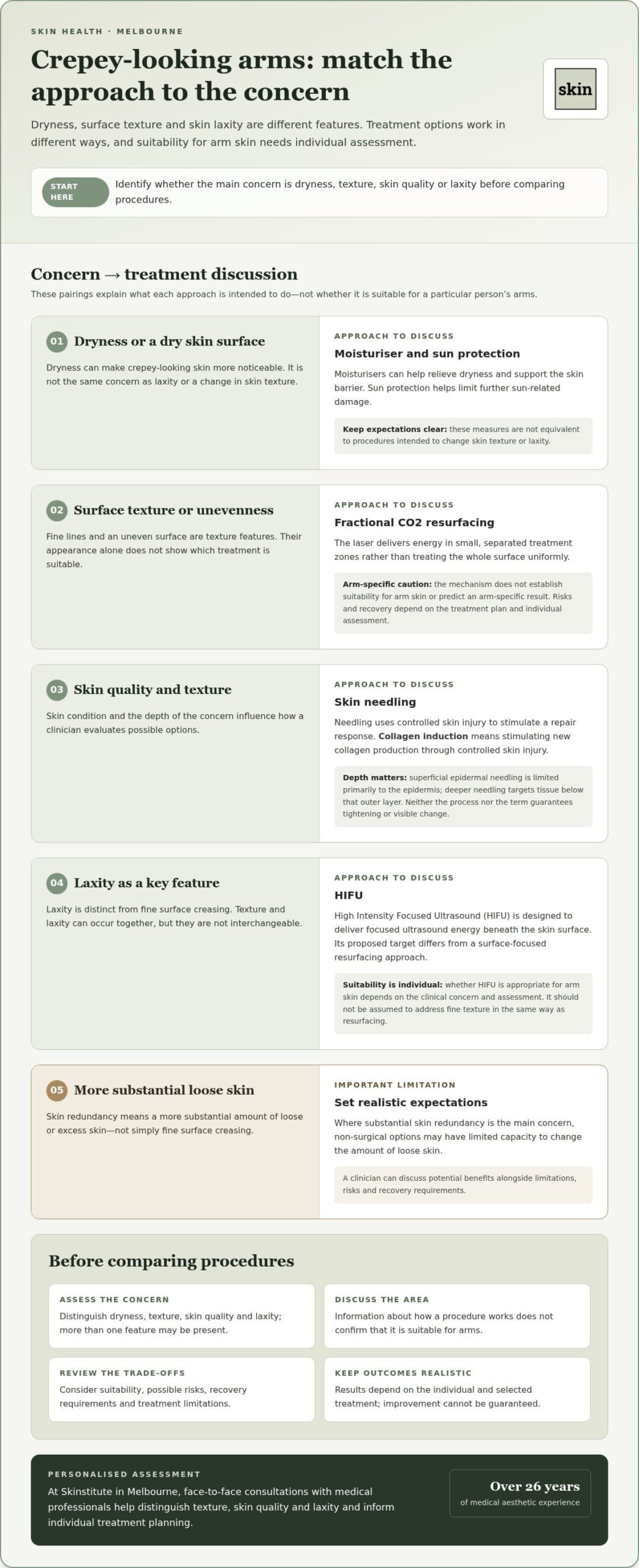
Creams, fractional CO2 laser, skin needling and HIFU work in different ways, and none should be assumed suitable for every arm concern. Some approaches aim to support skin renewal or collagen induction, while others may be considered when laxity is a key feature. Potential improvement, recovery and risks depend on the individual and treatment selected.
This article explains factors that can contribute to crepey-looking arm skin and compares treatment categories. It also outlines what to consider before choosing a personalised plan. At Skinstitute in Melbourne, face-to-face consultations with medical professionals help distinguish concerns involving texture, skin quality and laxity. The clinic brings over 26 years of medical aesthetic experience to an evidence-informed, medically supervised approach to treatment planning.
Key Takeaways
- Crepey-looking skin can involve dryness, texture changes, reduced epidermal thickness or laxity. Identifying the main concern helps guide treatment discussions.
- The best treatment for crepey skin on arms depends on the concern being addressed and requires an assessment of suitability, possible risks and recovery.
- Topical skin care and clinician-delivered options such as fractional CO2, skin needling and HIFU work differently. Their use for arm skin should be considered individually.
- Review skin health, compare options, plan for recovery and set realistic goals before choosing an approach.
- A face-to-face consultation with medical professionals can help distinguish texture, skin quality and laxity and inform a personalised treatment plan.
What causes crepey skin on the arms, and what can treatment change?
Crepey-looking arm skin describes an appearance, not a single diagnosis. It may involve fine surface lines, dryness, uneven texture, changes in epidermal thickness, reduced elasticity or a combination of these features. Ageing can affect skin structure over time, while cumulative sun exposure may contribute to visible changes by damaging collagen and elastin. The pattern and degree vary between individuals, so appearance alone cannot identify the underlying cause.
For a plain-language overview of sun-related skin change, see What causes crepey skin. Sun exposure is one possible contributor, rather than a complete explanation for every person’s arm skin. General skin ageing and individual skin condition also matter.
How to distinguish crepey texture from loose arm skin
Fine wrinkling, dryness and a papery or uneven surface are observable texture features. They may be more noticeable when the skin is dry or gently moved, but they don’t establish a diagnosis or show which treatment is suitable. Epidermal thickness refers to the thickness of the outer skin layer. It relates to skin quality, but is not the same as laxity.
Fine surface creasing affects how the skin looks and feels; skin redundancy describes a more substantial amount of loose or excess skin. These concerns can occur together, but they are not interchangeable. An in-person assessment helps determine whether texture, skin quality or laxity predominates and whether other factors need consideration.
Why cause and skin condition matter when comparing treatments
Treatment approaches act on different tissue characteristics, so they shouldn’t be treated as interchangeable. A plan intended to address surface texture may not address more pronounced laxity, while an approach considered for laxity may not resolve dryness. Skin health, the extent of the concern and the area being assessed all influence suitability.
This distinction is central to choosing the best treatment for crepey skin on arms. The realistic aim depends on what is being treated and how the skin responds; improvement can’t be guaranteed. A clinician can discuss potential benefits alongside limitations, risks and recovery requirements, and explain whether an approach is appropriate for the individual’s arm skin. Where substantial skin redundancy is the main concern, non-surgical options may have limited capacity to change the amount of loose skin.
How do treatments for crepey skin on arms work?
Different approaches act on different parts of the skin. Topical care supports the skin surface, while clinician-delivered procedures use controlled energy or physical stimulation to affect selected tissue. The best treatment for crepey skin on arms can’t be identified from a treatment name alone. The concern, skin condition and suitability for the specific area all need clinical consideration.
Moisturisers can help relieve dryness and support the skin barrier, while sun protection helps limit further sun-related damage. These measures are not equivalent to procedures intended to change skin texture or laxity. For a general overview of care approaches, see Healthline’s guide to crepey skin.
Fractional CO2 and skin resurfacing
Fractional CO2 is a resurfacing technology that delivers laser energy in small, separated treatment zones rather than treating the entire surface uniformly. This creates controlled areas of treatment alongside surrounding skin. However, the way the technology works does not establish that it is suitable for crepey skin on the arms or predict an arm-specific result.
Suitability, potential risks and recovery depend on the treatment plan and individual skin assessment. A clinician should explain these considerations for the area being discussed rather than assume that information about facial resurfacing applies to arms.
Skin needling and collagen induction
Skin needling uses controlled skin injury to stimulate a repair response. Collagen induction means the stimulation of new collagen production through controlled skin injury, but the term describes a process, not a guaranteed degree of tightening or visible change. Superficial epidermal needling is limited primarily to the epidermis, whereas deeper needling targets tissue below that outer layer. The depth and technique affect the treatment, and arm-specific suitability requires assessment.
HIFU and other energy-based approaches
High Intensity Focused Ultrasound (HIFU) is designed to deliver focused ultrasound energy beneath the skin surface. Its proposed target differs from a resurfacing approach that acts more directly on the surface, so it shouldn’t be assumed to address fine texture in the same way. Whether HIFU is appropriate for arm skin depends on the clinical concern and individual assessment.
A treatment mechanism explains how a procedure is intended to work; it doesn’t guarantee a particular clinical outcome. Risks and recovery vary with the person, treatment parameters and area treated. A face-to-face discussion can help clarify which approach, if any, is suitable. Skinstitute’s clinical skin treatment assessment provides an opportunity to discuss individual concerns and treatment planning.
Which crepey skin treatment for arms best matches your concern?
Compare options by the feature they are intended to address, not by assuming one treatment is best for every arm. The mechanisms below describe broad treatment categories; they don’t establish that a procedure is suitable for a particular person’s arms or predict its outcome. A clinician needs to assess the skin, medical history and treatment area before discussing suitability.
| Option | Potential target and mechanism | Suitability discussion | Limitations and recovery |
|---|---|---|---|
| Topical skin care | Dryness and surface comfort; moisturisers support the skin barrier, while sun protection helps limit further sun exposure. | Consider skin sensitivity, current products and general skin health. | Not equivalent to a procedure and shouldn’t be expected to correct skin redundancy. Recovery considerations differ from clinician-delivered procedures. |
| Fractional CO2 | Resurfacing with controlled, separated zones of laser treatment. | Arm-specific suitability and the intended concern require clinical assessment. | Resurfacing doesn’t guarantee improvement in laxity. Risks and recovery depend on the individual treatment plan. |
| Skin needling | Controlled skin injury intended to prompt a repair response, including collagen induction. | Discuss skin characteristics, medical history and the proposed treatment depth. | Collagen induction does not guarantee tightening or a particular arm-specific result. Recovery varies with the treatment and individual. |
| HIFU | Focused ultrasound energy is intended to reach tissue beneath the surface, rather than directly resurface it. | Whether it is appropriate for arm skin depends on the concern and clinical assessment. | It should not be assumed to address fine surface texture or skin redundancy. Risks and recovery are individualised. |
When roughness or uneven surface texture is the main concern
Dryness and surface irregularity may lead to a discussion about skin care or, if clinically appropriate, a procedure involving resurfacing or controlled skin injury. That doesn’t make either fractional CO2 or skin needling universally best for arms. Skin condition, medical history and the precise area being considered influence suitability.
When laxity or thin-looking skin is the main concern
Laxity calls for a different discussion from surface texture alone. A clinician needs to consider whether a proposed approach is appropriate for the degree and pattern of looseness. More noticeable skin redundancy may not respond adequately to non-surgical modalities, and substantial tightening shouldn’t be assumed.
How to interpret likely results, risks and recovery
The best treatment for crepey skin on arms depends on the concern, suitability and individual response. There is no standard recovery period that applies to all these options, and arm-specific outcomes can’t be compared from general descriptions alone. Before proceeding, discuss potential benefits, limitations, contraindications, risks and aftercare for the proposed treatment. This helps set realistic goals without treating a theoretical mechanism as evidence of a guaranteed result.
What should you consider before treating crepey skin on your arms?
A considered treatment decision starts with the concern itself, then weighs skin health, suitability, recovery and realistic goals. This five-step framework can help organise the discussion, but it doesn’t replace an individual clinical assessment.
- Identify the main concern. Note whether you’re most concerned about dryness, rough or uneven texture, thin-looking skin or laxity. More than one feature may be present, and they may call for different treatment discussions.
- Review your skin health and medical history. Discuss sensitivity, existing skin conditions, relevant medicines and previous treatments with the clinician. These factors may affect whether a procedure is appropriate and what risks need consideration.
- Compare the options by their intended role. Topical care, fractional CO2, skin needling and HIFU work differently. Ask how a proposed approach relates to your specific concern, what its limitations are and whether alternatives should be considered.
- Plan for recovery and aftercare. Recovery is procedure-specific and can vary between individuals. Understand the expected aftercare, possible adverse effects and any practical restrictions before deciding whether the plan suits your circumstances.
- Set realistic goals. Be clear about the change you hope to see and discuss what may be achievable. Response varies, and no procedure can guarantee a particular result or permanent improvement.
Basic skin care and sun protection support skin health and help limit further sun-related damage, but they aren’t equivalent to procedures that act on skin tissue. A clinician can give guidance suited to your skin and any proposed treatment, rather than relying on general aftercare advice.
Questions a clinical assessment should address
A face-to-face consultation should clarify whether texture, skin quality or laxity is the primary concern, and whether the proposed approach is suitable for the area. Discuss relevant medical history, potential risks, alternatives and realistic outcomes before selecting a procedure. At Skinstitute, treatment planning is tailored following a face-to-face consultation with medical professionals, including a Nurse and Dr.
Recovery, aftercare and realistic expectations
Recovery depends on the procedure, treatment approach and individual response, so a single timeline shouldn’t be assumed. Before proceeding, ask what aftercare applies to your plan, how sun exposure should be managed during recovery and what changes may warrant clinical review. Maintenance needs and the duration of any response can vary; permanence shouldn’t be presumed.
To discuss which considerations may apply to your arm skin, arrange a clinical skin assessment with Skinstitute in Melbourne.
How Skinstitute approaches crepey skin treatment in Melbourne
Choosing the best treatment for crepey skin on arms starts with understanding what is changing in the skin, rather than selecting a procedure from a generic ranking. At Skinstitute, a face-to-face consultation with medical professionals, including a Nurse and Dr, helps distinguish concerns involving surface texture, skin quality and laxity. The discussion informs an individual plan and whether a treatment approach is clinically appropriate for the area.
From assessment to a personalised treatment plan
Assessment considers the arm skin’s condition, your goals and relevant medical history. The clinician can discuss suitability, possible limitations and risks, along with what degree of change may be realistic. Skinstitute offers fractional CO2, skin needling and HIFU as different treatment modalities. Their mechanisms alone don’t establish that they are suitable for crepey skin on your arms or predict an outcome. Treatment selection is guided by the clinical discussion, not by a promise of improvement.
Skinstitute brings over 26 years of medical aesthetic experience in Melbourne to this assessment-led approach. A personalised plan takes account of the individual concern and the options under consideration, including potential benefits, risks and recovery requirements. Readers seeking more background can explore Skinstitute’s medical-grade aesthetic approach.
Choosing a considered next step in Melbourne
To make the consultation more useful, consider noting:
- Which feature concerns you most, such as dryness, uneven texture, thin-looking skin or laxity.
- Relevant medical history, skin sensitivity, medicines and previous treatments.
- What change you hope to achieve and what recovery requirements you can accommodate.
This information helps the medical professional discuss whether a proposed modality is appropriate, its limitations and whether your expectations align with them. It also allows risks and aftercare to be considered in relation to your circumstances, rather than assumed from general descriptions of a procedure. No treatment can guarantee a particular result.
A measured clinical conversation is more useful than choosing a procedure based on a universal “best” label. It gives you the opportunity to understand the reasoning behind a tailored plan before deciding how to proceed.
Choose your next step with informed expectations
Crepey-looking arm skin can reflect changes in surface texture, skin quality, laxity or a combination of concerns. Distinguishing these features matters because topical care, fractional CO2, skin needling and HIFU work differently, and none should be assumed suitable for every person or every arm concern.
The best treatment for crepey skin on arms depends on clinical assessment, individual skin characteristics and realistic goals. A face-to-face consultation can help clarify suitability, potential risks, recovery considerations and the degree of change that may be achievable, without promising a particular result.
At Skinstitute in Melbourne, consultations are conducted by medical professionals, including a Nurse and Dr, and inform personalised treatment plans. The clinic brings over 26 years of medical aesthetic experience to these discussions, helping patients consider their options in a medically supervised setting.
For a measured discussion of your skin concerns and possible treatment approaches, Explore Skinstitute’s clinical approach to skin treatments. Arrange a face-to-face consultation with Skinstitute to discuss your concerns and a personalised plan.
Frequently Asked Questions
What is the best treatment for crepey skin on arms?
The best treatment for crepey skin on arms depends on whether the main concern is surface texture, skin quality or laxity. Topical care, fractional CO2, skin needling and HIFU have different mechanisms, but that alone doesn’t show which is appropriate for an individual’s arms. A clinician needs to assess the skin, medical history and goals, then explain potential benefits, limitations, risks and recovery without guaranteeing a particular result.
Can crepey skin on the arms be improved without surgery?
Some aspects of crepey-looking skin may be addressed with non-surgical approaches, but the possible degree of change varies and can’t be guaranteed. Skin care may support dryness and the skin barrier, while clinician-delivered procedures are considered for specific concerns and suitability. More pronounced skin redundancy may not respond adequately to non-surgical modalities. A clinical assessment can clarify realistic goals and whether an approach is appropriate for the arm area.
Does skin needling help crepey skin on the arms?
Skin needling creates controlled skin injury, a process used to prompt a repair response that can include collagen induction. This mechanism does not establish a predictable tightening effect or result for crepey arm skin. Suitability depends on skin characteristics, medical history and the proposed technique. A clinician should discuss potential benefits, risks and individual recovery requirements before treatment, rather than assuming that information about another body area applies to the arms.
Can fractional CO2 laser treat crepey skin on the arms?
Fractional CO2 is a laser resurfacing approach, but its mechanism alone doesn’t confirm that it is suitable for crepey skin on the arms. The concern being treated, skin condition and individual clinical assessment matter. Before considering it, discuss arm-specific suitability, possible limitations, risks and recovery with a medical professional. Outcomes should not be assumed from general information about resurfacing or treatment of other areas.
Is crepey skin on the arms the same as loose skin?
No. Crepey-looking skin may describe fine surface wrinkling, dryness or uneven texture, while loose skin involves laxity or skin redundancy. These features can occur together, but they aren’t identical and may lead to different treatment discussions. An in-person assessment helps identify which concern predominates. Where there is more substantial excess skin, non-surgical treatments may have limited capacity to change the amount of loose skin.
How do I choose a treatment for crepey arms safely?
Choose through an individual clinical assessment, not a generic ranking. Discuss your main concern, medical history, skin sensitivity, medicines, treatment goals and relevant risks. A medical professional can explain suitability, alternatives, likely limitations and procedure-specific recovery. In Melbourne, Skinstitute’s face-to-face consultations are conducted by a team of medical professionals, including a Nurse and Dr. The clinic brings over 26 years of medical aesthetic experience to personalised treatment planning.