Smokers Lines Treatment Melbourne: A Clinical Guide to Perioral Rejuvenation
June 28, 2026
Cheek Filler for a Subtle Lift in Melbourne: A Clinical Guide to Midface Restoration
June 30, 2026
The most effective strategy for correcting under-eye hollows often begins with a clinical assessment of the mid-face rather than the eyes themselves. Many individuals find that despite maintaining a disciplined sleep schedule, a persistent shadow remains in the infraorbital region, creating an appearance of chronic fatigue. When researching tear trough filler melbourne cost, it’s essential to recognise that pricing is rarely a flat rate. Instead, it’s a reflection of anatomical complexity and the specific volume of prescription injectables required for a safe, natural result.
We understand that the variability in clinical quotes can be confusing. This is especially true when you’re balancing the desire for rejuvenation with concerns regarding safety near such a delicate area. This guide provides a comprehensive overview of the factors that determine your total investment, from the physiological causes of volume loss to the technical precision required for periorbital injections. You’ll learn how practitioners calculate treatment plans based on your unique facial structure, ensuring you’re equipped with the knowledge to choose a clinical environment that prioritises medical integrity over marketing hype.
Key Takeaways
- Identify the anatomical causes of periorbital ageing, such as fat pad migration and bone resorption, which contribute to the formation of a “true” tear trough.
- Understand how clinical factors, including practitioner expertise and the specific volume of product required, influence the total tear trough filler melbourne cost.
- Learn why a comprehensive clinical assessment often prioritises mid-face support to provide the necessary structural foundation for the under-eye area.
- Discover the role of advanced delivery methods, such as micro-cannulas, in enhancing procedural safety and minimising common side effects like the Tyndall effect.
- Gain clarity on how the chemical cross-linking and longevity of different prescription-only fillers impact the long-term value of your rejuvenation plan.
Understanding Tear Trough Fillers and Periorbital Ageing
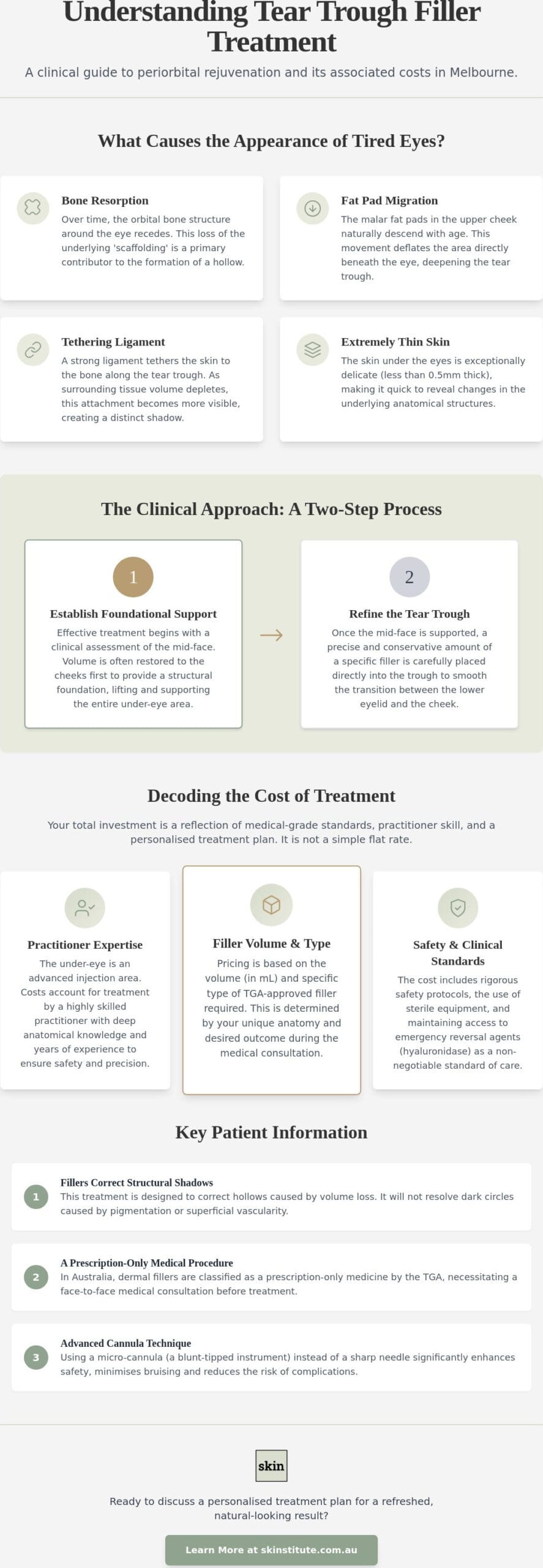
The tear trough is the anatomical depression located between the lower eyelid and the upper cheek. This groove, also known as the nasojugal groove, creates a distinct shadow that often results in a tired or prematurely aged appearance. While many people attribute this hollow to a lack of sleep, it’s actually the result of complex biological shifts within the mid-face. The tear trough ligament tethers the skin directly to the underlying bone; as we age, this attachment becomes more pronounced because of the loss of surrounding tissue volume.
Bone resorption in the maxilla and the migration of malar fat pads significantly alter the facial landscape. When these support structures diminish, the overlying skin loses its foundation, causing the tear trough to deepen and the “lid-cheek junction” to become more visible. Patients often find that topical creams, while beneficial for surface hydration, cannot address these deep-seated anatomical changes. Because the issue is structural, correction requires a medical-grade volume replacement. When considering tear trough filler melbourne cost, it’s vital to account for the technical skill required to navigate these intricate layers of tissue. A foundational understanding of injectable fillers clarifies how these biocompatible substances are used to bridge the gap between the eyelid and cheek, restoring a smoother transition.
The Anatomy of the Under-Eye Area
The periorbital region is one of the most complex zones of the face. The skin here is exceptionally thin, often measuring less than 0.5mm, which makes it highly susceptible to visible changes in the underlying structures. Beneath this delicate layer lies a dense network of blood vessels and the orbicularis oculi muscle. Precise placement of filler is required to ensure the product doesn’t interfere with muscle movement or cause vascular complications. Achieving aesthetic harmony requires the practitioner to respect the vascular complexity of the lower eyelid while ensuring the filler integrates seamlessly with the dermal layers.
Why Melbourne Patients Seek Tear Trough Correction
Factors Influencing Tear Trough Filler Cost in Melbourne
The financial investment in periorbital rejuvenation is determined by several variables that extend beyond the volume of the injectable itself. In Australia, the Therapeutic Goods Administration (TGA) classifies these substances as prescription-only medicines. This classification necessitates a face-to-face medical consultation with a qualified practitioner to ensure clinical suitability and patient safety. Consequently, the tear trough filler melbourne cost includes the rigorous clinical standards required to procure, store, and administer these controlled substances. Unlike over-the-counter aesthetic options, prescription injectables undergo extensive clinical trials to verify their safety profiles and physiological interactions.
Practitioner Expertise and Clinical Standards
The infraorbital region is anatomically dense with vital structures, including the infraorbital artery and various nerve branches. For this reason, medical professionals categorise the tear trough as an “advanced” injection site. Selecting a clinic with established longevity, such as a team with over 26 years of experience, ensures that the injector possesses the refined tactile feedback necessary for deep-plane placement. A significant portion of the clinical overhead involves risk mitigation. This includes maintaining immediate access to emergency reversal agents like hyaluronidase. While these protocols add to the operational cost, they’re a non-negotiable standard for maintaining medical integrity and patient safety.
Product Selection: Rheology and Longevity
The physical properties of a filler, known as its rheology, dictate how it behaves once integrated into the tissue. G-Prime refers to the “hardness” or lifting capacity of the gel. In the delicate periorbital area, a high G-Prime filler is often unsuitable because it can feel palpable or appear unnatural under thin skin. Instead, practitioners typically select softer, low-hydrophilic fillers that don’t attract excessive water. High-swelling fillers are often more affordable but carry a higher risk of post-procedural oedema or the Tyndall effect. Reviewing FDA Information on Dermal Fillers provides further insight into how different chemical compositions are approved for specific facial zones.
Longevity also plays a definitive role in the total investment. Premium fillers with sophisticated chemical cross-linking technologies tend to last between 9 and 18 months, which reduces the frequency of maintenance treatments. A comprehensive medical skin analysis is the first step in determining which product rheology is appropriate for your specific tissue quality. During this process, a practitioner will outline the expected duration and volume required for your unique anatomy. For those seeking a professional assessment, booking a clinical consultation ensures your treatment plan is based on anatomical evidence rather than a generic approach. This transparent breakdown helps patients understand that the tear trough filler melbourne cost reflects a commitment to clinical excellence and long-term aesthetic stability.
Clinical Assessment: True Trough vs. Mid-face Volume Loss
Distinguishing between a true anatomical trough and secondary volume loss is the most critical phase of a clinical consultation. A true tear trough is a localised depression caused by the attachment of the tear trough ligament to the periosteum. In contrast, many patients experience a “pseudo-trough” caused by the descent of mid-face tissues and bone resorption in the maxillary region. Mid-face support is the foundation for periorbital rejuvenation. By addressing the underlying structural deficit first, practitioners can often achieve a more harmonious result while minimising the risk of overfilling the delicate under-eye skin.
The bio-mechanical link between the cheek and the lower eyelid is defined by the “V-deformation” of the mid-face. As the deep medial fat pad loses volume, the overlying skin loses its tension, leading to a visible hollow that extends from the inner corner of the eye. An indirect approach involves placing prescription injectables into the malar region to restore this lost volume. This technique provides a structural scaffold that lifts the tissue and softens the nasojugal groove. Adhering to FDA guidance on dermal filler safety, practitioners prioritise this foundational work to avoid placing excessive product in the high-risk periorbital zone. This staged approach is essential for maintaining proper lymphatic drainage and preventing long-term complications such as chronic puffiness.
The Mid-face Foundation
Analysing the deep and superficial fat pads is essential for a successful outcome. The deep medial fat pad acts as the primary anchor for the mid-face; when it diminishes, the lid-cheek junction becomes elongated and more prominent. Restoring this area provides a seamless transition from the lower eyelid to the cheek, which is a hallmark of a youthful, rested appearance. This structural reinforcement typically reduces the total amount of product required directly in the tear trough, which is a significant factor in the overall tear trough filler melbourne cost.
Determining the Total Volume Required
Most patients require between 1ml and 2ml of product for a comprehensive bilateral correction. While it might be tempting to resolve the hollow in a single session, a staged treatment plan is often safer for the patient. The periorbital area has limited lymphatic drainage, and over-volumising can lead to chronic oedema or filler migration. A “less is more” philosophy ensures that the results remain natural and that the filler integrates properly with the surrounding tissue. This cautious approach also allows for a more accurate assessment of the tear trough filler melbourne cost over the duration of a treatment plan, ensuring value through precision rather than volume.
Safety, Longevity, and Value in Periorbital Treatments
Clinical safety in the periorbital region is inextricably linked to the technique used by the practitioner. While traditional needles are occasionally necessary for precise bolus placement on the bone, many advanced clinics prioritise the use of micro-cannulas. These blunt-tipped instruments slide through the tissue layers, pushing blood vessels and nerves aside rather than piercing them. This delivery method significantly reduces the incidence of bruising and internal trauma, contributing to a more predictable recovery period. When evaluating the tear trough filler melbourne cost, patients should consider the clinical value of these safety-first techniques, which minimise the risk of vascular compromise.
Post-procedural side effects such as swelling and minor discolouration are common but manageable. The Tyndall effect, a bluish hue visible under the skin, occurs when hyaluronic acid gel is placed too superficially, causing light to scatter. Correcting this requires the precise administration of hyaluronidase to dissolve the misplaced product. To maximise the lifespan of the injectable, patients must follow a strict clinical aftercare protocol. This includes avoiding high-intensity heat and excessive pressure on the treated area during the initial integration phase, which typically lasts two weeks.
Managing Potential Complications
A reputable clinic maintains a rigorous protocol for managing delayed onset nodules or persistent oedema. Regular follow-up appointments allow the practitioner to monitor how the filler is integrating with the surrounding anatomy. Choosing a medical-grade facility ensures that you aren’t just paying for the injectable, but for the comprehensive clinical oversight required to handle any physiological response. This level of professional monitoring is a vital component of the tear trough filler melbourne cost, providing a safety net that discount providers often lack.
Holistic Rejuvenation: Beyond Fillers
Achieving the best possible outcome often requires a multi-modality approach. While fillers address volume loss, they don’t improve the actual quality or elasticity of the overlying skin. Integrating Rejuran Melbourne treatments can enhance results by using polynucleotides to stimulate cellular repair and collagen production. Similarly, a Fractional CO2 Laser is frequently utilised to tighten the thin skin of the lower eyelid, creating a firmer foundation for the filler. This combination of structural support and skin regeneration offers superior long-term value compared to relying on fillers alone. To begin your journey towards a refreshed appearance, contact our clinical team for a detailed assessment of your periorbital health.
Why Choose Skinstitute for Tear Trough Fillers in Melbourne
Selecting a clinical partner for periorbital rejuvenation requires a rigorous evaluation of both experience and technical proficiency. At Skinstitute, our 26-year history of providing medical-grade cosmetic enhancements in Melbourne provides a foundation of stability and established authority. We prioritise clinical education, ensuring that every patient understands the physiological interactions between prescription injectables and their unique facial anatomy. This transparency is central to our philosophy; we believe that a clear understanding of the tear trough filler melbourne cost should be coupled with a deep appreciation for the clinical standards we maintain throughout the process.
Our expertise in advanced periorbital anatomy allows us to deliver results that respect individual facial harmony. We recognise that the under-eye area is not an isolated feature but part of a complex mid-face system. By focusing on evidence-based treatment plans, we avoid the pitfalls of over-volumisation, instead opting for a refined approach that restores a natural, refreshed appearance. This commitment to precision ensures that every intervention is both safe and aesthetically balanced, mirroring the standards of a professional medical consultation.
The Skinstitute Clinical Advantage
Staying at the forefront of aesthetic medical technology is a core priority for our practitioners. We continuously refine our techniques to incorporate the latest advancements in delivery methods and product rheology. A professional assessment at Skinstitute Melbourne provides more than just a treatment plan; it offers a comprehensive analysis of your skin health. Our patient-centric approach ensures that long-term physiological well-being is never sacrificed for immediate aesthetic gains, providing a reassuring sense of technical proficiency.
Booking Your Consultation
Your journey begins with an initial clinical skin analysis. During this session, we evaluate the structural integrity of your mid-face, the quality of the dermal layers, and the specific depth of the nasojugal groove. This detailed examination allows us to develop a bespoke treatment plan tailored to your specific anatomical requirements. We take the time to explain the biological rationale behind every recommendation, allowing you to feel informed and respected throughout the process. Taking the first step toward a refreshed appearance involves a partnership with an expert medical team dedicated to technical mastery. By choosing a clinic that values medical integrity and evidence-based results, you can move forward with confidence in your aesthetic investment. The tear trough filler melbourne cost is ultimately an investment in professional standards and long-term facial harmony.
Advancing Your Journey Toward Periorbital Restoration
Under-eye rejuvenation is a sophisticated clinical process that extends far beyond simple volume replacement. By addressing the underlying anatomical causes of hollowness, such as ligament tethering and mid-face volume loss, you can achieve a transition between the lower lid and cheek that appears natural and seamless. We’ve explored how the tear trough filler melbourne cost reflects the convergence of high-quality prescription injectables and the technical skill required to navigate the vascular complexity of the periorbital region. Choosing a practitioner who understands this bio-mechanical relationship is essential for both safety and aesthetic longevity.
With over 26 years of clinical experience, our team utilises medical-grade aesthetic technologies to ensure every treatment plan is grounded in evidence. Our expertise in complex periorbital treatments allows us to create bespoke solutions that respect your unique facial structure while prioritising long-term tissue health. If you’re ready to address the structural foundations of your appearance, we invite you to take the next step toward a refreshed look.
Book Your Clinical Tear Trough Assessment at Skinstitute Melbourne to receive a comprehensive analysis tailored to your anatomical needs. Restoring your vitality is a precise medical journey, and we’re here to provide the clinical guidance you deserve.
Frequently Asked Questions
How long does tear trough filler typically last?
Tear trough fillers typically maintain their corrective effect for 9 to 18 months, depending on the specific rheology of the chosen injectable and the patient’s metabolic rate. Because the periorbital area is relatively static compared to the mouth or cheeks, the product tends to degrade more slowly. Factors such as the chemical cross-linking of the gel also influence longevity, ensuring that the initial investment remains viable over a significant period.
Is the tear trough filler procedure painful?
Most patients describe the sensation as a mild pressure rather than acute pain, particularly when a micro-cannula is utilised. These advanced instruments require only a single entry point, which is often pre-treated with a local anaesthetic. Additionally, many prescription injectables contain lidocaine, a numbing agent that further minimises discomfort during the integration process. This clinical approach prioritises patient comfort while maintaining the precision required for such a delicate anatomical zone.
What is the difference between a cheap filler and a medical-grade filler?
The primary distinction lies in the product’s chemical stability and its interaction with human tissue. Medical-grade fillers are TGA-approved substances with sophisticated cross-linking that prevents excessive water absorption, reducing the risk of chronic post-procedural swelling. Lower-cost alternatives often lack this refined rheology, which can lead to visible lumps or the Tyndall effect. Understanding this distinction is essential when evaluating tear trough filler melbourne cost, as premium products offer greater safety and predictable outcomes.
Can tear trough filler help with dark circles?
Dermal fillers only address dark circles that are caused by structural shadows and hollows in the infraorbital region. If the darkness is the result of dermal pigmentation or superficial vascularity, volume replacement will not resolve the colouration. In these instances, a practitioner might recommend a multi-modality approach, potentially incorporating skin needling or laser resurfacing to address the skin’s biological pigment alongside the structural deficit.
How much downtime is required after an under-eye filler treatment?
Most patients experience minimal downtime, with any swelling or minor bruising typically resolving within 24 to 48 hours. We recommend avoiding strenuous exercise or heat exposure for the first few days to prevent increased blood flow to the area, which can exacerbate oedema. While you can return to professional duties almost immediately, the filler takes approximately two weeks to fully integrate with your facial tissues and reveal the final result.
What happens if I am unhappy with my tear trough filler results?
Hyaluronic acid fillers are fully reversible through the administration of an enzyme called hyaluronidase. If a patient is dissatisfied with the aesthetic outcome or if a complication such as filler migration occurs, this enzyme can be injected to safely dissolve the product within hours. This safety feature is a significant advantage of using biocompatible gels, providing patients with peace of mind that the results are not permanent if adjustments are required.
Are there any long-term risks associated with under-eye fillers?
Long-term risks are rare but may include chronic swelling, filler migration, or the Tyndall effect if the product is placed too superficially. Over-volumising the area can also obstruct lymphatic drainage, leading to persistent puffiness. These risks are mitigated by choosing an experienced practitioner who understands the complex anatomy of the periorbital region and selects the appropriate volume. Regular clinical monitoring ensures that any delayed onset issues are identified and managed promptly.
How do I know if I need cheek filler or tear trough filler?
A clinical assessment of your mid-face support is necessary to determine if the hollowness is a “true trough” or a result of malar volume loss. If the depression improves when the cheek tissue is gently lifted, the primary issue is likely a lack of structural foundation in the mid-face. In such cases, treating the cheeks first provides the necessary scaffold, often reducing the total tear trough filler melbourne cost by decreasing the amount of product needed directly under the eyes.