Clinical Guide to Rejuran in Melbourne: The Science of Polynucleotide Skin Bio-Stimulation
May 28, 2026
Sclerotherapy: The Clinical Standard for Leg Vein Resolution in Melbourne
May 30, 2026
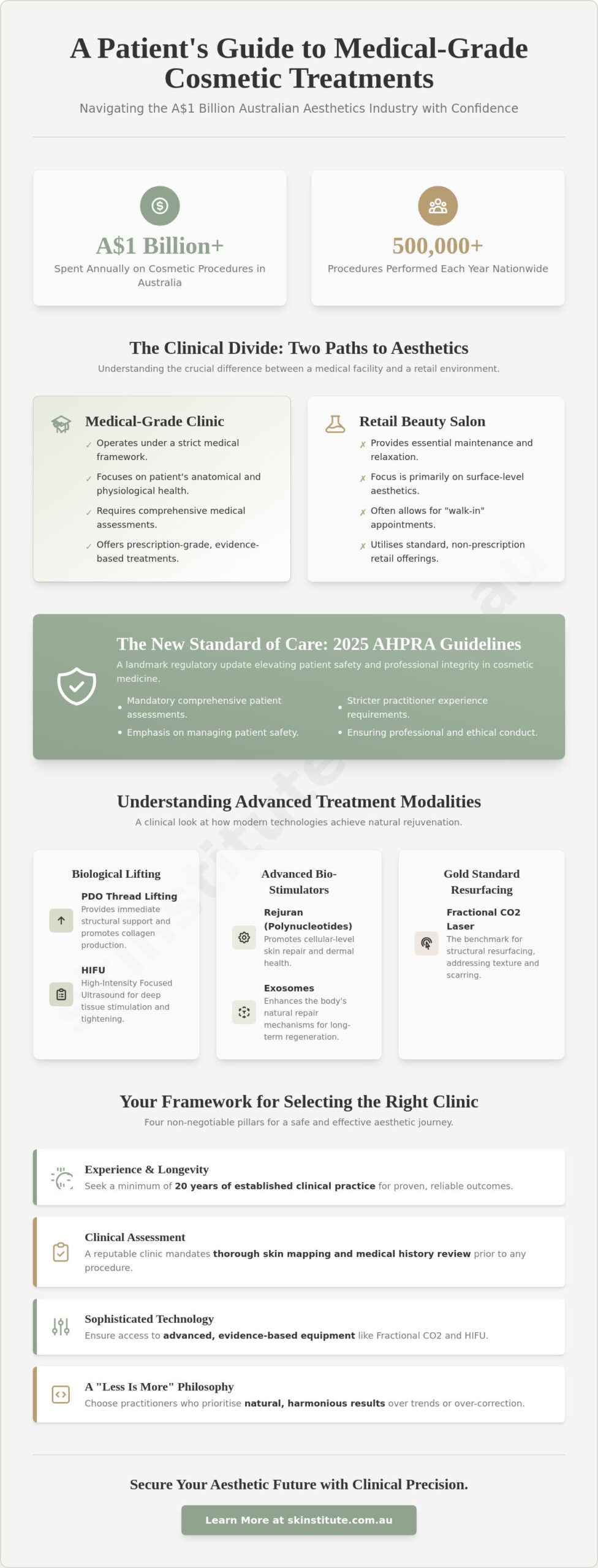
Australians now spend over A$1 billion annually on more than 500,000 cosmetic procedures, a figure that underscores the growing demand for aesthetic refinement and the vital importance of selecting reputable cosmetic clinics in Melbourne. It’s common to feel a sense of hesitation when confronted with the proliferation of high-street providers, particularly given the historical lack of regulation and the pervasive fear of achieving an unnatural or “overdone” appearance. The implementation of the 2025 AHPRA guidelines reflects a necessary transition toward higher medical standards, mandating comprehensive patient assessments and stricter practitioner experience requirements to ensure safety and professional integrity.
This article provides a clinical framework for evaluating medical-grade aesthetic treatments, drawing upon 26 years of established expertise to help you achieve natural-looking facial rejuvenation and sustained skin health. We will examine the physiological interactions of advanced regenerative technologies, such as polynucleotide-based Rejuran and mesenchymal-derived Exosomes, while clarifying how prescription-only medical treatments differ from standard retail offerings. By understanding the biological mechanics of procedures like PDO Thread Lifting and High Intensity Focused Ultrasound (HIFU), you can make informed decisions rooted in scientific evidence rather than marketing trends.
Key Takeaways
- Learn to differentiate between retail beauty environments and medical-grade cosmetic clinics in Melbourne by evaluating practitioner clinical experience and institutional longevity.
- Understand the physiological mechanisms behind biological lifting, specifically comparing the structural support provided by PDO Thread Lifting with the deep tissue stimulation of High Intensity Focused Ultrasound (HIFU).
- Discover why prescription-only aesthetic treatments require rigorous clinical oversight to ensure precise application and the effective management of patient safety.
- Explore the role of advanced bio-stimulators, such as Rejuran and Exosomes, in promoting long-term dermal health through the principles of regenerative medicine.
- Access a professional framework for selecting a clinic based on a minimum of 20 years of experience and the availability of sophisticated technologies like Fractional CO2 lasers.
Navigating Cosmetic Clinics in Melbourne: The Clinical Standard
In 2026, the definition of a medical-grade facility has become more stringent following the AHPRA regulatory updates of late 2025. High-calibre cosmetic clinics in Melbourne are now distinguished by their adherence to clinical protocols that go beyond the aesthetic surface. While retail beauty salons provide essential maintenance and relaxation, a clinical centre operates under a medical framework, prioritising the anatomical and physiological health of the patient. This distinction is vital for those seeking prescription-grade interventions or advanced modalities like PDO Thread Lifting, where medical oversight is non-negotiable for safety.
A “less is more” philosophy serves as the cornerstone of natural results. It isn’t merely a stylistic preference; it’s a clinical strategy designed to preserve facial harmony over decades. Seasoned practitioners understand that over-correction can lead to dermal stress and unnatural contours. Instead, they focus on subtle refinements that respect the patient’s unique bone structure and tissue quality. This approach ensures that treatments enhance the individual’s features without creating the “overdone” look that many patients rightly fear.
The Evolution of Melbourne’s Aesthetic Market
Patient expectations in Victoria have transitioned from immediate, high-volume correction to long-term regeneration. This shift is reflected in the rising popularity of bio-stimulators like Rejuran and Exosomes, which work at a cellular level to enhance the body’s natural repair mechanisms. While cosmetic surgical principles traditionally prioritise invasive structural changes, the modern clinical standard in Melbourne focuses on skin quality and biological age reversal. A clinic with a 20-year legacy provides a level of stability that newer entrants cannot match, as they’ve observed the long-term outcomes of various technologies across diverse patient demographics. Melbourne residents are increasingly seeking these evidence-based skin therapies that offer predictable and safe results.
Core Pillars of a Reputable Clinic
A clinical standard is defined by the depth of the initial assessment. Reputable cosmetic clinics in Melbourne don’t offer “walk-in” procedures for complex treatments. Instead, they require comprehensive skin mapping and a thorough medical history review to ensure that treatments like Fractional CO2 or HIFU are safe for the patient’s specific skin type. The integration of diagnostic technology with practitioner expertise allows for the identification of underlying vascular or pigmentary issues before they become problematic. Commitment to ongoing medical education and safety protocols is also a non-negotiable pillar. This ensures that the clinic stays at the forefront of complication management and emerging technology, providing a reassuring sense of stability for the patient’s long-term aesthetic journey.
Evaluating Treatment Modalities: From Injectables to Bio-Stimulators
Medical-grade cosmetic clinics in Melbourne evaluate treatment modalities through a lens of physiological efficacy rather than aesthetic trends. Prescription injectables, for instance, are not merely tools for volume replacement; they’re complex substances that interact with the extracellular matrix to address age-related fat pad depletion and structural resorption. The administration of these substances is strictly governed by the New guidelines for cosmetic procedures, which mandate a higher level of patient assessment and practitioner accountability. This regulatory framework ensures that every intervention is preceded by a clinical evaluation of the patient’s unique anatomical requirements.
Structural resurfacing remains a critical component of a comprehensive rejuvenation plan. Fractional CO2 Laser technology is the established gold standard for this purpose. It works by creating columns of microscopic thermal injury in the dermis while leaving the surrounding tissue intact. This process triggers a robust wound-healing response, leading to the replacement of damaged elastic fibres with new, organised collagen. It’s a precise method for correcting deep textural irregularities and actinic damage that topical applications cannot reach.
Non-Surgical Lifting Technologies
The distinction between a mechanical and a biological lift is fundamental to modern aesthetic practice. PDO Thread Lifting provides an immediate mechanical elevation of sagging tissue through micro-suspension. Once the threads are positioned within the subcutaneous layer, they act as a scaffold that stimulates the body’s natural collagen synthesis. Conversely, High Intensity Focused Ultrasound (HIFU) delivers concentrated thermal energy to the Superficial Musculoaponeurotic System (SMAS). This is the same deep tissue layer addressed in traditional surgery. The resulting thermal coagulation points cause immediate contraction and long-term tightening. Advanced cosmetic clinics in Melbourne often combine these modalities to achieve multi-dimensional contouring that addresses both surface laxity and deep structural descent.
Regulatory Compliance: Schedule 4 Substances and AHPRA Reforms
The administration of aesthetic injectables in Victoria involves the use of Schedule 4 substances. These are legally classified as prescription-only medications. They require a formal medical consultation and a prescription from a registered practitioner before any procedure can commence. This isn’t a bureaucratic hurdle. It’s a vital safety mechanism designed to prevent adverse systemic interactions. Leading cosmetic clinics in Melbourne prioritise this medical oversight to ensure that every substance introduced into the body is appropriate for the patient’s specific physiological profile and medical history.
The 2026 regulatory environment is shaped by the Australian Government cosmetic surgery reforms and updated AHPRA guidelines. These mandates have formalised stricter licensing and higher practitioner qualifications across the industry. Such regulations protect patients from the risks associated with unregulated high-street providers who may lack the clinical depth to manage complex anatomical challenges. While “off-the-shelf” topical solutions offer surface-level hydration, they cannot replicate the structural changes achieved through medical-grade interventions. Prescription care allows for the precise modulation of dermal layers that retail products simply cannot reach, whether through bio-stimulators or targeted treatments like Sclerotherapy for vascular concerns.
The Science of Skin Regeneration
Regenerative medicine has introduced a new paradigm in skin health, moving beyond temporary correction toward cellular repair. Rejuran utilises polynucleotides (PN) derived from salmon DNA to improve the physiological condition of damaged skin. These molecules promote fibroblast activation and enhance hydration from within the dermal layers. Exosome therapy represents the next frontier, utilising extracellular vesicles as signalling molecules to facilitate intercellular communication and tissue renewal. When paired with Skin Needling, which creates controlled micro-trauma, these regenerative agents can penetrate deeper into the dermis. This synergy triggers a healing cascade that improves skin thickness and elasticity. Understanding these biological interactions is central to the approach at Skinstitute, where treatments are tailored to individual physiological needs.
The Consultation as a Diagnostic Tool
A professional consultation functions as a comprehensive diagnostic assessment. It goes beyond surface aesthetics to evaluate underlying bone resorption patterns and facial fat pad migration. As we age, the skeletal structure of the face changes. This loss of support causes the overlying soft tissue to descend. By identifying these anatomical shifts, a practitioner can develop a targeted treatment plan that restores volume where it’s been lost rather than just filling superficial lines, a standard of care also championed by international specialists like the Best Filler Clinic. This process also involves a rigorous medical history review to identify potential contraindications. Establishing realistic clinical outcomes is essential. It helps patients move away from the distorted reality of social media filters toward achievable, natural-looking results that respect their unique anatomy.
Safety Standards in Melbourne Clinics
Clinical safety is predicated on the maintenance of a sterile environment and the use of TGA-approved medical equipment. This emphasis on quality is mirrored across professional industries in Australia, where sourcing medical-grade supplies from specialists like Tatt Lab ensures that procedural environments remain safe and sterile. In reputable cosmetic clinics in Melbourne, safety protocols extend to the sophisticated management of rare but serious risks, such as vascular compromise or inflammatory responses. Experienced clinicians are trained to recognise early signs of adverse reactions and maintain immediate access to the necessary reversal agents. Patients should always verify practitioner credentials and confirm that the facility maintains appropriate medical indemnity insurance. This transparency is a hallmark of a professional aesthetic practice. It ensures that patient well-being and clinical integrity are the primary objectives at every stage of the journey.
Selecting the Right Clinic: A Framework for Melbourne Patients
Patients seeking clinical excellence must look beyond lifestyle marketing to identify facilities that operate with medical rigour. A robust framework for evaluating cosmetic clinics in Melbourne begins with institutional longevity. A clinic with over 20 years of experience has a proven track record of patient safety and aesthetic consistency. This historical data is invaluable; it allows practitioners to understand how different skin types respond to treatments over decades rather than months. It’s this depth of experience that ensures a stable and predictable patient journey.
The second step involves reviewing the breadth of available medical technology. A reputable centre should offer a diverse range of modalities, including Fractional CO2 lasers and High Intensity Focused Ultrasound (HIFU), to address various dermal concerns. Transparency is equally critical. Patients should receive clear documentation regarding their consultation and a detailed aftercare plan. Analysing clinical before-and-after photographs is another essential step. These images should demonstrate subtle, natural refinements that respect facial proportions. Finally, confirm that all materials used are TGA-approved. Using non-approved or “grey market” products introduces unnecessary risks to patient health and compromises the integrity of the results.
Red Flags to Avoid in Cosmetic Medicine
Be wary of providers offering “discount” injectables or using high-pressure sales tactics. These methods often indicate a prioritisation of volume over patient safety. A significant red flag is any clinic that skips a formal medical consultation or fails to take a thorough medical history. Without this diagnostic foundation, the risk of adverse reactions increases. Additionally, a lack of clear information regarding the specific brand or origin of the products being utilised should be viewed with suspicion. Professional practitioners are always transparent about the substances they prescribe and the expected physiological responses.
The Value of Specialisation
Clinics that focus exclusively on non-surgical aesthetics often provide superior technical results because their practitioners perform these specific procedures with high frequency. This specialisation leads to a deeper understanding of tissue response and refined injection techniques. A dedicated Melbourne location ensures that patients have access to consistent follow-up care, which is vital for monitoring long-term progress. When evaluating options, consider the “total cost of care” rather than the price of a single treatment. This includes the value of experience, the quality of technology, and the security of knowing you are in a medically supervised environment. For those prioritising clinical standards, you can book a professional consultation at Skinstitute to discuss your specific aesthetic goals in a clinical setting.
The Skinstitute Approach: 26 Years of Aesthetic Excellence
Skinstitute operates at the intersection of established clinical experience and emerging bio-technology. With a 26-year legacy, the clinic provides a level of stability that is rare among cosmetic clinics in Melbourne. This longevity allows for a longitudinal understanding of how various treatments, from prescription injectables to advanced laser therapies, perform over a patient’s lifetime. The “Regeneration and Rejuvenation” clinical model prioritises the restoration of biological function alongside aesthetic improvement. It’s an approach that moves beyond temporary fixes to foster long-term dermal resilience and structural integrity.
Accessing high-tech solutions like Fractional CO2 and High Intensity Focused Ultrasound (HIFU) requires a professional setting where the physics of the technology is understood as deeply as the anatomy of the patient. While HIFU provides a non-invasive method for contracting the SMAS layer, Fractional CO2 remains the definitive tool for structural resurfacing. These modalities are not used in isolation. They’re integrated into a cohesive strategy that may include PDO Thread Lifting for mechanical support or Sclerotherapy for vascular clarity. This ensures that every technical intervention is grounded in a two-decade history of clinical success.
Our Clinical Philosophy
Biological skin health is the fundamental prerequisite for any aesthetic enhancement. This is why Skinstitute has integrated medical-grade exosomes and Rejuran into its core offerings. Rejuran utilise polynucleotides to repair the skin from a cellular level, while exosomes facilitate essential intercellular communication for tissue renewal. We choose these regenerative agents because they align with our commitment to evidence-based results. In a Melbourne market that is frequently distracted by fleeting trends, our 26-year history serves as a benchmark for stability and technical proficiency. We rely on established scientific principles to ensure patient safety and predictable outcomes.
Beginning Your Aesthetic Journey
Your journey begins with a comprehensive clinical assessment at our Melbourne centre. This isn’t a cursory review. It’s a diagnostic process where we evaluate your unique anatomical needs, bone resorption patterns, and skin quality. We don’t believe in generic treatment plans. Every patient receives a personalised strategy that addresses their specific physiological concerns while respecting their natural features. This methodical approach ensures that you feel informed and respected at every stage of your care. To begin this process with a seasoned practitioner, you may Book a Clinical Consultation at Skinstitute. Our goal is to provide a clear, evidence-based path toward sustained facial harmony and skin health.
Securing Your Aesthetic Future with Clinical Precision
As the regulatory environment for cosmetic clinics in Melbourne continues to evolve, the prioritisation of medical integrity remains paramount. Achieving natural-looking rejuvenation requires a deep understanding of the biological interactions between advanced modalities and your unique anatomy. By selecting a facility that operates within an AHPRA-compliant environment and values the diagnostic depth of a professional consultation, you ensure that your aesthetic journey is both safe and scientifically grounded.
The transition toward regenerative technologies, such as PDO Thread Lifting and polynucleotide-based bio-stimulators, represents a significant advancement in sustained skin health. These treatments offer more than superficial correction; they facilitate cellular repair and structural support from within the dermal layers. With over 26 years of clinical experience, our practitioners provide the stability and technical proficiency necessary to manage these complex procedures effectively. It’s through this clinical lens that we evaluate every intervention to ensure it aligns with your long-term goals.
Establishing a partnership with a seasoned clinical guide allows for a methodical and personalised approach to facial harmony. We invite you to Schedule Your Professional Skin Assessment at Skinstitute to explore how evidence-based treatments can be tailored to your specific physiological needs. We look forward to supporting your commitment to professional skin health and technical excellence.
Frequently Asked Questions
How do I choose between the many cosmetic clinics in Melbourne?
Selecting a facility requires an evaluation of institutional longevity and practitioner clinical experience. Prioritise cosmetic clinics in Melbourne that have operated for over 20 years, as this indicates a stable history of patient safety and technical proficiency. A reputable clinic will always mandate a comprehensive medical consultation before suggesting any prescription-grade interventions.
Are cosmetic injectables in Australia regulated by the TGA?
All cosmetic injectables are classified as Schedule 4 substances and are strictly regulated by the Therapeutic Goods Administration (TGA). These medications require a prescription from a registered medical practitioner. It’s illegal in Australia to administer these substances without a prior clinical assessment that identifies the patient’s suitability and medical history.
What is the difference between a skin clinic and a cosmetic medical clinic?
A cosmetic medical clinic operates under a formal medical framework and provides prescription-only treatments such as Sclerotherapy or PDO Thread Lifting. Conversely, a skin clinic typically focuses on non-prescription dermal maintenance and relaxation-based therapies. Medical clinics utilise advanced technologies that interact with deeper anatomical layers to achieve structural change.
How much do cosmetic treatments typically cost in Melbourne?
Investment levels vary based on the complexity of the procedure and the specific technology utilised. Professional cosmetic clinics in Melbourne provide transparent, itemised quotes following a diagnostic consultation. This ensures you understand the total cost of care, which includes the practitioner’s expertise, the quality of TGA-approved materials, and necessary follow-up assessments.
What qualifications should a cosmetic injector have in Victoria?
Practitioners must be registered health professionals, such as doctors or registered nurses, who adhere to the 2025 AHPRA guidelines. These regulations require injectors to have at least one year of general clinical experience. You should always verify that your practitioner maintains current registration and operates within a medically supervised environment.
How long is the recovery time for advanced treatments like PDO threads or CO2 laser?
Recovery durations are modality-dependent and vary based on individual physiological responses. PDO Thread Lifting typically involves minor swelling or bruising for approximately 48 to 72 hours. Fractional CO2 laser resurfacing requires a more significant downtime of 5 to 7 days to allow for complete epithelial healing and tissue regeneration.
Can I combine different cosmetic treatments in one session?
Combining modalities is a common clinical strategy to address multi-dimensional ageing concerns. For instance, pairing High Intensity Focused Ultrasound (HIFU) with Skin Needling allows for deep structural tightening and surface textural improvement simultaneously. Your practitioner will determine the safety and efficacy of combining specific treatments during your initial clinical assessment.
Is Rejuran or Exosome therapy better for my skin type?
The choice between these regenerative therapies depends on your specific dermal requirements. Rejuran utilise polynucleotides to improve skin thickness and hydration through structural repair. Exosome therapy employs signalling molecules to facilitate cellular renewal and intercellular communication. A professional skin mapping session is essential to identify which biological agent will best support your skin health.