HIFU vs Thread Lift Melbourne: A Clinical Comparison of Non-Surgical Facelifts
July 22, 2026
Cosmetic Injectables Cost in Melbourne: A 2026 Clinical Guide to Aesthetic Investment
July 25, 2026
Acne scars don’t respond to concealer, and they don’t respond to wishful thinking. The textural irregularities left behind by moderate to severe acne represent a genuine structural disruption to the dermal architecture, one that topical products simply cannot address at the depth required for meaningful correction. If you’ve been researching CO2 laser for acne scars in Melbourne and found yourself overwhelmed by conflicting information about ablative versus non-ablative options, recovery timelines, and whether the treatment is actually worth it, that confusion is entirely understandable.
What most resources fail to explain is that Fractional CO2 laser isn’t simply a resurfacing procedure. It’s a controlled biological reset that initiates a precise cascade of collagen remodelling within the dermis itself. The distinction matters enormously when you’re trying to determine whether this technology is appropriate for your specific scar morphology and your lifestyle.
This guide draws on over 26 years of clinical experience to walk you through the medical science underpinning Fractional CO2 technology, how it systematically remodels scar tissue, what a structured recovery process genuinely looks like, and how combining this treatment with advanced bio-stimulators can further optimise your results.
Key Takeaways
- Fractional CO2 laser works by targeting water within skin cells to create microscopic columns of controlled damage, leaving surrounding tissue intact — a mechanism that makes it fundamentally different from traditional ablative resurfacing.
- The biological response to CO2 laser for acne scars in Melbourne extends well beyond the surface, initiating a dermal wound-healing cascade that drives genuine collagen remodelling at the structural level.
- Not all acne scar morphologies respond equally to laser energy, and a thorough clinical assessment is essential to match treatment parameters to your specific scar depth and skin type.
- A structured pre- and post-treatment protocol — including melanocyte stabilisation and barrier support — is critical to minimising downtime and achieving consistent, predictable outcomes.
- Combining Fractional CO2 with regenerative bio-stimulators such as Rejuran can accelerate tissue repair and further optimise long-term scar revision results.
Understanding Fractional CO2 Laser for Acne Scars
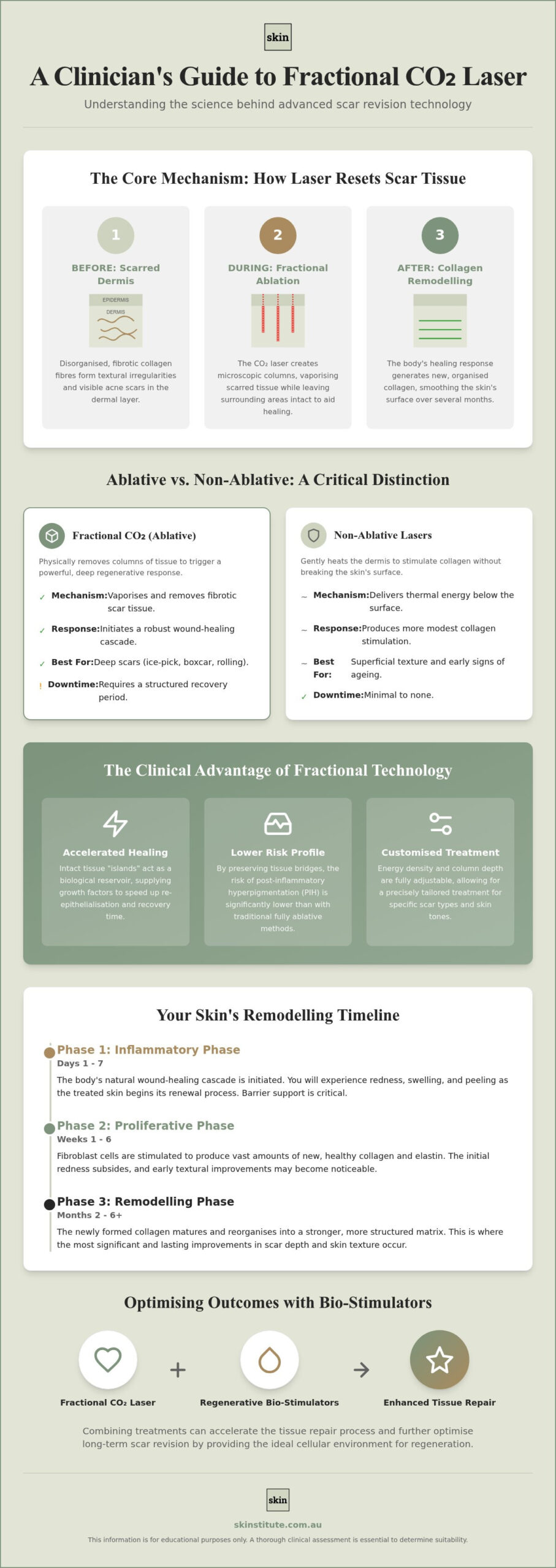
Fractional Carbon Dioxide (CO2) laser is an ablative modality operating at a wavelength of 10,600 nanometres, a specific frequency that is absorbed almost exclusively by intracellular water, allowing it to vaporise targeted tissue with exceptional precision while leaving the surrounding dermal matrix structurally intact. This physical property is what separates CO2 technology from the broader category of laser resurfacing options and explains why it remains the clinical benchmark for deep-seated acne scarring and dermal texture revision.
The term “fractional” describes the delivery mechanism rather than the energy source itself. Rather than treating the entire skin surface uniformly, fractional technology directs laser energy into thousands of microscopic treatment columns, known as microthermal zones, across the targeted area. Each column penetrates to a precise depth within the dermis, while the tissue between columns remains completely unaffected. This architectural approach is clinically significant: the intact surrounding tissue acts as a biological reservoir, supplying the growth factors, keratinocytes, and fibroblasts that drive accelerated healing from the edges inward.
For those considering CO2 laser for acne scars in Melbourne, understanding this distinction from non-ablative alternatives is essential. Non-ablative lasers deliver thermal energy beneath the skin’s surface without removing tissue, producing more modest collagen stimulation with minimal downtime. They’re appropriate for superficial textural concerns. Ablative CO2 laser, by contrast, physically removes fibrotic scar tissue and initiates a far more robust wound-healing response, making it the appropriate clinical choice for ice-pick, boxcar, and rolling scars that have disrupted dermal architecture at depth.
How the CO2 Laser Interacts with Scar Tissue
The mechanism underpinning CO2 laser efficacy is selective photothermolysis: the conversion of light energy into controlled thermal injury within a precisely defined target. When the 10,600nm wavelength contacts scar tissue, intracellular water rapidly absorbs the energy, reaches vaporisation point, and the damaged, fibrotic cellular structures are eliminated. The surrounding thermal coagulation zone then triggers the body’s wound-healing cascade, stimulating fibroblast proliferation and new collagen synthesis within the papillary and reticular dermis.
The Clinical Benefits of Fractional Technology
Fractional delivery offers three clinically meaningful advantages over traditional fully ablative resurfacing. First, re-epithelialisation occurs substantially faster because intact tissue islands migrate across the treated columns, reducing overall healing time. Second, the risk profile for post-inflammatory hyperpigmentation is considerably lower, since the preserved tissue bridges limit the extent of melanocyte disruption. Third, the treatment parameters, including energy density and column depth, are adjustable to accommodate different scar morphologies and Fitzpatrick skin types, allowing for genuinely tailored scar revision rather than a one-size-fits-all approach.
This combination of precision, biological efficiency, and customisable parameters is precisely why CO2 laser for acne scars in Melbourne continues to represent the most clinically validated pathway for meaningful structural scar correction.
The Biological Mechanism: How Laser Remodels Your Skin
The visible results of CO2 laser for acne scars in Melbourne don’t emerge from the treatment session itself. They emerge from what happens in the weeks and months that follow, as the body executes a highly orchestrated biological programme in response to the controlled injury introduced by the laser. Understanding this programme, phase by phase, is what separates an informed patient from one who abandons the process prematurely.
The immediate post-pulse response involves two simultaneous events. First, rapid tissue vaporisation within the microthermal zones eliminates the fibrotic, disorganised collagen that characterises scar tissue. Second, the thermal energy propagating outward from each column induces immediate collagen fibre contraction, producing a visible tightening effect at the skin’s surface. This contraction occurs as the triple-helix structure of existing collagen denatures under heat, physically shortening and compacting the dermal matrix. It’s a structural change that’s perceptible from day one, though it represents only the beginning of a far longer remodelling sequence.
The Three Phases of Dermal Remodelling
The wound-healing cascade that follows CO2 laser treatment proceeds through three distinct, overlapping phases, each with a specific biological mandate. The inflammatory phase (days one to three) is characterised by immediate vasodilation, neutrophil infiltration, and the release of pro-inflammatory cytokines including interleukin-1 and tumour necrosis factor-alpha. These signalling molecules recruit macrophages that clear cellular debris and release platelet-derived growth factor, which primes the dermal environment for tissue regeneration. The proliferative phase (weeks one to four) sees fibroblasts migrate into the treated zones and begin synthesising new Type III collagen, the preliminary scaffold of regenerating tissue, alongside fibronectin and hyaluronic acid. As the acne scar diagnosis and treatment guidance from the American Academy of Dermatology acknowledges, stimulating this fibroblast activity at depth is central to achieving meaningful structural correction. The maturation phase (months three to six) is where the most clinically significant transformation occurs: Type III collagen is progressively replaced by Type I collagen, the primary structural protein of healthy dermis, and the fibres reorganise along lines of mechanical tension, producing a smoother, more uniform dermal matrix.
Elastin synthesis runs parallel to this collagen remodelling process. Scar tissue is characteristically elastin-deficient, which accounts for its rigid, tethered quality. The thermal stimulus of CO2 laser activates elastin gene expression in dermal fibroblasts, gradually restoring the mechanical flexibility and ‘snap-back’ quality of the skin surface.
Addressing the ‘Memory’ of Scar Tissue
Acne scars persist not simply because collagen is absent, but because the existing scar tissue carries a structural memory: densely packed, horizontally oriented collagen bundles that tether the overlying skin downward, creating the characteristic depressed morphology of boxcar and rolling scars. CO2 laser disrupts this architecture directly, vaporising the tethered fibres and creating the biological conditions necessary for their replacement with a more organised matrix.
A critical and often overlooked component of this process is the activation of heat-shock proteins, particularly HSP47 and HSP70, in response to the thermal stimulus. These molecular chaperones regulate collagen folding and assembly, ensuring that newly synthesised collagen is structurally sound rather than disorganised. Their sustained activity in the weeks following treatment contributes meaningfully to the long-term quality of the remodelled dermal architecture, rather than simply producing a temporary volumetric response.
For patients exploring this treatment pathway, understanding the full biological timeline is essential. A consultation with an experienced clinician can help you assess whether your scar morphology and skin type are positioned to benefit from this remodelling process. Learn more about the clinical approach to scar revision to understand what a structured treatment plan might look like for your specific presentation.
Assessing Acne Scar Types: Is CO2 Laser the Right Modality?
Not every acne scar is the same, and not every scar responds to CO2 laser energy in the same way. This is the clinical reality that generic treatment information consistently fails to address, and it’s precisely why a thorough skin analysis at Skinstitute forms the essential first step before any treatment parameters are determined. A clinician must assess scar morphology, depth, distribution, and your Fitzpatrick skin type before recommending a course of action, because the margin between an optimal outcome and an avoidable complication often lies in those details.
The clinical assessment process involves mapping the specific scar types present across the treatment area, since most patients present with a combination of morphologies rather than a single uniform pattern. Each type represents a distinct structural disruption within the dermis, and each responds differently to fractional ablative energy.
Matching Laser Treatment to Scar Morphology
Rolling scars are characterised by broad, gently sloping depressions with soft, poorly defined edges. They result from fibrous tethering bands that anchor the epidermis to the subcutaneous tissue below. CO2 laser is highly effective for rolling scars because the ablative columns disrupt the superficial fibrotic tethering and initiate the collagen remodelling sequence needed to elevate the depressed surface over subsequent months.
Boxcar scars present as sharply defined, vertical-walled depressions with a flat base, resembling a punched-out appearance. Fractional ablation softens the angular edges by stimulating new collagen deposition along the scar walls, gradually reducing the shadow effect that makes these scars visually prominent. Multiple treatment sessions are typically required to achieve meaningful edge softening.
Ice-pick scars are narrow, deep, and epithelium-lined channels that extend into the mid-to-deep dermis. This morphology represents the most challenging category for laser monotherapy. Because ice-pick scars are deeper than the effective ablative range of fractional CO2, laser treatment alone produces limited structural correction. Adjunctive techniques, such as punch excision or subcision, are frequently recommended alongside laser resurfacing to address these effectively.
Suitability and Skin Type Considerations
Skin type is a critical variable in treatment planning, particularly regarding the risk of post-inflammatory hyperpigmentation (PIH). Patients with Fitzpatrick skin types IV through VI carry a higher baseline risk of melanocyte dysregulation following ablative procedures. Managing this risk requires pre-conditioning the skin with medical-grade topicals, typically including a tyrosinase inhibitor such as hydroquinone or kojic acid, for a structured period prior to treatment. This melanocyte stabilisation protocol reduces the likelihood of PIH and supports more predictable outcomes across diverse skin tones.
Active acne represents an absolute contraindication to treatment. Delivering laser energy to inflamed follicular units risks spreading bacterial content, triggering a more pronounced inflammatory response, and compromising the integrity of the healing process. Treatment must be deferred until acne activity is fully suppressed, which may require a medically supervised course of topical or oral therapy beforehand.
For patients with significant textural disruption across multiple scar types, fractional CO2 laser resurfacing in Melbourne remains the most clinically validated modality for structural scar revision. When considering CO2 laser for acne scars in Melbourne, the distinction between scar morphologies isn’t a minor detail; it’s the foundation on which an effective, personalised treatment plan is built.
The Clinical Journey: Preparation and Recovery in Melbourne
Understanding the biological mechanism of CO2 laser is one thing. Knowing precisely what to do in the weeks before and after your session is what determines whether that biology works in your favour. The clinical journey surrounding CO2 laser for acne scars in Melbourne is as structured as the procedure itself, and shortcuts at either end of the process have measurable consequences for your outcomes.
Step-by-Step Pre-Care and Procedure
Pre-treatment preparation begins approximately two weeks before your scheduled session. During this window, retinoids must be discontinued entirely. These vitamin A derivatives accelerate cellular turnover and sensitise the skin, increasing the risk of excessive thermal response when laser energy is delivered. Sun exposure must also be avoided rigorously, and any active tanning, whether natural or artificial, represents a contraindication to proceeding. A compromised or UV-stimulated melanocyte population is far more reactive, and proceeding without adequate melanocyte stabilisation materially increases the risk of post-inflammatory hyperpigmentation.
On the day of treatment, a topical anaesthetic cream is applied to the treatment area and allowed adequate contact time to achieve meaningful dermal penetration. This is not a perfunctory step; the depth of anaesthesia directly influences patient comfort and, by extension, the ability of your clinician to work methodically across the full treatment zone. Integrated cooling systems are used throughout the session to manage surface temperature, reduce thermal discomfort, and protect the epidermal layer adjacent to each ablative column. The sensation most patients describe is a combination of warmth and a brief, sharp stimulus with each pulse, which the cooling system substantially mitigates.
Immediately post-procedure, a clinical-grade protective balm is applied to the treated skin. This creates an occlusive barrier that supports the initial healing environment, reduces transepidermal water loss, and shields the vulnerable tissue from environmental irritants before the re-epithelialisation process has commenced.
Post-Treatment Aftercare and Healing Timeline
The recovery window is predictable and manageable when approached with clinical precision. Here’s what to expect across the healing timeline:
- Days 1 to 2: Erythema and oedema are expected and represent the normal inflammatory phase response. Keeping the head elevated, applying cool compresses, and using only prescribed barrier products during this period supports the process without disrupting it. Avoid all active skincare ingredients.
- Days 3 to 5: The treated skin takes on a bronzed appearance as the micro-columns begin to shed their superficial debris. This is the micro-peeling phase, and it is critical that you do not pick, rub, or mechanically disturb the skin. Premature removal of this tissue disrupts the re-epithelialisation process and significantly increases the risk of scarring and pigment irregularity.
- Days 5 to 7: The skin progressively lightens and softens as the new epithelial layer consolidates. Social presentability is typically achievable within this window for most patients, though individual variation exists based on treatment parameters and skin type.
Melbourne’s UV environment deserves specific attention in the post-treatment period. Victoria’s solar UV index can reach extreme levels year-round, not only in summer, and freshly resurfaced skin has virtually no photoprotective capacity. Broad-spectrum SPF 50+ sunscreen is non-negotiable from day five onward, applied every two hours during daylight exposure. Physical blockers containing zinc oxide are preferred over chemical filters during the early healing phase, as they sit on the skin surface rather than requiring absorption into a compromised barrier. This isn’t a precautionary recommendation; it’s a clinical requirement. Unprotected UV exposure during the remodelling phase can trigger melanocyte dysregulation and undo the precision work of the procedure itself.
Managing this recovery well is directly connected to the quality of your long-term result. Speak with the Skinstitute team about a structured aftercare protocol tailored to your skin type and Melbourne’s specific environmental conditions.
Enhancing Results: The Skinstitute Approach to Scar Revision
CO2 laser for acne scars in Melbourne delivers its most significant outcomes not as a standalone procedure, but as the centrepiece of a strategically layered treatment programme. The biological window that opens immediately following ablative resurfacing represents an extraordinary opportunity: the dermal environment is primed, fibroblasts are active, and the tissue is receptive to regenerative signals in a way that normal, uninjured skin simply isn’t. Capitalising on that window is where Skinstitute’s clinical approach diverges meaningfully from single-modality treatment.
Bio-Stimulation and Laser Synergy
Polynucleotide therapy, delivered through Rejuran in Melbourne, is the regenerative modality most frequently paired with fractional CO2 at Skinstitute. Polynucleotides are long-chain DNA fragments derived from salmon sperm DNA, and their clinical value lies in a specific biological function: they provide the nucleotide building blocks required for cellular DNA repair and replication in the post-laser environment. When fibroblasts are actively synthesising new collagen, the availability of these substrates accelerates the proliferative phase and supports more organised matrix assembly. The result is a healing trajectory that is both faster and structurally superior to what laser energy alone can achieve.
Exosome therapy operates through a complementary but distinct mechanism. Exosomes are extracellular vesicles that function as intercellular messengers, carrying growth factors, microRNA, and signalling proteins that instruct surrounding cells to modulate inflammation, proliferate, and differentiate. Applied in the immediate post-laser period, exosomes serve to calm the acute inflammatory response, reduce erythema duration, and amplify the collagen-stimulating signals already initiated by the thermal injury. For patients concerned about downtime, this is a clinically meaningful advantage.
Why Skinstitute is the Preferred Melbourne Clinic
With over 26 years of clinical experience in medical-grade aesthetic treatments, Skinstitute approaches scar revision from a position of genuine technical authority. Every treatment pathway is constructed around the root cause of the presenting concern, not the presenting symptom. That distinction is what separates a clinic that treats acne scars from one that genuinely resolves them.
Patient safety and evidence-based outcomes are the non-negotiable foundations of every clinical decision made here. If you’re ready to explore a structured, personalised approach to scar revision, speak with the Skinstitute team to begin with a thorough clinical assessment.
Taking the Next Step Towards Clearer Skin
Acne scarring represents a genuine structural disruption within the dermis, and addressing it requires a treatment modality that works at that same structural level. CO2 laser for acne scars in Melbourne remains the most clinically validated pathway for meaningful scar correction precisely because it initiates a biological remodelling process that topical products and superficial treatments cannot replicate. When paired with advanced regenerative protocols including Rejuran and exosome therapy, that remodelling process becomes more efficient and more durable.
What separates a good outcome from a genuinely transformative one is the clinical experience guiding every decision, from scar morphology assessment through to post-treatment recovery. With over 26 years of experience in medical-grade laser aesthetics, Skinstitute brings a level of technical authority and personalised care that makes a measurable difference to long-term results.
If you’re ready to move beyond guesswork and approach scar revision with clinical precision, book a clinical skin assessment at Skinstitute Melbourne and take the first concrete step towards skin that genuinely reflects the progress you deserve.
Frequently Asked Questions About CO2 Laser for Acne Scars in Melbourne
How many CO2 laser sessions are typically required for acne scars?
Most patients require between two and four sessions to achieve meaningful structural correction, though this varies considerably based on scar depth, morphology, and individual healing response. Sessions are typically spaced eight to twelve weeks apart to allow the full collagen remodelling cycle to progress before the next treatment is delivered. Attempting to compress this timeline doesn’t accelerate results; it disrupts the biological process that produces them.
Patients presenting with a combination of scar types, particularly those with deeper ice-pick scars alongside rolling or boxcar morphologies, may require additional sessions or adjunctive procedures to address the full clinical picture. A thorough assessment at your initial consultation will provide a realistic treatment projection specific to your presentation.
Is the Fractional CO2 laser treatment painful?
Discomfort is effectively managed through a topical anaesthetic cream applied prior to treatment, which is given adequate contact time to achieve genuine dermal penetration rather than superficial numbing. Most patients describe the sensation as a combination of warmth and a brief, sharp stimulus with each pulse. Integrated cooling systems used throughout the session substantially reduce thermal discomfort at the skin surface.
Individual pain thresholds vary, and the density of treatment parameters also influences the intensity of sensation. Your clinician will discuss your comfort throughout the procedure and can adjust the approach accordingly. The experience is generally well-tolerated when the pre-treatment anaesthetic protocol is followed correctly.
What is the difference between Fractional CO2 and traditional laser resurfacing?
Traditional fully ablative resurfacing treats the entire skin surface uniformly, removing the complete epidermal layer across the treatment zone. Fractional CO2 delivers energy into thousands of microscopic columns called microthermal zones, leaving the surrounding tissue completely intact. This preserved tissue acts as a biological reservoir, supplying the growth factors and keratinocytes that drive faster re-epithelialisation from the edges inward.
The practical consequences of this distinction are significant: fractional delivery produces a considerably shorter recovery period, a lower risk profile for post-inflammatory hyperpigmentation, and adjustable treatment parameters that accommodate different scar depths and skin types. It represents a more precise and clinically versatile approach than traditional ablative methods, without sacrificing the depth of correction that makes ablative technology worthwhile.
Can CO2 laser be used on all skin types and colours?
CO2 laser can be used across a range of skin types, but treatment planning must account carefully for Fitzpatrick classification. Patients with darker skin tones, specifically Fitzpatrick types IV through VI, carry a higher baseline risk of post-inflammatory hyperpigmentation because melanocytes in more pigmented skin are more reactive to thermal stimulation. This doesn’t preclude treatment; it requires a more conservative parameter selection and a structured pre-conditioning protocol.
Melanocyte stabilisation using tyrosinase inhibitors in the weeks before treatment is a standard component of the pre-treatment protocol for higher-risk skin types. A thorough clinical assessment is essential before proceeding, as treating without this preparation materially increases the likelihood of pigment irregularity and undermines the outcome.
How long does it take to see the final results from a CO2 laser treatment?
The most clinically significant results from CO2 laser for acne scars in Melbourne emerge between three and six months following each treatment session, during the maturation phase of dermal remodelling. This is when Type III collagen is progressively replaced by the structurally superior Type I collagen and fibres reorganise along lines of mechanical tension, producing a smoother, more uniform dermal surface. Early improvements in skin texture are visible within weeks, but they represent only the beginning of a longer process.
Patients frequently underestimate this timeline and assess their results prematurely. Understanding that the skin is continuing to remodel well beyond the point of visible healing is important for setting realistic expectations and avoiding the conclusion that treatment hasn’t worked when the biological programme is still actively running.
What are the potential side effects of CO2 laser resurfacing?
Expected post-treatment responses include erythema, oedema, and a bronzed micro-peeling phase as the treated columns shed superficial debris. These are normal inflammatory phase responses, not adverse events, and they resolve within the anticipated recovery window. Prolonged redness beyond the expected timeframe, post-inflammatory hyperpigmentation, and, in rare cases, infection or scarring represent genuine complications that are minimised through proper pre-treatment preparation and structured aftercare adherence.
The risk of hyperpigmentation is the most clinically relevant consideration for Melbourne patients, given the region’s high UV index year-round. Strict broad-spectrum SPF 50+ photoprotection from day five of recovery onward is a non-negotiable clinical requirement, not an optional precaution. Unprotected sun exposure during the remodelling phase is one of the most common and avoidable causes of compromised outcomes.
Can I combine CO2 laser with other treatments like Rejuran or fillers?
Combining Fractional CO2 with Rejuran polynucleotide therapy is a well-supported clinical approach at Skinstitute. The post-laser dermal environment is uniquely receptive to regenerative bio-stimulators, and Rejuran’s polynucleotide chains provide the nucleotide substrates that actively proliferating fibroblasts require for DNA repair and collagen synthesis. This combination accelerates the proliferative phase and supports more organised matrix assembly than laser treatment alone achieves.
The sequencing and timing of combination treatments matters considerably and should be determined by your clinician based on your skin’s healing trajectory. Exosome therapy is also frequently used in the immediate post-laser period to modulate the acute inflammatory response and reduce erythema duration. Any decisions about combining modalities should be made within a structured treatment plan rather than added ad hoc.
How should I prepare my skin for a CO2 laser appointment in Melbourne?
Preparation begins approximately two weeks before your scheduled session. Retinoids must be discontinued entirely during this window, as they sensitise the skin and increase the risk of an excessive thermal response. Rigorous sun avoidance is equally important; active tanning, whether from natural UV exposure or artificial sources, constitutes a contraindication to proceeding. Any compromised or UV-stimulated melanocyte population significantly elevates the risk of post-treatment pigment irregularity.
For patients with higher-risk skin types, a pre-conditioning course of medical-grade topicals, typically including a tyrosinase inhibitor, will be prescribed as part of the melanocyte stabilisation protocol. Active acne must also be fully suppressed before treatment can proceed. Your clinician will provide a personalised preparation checklist at your consultation that accounts for your specific skin type and Melbourne’s environmental conditions.