Anti-Ageing Clinic Melbourne: A Clinical Guide to Medical-Grade Rejuvenation (2026)
August 4, 2026
Choosing the Best Medical Aesthetic Clinic in Melbourne: A 2026 Clinical Guide
August 6, 2026
Achieving a complete dermal reset is less about aggressive abrasion and more about a precision-engineered biological reboot of the skin’s structural integrity. Many individuals find that even the most advanced topical serums are insufficient for resolving deep-seated solar elastosis or persistent acne scarring exacerbated by the intense Australian climate. It is natural to feel a sense of apprehension regarding the downtime and physiological response associated with traditional ablative treatments. This clinical overview explains how modern co2 laser skin resurfacing melbourne utilizes fractional technology to trigger profound collagen synthesis while maintaining a strictly controlled safety profile.
We’ll explore the evidence-based mechanisms of fractional photothermolysis and how these medical-grade protocols differ from standard aesthetic offerings. You’ll gain a clear understanding of the regenerative timeline, including the potential integration of bio-stimulators to enhance the healing response. By the end of this guide, you will have a comprehensive roadmap of the treatment process, from the initial thermal interaction to the long-term maturation of new collagen fibres. This methodical approach ensures that your journey toward skin health is grounded in transparency and technical excellence.
Key Takeaways
- Understand the biological mechanism of the 10,600nm wavelength used in co2 laser skin resurfacing melbourne to trigger controlled tissue vaporisation and subsequent dermal remodelling.
- Compare the clinical advantages of fractional delivery systems against traditional fully ablative methods to balance recovery downtime with therapeutic outcomes.
- Identify how specific dermal concerns, such as atrophic acne scarring and advanced solar elastosis, respond to targeted medical-grade laser protocols.
- Learn the essential requirements for pre-treatment skin priming and post-operative care to mitigate risks such as post-inflammatory hyperpigmentation.
- Discover how integrating bio-stimulators like Rejuran or Exosomes into a laser protocol can accelerate the regenerative timeline and enhance long-term structural results.
Understanding Fractional CO2 Laser Technology in a Clinical Context
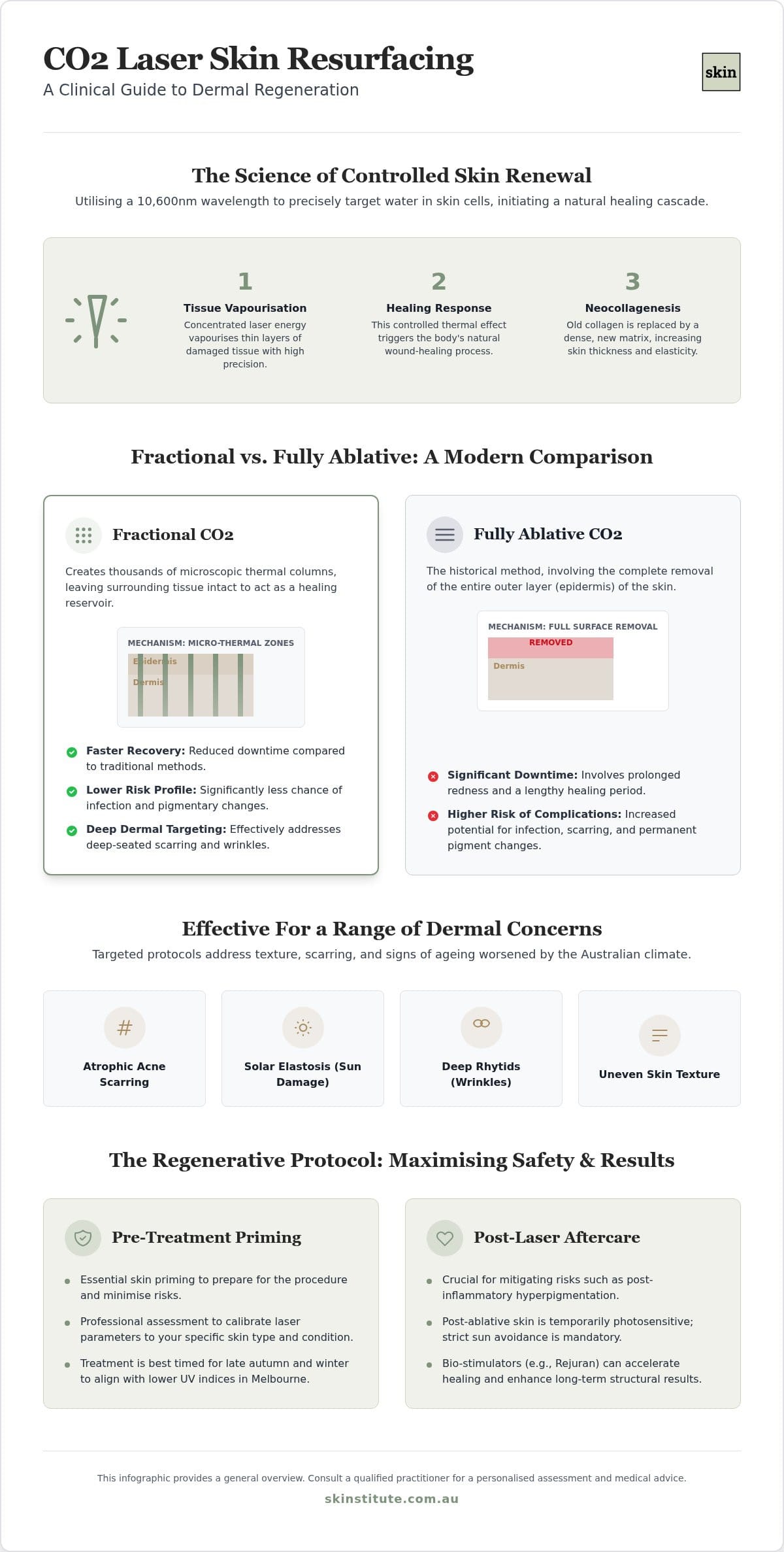
The carbon-dioxide laser represents the pinnacle of ablative technology in the aesthetic field, operating at a specific wavelength of 10,600nm. This particular frequency is highly absorbed by the water molecules found within the skin’s cellular structure, allowing for extreme precision during the procedure. When applied clinically for co2 laser skin resurfacing melbourne, the device delivers concentrated energy that vapourises thin layers of damaged tissue. This precise destruction isn’t random; it’s a calculated initiation of the body’s natural wound-healing cascade. By removing compromised cells, the treatment forces the dermis to reconstruct itself from the foundation up, replacing aged tissue with a fresh, resilient biological matrix.
The Mechanism of Controlled Thermal Ablation
Modern Carbon-dioxide laser technology has evolved from the fully ablative systems of the past to sophisticated fractional delivery. Instead of removing the entire skin surface, fractional lasers create thousands of microscopic, vertical columns of thermal injury known as Micro-Thermal Treatment Zones (MTZs). These columns extend deep into the dermis while leaving the surrounding tissue entirely intact. This “fractional” pattern is vital for clinical safety, as the healthy tissue acts as a biological reservoir for rapid re-epithelialisation. Within these zones, the heat triggers a process called neocollagenesis. This is where old, fragmented collagen fibres are replaced by a dense, organised matrix of new collagen and elastin, leading to a measurable increase in dermal thickness and elasticity over the following months.
Why Melbourne’s Climate Necessitates Advanced Resurfacing
Residents of Victoria frequently exhibit advanced signs of solar elastosis, a condition where chronic UV exposure degrades the skin’s elastic fibres, leading to deep rhytids and a leathery texture. The harsh Australian sun accelerates dermal ageing, often necessitating more intensive interventions than topical therapies can provide. Clinical co2 laser skin resurfacing melbourne is usually strategically timed to coincide with the lower UV indices of late autumn and winter. This seasonal approach is a critical safety measure, as post-ablative skin is temporarily more susceptible to photosensitivity and potential pigmentary changes. A thorough professional assessment ensures that the laser’s energy parameters are precisely calibrated to the patient’s specific degree of sun damage and Fitzpatrick skin type. This bespoke calibration ensures the most robust regenerative response possible while respecting the skin’s physiological limits. Practitioners must account for the cumulative effects of the Victorian climate to ensure that the treatment addresses both surface irregularities and deeper structural deficits.
Fractional vs. Fully Ablative CO2: Navigating Modern Modalities
Historically, fully ablative CO2 lasers involved the total removal of the epidermal layer, effectively “stripping” the skin to reveal a new surface. While this method produced dramatic results, it carried a significant risk of prolonged erythema, infection, and permanent pigmentary changes. The shift toward fractional delivery has fundamentally altered the safety profile of co2 laser skin resurfacing melbourne. By distributing the laser energy into a pixelated grid, practitioners can achieve deep dermal penetration without the extensive trauma associated with full-field ablation. This technical advancement allows for a more controlled biological response, significantly reducing the likelihood of adverse scarring while still addressing complex textural concerns.
The Evolution of eCO2 and Pixelated Delivery
The “dot” pattern used in fractional technology is designed to preserve the skin’s structural integrity. By leaving microscopic bridges of untreated tissue between the laser columns, the body’s natural healing mechanisms are triggered more efficiently. This pattern allows for precise customisation, as practitioners can adjust the depth of penetration to target superficial epidermal pigmentation or deep-seated dermal scarring. According to the clinical practice guidelines for laser resurfacing, this selective thermal injury is what makes modern CO2 lasers safer for a wider range of patients. Fractional delivery is a method that treats only a percentage of the skin surface to facilitate rapid re-epithelialisation.
Balancing Efficacy with Down-Time Requirements
In a medical-grade context, “downtime” refers to the physiological period required for the skin to restore its barrier function. While a fully ablative treatment might necessitate several weeks of clinical recovery, fractional protocols typically involve five to seven days of social downtime. During this period, the microscopic treatment zones undergo a process of shedding and renewal. The expected outcomes range from immediate improvements in superficial texture to deep structural remodelling that continues for months. Skinstitute organises treatment plans that respect these biological timelines, ensuring the intensity of the session aligns with each client’s lifestyle constraints. A thorough clinical consultation is essential to determine whether a single intensive session or a series of lighter treatments will best meet your dermal goals.
The success of the procedure also depends on the manipulation of specific laser parameters, such as energy density and dwell time. Dwell time refers to the duration the laser beam remains on a single microscopic point. A longer dwell time increases the thermal spread, which can be beneficial for tightening lax skin but requires a more cautious approach to prevent collateral heat damage. By carefully balancing these settings, clinicians can tailor the treatment to address specific pathologies like atrophic acne scars or solar elastosis, ensuring the energy is delivered exactly where it is needed most for cellular regeneration.
Clinical Indications: Addressing Texture, Pigmentation, and Scarring
The clinical application of co2 laser skin resurfacing melbourne extends far beyond superficial aesthetic enhancement. It is primarily indicated for the correction of moderate to severe photo-ageing, where chronic ultraviolet exposure has compromised the skin’s structural integrity. By targeting both the epidermal and dermal layers, the laser effectively addresses dyschromia, which refers to irregular pigmentation, and deep rhytids that have become resistant to non-ablative modalities. While the face remains the most common treatment area, the technology is also highly effective for rejuvenating the neck, décolletage, and the dorsal aspect of the hands, where skin is often thinner and more prone to visible ageing.
Targeted Treatment for Acne Scars and Dermal Irregularities
For individuals dealing with atrophic acne scarring, particularly boxcar and icepick variants, the fractional CO2 laser provides a level of efficacy that non-ablative systems often cannot match. The laser’s thermal energy is used to break down the dense, fibrotic scar tissue that tethers the skin downward, creating the characteristic pitted appearance. By delivering controlled columns of ablation, the treatment stimulates the production of organised collagen to fill these depressions from beneath. In complex cases, clinicians often recommend a multi-modality approach. This may involve alternating laser sessions with skin needling Melbourne to maximise the mechanical and thermal stimulation of the dermis, leading to a more comprehensive improvement in surface texture.
Reversing Solar Elastosis and Deep Rhytids
Solar elastosis is a hallmark of the Australian climate, characterised by an accumulation of abnormal elastic tissue in the dermis. This manifests as deep, vertical lip lines and periorbital wrinkles that contribute to a prematurely aged appearance. Laser resurfacing for skin conditions such as these works by inducing immediate collagen contraction followed by a long-term remodelling phase. The result is a significant tightening of the dermal matrix. To enhance these outcomes, advanced protocols now include the use of polynucleotides. Integrating rejuran melbourne into the treatment plan can prime the skin before the laser procedure and support the subsequent healing phase, ensuring the newly formed tissue is of the highest possible quality. This combination of thermal ablation and bio-stimulation represents a sophisticated approach to dermal regeneration.
The Regenerative Protocol: Pre-Treatment and Post-Laser Aftercare
Achieving the optimal outcome from co2 laser skin resurfacing melbourne requires a disciplined adherence to a multi-stage clinical protocol. The process begins long before the laser makes contact with the skin. Priming is an essential phase designed to stabilise melanocyte activity and ensure the dermis is in a peak state for regeneration. Without this preparation, the risk of post-inflammatory hyperpigmentation (PIH) increases, particularly in individuals with darker Fitzpatrick skin types who are naturally more prone to pigmentary shifts following thermal stress.
Priming the Skin for Laser Aesthetic Treatments
Tyrosinase inhibitors are typically prescribed for several weeks preceding the treatment. These active ingredients work to suppress the enzyme responsible for melanin production, providing a safety buffer during the intentional injury of the laser session. Medical-grade skin preparation is considered non-negotiable; it ensures that the skin’s response to thermal stress is predictable and controlled. During a pre-treatment consultation, the clinician assesses the current health of the skin barrier and organises a bespoke preparation programme tailored to the patient’s specific physiological needs and history of sun exposure.
The clinical recovery timeline generally follows a predictable sequence over fourteen days:
- Days 1–3: Intense erythema and swelling occur as the inflammatory cascade begins. The microscopic “grid” pattern from the fractional laser is often visible during this stage.
- Days 4–7: The “peeling” or shedding phase commences. The microscopic treatment zones are shed as the new epidermis forms underneath. It’s vital not to prematurely pick or exfoliate the skin during this window.
- Days 7–14: The skin remains slightly pink but the barrier function is largely restored. This is the period where structural remodelling begins in earnest.
Clinical Aftercare and the Role of Exosomes in Healing
One of the most significant advancements in post-laser recovery is the integration of Exosomes. These regenerative molecules provide the necessary signalling proteins and mRNA to the micro-thermal zones, effectively “instructing” the cells to repair tissue more efficiently. By using Exosomes immediately following co2 laser skin resurfacing melbourne, clinicians can often reduce the duration of social downtime and enhance the final textural result. This synergy between thermal ablation and bio-signalling represents the modern standard in medical-grade skin revision.
Long-term maintenance is equally critical. Strict sun avoidance is mandatory in the Victorian climate, as the newly formed epidermis is highly susceptible to UV-induced damage. Patients must utilise high-protection SPF and medical-grade barrier repair creams to prevent transepidermal water loss. To ensure your recovery is managed with professional precision, you can book a clinical assessment to discuss a tailored regenerative protocol that incorporates these advanced healing modalities.
The Skinstitute Approach to CO2 Laser in Melbourne
The Skinstitute approach to co2 laser skin resurfacing melbourne is grounded in a legacy of 26 years of clinical expertise, prioritising technical precision over superficial results. We recognise that the laser device itself is merely a tool; its efficacy is entirely dependent on the clinician’s ability to manipulate complex parameters such as pulse duration, overlap, and energy density. Each protocol is bespoke, acknowledging that the biological response of the dermis varies significantly between individuals. By leveraging decades of experience, we ensure that every session is calibrated to maximise dermal remodelling while strictly maintaining the integrity of the surrounding tissue. This methodical focus on safety and technical mastery distinguishes our practice within the Melbourne aesthetic community.
The Importance of a Specialist Consultation
Evaluating skin thickness, elasticity, and the presence of underlying solar damage is fundamental to our diagnostic process. During a specialist consultation, we move beyond surface-level observations to understand the physiological state of your skin. This assessment allows us to discuss realistic clinical outcomes and manage expectations regarding the recovery timeline. We don’t view laser as an isolated event but as part of a broader strategy. This often results in a multimodal plan that may include a clinically validated fractional co2 laser resurfacing melbourne protocol, ensuring the treatment depth aligns perfectly with your specific dermal pathology.
Synergistic Outcomes: CO2 and Bio-Stimulators
Our philosophy centres on the dual concepts of rejuvenation and regeneration. While the CO2 laser provides the necessary thermal stimulus for collagen contraction, the subsequent healing phase can be significantly enhanced through bio-stimulation. We frequently integrate CO2 with other medical-grade aesthetic treatments to provide a holistic reboot of the skin’s architecture. Pairing the laser with polynucleotides like Rejuran or advanced Exosome therapy provides the dermis with the essential building blocks required for rapid structural repair. This synergistic approach reduces inflammatory downtime and ensures that the new collagen fibres are dense, organised, and resilient.
The journey toward profound skin renewal begins with a professional assessment at our Melbourne clinic. By combining established scientific principles with advanced regenerative technologies, we provide a stable and authoritative environment for your dermal transformation. We invite you to book a consultation to discuss a customised treatment plan that reflects our commitment to clinical excellence and long-term skin health.
Advancing Toward Structural Dermal Integrity
Selecting a clinical pathway for skin revision requires an understanding of both the technology involved and the biological processes it triggers. We’ve explored how fractional delivery systems have refined the safety profile of co2 laser skin resurfacing melbourne, allowing for deep structural remodelling without the risks of traditional full-field ablation. The success of this intervention is fundamentally linked to a rigorous adherence to clinical protocols, including pre-treatment priming and the strategic application of regenerative therapies to support the healing phase.
With over 26 years of clinical experience, Skinstitute is established as a specialist in regenerative medical aesthetics. Our use of advanced fractional eCO2 technology ensures that every laser parameter is precisely adjusted to meet your unique dermal requirements. To begin a professional assessment of your skin’s health and suitability for this procedure, we invite you to Book your clinical CO2 laser consultation at Skinstitute Melbourne. We look forward to partnering with you to achieve a resilient and restored skin texture through evidence-based practice.
Frequently Asked Questions
How much does CO2 laser skin resurfacing cost in Melbourne?
The investment for clinical resurfacing is determined by the surface area treated and the physiological complexity of the skin concerns. Industry pricing in Victoria varies depending on whether the protocol targets isolated zones, such as the periorbital region, or requires a full-face reconstruction for deep scarring. A precise financial estimate is only established following a clinical assessment where the practitioner determines the required energy parameters and the projected number of sessions.
Is fractional CO2 laser resurfacing painful?
Most patients report a sensation of intense heat rather than acute pain during the procedure. We utilise high-potency topical anaesthetics and integrated cooling systems to maintain comfort throughout the thermal delivery. Following the session, the skin typically feels similar to a moderate sunburn for several hours, a sensation that is managed with prescribed post-operative balms and cooling compresses as part of the clinical recovery protocol.
How long is the downtime after a CO2 laser treatment?
The social downtime following a treatment of co2 laser skin resurfacing melbourne typically lasts between five and seven days. During this window, the skin exhibits redness and swelling followed by the shedding of microscopic epidermal debris as the new surface matures. While the barrier function begins to restore itself within the first week, patients must avoid direct sun exposure and strenuous exercise to ensure the inflammatory response remains productive.
How many CO2 laser sessions are needed for acne scars?
The number of sessions required for acne scarring depends on the morphological type and depth of the lesions. While superficial boxcar scars may show significant improvement after a single intensive session, deeper icepick or tethered scars often necessitate a series of two to four treatments. These sessions are strategically spaced several months apart to allow for the full biological maturation of the newly synthesised collagen matrix within the dermis.
What is the difference between Fraxel and CO2 laser?
The fundamental difference lies in the wavelength and the resulting interaction with the skin tissue. Fraxel systems often utilise non-ablative or mildly ablative wavelengths that heat the tissue without vapourising it. In contrast, the CO2 laser operates at a 10,600nm wavelength to achieve true tissue ablation. This removes columns of damaged skin to trigger a more robust regenerative response, making it superior for treating advanced photo-ageing and deep textural irregularities.
Can CO2 laser be used on dark skin tones safely?
CO2 lasers can be used on darker skin tones provided the patient undergoes a rigorous pre-treatment priming phase. This protocol involves the use of tyrosinase inhibitors to stabilise melanocyte activity before the thermal injury occurs. By carefully adjusting the laser’s density and dwell time, clinicians can safely treat higher Fitzpatrick skin types while minimising the risk of post-inflammatory hyperpigmentation or other unwanted pigmentary changes during the healing process.
When will I see the final results of my laser resurfacing?
Final results from co2 laser skin resurfacing melbourne generally become apparent approximately six months after the procedure. Although initial improvements in skin tone and surface smoothness are visible once the peeling phase concludes at day fourteen, the deeper structural changes rely on the maturation of new collagen fibres. This biological process continues to enhance skin tension and elasticity for several months following the initial thermal stimulus provided by the laser.
What are the risks associated with ablative laser treatments?
Potential risks associated with ablative treatments include prolonged erythema, temporary pigmentary shifts, and a risk of infection if the skin barrier isn’t properly maintained. However, the move toward fractional technology has significantly lowered the incidence of permanent scarring or depigmentation compared to older, fully ablative methods. Adhering to medical-grade aftercare instructions and maintaining a sterile environment during the initial healing phase is critical for ensuring a safe and successful outcome.