Fractional CO2 Laser Melbourne: Is Resurfacing Right for Your Skin?
October 10, 2026
Getting Rid of Turkey Neck Without Surgery: A Clinical Guide
October 12, 2026
There is no dependable, universal timeline for visible changes after exosome therapy. If you’re asking how long does exosome therapy last, first clarify what “last” means: how long an applied product remains in the skin is different from how long a change in skin texture or appearance can be observed. Online claims can sound more certain than the clinical evidence supports.
Exosomes are cell-free messengers studied for their role in cell communication and tissue repair, but evidence for aesthetic use is still developing. Findings are difficult to compare without considering the product and application method, whether treatment was combined with microneedling or another procedure, the skin concern being assessed and the study’s follow-up period. A change measured weeks after treatment does not establish how long it will remain visible.
This guide explains why there is no single duration figure, which treatment and study details matter when assessing claims, and what to discuss during a personalised clinical assessment, including suitability, possible risks, recovery and realistic expectations. At Skinstitute in Melbourne, exosome treatment is considered as part of a tailored skin regeneration plan following face-to-face assessment by medical professionals, without a promised timeframe.
Key Takeaways
- There is no universal answer to how long does exosome therapy last. Interpret reported outcomes in light of the treatment and follow-up period.
- Exosomes are involved in cell-to-cell communication, but proposed regenerative effects should be distinguished from outcomes demonstrated in clinical studies.
- Formulation, delivery method, skin concern and baseline condition can all affect how results are observed and assessed.
- Set clear goals, record your baseline and follow clinical guidance. Consistent photographs can support review, but do not prove treatment efficacy.
- A face-to-face assessment can help Skinstitute’s medical professionals discuss suitability, realistic expectations, risks and recovery as part of a personalised plan.
How long does exosome therapy last? The evidence-based answer
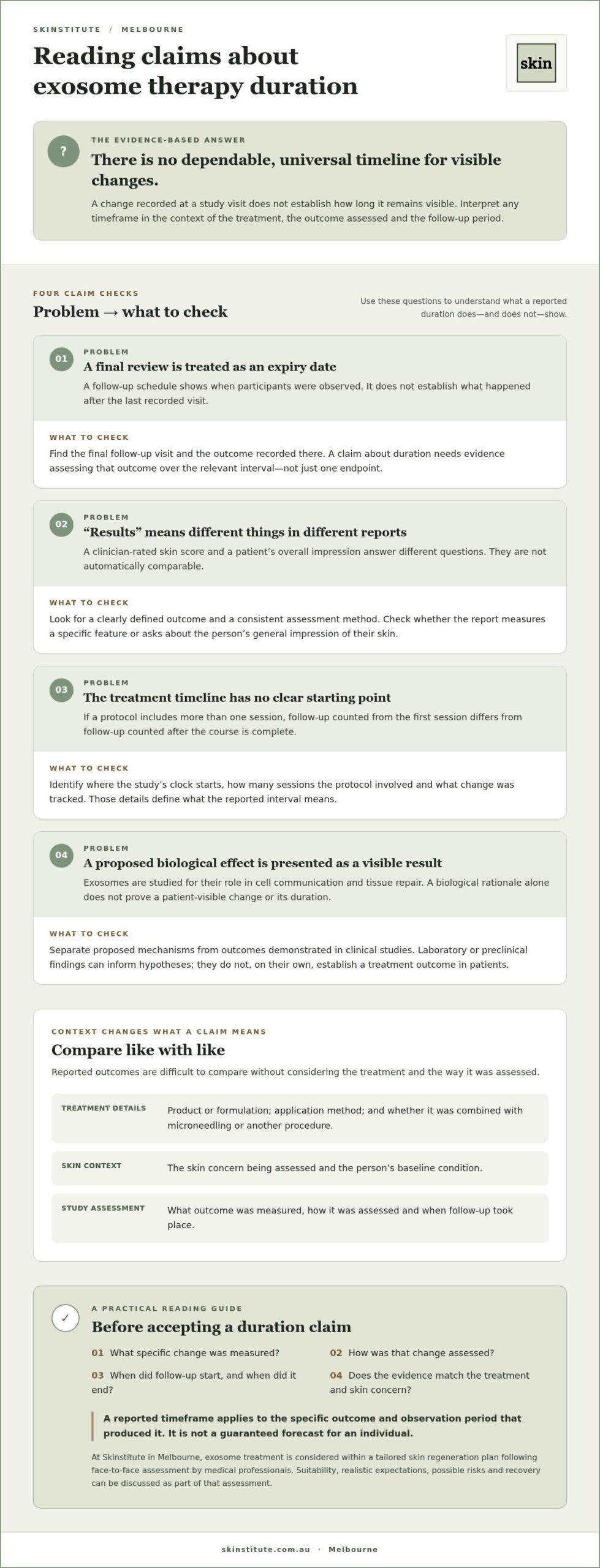
There is no established duration that applies to everyone receiving exosome therapy. In this guide, “treatment duration” means how long a defined, observable skin change is reported after treatment. It does not mean how long exosomes or other treatment components remain in the skin. Those are separate questions, and a visible change at a study review does not establish that it will continue indefinitely.
So, how long does exosome therapy last? It depends on what researchers count as a result and when they assess it. A study might record a change on a clinical scale at a particular visit, while a patient might describe an overall impression of their skin. Neither measure alone provides a guaranteed forecast for an individual. Any reported timeframe applies to the specific outcome and observation period that produced it.
The starting point for measuring duration also matters. If a protocol involves more than one session, a study may report follow-up from the first session or from completion of the course. These timepoints describe different intervals. When reading a claim, check where the clock starts, what change is being tracked and whether the report identifies the last time it was observed or proves when it stopped.
What does “how long it lasts” mean in clinical studies?
Studies can assess a defined feature, such as a clinician-rated skin score, while patients may report whether they feel their skin has changed. These measures answer different questions. A rating may register a change without establishing that every patient notices it. An overall impression can matter to the person, but it is harder to compare consistently between studies.
For a duration claim to be interpretable, the outcome needs a clear definition and a consistent assessment method. A follow-up schedule shows when participants were observed, not how long a benefit lasted beyond the last recorded visit.
Why there is no single duration for everyone
Even when two reports use similar language, their endpoints may differ. One might count a change on an assessment scale; another might ask participants how their skin appears to them. Treat results as equivalent only if the outcomes and measurement approaches are comparable. The background description of Exosome (vesicle) on Wikipedia explains the vesicles’ biological role, but does not establish the duration of a cosmetic treatment.
Study timing can also limit what a result tells us. If researchers observe an outcome at a final review, that establishes what they recorded at that visit, not what happened afterwards. A claim that a result lasts until a specified point needs evidence assessing that outcome over the relevant interval, rather than an observation at a single endpoint.
When comparing claims, look for the treatment’s starting point, the outcome being measured, how it was assessed and the final follow-up visit. Without these details, a timeframe can sound more definitive than the evidence warrants. Individual results cannot be guaranteed, and interpretation depends on the treatment and clinical context.
What happens after exosome therapy: the proposed skin response
Exosomes are extracellular vesicles, small membrane-bound structures released by cells. They can carry biological material between cells, acting somewhat like packages of information to which recipient cells may respond. Their contents and effects can vary according to their source and preparation, so the word “exosomes” alone does not describe a single, standardised treatment or guarantee a particular skin response.
In skin research, scientists are investigating whether signals carried by exosomes may influence cell activity associated with tissue repair and skin quality. This proposed mechanism helps explain why exosomes are being studied in aesthetic settings. It does not show that every product, application method or patient will produce the same response. The general biology described in Exosome (vesicle) on Wikipedia provides background on these structures, but is not evidence of a specific cosmetic treatment’s effectiveness.
A biological rationale does not establish that a patient-visible change will occur or how long it may remain noticeable. This distinction is essential when interpreting claims about skin regeneration. A proposed signal between cells is not itself a measured change in appearance, and biological activity does not provide a reliable timetable for an individual.
Exosomes and cell signalling in skin
Cell signalling describes how cells send, receive and respond to information. Researchers are examining whether exosomes may deliver signals to skin cells that affect processes involved in repair, inflammation or the production of structural proteins such as collagen. These processes are relevant to skin function, but the proposed pathway should not be presented as a guaranteed treatment outcome.
Responses observed in laboratory or preclinical research can help researchers form hypotheses about what might happen in human skin. They cannot, on their own, establish that a treatment improves a particular concern in patients. The source and preparation of vesicles, along with how they are applied, also matter when interpreting research findings.
Biological activity is not the same as lasting visible results
A laboratory observation might show that cells responded to a signal under controlled conditions. A clinical study needs to answer a different question: whether people receiving a defined treatment show a meaningful change in a relevant skin outcome. That outcome needs to be assessed in people using a suitable method, with enough follow-up to observe how findings develop after treatment.
Even a measured change in a human study applies to its particular participants, treatment protocol and assessment. It does not automatically establish a lasting effect for other patients or for a different application method. To judge a claim, consider whether the research assessed the skin concern you’re interested in, whether exosomes were used alone or with another procedure, and what the follow-up actually recorded.
Skinstitute’s Exosomes and Rejuran information offers broader treatment context. A face-to-face assessment can help relate your skin concern and goals to the proposed approach, including suitability, possible risks and recovery. A biological explanation should not be treated as a promise of a specific result.
What can change the duration of exosome therapy results?
Reported outcomes can differ because exosome treatments and the studies examining them are not necessarily alike. Formulation, preparation and delivery method may vary, as may the skin concern being assessed and the participant group. A result from one protocol is not a forecast for a different treatment or an individual patient.
Treatment and study differences behind duration claims
The research examples below illustrate why the method and measured outcome matter. They use different approaches and endpoints, so they should not be read as a direct comparison or a universal estimate of how long results last.
| Study and follow-up | Reported outcome | What the finding can’t establish |
|---|---|---|
| A 2025 clinical trial examined exosome therapy combined with microneedling over 5.5 months. | It reported reductions in pore size, redness and melanin content. | Because microneedling was part of the protocol, the results do not show what exosome therapy alone would produce or how another delivery method would compare. |
| A Mayo Clinic study assessed topical exosome application for sun-damaged skin after six weeks. | It reported a 40% reduction in pro-inflammatory secretions, a biological measure associated with inflammation. | This measure is not the same as a visible change in skin, and the stated follow-up does not establish how long any patient-visible benefit may persist. |
These reports assess different outcomes. A change in pore size or redness is not interchangeable with a change in another skin concern, and a biological measure cannot be assumed to represent an appearance-based result. The research details provided do not establish enough about formulation or preparation to compare products directly. Conclusions should therefore remain specific to each study’s method and endpoint.
Patient factors and treatment goals
Observed outcomes may also depend on the skin’s condition before treatment, the concern being addressed and the person’s individual response. Age, lifestyle factors such as sun exposure and smoking, and adherence to a recommended plan may be relevant when clinicians consider skin health, but they do not determine a fixed treatment lifespan. These factors cannot be used to calculate how long an individual’s result will last.
For example, evidence from a study of sun-damaged skin may have limited relevance to someone seeking help with acne scarring. The target concern and the measure used to assess it need to align before findings can inform expectations. A personalised assessment can consider your skin concern, medical history, suitability and possible risks or recovery needs.
A confident advertised timeframe is not automatically a proven duration. Before relying on one, consider whether it refers to the same treatment approach and outcome, and whether the study followed participants for that interval. A clinical assessment of exosome treatment can help place general claims in the context of your skin and goals without promising a particular result.
How to assess exosome therapy results over time
A planned review is more informative than relying on memory or a single impression. Before treatment, agree on the skin concern you want to address and how it will be assessed. Record a baseline, follow the treating clinician’s guidance and review changes at the advised follow-up. This can support a balanced discussion, but cannot guarantee an outcome or establish that treatment caused every observed change.
Set a useful baseline and follow-up plan
Before treatment, describe the concern in specific terms, such as uneven texture or visible redness, and clarify what change would matter to you. If photographs are used, consistent lighting, distance, camera angle and facial expression make comparisons more useful. Even carefully matched images can be affected by lighting and other factors, so use them to support clinical discussion, not as proof of treatment efficacy.
Follow the aftercare instructions and review plan provided by your treating clinician. Recovery is part of the assessment: temporary effects related to treatment or a procedure may influence how the skin looks before it settles. If you have concerns during recovery, seek advice from your treating clinician rather than interpreting photographs alone.
Questions to ask about duration claims
Write down questions before your consultation, particularly if you have seen a specific timeframe advertised. Ask what visible or measured outcome that duration refers to, how it was assessed, and whether the supporting evidence relates to the same formulation and delivery method being proposed for you. Ask how long participants were followed and whether the evidence concerns exosomes alone or a combined procedure.
Use the discussion to clarify whether the approach suits your skin concern and medical history. Ask about possible risks, expected recovery, aftercare and any relevant alternatives. The aim is not to obtain a guaranteed timeframe, but to understand the basis for a proposed plan and how your progress will be reviewed.
A practical sequence can help keep expectations grounded:
- Establish your goal. Identify the concern and the type of change you hope to assess.
- Document your baseline. Record relevant observations and, if appropriate, take photographs under consistent conditions.
- Follow clinical guidance. Use the recommended aftercare and attend the planned review.
- Review changes in context. Compare the same concern over time, allowing for recovery and ordinary variation in skin appearance.
If you’re considering treatment in Melbourne, a face-to-face assessment can relate your goals and suitability to a personalised plan. To discuss your skin concerns and exosome treatment, arrange a clinical assessment.
Discussing exosome therapy and realistic expectations at Skinstitute
A face-to-face assessment connects a treatment discussion to your skin, rather than relying on a general duration claim. At Skinstitute, medical professionals including nurses and doctors consider your concerns, goals and relevant clinical history before discussing whether exosome therapy may be suitable. Skinstitute brings over 26 years of clinical experience in Melbourne to treatment planning informed by individual assessment.
The aim is to clarify what a treatment is intended to address, what evidence can and cannot establish, and what risks or recovery considerations may apply. No particular duration or visible outcome can be promised. Your clinician can discuss how progress might be reviewed and whether the proposed approach aligns with your expectations.
What a personalised assessment can clarify
Bring a clear description of the concern you want to address, such as changes in texture, visible scarring or signs of photo-ageing. Your medical history and current skin condition also help inform suitability. A medical professional can explain the proposed treatment approach, potential risks, aftercare and recovery in relation to your circumstances, rather than treating another patient’s result as a prediction.
If treatment is considered appropriate, a regeneration plan can set out the proposed sessions and any topical enhancements. The plan should relate to your goals and clinical assessment, not imply a fixed lifespan or guaranteed response. It can also provide a framework for reviewing how your skin changes over time.
When to discuss other regenerative options
There is no universal longevity ranking that makes one regenerative treatment the right choice for everyone. Suitability depends on the concern being treated, the approach under consideration and the relevant evidence. Rejuran has a distinct polynucleotide-based approach, so its rationale and treatment considerations should be discussed separately from exosome therapy rather than compared by a single duration claim.
A consultation can help you understand these differences and decide which questions matter for your treatment goals. Ask how the proposed option is intended to address your concern, what is known about its outcomes, and what uncertainty remains. This keeps the discussion centred on informed choice, clinical suitability and realistic expectations.
If you’re considering exosome therapy or Rejuran in Melbourne, arrange a clinical consultation with Skinstitute to discuss your skin, suitability, possible risks and recovery considerations. The purpose is to develop an individual plan based on assessment, not to promise a particular result or timeframe.
Make your next step an informed one
Rather than trying to settle how long does exosome therapy last with a single number, use your consultation to clarify which outcome matters to you and what the available evidence can reasonably say about it. A useful discussion should leave you with a clear understanding of the proposed approach, its suitability for your skin concern, possible risks and recovery, and how any changes would be reviewed.
Bring questions or duration claims you have encountered online. Discussing what they measure, and whether they relate to the treatment being considered, can help you make a decision based on your circumstances rather than someone else’s reported result.
Skinstitute’s Melbourne consultations are conducted by medical professionals, including nurses and doctors, and draw on over 26 years of clinical experience. To discuss your goals and whether exosome therapy may be appropriate for you, arrange a clinical consultation with Skinstitute.
A thoughtful, personalised plan is a constructive place to begin.
Frequently Asked Questions
Is there a proven timeframe for how long exosome therapy lasts?
No, there is no single proven timeframe that applies to every exosome treatment. If you’re asking how long does exosome therapy last, check whether a claim describes a measured skin change, a participant’s impression or simply the end of a study’s observation period. These are not interchangeable. Before relying on a timeframe, look for details about the specific treatment, outcome measured and follow-up schedule.
How soon might I notice changes after exosome therapy?
The timing of any noticeable change varies, and an early difference does not necessarily predict the eventual outcome. For example, skin may look different during recovery from a procedure used alongside topical exosomes. Ask your treating clinician which changes are relevant to your plan and when they recommend reviewing them. If your skin is irritated or recovering, follow the aftercare guidance rather than judging treatment from an early appearance alone.
Can exosome therapy results vary from person to person?
Yes. The same treatment approach may be associated with different observations because people have different skin concerns, starting conditions and treatment goals. A study’s group findings cannot tell you exactly how your skin will respond. For instance, a reported change in redness does not predict a change in scarring. Treat another person’s photographs as an illustration, not a forecast, and discuss your expectations during clinical assessment.
Does one exosome therapy session provide lasting results?
There is no universal answer because session plans and evidence differ across treatment approaches. Do not assume one session will produce a lasting result, or that additional sessions will extend one. Before proceeding, ask why a particular number of sessions is being proposed, what outcome the plan aims to assess, and when progress will be reviewed. The plan should reflect clinical assessment and the evidence relevant to that protocol.
Are exosome therapy results permanent?
Exosome therapy should not be described as permanent without strong evidence for that claim. Skin appearance can change over time, and an observation made during a study does not establish that it will continue indefinitely. If you see “permanent” used in a treatment claim, ask what was measured and for how long. A clinician can explain whether the available evidence relates to the specific treatment being considered and what remains uncertain.
Can skincare affect how long exosome therapy results last?
Appropriate skincare and sun protection support general skin care, but should not be presented as proven ways to extend exosome therapy results without treatment-specific evidence. Follow the aftercare advice for your procedure and discuss your usual products with your clinician. This is particularly relevant if your routine includes active ingredients or products that cause sensitivity. Your clinician can advise whether adjustments are appropriate during recovery and as part of your ongoing skin care.
Is exosome therapy suitable for everyone?
No, suitability needs to be assessed individually. Your skin concern, medical history, treatment goals and proposed protocol all inform the discussion. Before treatment, ask what risks and recovery requirements may apply and whether another approach may better match your needs. In Melbourne, a face-to-face assessment with a medical professional can help you understand these considerations. Online duration claims alone cannot determine whether treatment is appropriate for you.