
Cosmetic Injectables Cost in Melbourne: A 2026 Clinical Guide to Aesthetic Investment
July 25, 2026
Sclerotherapy Melbourne: The Clinical Standard for Leg Vein Removal
July 28, 2026
A defined mandibular angle is not merely a matter of volume; it is a complex intersection of bone structure, muscle activity, and skin elasticity. When researching options for jawline filler Melbourne, many patients realise that a softening lower face is rarely caused by a single factor. You may have noticed your profile losing its crispness due to natural ageing, or perhaps a wide lower face caused by bruxism is masking your features. It is natural to feel hesitant about treatments, especially with the fear of looking overfilled or losing your unique facial character.
This clinical guide provides a comprehensive medical overview of how prescription injectables and advanced aesthetic technologies restore jawline definition and facial symmetry. We will move beyond surface-level aesthetics to explain the physiological mechanics of structural rejuvenation. You will learn how a bespoke clinical analysis identifies whether your concerns require volume replacement, muscle modulation, or the mechanical lift of PDO threads. By understanding the science of non-surgical contouring, you can approach your aesthetic journey with the confidence that results will be both precise and medically sound.
Key Takeaways
- Understand how the biological processes of bone resorption and fat migration contribute to the gradual loss of definition in the lower face.
- Discover how medical practitioners use jawline filler Melbourne to provide structural projection and restore the crisp mandibular angle that often softens with age.
- Learn why managing the masseter muscle with prescription injectables is sometimes necessary to achieve a slimmer profile for those experiencing bruxism or muscle-related width.
- Identify the clinical indicators for when volume replacement should be combined with PDO Thread Lifting or HIFU to address significant skin laxity.
- Recognise the importance of a professional clinical analysis and TGA-compliant protocols to ensure safety and anatomical precision during treatment.
Understanding Jawline Anatomy: Why Definition Fades with Age
Clinical analysis of the lower face reveals that a sharp, defined profile is the result of structural integrity across multiple anatomical layers. When patients seek an injectable filler treatment, they’re often responding to the cumulative effect of biological changes that begin deep within the skeletal foundation and extend to the surface of the dermis. Achieving a natural result with jawline filler Melbourne requires a practitioner to understand how these layers interact and where the structural “scaffolding” has begun to fail.
The Three Pillars of the Lower Face
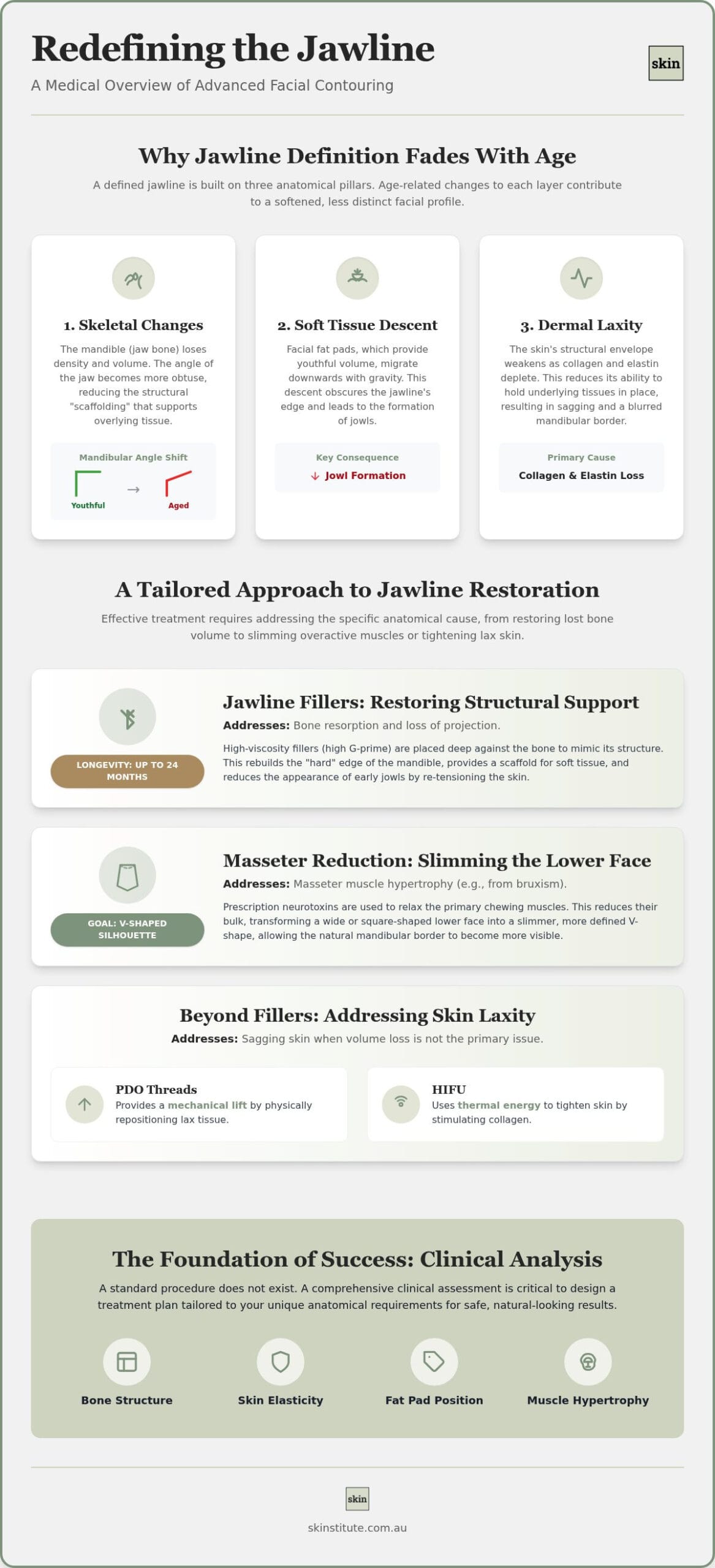
To understand how a crisp mandibular line is maintained, we must look at the three primary pillars of facial architecture. First, the bone provides the rigid foundation and projection required for a distinct, angled silhouette. Second, soft tissue, including deep and superficial fat pads, provides the necessary volume to smooth transitions between the cheek and the chin. Finally, the dermis acts as the structural envelope, relying on a dense network of collagen and elastin to hold these components in place against the persistent force of gravity. When any of these pillars weaken, the jawline loses its sharp edge.
Skeletal Changes and the Mandibular Angle
One of the most significant yet overlooked factors in facial ageing is bone resorption. Over time, the mandible loses volume and density, causing the jawbone to recede and the chin to lose its forward projection. Mandibular resorption reduces the vertical height of the lower face and compromises the structural ledge upon which the skin and fat sit. As this foundation shrinks, the mandibular angle, which is the corner of the jaw, increases. This change leads to a flatter, less distinct transition between the face and the neck. This is why topical skincare cannot restore a lost profile; no cream can compensate for the recession of the underlying bone.
While the bone recedes, the soft tissue simultaneously descends. The malar fat pads in the mid-face lose their attachment strength, migrating downwards to rest along the jawline. This accumulation of displaced volume creates what we clinically refer to as jowls. When combined with skin laxity caused by the natural depletion of elastin, the once-sharp edge of the mandible becomes obscured by sagging tissue. For many patients considering jawline filler Melbourne, the goal is to use prescription injectables to mimic the lost bone structure and provide a new “ledge” for this descended tissue to rest upon.
The masseter muscle also plays a critical role in the lower face’s silhouette. In many cases, the issue isn’t just a lack of definition but an overactive masseter muscle, often due to chronic teeth grinding or bruxism. This hypertrophy creates a square, bulky appearance that can widen the lower face and detract from a slim, V-shaped profile. Addressing these multi-layered changes requires a sophisticated clinical approach that treats the face as a dynamic, three-dimensional system rather than a flat surface.
Jawline Fillers: Restoring Structural Support and Projection
The restoration of a defined profile relies on the strategic placement of high-G-prime prescription injectables. These specific formulations are designed with a high level of viscosity and elasticity, allowing them to resist deformation and mimic the structural density of bone. When administering jawline filler Melbourne, the objective is to create a rigid “ledge” that provides both projection and a clear demarcation between the face and the neck. This mechanical support is particularly effective for addressing the skeletal recession discussed in the previous section, as it replaces lost volume at the foundation level.
Clinical data regarding FDA-approved dermal fillers highlight the importance of choosing the correct rheology for the anatomical site. For the jawline, a “harder” gel is required to maintain the sharp L-shape at the mandibular angle. This definition is often achieved by bolus injections at the periosteum level, ensuring the product remains stable and provides the necessary lift to overlying soft tissues. High-G-prime fillers used in 2026 offer enhanced longevity, often maintaining their structural integrity for 12 to 24 months depending on the patient’s metabolic rate and the specific product selected during the clinical consultation.
Customising the Mandibular Line
A bespoke clinical analysis is essential because jawline aesthetics vary significantly between individuals. For a more masculine profile, the focus often lies on widening the posterior jaw and creating a more acute, prominent gonial angle. Conversely, feminine aesthetics typically favour a softer, tapered V-line that flows seamlessly from the ear to the chin. A critical area of focus for many patients is the pre-jowl sulcus, which is the depression that forms on either side of the chin. By precisely filling this notch, a practitioner can mask the appearance of early jowling without adding unnecessary bulk to the lower face. This nuanced approach ensures that the result remains natural and avoids the “heavy” appearance often seen with poor placement.
The Procedure: What to Expect in the Clinic
The process begins with a detailed assessment of facial proportions and symmetry. The application of jawline filler Melbourne requires a deep understanding of the chin-jawline connection. If the chin lacks projection, the jawline will appear shorter and less defined, regardless of the work done at the posterior angle. During the treatment, practitioners may use a combination of sharp needles for deep, precise placement on the bone and blunt-tipped cannulas for broader contouring. Cannulas are often preferred for their ability to navigate the subcutaneous layers with reduced trauma to blood vessels, which enhances patient safety and minimises downtime. While structural results are visible immediately, the product requires a two-week settling period to integrate fully with the surrounding tissue. For those seeking professional guidance, a clinical analysis in Melbourne is the first step in determining the most appropriate technical approach for your unique anatomy.
Masseter Muscle Reduction: Slimming the Lower Face with Neurotoxins
While the structural recession of the mandible is a primary driver of a softening profile, the masseter muscle often dictates the overall width and shape of the lower face. The masseter is the primary muscle of mastication, or chewing, and is one of the strongest muscles in the human body. When this muscle becomes overactive or enlarged, a condition known as hypertrophy, it creates a square, bulky appearance at the jaw angle. For many patients investigating jawline filler Melbourne, the clinical goal is not always to add volume, but rather to modulate muscle activity to achieve a more contoured, V-shaped silhouette.
The use of neurotoxins for masseter reduction works by blocking the neurotransmitters that signal the muscle to contract. When the muscle is placed in a state of deep relaxation, its physical bulk gradually diminishes through a process of physiological atrophy. This reduction in volume narrows the lower third of the face, creating a more tapered and refined appearance. According to the Cleveland Clinic’s guide to jawline fillers and related injectables, these treatments are highly effective for patients whose wide jawline is muscular rather than skeletal in nature.
Beyond the aesthetic slimming of the face, masseter reduction offers significant functional benefits. Chronic teeth grinding, known as bruxism, and jaw clenching often lead to tension headaches and wear on the dental enamel. Relaxing the masseter muscle alleviates this mechanical pressure, providing relief from jaw tension while simultaneously refining the facial profile. This dual-purpose outcome is a hallmark of medical aesthetic treatments that prioritise both biological function and visual harmony.
For individuals whose aesthetic goals include broader weight management alongside facial slimming, you can learn more about Medi Slim to discover how physician-supervised medical weight loss can complement a rejuvenation plan.
Is Masseter Slimming Right for You?
A professional clinical analysis is required to differentiate between a wide jaw caused by bone structure and one caused by muscle hypertrophy. During a consultation, practitioners often perform a “clench test,” where the patient bites down firmly to allow the practitioner to palpate the thickness and strength of the masseter muscle. If the muscle is found to be the primary cause of width, neurotoxins are the preferred solution. In some cases, a combination of masseter slimming and jawline filler Melbourne is utilised to simultaneously narrow the mid-jaw and project the mandibular angle for a truly three-dimensional contour.
Maintenance and Long-Term Effects
The results of masseter reduction are not immediate; the muscle typically requires four to six weeks to show visible slimming as the atrophy takes effect. Typical treatment intervals in Melbourne clinics range from four to six months, though consistent treatment often leads to long-term muscle changes. Over time, the muscle may remain smaller for longer periods, allowing for extended intervals between sessions. It is essential that these injections are placed with anatomical precision to avoid impacting the risorius muscle, which is responsible for the dynamics of the smile. A seasoned practitioner ensures that the slimming effect is achieved without compromising facial expressions or symmetry.
Beyond Fillers: Addressing Skin Laxity with PDO Threads and HIFU
While the strategic application of jawline filler Melbourne is highly effective for restoring lost volume, adding more product is not always the clinically appropriate solution for sagging skin. If a patient presents with significant tissue laxity, or jowling, attempting to “fill” the problem can lead to an unnatural, heavy appearance in the lower third of the face. In these instances, the clinical objective shifts from volume replacement to mechanical lifting and structural tightening. By addressing the skin’s structural integrity, we can reveal the crisp mandibular edge that has been obscured by descending soft tissue.
The integration of multi-modal therapies ensures that the results are both structural and regenerative. Modern medical aesthetics relies on a combination of mechanical lifting, deep tissue tightening, and bio-stimulation to achieve a long-term rejuvenation of the jawline. Advanced technologies such as HIFU and PDO threads work synergistically with prescription injectables to provide a three-dimensional result that volume alone cannot replicate.
PDO Threads for Jawline Definition
PDO Thread Lifting utilises polydioxanone, a biocompatible and absorbable material that has been used in medical suturing for decades. During the procedure, threads are strategically placed in the subcutaneous layer to provide an immediate mechanical lift. This process relies on vectoring, where the threads are used to pull displaced tissue away from the jawline and back toward the ears and hairline. Beyond the physical lift, the presence of the polydioxanone material triggers a biological response known as neocollagenesis. This induction of new collagen creates a secondary, long-term support structure that remains even after the threads have naturally dissolved. Unlike a “liquid lift” achieved through fillers, threads provide a mechanical repositioning of the tissue that is essential for patients with moderate skin laxity.
HIFU: The Non-Invasive Foundation
High Intensity Focused Ultrasound (HIFU) serves as a critical foundation for lower face rejuvenation by targeting the Superficial Muscular Aponeurotic System (SMAS). This is the same deep tissue layer that is traditionally addressed during a surgical facelift. By delivering precise thermal energy to this depth, HIFU induces immediate contraction of the SMAS and stimulates long-term collagen production. This modality is often used as a “primer” for other treatments, as it tightens the structural envelope before volume is added. For a deeper understanding of these technologies, you can explore Skinstitute’s medical-grade aesthetic treatments.
To further enhance the quality of the dermis, bio-stimulators such as Rejuran and Exosomes are utilised to improve skin elasticity and hydration at a cellular level. These treatments use polynucleotides or signalling molecules to regenerate damaged tissue, ensuring that the skin sitting over the jawline is firm and resilient. If you are ready to address the complexities of your profile, you can book a clinical analysis at Skinstitute to determine the most effective combination of lifting and contouring for your needs.
Clinical Assessment and Safety: The Skinstitute Protocol in Melbourne
The successful restoration of a mandibular profile is as much a matter of medical safety as it is of aesthetic precision. At Skinstitute, our 26-year legacy in medical-grade aesthetics is built upon an exhaustive understanding of facial anatomy, which serves as the ultimate safety feature for every patient. When administering jawline filler Melbourne, a practitioner must navigate a complex network of facial arteries, nerves, and lymphatic vessels. Precision in depth and placement is not merely about the visual result; it is about ensuring the physiological integrity of the surrounding tissues remains uncompromised.
Navigating the regulatory environment in Australia is a critical component of patient safety. As of 2026, the Therapeutic Goods Administration (TGA) has maintained a rigorous focus on the compliance and enforcement of prescription-only medicines used in cosmetic procedures. Because these injectables are classified as prescription items, they require a face-to-face clinical consultation with a qualified medical practitioner before any treatment can proceed. This process ensures that the chosen intervention is medically appropriate for your specific health profile and anatomical requirements, moving beyond the “one-size-fits-all” approach often found in less regulated environments.
Managing clinical risks is an integral part of our professional protocol. While mild swelling and bruising are common physiological responses to the injection process, more significant complications, such as vascular occlusion, require immediate and expert medical intervention. Our clinical environment is equipped with the necessary reversal agents and emergency protocols to manage rare adverse events effectively. By prioritising transparency and objective information, we ensure that every patient understands both the biological benefits and the potential risks associated with structural rejuvenation.
Why a Medical-Grade Environment Matters
The distinction between a retail beauty setting and a medical-grade institute lies in the standard of sterile protocols and the depth of the clinical review process. A medical-grade environment allows for the seamless integration of multi-modal therapies to achieve total skin health. For example, we may recommend a Fractional CO2 Laser treatment to address surface texture and pigmentation alongside structural injectables. This holistic approach ensures that the skin quality matches the improved underlying structure, providing a more cohesive and natural outcome.
Similarly, clinics like RJ Clinic focus on comprehensive skin health by offering chemical peels that work in tandem with other rejuvenation methods to achieve a radiant, even-toned complexion.
Your Journey at Skinstitute Melbourne
Every journey begins with a professional clinical skin analysis, where we move from a patient’s desired “look” to a comprehensive understanding of what their unique anatomy requires. This analysis allows us to develop a long-term “rejuvenation and regeneration” plan that may involve a combination of jawline filler Melbourne, PDO threads, or bio-stimulators. We value professional integrity over quick conversions, taking the time to explain the “why” and “how” behind every step of your treatment plan. To begin your journey toward a more defined and balanced profile, you can organise your clinical consultation at Skinstitute today.
Defining Your Path to Structural Rejuvenation
Restoring a crisp, defined profile requires a sophisticated understanding of how bone resorption, muscle activity, and skin laxity interact over time. As we’ve explored, the most effective outcomes are rarely achieved through a single modality. Instead, they rely on a bespoke combination of structural support, such as jawline filler Melbourne, and advanced lifting techniques like PDO threads or HIFU. This integrated approach ensures that results are not only visually harmonious but also biologically sound.
With 26+ years of clinical expertise, Skinstitute remains dedicated to providing medical-grade aesthetic technologies in a professional, stable environment. Our focus on rejuvenation and regeneration allows us to address complex anatomical concerns with quiet confidence and technical mastery. By prioritising a thorough clinical analysis, we ensure that every treatment plan is tailored specifically to your unique facial architecture and long-term aesthetic goals.
If you’re ready to explore how advanced non-surgical contouring can restore your mandibular definition, we invite you to take the next step in your journey. Book Your Clinical Jawline Assessment at Skinstitute Melbourne to consult with our experienced practitioners. We look forward to partnering with you to achieve a refreshed and naturally balanced profile.
Frequently Asked Questions
How long does jawline filler last on average?
On average, high-density prescription injectables used for the jawline maintain their structural integrity for 12 to 24 months. The actual duration depends on your individual metabolic rate and the specific rheology of the product selected during the clinical consultation. Because the jawline requires a firmer gel to mimic bone, these products generally resist degradation longer than those used in more mobile areas like the lips.
Is the procedure painful, and is there downtime involved?
Most patients experience only mild discomfort during the procedure, as modern prescription injectables contain integrated local anaesthetic to numb the treatment area. While there’s no significant downtime required, you may observe minor swelling or bruising for three to five days following the session. It’s recommended to avoid strenuous exercise or extreme heat for the first 24 hours to allow the product to settle correctly within the tissue.
Will jawline filler make my face look wider or ‘chunky’?
Correct placement of jawline filler melbourne is designed to sharpen the mandibular angle and provide definition rather than adding indiscriminate bulk. If the product is placed deep on the periosteum, it creates a crisp ledge that separates the face from the neck, often resulting in a slimmer, more contoured appearance. A “chunky” look is typically the result of overfilling or poor anatomical targeting, which our clinical analysis specifically aims to avoid.
Can I combine jawline fillers with masseter slimming injections?
Combining these treatments is a common clinical strategy to achieve a refined V-shaped lower face. While the filler provides structural projection at the mandibular angle and chin, neurotoxins relax the masseter muscle to reduce width caused by hypertrophy or bruxism. This dual-action approach addresses both the skeletal foundation and the muscular envelope for a more comprehensive contouring result.
What is the difference between jawline filler and a thread lift for jowls?
The primary difference lies in the mechanism of action: fillers replace lost volume and mimic bone structure, while PDO threads provide a mechanical lift for sagging soft tissue. If your concern is a lack of definition due to bone resorption, fillers are the appropriate choice. However, if the jawline is obscured by descending jowls, a thread lift is required to reposition the tissue before any structural volume is added.
Are there any side effects I should be aware of before treatment?
Common side effects include localised swelling, redness, and bruising at the injection sites, which typically resolve within a week. More significant but rare complications can include infection or vascular occlusion, where the product inadvertently enters a blood vessel. Our medical-grade protocols and 26 years of clinical experience ensure that we’re equipped to identify and manage these risks through precise anatomical knowledge and immediate corrective measures.
How many ml of filler are typically needed for a defined jawline?
The volume required varies significantly based on your existing bone structure and the level of definition you wish to achieve. Most clinical cases require between two and four millilitres of product to create a visible change across the entire length of the mandible and chin. During your initial clinical analysis, we determine the precise volume necessary to restore symmetry without overfilling the face.
Is jawline filler a permanent solution for a weak chin?
No, jawline filler melbourne isn’t a permanent solution, as the biocompatible gel is gradually absorbed by the body’s natural metabolic processes. However, it offers a long-term alternative to invasive surgery, providing structural projection that can be maintained with periodic top-up treatments every 18 to 24 months. This allows for adjustments to be made as your facial anatomy continues to change naturally with age.