How Long Do PDO Threads Last? Longevity & Results Guide
August 8, 2026
Risks of Thread Lifting Procedures: A Clinical Perspective on Safety and Complications
August 10, 2026
Clinical recovery after a PDO thread lift isn’t a passive waiting period; it’s a critical biological phase where the body’s controlled inflammatory response transforms into a durable scaffold of structural collagen. While the physical lifting of the polydioxanone sutures is immediate, the long-term success of the procedure depends entirely on how effectively the surrounding tissue integrates with the threads during the first few weeks. It’s common to feel a sense of trepidation when observing initial post-procedural swelling or minor skin irregularities, especially when conflicting advice found online creates uncertainty regarding the pdo thread lift recovery time.
We understand that the transition from the treatment room to your daily routine requires more than just patience; it demands a precise adherence to medical-grade aftercare protocols to protect your results. This article provides a comprehensive clinical roadmap of the healing process, detailing the physiological shifts from the initial inflammatory phase to the peak of neocollagenesis seen at three to six months. You’ll gain a thorough understanding of what constitutes a normal biological response, learn how to protect the structural integrity of your threads through restricted facial mechanics, and discover the professional standards we maintain at our Melbourne centre to ensure your safety and optimal aesthetic outcome.
Key Takeaways
- Understand the physiological importance of the first 48 hours, where controlled inflammation initiates the critical anchoring process within the subcutaneous tissue layer.
- Gain a clear understanding of the pdo thread lift recovery time through a structured 30-day roadmap, detailing the transition from initial tissue settling to complete internal integration.
- Learn which clinical skincare actives and environmental factors, such as high-temperature environments, must be avoided to prevent premature thread degradation or skin irritation.
- Identify the clinical distinction between expected post-procedural phenomena like “puckering” and rare complications that require professional intervention at an accredited Melbourne centre.
- Explore how medical-grade regenerative therapies, including Rejuran and Exosomes, can be utilised to accelerate cellular repair and optimise the collagen synthesis phase.
The Critical 48 Hours: Managing the Immediate Inflammatory Response
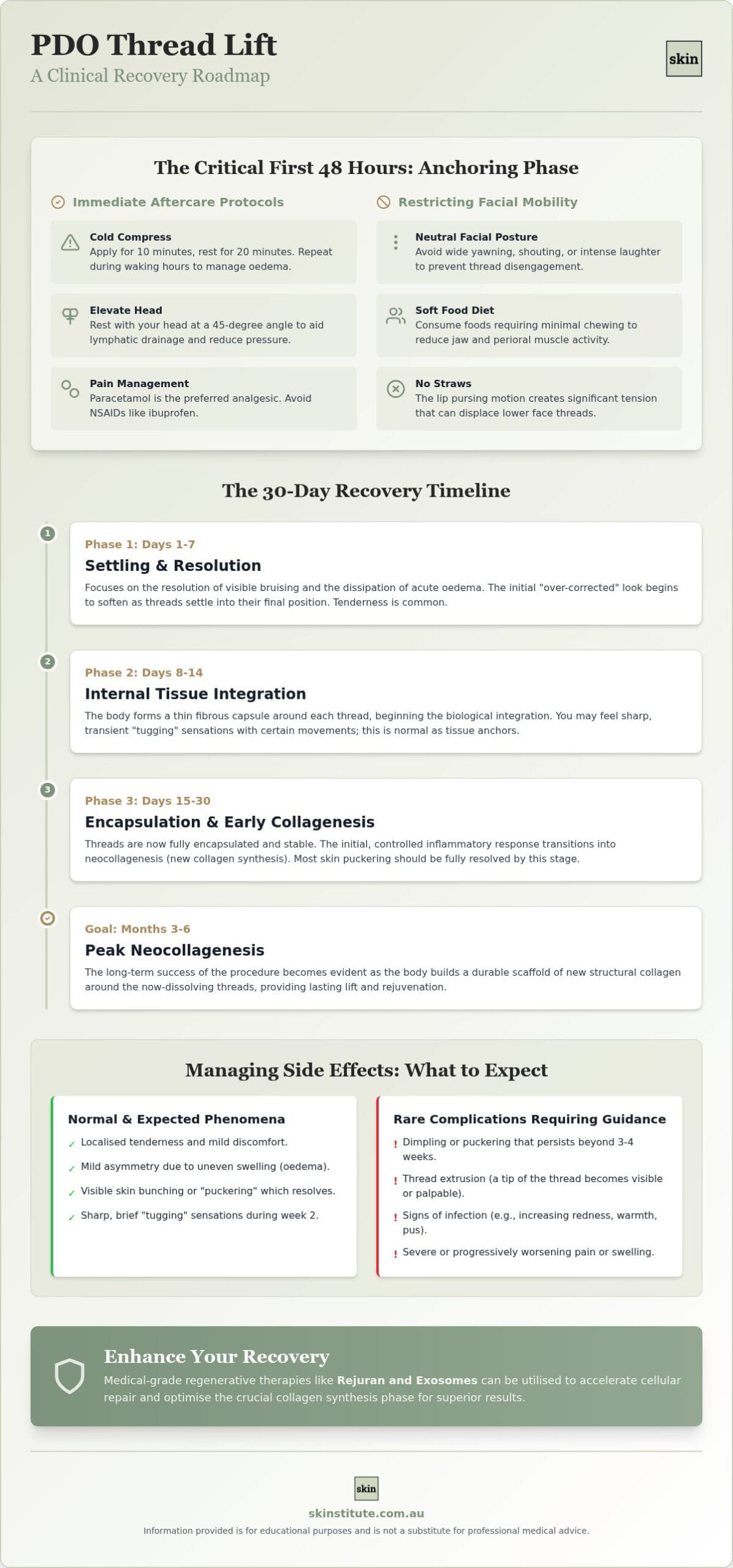
The initial 48 hours following a PDO thread lift represent the most volatile phase of the pdo thread lift recovery time. During this window, the body initiates a controlled inflammatory cascade, which is the biological prerequisite for neocollagenesis. While modern polydioxanone sutures are more advanced than historical predecessors like Contour threads, the mechanical principle remains similar; the threads must remain undisturbed within the subcutaneous layer to ensure the barbs or cogs successfully anchor into the surrounding tissue. This anchoring process is fragile in its early stages and relies on the stability of the dermal environment to prevent thread migration or loss of tension.
Patients should expect several clinical signs that, while potentially alarming, are entirely normal within this timeframe. Localised tenderness, mild asymmetry due to uneven oedema, and visible skin bunching or “puckering” are standard physiological responses. These occurrences reflect the mechanical lift of the tissue and the body’s immediate reaction to the foreign material. At our Melbourne centre, we emphasise that these symptoms usually peak within the first two days before beginning a gradual resolution.
Immediate Aftercare Protocols: The First Two Days
Managing the initial inflammatory response requires a disciplined approach to aftercare. To control post-procedural oedema, we recommend applying a cold compress for 10 minutes, followed by a 20-minute rest period. This cycle should be repeated frequently during waking hours to constrict blood vessels and limit fluid accumulation. When resting, maintaining a 45-degree elevation of the head is medically superior to lying flat, as it utilizes gravity to facilitate lymphatic drainage and reduce facial pressure.
Pharmacological management is equally specific. Paracetamol is the preferred analgesic for managing discomfort. Non-steroidal anti-inflammatory drugs (NSAIDs) like ibuprofen must be avoided to preserve the necessary inflammatory trigger required for the body to begin synthesising new collagen. Inhibiting this natural response can inadvertently diminish the long-term structural benefits of the treatment.
Restricting Facial Mobility
The structural integrity of the lift is highly dependent on restricted facial movement during these first 48 hours. Exaggerated expressions, such as wide yawning, shouting, or intense laughter, can exert undue tension on the threads, potentially causing them to disengage from the subcutaneous tissue. We advise patients to adopt a “frozen” or neutral facial posture as much as possible to allow the threads to settle.
Dietary choices also play a role in thread stability. Patients should consume soft foods that require minimal mastication to reduce jaw strain and perioral muscle activity. Using straws is strictly prohibited during this period; the repetitive pursing of the lips creates significant perioral muscle tension that can displace threads placed in the lower face or jawline area.
The 30-Day PDO Thread Lift Recovery Timeline
The 30-day window following a procedure is a period of significant internal transition; it’s a phase where mechanical lifting shifts toward biological integration. While the structural change is established instantly, the pdo thread lift recovery time involves three distinct physiological stages. A structured approach to the pdo thread lift recovery time helps ensure that the threads remain undisturbed during the critical encapsulation phase. Understanding these stages allows patients to manage expectations and distinguish between normal healing and potential complications of thread lifts such as persistent dimpling or thread extrusion.
- Phase 1 (Days 1-7): Focuses on the resolution of visible bruising and the dissipation of acute oedema. The initial “over-correction” begins to soften as the threads settle into their final position.
- Phase 2 (Days 8-14): Defined by internal tissue integration where the body forms a thin fibrous capsule around each thread. Sharp “tugging” sensations during facial movement usually cease.
- Phase 3 (Weeks 3-4): Marks the transition to active collagen synthesis as fibroblasts produce Type I and Type III collagen around the polydioxanone material.
Week 1: Returning to Social Activities
Social downtime is often shorter than clinical recovery. Most patients don’t require more than 3 to 5 days away from public life once the initial swelling subsides. Makeup can be safely applied over entry points after 48 to 72 hours, provided the sites have closed completely. This “settling” phase is when the facial contours begin to appear more natural, moving away from the heightened lift seen immediately post-procedure. It is common to see minor irregularities during this first week as the tissue adjusts to the new structural support.
Weeks 2-4: Resuming Your Lifestyle
Lifestyle reintegration should be gradual to protect the delicate anchoring of the threads. Light walking is encouraged from the second week, but high-intensity interval training (HIIT) or heavy weightlifting should be avoided until week four to prevent sudden spikes in blood pressure that could affect tissue integration. Dental appointments and deep-tissue facial massages should be postponed for a full four weeks to avoid excessive jaw stretching or mechanical disruption of the threads.
During this time, the polydioxanone material begins its slow process of hydrolytic resorption, leaving behind a permanent “collagen scaffold” that maintains the lift long after the thread has dissolved. You’ll need to remember that peak results from neocollagenesis won’t be fully realised until the 3-month mark, rather than at the one-month conclusion. If you have concerns about your specific healing progress, a professional assessment at our Melbourne centre can provide peace of mind.
Professional Aftercare: Clinical Do’s and Don’ts
Adherence to professional aftercare protocols is the primary determinant of a successful long-term outcome. While the biological process of neocollagenesis is automatic, external variables can significantly impede or accelerate the pdo thread lift recovery time. We categorise these protocols into environmental, chemical, and mechanical restrictions designed to protect the integrity of the polydioxanone sutures while they integrate with your dermal tissue. Neglecting these clinical guidelines doesn’t just increase discomfort; it risks premature thread degradation and suboptimal structural support.
One of the most critical mechanical restrictions is the “No-Pressure” rule. For at least three weeks, patients must avoid side-sleeping or any face-down positions, such as those required for remedial massages. The pressure exerted on the face during sleep can cause the barbs to disengage from the subcutaneous tissue, leading to visible asymmetry or loss of tension. Additionally, strict sun protection is mandatory. The entry points are small puncture wounds that remain susceptible to post-inflammatory hyperpigmentation (PIH) if exposed to UV radiation. Applying a medical-grade SPF 50+ daily is essential to ensure these sites heal without permanent discolouration.
Heat and Blood Flow Management
Temperature regulation is a vital component of the recovery phase. Exposure to high-heat environments, such as saunas, steam rooms, and hot yoga studios, must be avoided for at least 14 days. Heat induces significant vasodilation, which increases blood flow to the treated areas. This can exacerbate post-procedural oedema and, more critically, may accelerate the hydrolytic degradation of the threads before the body has established a sufficient collagen scaffold.
We recommend maintaining lukewarm water temperatures during showers and being particularly cautious when washing hair. Avoid vigorous scrubbing or leaning the head forward for extended periods. Similarly, high-intensity cardio should be delayed for two to four weeks. Sudden spikes in blood pressure can increase internal pressure on the threads, potentially leading to displacement or increased bruising during the early pdo thread lift recovery time.
Skincare and Cosmetic Products
The chemical environment of the skin must remain stable to facilitate healing. During the first 24 hours, entry points must be kept entirely sterile and dry; no products, including water, should touch these sites. Once this initial window has passed, you should use a non-comedogenic, gentle cleanser that doesn’t contain active exfoliants. Actives such as Retinol, Vitamin C, and AHA/BHAs must be paused for at least seven days to prevent unnecessary irritation or dermatitis, which could trigger a secondary inflammatory response.
Resuming advanced laser skin aesthetics or chemical peels requires a clinical assessment. Usually, these treatments should be postponed for four to six weeks to ensure the threads are fully encapsulated. At our Melbourne centre, we coordinate these combination therapies to ensure they complement rather than disrupt the thread integration process.
Managing Side Effects: When to Seek Professional Guidance
While the pdo thread lift recovery time is generally predictable, patients must be equipped to distinguish between expected physiological responses and clinical complications that require intervention. The introduction of polydioxanone sutures into the subcutaneous layer triggers a local tissue reaction that often manifests as visible or sensory changes. Most of these are transient and resolve as the inflammatory phase transitions into neocollagenesis. Maintaining a clear line of communication with your practitioner ensures that any deviation from the standard healing trajectory is addressed promptly.
One sensory experience frequently reported is an intermittent “zapping” or sharp, needle-like sensation. This occurs as the surrounding tissue settles around the barbed threads or when specific facial muscles interact with the anchoring points. These sensations are a normal part of the internal integration process and typically dissipate by the third week. Similarly, a feeling of significant tightness or restricted movement is expected, as this confirms the mechanical tension required for the initial lift.
Common vs. Rare Side Effects
Distinguishing between normal healing and rare complications is essential for patient peace of mind. Normal responses include localised haematoma (bruising), oedema (swelling), and minor skin irregularities. In contrast, rare complications such as thread protrusion, where the end of a suture becomes visible at the entry point, or persistent dimpling that doesn’t resolve with time, require professional attention. Clinical signs of a secondary infection include increasing heat, spreading erythema, purulent discharge, or a systemic fever, all of which necessitate an immediate clinical review.
The “puckering” phenomenon, where the skin appears bunched or uneven, is often a result of the high-tension anchoring necessary for a significant lift. While most puckering resolves as the tissue relaxes over the first 14 days, some instances may require a minor manual adjustment to ensure a smooth contour. If dimpling remains fixed or becomes more pronounced after the first week, it’s vital to seek a professional assessment rather than attempting to massage the area yourself, as this could dislodge the thread.
The Role of the Follow-Up Appointment
At our Melbourne centre, the two-week follow-up appointment is a non-negotiable component of the Skinstitute Standard of care. This consultation allows your practitioner to assess thread symmetry and the progress of tissue integration. During this visit, we can perform “manual smoothing” techniques to resolve any persistent skin bunching, ensuring the final aesthetic result is seamless. Documenting this stage of your recovery is also vital for long-term aesthetic planning, as it provides a baseline for the peak results expected at the three-month mark. If you’re experiencing any concerns during your recovery, you should contact our Melbourne clinic for a clinical review.
Enhancing Your Recovery with Bio-Stimulators and Clinical Skincare
Synergistic Treatments for Superior Results
Combining specific medical-grade aesthetic treatments with PDO threads can create a more robust structural result. Medical-grade LED light therapy is highly effective in the first week post-procedure; it uses specific wavelengths to increase cellular ATP, which helps dissipate bruising and reduce oedema. Once the threads have integrated, usually at the four-week mark, High Intensity Focused Ultrasound (HIFU) can be employed to provide additional thermal tightening in the deeper SMAS layers, complementing the mechanical lift of the threads.
Skin needling is another valuable tool in our clinical arsenal. By creating controlled micro-channels in the epidermis after the initial pdo thread lift recovery time has passed, we can further stimulate the fibroblasts that are already congregating around the polydioxanone sutures. This secondary stimulation ensures the collagen scaffold is as dense and durable as possible. These treatments are timed precisely to ensure they don’t disrupt the anchoring of the threads.
The Skinstitute Approach to Longevity
At our Melbourne centre, we advocate for a skin-first philosophy. This means we don’t just focus on the lift; we prioritise the health of the tissue that supports it. Polynucleotide treatments like Rejuran are instrumental here. These DNA-derived molecules act as bio-stimulators that repair damaged skin cells and enhance the metabolic activity of fibroblasts, effectively accelerating the healing phase. Similarly, the use of Exosomes provides potent signalling factors that reduce inflammation and shorten the visible downtime.
To sustain these results, we provide customised aftercare kits containing clinical-grade topicals that support the skin’s barrier function without disrupting thread integration. A long-term maintenance plan should always include a professional assessment at the three-month mark to monitor the peak of neocollagenesis. This proactive approach ensures that as the PDO threads naturally dissolve, the underlying structural support remains resilient, providing a lasting, rejuvenated appearance.
Securing Your Long-Term Aesthetic Results
The success of a procedure depends as much on the biological response as it does on the technical skill of the practitioner. By understanding the pdo thread lift recovery time, you’ve gained the knowledge required to navigate the critical transition from immediate inflammation to durable collagen synthesis. Adhering to professional aftercare protocols, such as temperature regulation and mechanical restrictions, ensures that the polydioxanone sutures integrate seamlessly with your dermal tissue for a natural-looking lift.
At our Melbourne centre, we bring over 26 years of medical aesthetic expertise to every treatment, providing clinical-grade aftercare protocols that prioritise your safety and satisfaction. Our expert practitioners are dedicated to guiding you through each stage of the healing process, from the first 48 hours to the peak of neocollagenesis. We invite you to book your clinical PDO thread consultation at our Melbourne centre to discuss a customised rejuvenation plan tailored to your unique anatomy.
While the initial recovery requires a disciplined approach, the long-term structural benefits of a reinforced collagen scaffold offer a rewarding outcome for your skin health. We look forward to partnering with you on this clinical journey toward lasting facial revitalisation.
Frequently Asked Questions
How long does the swelling last after a PDO thread lift?
Acute swelling, or oedema, typically resolves within three to seven days post-procedure. While the most visible inflammation peaks during the first 48 hours, minor internal swelling may persist for up to two weeks as the tissue integrates with the polydioxanone material. Following the prescribed cold compress routine during the initial stage of the pdo thread lift recovery time is essential for managing this response effectively.
When can I sleep on my side after getting threads?
You must avoid sleeping on your side for a minimum of three weeks to ensure optimal results. This restriction prevents unilateral pressure from dislodging the barbed threads before the body has successfully encapsulated them with new collagen. We recommend sleeping on your back with your head elevated at a 45-degree angle for the first fortnight to facilitate lymphatic drainage and maintain symmetry.
Can I exercise after a PDO thread lift?
Light walking is permissible 48 hours after your treatment, but vigorous exercise must be avoided for at least four weeks. High-intensity activities or heavy weightlifting cause significant blood pressure spikes and facial muscle strain, which can lead to thread displacement or increased bruising. Resuming a full fitness routine should be a gradual process monitored during your follow-up assessment at our Melbourne centre.
Is it normal to feel a “tugging” sensation in my face?
Yes, experiencing a “tugging” or intermittent “zapping” sensation is a standard physiological response during the integration phase. These sensations occur as facial muscles interact with the mechanical barbs of the threads during normal expression. This typically subsides within two to three weeks as the initial inflammatory response transitions into active neocollagenesis and the threads settle into the subcutaneous layer.
When can I wear makeup after the procedure?
Makeup can generally be applied 48 to 72 hours after the procedure once the entry points have closed completely. It is vital to wait until these small puncture sites are sealed to prevent bacteria from entering the deeper tissue layers. Using clean applicators and gentle, non-comedogenic products is recommended during the first week of your pdo thread lift recovery time to avoid irritating the healing skin.
What happens if I accidentally yawn or open my mouth too wide?
A single accidental wide yawn is unlikely to compromise the entire procedure, but it may cause a temporary “clicking” sensation as a thread adjusts. However, frequent exaggerated mouth movements during the first 14 days can exert excessive tension on the anchoring points, potentially leading to a loss of lift. If you notice a visible shift in symmetry after such a movement, a clinical review is necessary.
How do I know if my thread has moved or snapped?
Clinical signs of thread displacement include a sudden loss of visible lift, new-onset asymmetry, or the end of a thread protruding through the skin. A snapped thread may be accompanied by an audible “pop” followed by localised swelling or discomfort. If you observe any of these symptoms, you should contact your practitioner immediately for a professional assessment rather than attempting to manipulate the tissue yourself.
Can I have a facial or massage after my thread lift?
Professional facials and deep-tissue massages must be postponed for at least four to six weeks. The mechanical pressure and skin manipulation involved in these treatments can disrupt the delicate anchoring of the threads and interfere with the formation of the collagen scaffold. This restriction also applies to any remedial treatments that require you to lie face-down for extended periods, which could compromise thread positioning.