City Skin Clinic vs Skinstitute for Fillers: A Clinical Comparison of Melbourne Aesthetic Practices
September 10, 2026
Cost of PDO Thread Lift Melbourne: A Clinical Guide to Treatment Investment
September 12, 2026
Relying on topical firming creams to resolve descending facial tissue is often akin to treating a structural architectural shift with a fresh coat of paint. Many patients find that despite a rigorous skincare regime, the gradual loss of mandibular definition and the emergence of jowls feel increasingly difficult to manage. It’s common to feel skeptical of miracle products while simultaneously fearing the over-filled, unnatural appearance sometimes associated with traditional dermal fillers. For those seeking a precise clinical solution, pdo threads for jowls melbourne offer a sophisticated alternative that prioritises structural repositioning over simple volume addition.
At Skinstitute, we draw on over 26 years of experience to provide an authoritative medical approach to jawline contouring. This guide explains the dual-action mechanism of Polydioxanone threads, which provide an immediate mechanical lift while stimulating long-term collagen synthesis within the dermis. You’ll learn how these bio-absorbable sutures interact with your anatomy to restore a refined, natural profile. We also cover the essential 2026 AHPRA regulatory requirements, including mandatory consultations and cooling-off periods, to ensure your journey towards a restored jawline is grounded in transparency, safety, and clinical excellence.
Key Takeaways
- Understand the anatomical causes of jowls, specifically the ptosis of fat pads and the degradation of structural collagen fibres.
- Learn how pdo threads for jowls melbourne provide an immediate mechanical lift using microscopic barbs to reposition descending tissue.
- Compare the technical differences between mechanical thread lifting, thermal HIFU tightening, and volume-based dermal fillers for the lower face.
- Discover how the Polydioxanone polymer facilitates long-term tissue rejuvenation by stimulating the body’s natural healing response as it dissolves.
- Review the clinical safety standards and mandatory Australian regulatory protocols that ensure a transparent and informed patient experience.
Understanding the Jowl: Anatomical Descent and Structural Loss
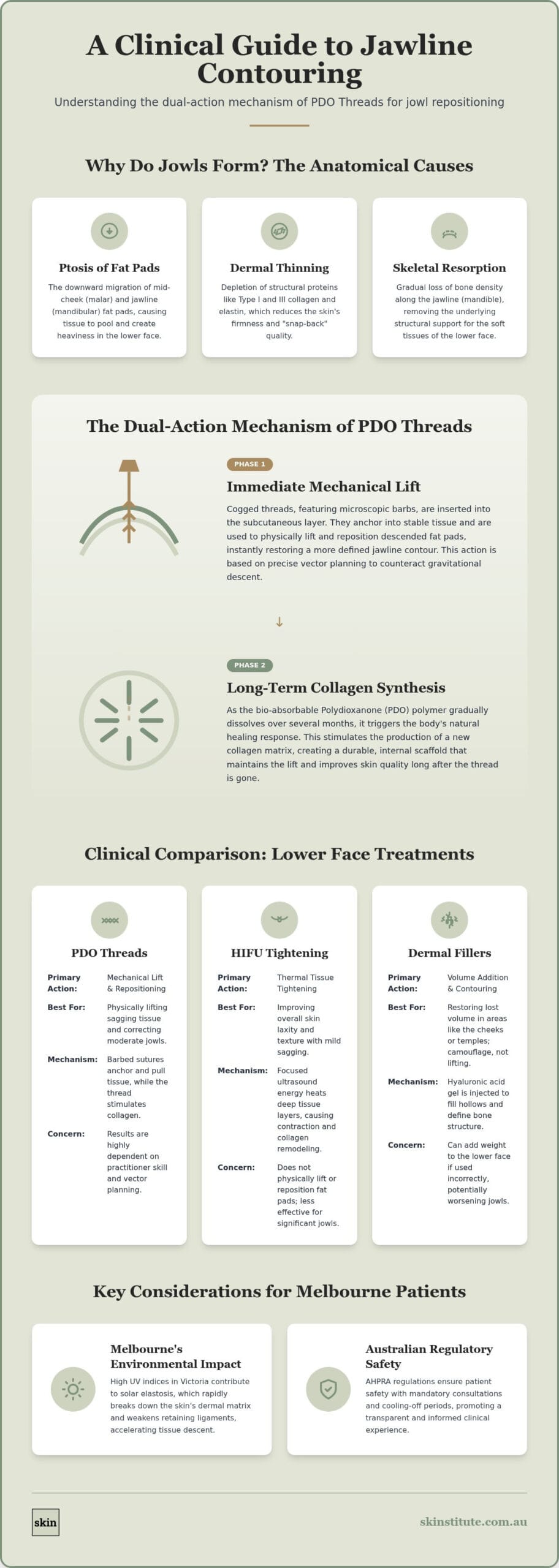
The formation of jowls isn’t merely a surface-level skin concern; it’s a complex multi-layered process involving several key anatomical changes that occur deep within the facial structure. As we age, the internal scaffolding that once held tissues in a superior position begins to fail. This biological degradation is primarily driven by three factors:
- Ptosis of fat pads: The downward migration or sagging of the malar (mid-cheek) and mandibular fat pads.
- Dermal thinning: The depletion of type I and type III collagen fibres, alongside a reduction in elastin, which provides the skin’s “snap back” quality.
- Skeletal resorption: The loss of bone density along the mandibular border, which removes the physical ledge that previously supported the soft tissues of the lower face.
The jowl is the intersection of soft tissue descent and structural bone resorption.
The Role of the Malar Fat Pad
Mid-face volume loss acts as a primary catalyst for lower face laxity. When the malar fat pad in the cheek loses its projection and shifts inferiorly, it creates a cascading effect that culminates in the pooling of tissue at the jawline. Traditional approaches often mistakenly attempt to “fill” this area with dermal fillers, which can inadvertently add weight to an already heavy lower face, potentially worsening the appearance of the jowl. A more sophisticated clinical approach using pdo threads for jowls melbourne focuses on mechanical repositioning. By physically lifting the descended fat pads back toward their original anatomical position, we address the root cause of the jowl without creating an over-filled or distorted facial profile. This method respects the natural anatomy of the face, ensuring that the result is a restoration of previous contours rather than the addition of artificial volume.
Why Melbourne Lifestyle Factors Accelerate Ageing
Residents of Victoria face unique environmental challenges that can accelerate the visible signs of ageing. High UV indices in Melbourne significantly contribute to solar elastosis, a condition where UV radiation breaks down the dermal matrix more rapidly than in cooler climates. This environmental stressor weakens the retaining ligaments, which are the fibrous bands that tether the skin to the underlying bone. When these ligaments lose their tension, tissue descent occurs earlier and more prominently. While early concepts like Contour threads introduced the idea of mechanical lifting, modern medical-grade PDO threads provide the necessary tensile strength and biological stimulation to counteract these harsh local conditions. When considering pdo threads for jowls melbourne, it’s important to recognise that clinical-grade treatments are essential here, as they work to rebuild the structural integrity that the Melbourne environment tends to strip away.
The Clinical Mechanism of PDO Threads for Jowl Repositioning
Polydioxanone (PDO) is a medical-grade, bio-absorbable polymer that has been utilised in cardiovascular and orthopaedic surgery for decades due to its high safety profile and predictable degradation. In the context of aesthetic medicine, PDO threads function through a dual-phase process. The initial phase is purely mechanical, where the thread provides an immediate lift to the sagging tissue. The second phase is biological, involving the gradual replacement of the thread with a natural collagen matrix. When performing pdo threads for jowls melbourne, clinicians distinguish between two primary thread architectures: Mono threads, which are smooth and primarily used to improve skin thickness and texture, and Cog threads, which feature microscopic barbs designed to grasp and reposition the subcutaneous fat pads.
Mechanical Anchoring and Vector Planning
The success of a jawline contouring procedure depends heavily on precise vector planning. Gravitational forces pull the malar and mandibular fat pads downward and inward; therefore, the practitioner must calculate an opposing vector to neutralise this descent. During the procedure, cogged threads are inserted into the subcutaneous layer and anchored into the relatively stable fascia. This anchoring point acts as a fixed pivot, allowing the barbs to engage with the mobile tissue and pull it back toward a more superior, youthful position. Achieving the correct depth is vital. If the thread is placed too superficially, it may cause visible dimpling or “tugging” on the skin surface. Conversely, placing it too deep may result in ineffective lifting or involvement of deeper vascular structures. Patients seeking to understand how these biological mechanisms apply to their specific anatomy can explore the clinical assessment process at our Melbourne facility.
The Science of Neocollagenesis
While the mechanical lift is immediate, the long-term resolution of jowls relies on a process called neocollagenesis. Once the PDO thread is situated within the tissue, it triggers a controlled foreign body response. This physiological reaction stimulates fibroblasts to produce Type I and Type III collagen around the thread. Effectively, the thread acts as a temporary scaffold for new fibrous tissue growth. As the Polydioxanone undergoes hydrolysis, it is typically absorbed by the body within 6 to 9 months. However, the structural support does not vanish with the thread. The newly formed collagen matrix remains in place, providing a biological “internal splint” that maintains the lifted position of the jawline for 12 to 24 months. This secondary phase ensures that the results of pdo threads for jowls melbourne appear natural and evolve with the patient’s own tissue rather than relying on permanent foreign materials.
PDO Threads vs. HIFU and Fillers: A Clinical Comparison
Selecting the appropriate modality for jawline rejuvenation requires a nuanced understanding of how different technologies interact with facial anatomy. While many patients initially consider dermal fillers or energy-based devices, the clinical objectives of these treatments vary significantly from those of pdo threads for jowls melbourne. The primary distinction lies in the method of correction: thermal tightening, volumetric addition, or mechanical repositioning. While fillers add volume, threads reposition existing volume. For patients in Melbourne experiencing the characteristic “heavy” appearance of descending tissue, choosing the wrong intervention can lead to suboptimal results that fail to address the underlying structural shift.
The HIFU Advantage for Skin Tightening
For patients presenting with early-stage skin laxity or a loss of dermal density, High Intensity Focused Ultrasound (HIFU) offers a non-invasive pathway to tissue contraction. Unlike threads, which physically lift tissue, HIFU delivers targeted thermal energy to the Superficial Muscular Aponeurotic System (SMAS) layer. This heat induces immediate collagen contraction and triggers a healing response that firms the skin over several months. In a clinical setting, we often use HIFU as a foundational treatment to improve skin quality and “prep” the dermis. This ensures that when pdo threads for jowls melbourne are later introduced, the skin has the necessary structural integrity to support the mechanical lift. However, HIFU lacks the ability to physically shift descended fat pads, making it more of a tightening agent than a repositioning tool.
Fillers vs. Threads: Avoiding the “Over-Filled” Look
The use of dermal fillers in the lower face presents a specific clinical challenge. When jowls are prominent, the tissue has already migrated downward. Adding volume to the jawline with fillers in an attempt to “mask” the jowl often results in a wider, heavier lower face, sometimes referred to as the “over-filled” look. This is particularly problematic for patients with thicker skin or significant fat pad ptosis. In these cases, threads are the preferred intervention because they utilise the patient’s existing tissue to restore contour. By integrating threads with prescription injectables in other areas, such as the mid-face, we achieve a holistic result that maintains natural facial proportions. Threads provide the lift, while injectables can be used sparingly to refine specific hollows, ensuring the jawline remains sharp and defined rather than bulky.
The Procedural Journey and Clinical Aftercare in Melbourne
The clinical application of pdo threads for jowls melbourne follows a structured protocol designed to ensure anatomical precision and patient safety. The journey begins with a comprehensive clinical assessment. During this phase, the practitioner evaluates skin laxity, the degree of fat pad ptosis, and the underlying skeletal support. This diagnostic step is essential to determine if the patient has sufficient dermal density to support the mechanical lift. In accordance with 2026 AHPRA regulations, this process includes a mandatory cooling-off period of at least seven days following the final consultation, ensuring patients have adequate time to make an informed decision before proceeding.
Once the treatment day arrives, the procedure commences with the administration of local anaesthesia to the entry and exit points to ensure patient comfort. Using a meticulous aseptic technique, the threads are inserted into the subcutaneous layer. Immediately following the insertion, the practitioner performs a detailed post-procedural assessment of facial symmetry and thread tension. This allows for fine adjustments to the vector pull, ensuring a balanced and natural contour that respects the patient’s existing facial proportions. The first 24 to 48 hours represent a critical recovery window where the threads begin to integrate with the surrounding tissue.
Clinical Aftercare and Activity Restrictions
Adhering to post-procedural restrictions is vital to prevent thread displacement or the loss of tension in the barbs. We advise patients to sleep on their backs in an elevated position for the first week to minimise pressure on the treated area. Vigorous exercise, heavy lifting, and high-impact activities must be avoided for at least seven days to prevent the threads from shifting. Additionally, patients should postpone dental appointments or any activity involving excessive jaw opening for two weeks to allow the anchoring points to stabilise. Managing post-procedural swelling involves following medical-grade protocols, such as using cold compresses and avoiding specific supplements that may increase bruising risk.
Long-term Maintenance and Synergy
Protecting the newly induced collagen scaffold is paramount, especially given the high UV indices in Victoria. Environmental sun exposure can degrade the very collagen the threads are designed to stimulate, potentially shortening the longevity of the results. Daily application of broad-spectrum SPF is a non-negotiable component of long-term maintenance. To further enhance skin elasticity and tissue health, many patients benefit from the integration of Rejuran. This polynucleotide-based treatment works synergistically with pdo threads for jowls melbourne by improving the biological environment for neocollagenesis. Regular follow-up assessments allow us to monitor the integration of the threads and the progression of the new collagen matrix. For those ready to begin their journey toward a restored jawline, we invite you to book a clinical consultation at our Melbourne facility to discuss a tailored treatment plan.
Why Clinical Expertise is Vital for PDO Thread Lifting
The efficacy of pdo threads for jowls melbourne is fundamentally dependent on the technical proficiency of the practitioner. While the procedure is minimally invasive, it requires a sophisticated understanding of three-dimensional facial architecture to avoid clinical complications. Suboptimal placement can lead to visible irregularities such as skin dimpling or “tugging” if the threads are situated too superficially. Conversely, improper depth increases the risk of nerve involvement or vascular compromise. At Skinstitute, our 26 years of aesthetic experience serves as a benchmark for safety, ensuring that every suture is placed with absolute precision within a sterile, medical-grade environment. This level of experience allows us to manage the delicate balance between achieving a visible lift and maintaining the structural integrity of the tissue.
The Importance of Anatomical Knowledge
Expertise in lower facial anatomy is non-negotiable when repositioning descending tissue. The lower face contains a complex network of branches from the facial nerve and various vascular structures that must be avoided during the insertion process. A seasoned practitioner doesn’t apply a generic approach; instead, they customise the thread count and type based on the specific density of the patient’s dermis and the weight of the malar fat pads. Expert placement ensures that the lift remains natural and harmonious with the patient’s expressions. By prioritising conservative placement over aggressive pulling, we avoid the distorted “wind-tunnel” appearance and ensure the results evolve gracefully as the threads undergo biological absorption.
Your Consultation at Skinstitute Melbourne
A clinical consultation at our facility involves a rigorous diagnostic assessment of your skin’s current state. We perform a detailed analysis of skin quality, looking for signs of solar elastosis or significant dermal thinning that might require pre-treatment. This professional assessment is vital for setting realistic expectations and identifying the most appropriate intervention. For some patients, we may recommend a bespoke treatment plan that integrates pdo threads for jowls melbourne with Fractional CO2 Laser to address surface-level texture while the threads provide structural support. This multi-modal approach reflects our commitment to long-term patient care and safety. Our goal is to provide a stable, evidence-based solution that respects the biological limits of the skin while delivering a refined, contour-focused outcome.
Restoring Mandibular Definition Through Clinical Precision
Addressing the descent of facial tissue requires more than surface-level intervention; it necessitates a deep clinical understanding of how anatomy shifts and how it can be precisely repositioned. By moving beyond the limitations of traditional volume-based fillers, pdo threads for jowls melbourne provide a dual-action solution that resolves both immediate structural loss and long-term dermal thinning through neocollagenesis. This sophisticated approach ensures that the jawline is not merely masked with volume, but biologically and mechanically restored to its natural anatomical position.
At Skinstitute, our practitioners rely on over 26 years of clinical experience in Melbourne to deliver these advanced techniques within a dedicated medical-grade facility. We prioritise safety, anatomical accuracy, and transparent patient care to achieve results that respect your unique facial proportions. If you’re ready to explore a professional, non-surgical alternative for jawline contouring, we invite you to Book a Clinical Consultation at Skinstitute Melbourne. Taking this step allows for a thorough diagnostic assessment tailored to your specific physiological needs. We look forward to guiding you toward a more defined and refreshed profile.
Frequently Asked Questions
How long do PDO threads for jowls last?
Results typically remain visible for 12 to 24 months, even though the physical sutures are absorbed much earlier. The Polydioxanone material undergoes hydrolysis and is typically absorbed by the body within 6 to 9 months. However, the initial mechanical lift is sustained by the induction of a new collagen matrix. This biological scaffold provides ongoing structural support to the jawline long after the initial threads have dissolved, maintaining the refined profile.
Is the PDO thread lift procedure painful?
Most patients report minimal discomfort during the procedure because local anaesthesia is applied to the entry and exit points. While you may feel a sensation of pressure or slight tugging as the threads are positioned within the subcutaneous layer, significant pain is uncommon. Post-procedural soreness or a “tight” sensation is normal for several days; however, this is typically managed effectively with standard over-the-counter relief and our specific clinical aftercare protocols.
What is the difference between PDO threads and a surgical facelift?
A PDO thread lift is a minimally invasive clinical procedure that repositions tissue without the incisions or general anaesthesia associated with invasive plastic surgery. Unlike a surgical facelift, which involves the excision of redundant skin, pdo threads for jowls melbourne rely on mechanical barbs and biological neocollagenesis. While surgery offers more permanent results, threads provide a natural-looking restoration of the mandibular border with significantly lower risk and a much shorter recovery period.
Can PDO threads be combined with dermal fillers?
Combining these modalities is often recommended to achieve a comprehensive facial rejuvenation. While threads are utilised to mechanically lift and reposition descended fat pads, dermal fillers can address specific areas of volume loss in the mid-face. This combination ensures that the jawline is sharpened by the threads while the overall facial proportions remain balanced. We often sequence these treatments during a bespoke consultation to ensure optimal tissue integration and long-term patient safety.
How many threads are usually required for a jowl lift?
The number of threads required varies based on an individual’s skin laxity, tissue density, and the degree of fat pad ptosis. Generally, a standard jowl treatment involves the insertion of 4 to 8 cogged threads per side to provide sufficient mechanical support. During your professional assessment at our Melbourne clinic, we determine the precise count and vector planning necessary to restore your specific jawline contour while maintaining a natural and symmetrical appearance.
What is the typical downtime after a thread lift in Melbourne?
Most patients experience a recovery period of three to seven days, during which minor swelling, bruising, or tenderness may occur. While you can typically return to sedentary work within 24 to 48 hours, vigorous exercise and high-impact activities must be avoided for at least one week. This downtime allows the threads to anchor firmly within the fascia. We provide specific clinical guidelines to manage this window and ensure the longevity of the results.
Are there any side effects or risks associated with PDO threads?
Potential side effects include temporary bruising, swelling, and a sensation of tightness in the lower face. Rare but more significant risks include infection, thread migration, or visible dimpling if the placement is too superficial. These risks are significantly mitigated by choosing a practitioner with extensive anatomical knowledge and a medical-grade environment. Our 26 years of experience ensures that every pdo threads for jowls melbourne procedure is conducted with the precision required to maintain safety.