
Is Fractional CO2 Laser Painful? Sensation and Management
September 9, 2026
PDO Threads for Jowls in Melbourne: A Clinical Approach to Jawline Contouring
September 11, 2026
The success of a dermal filler procedure is dictated less by the substance in the syringe and more by the practitioner’s understanding of three-dimensional facial anatomy. When you are researching city skin clinic vs skinstitute for fillers, you aren’t just comparing locations; you’re evaluating two distinct clinical philosophies within Melbourne’s aesthetic landscape. It’s common to feel a sense of trepidation regarding the safety of prescription-only substances or the risk of an over-filled appearance that compromises your natural features. You want a result that looks refreshed rather than obvious, prioritising the biological integrity of your skin over a temporary aesthetic fix.
This article provides an objective, medical-grade analysis of the expertise and technical standards at both practices to help you make an informed decision for your facial rejuvenation journey. We will examine how each clinic approaches patient safety, the necessity of real-time consultations under 2025 AHPRA guidelines, and the integration of advanced bio-stimulators to ensure your results respect your unique physiological structure. By focusing on clinical proficiency rather than marketing trends, you can gain the confidence needed to choose a partner who values long-term skin health and technical mastery.
Key Takeaways
- Understand the regulatory framework governing prescription injectables in Australia to ensure your treatment meets medical-grade safety standards and TGA requirements.
- Evaluate the differences between city skin clinic vs skinstitute for fillers by examining clinical philosophies, practitioner continuity, and the depth of anatomical expertise.
- Learn why over 26 years of clinical experience is vital for transitioning from simple line-filling to comprehensive structural rejuvenation that respects your unique facial anatomy.
- Discover how the integration of medical technologies like Fractional CO2 and PDO threads can enhance the longevity and natural appearance of dermal filler results.
- Identify the essential criteria for selecting a Melbourne injector, including the verification of medical registration and the mandatory requirement for real-time clinical consultations.
Understanding Prescription Injectables: The Clinical Standard in Melbourne
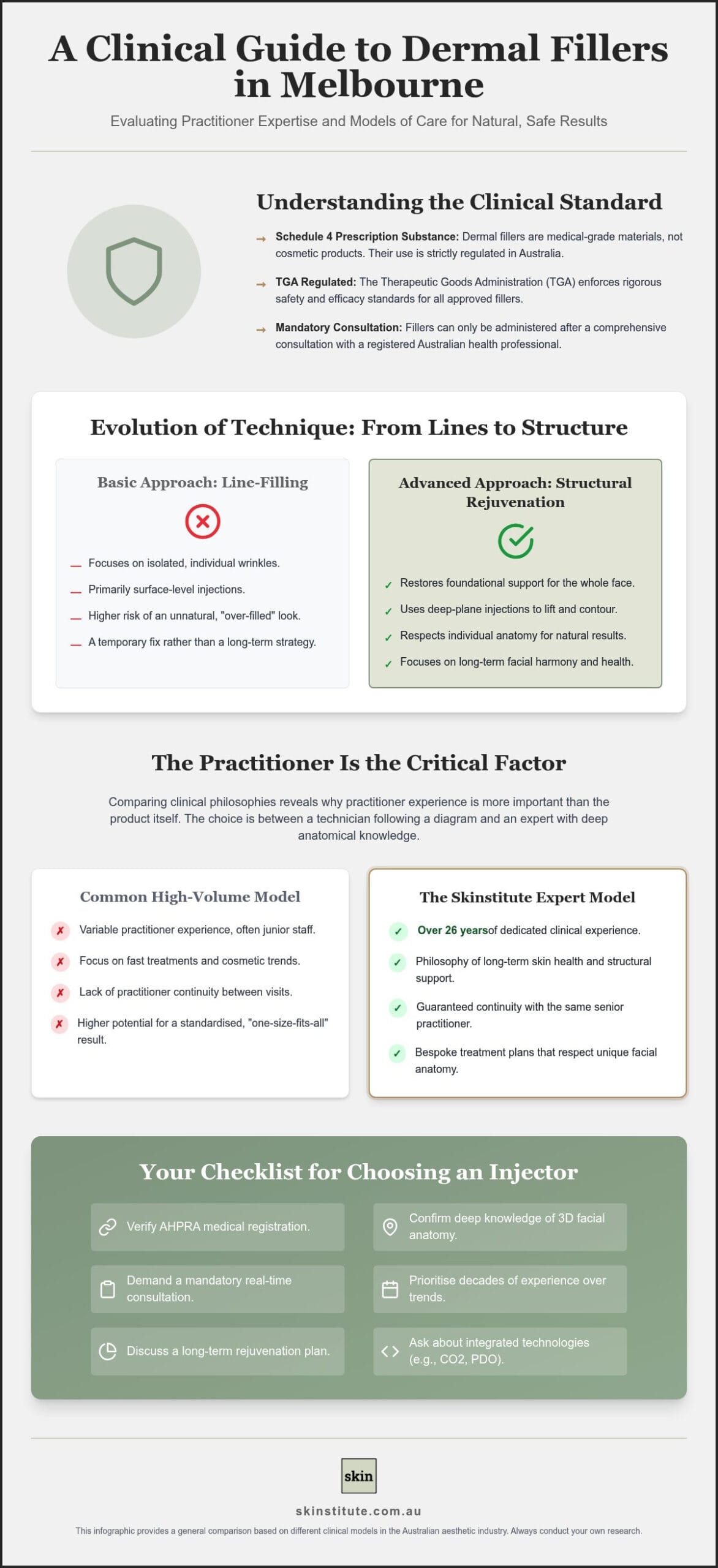
In the Australian aesthetic landscape, an Injectable filler is classified as a Schedule 4 prescription substance. This means it’s a medical-grade material that can only be administered following a consultation with a registered health professional. The Therapeutic Goods Administration (TGA) provides a rigorous framework to ensure these substances meet high safety and efficacy standards. When patients evaluate city skin clinic vs skinstitute for fillers, the focus should remain on how these clinical standards are upheld in a professional environment. A clinic prioritising medical-grade protocols will always favour sterile, controlled settings over the fast-paced atmosphere of retail aesthetics.
Modern aesthetic medicine has moved beyond the simplistic approach of “filling a wrinkle.” Today, practitioners focus on complex 3D facial contouring and providing structural support to an ageing face. This shift requires a deep understanding of how prescription injectables interact with biological tissues over time. Rather than just masking a line, the objective is to restore lost volume in a way that respects the natural movement and proportions of the face. This level of technical proficiency is what distinguishes a medical-grade facility from a high-volume cosmetic outlet.
The Science of Hyaluronic Acid and Tissue Integration
Hyaluronic acid-based fillers are designed to mimic the body’s natural sugar molecules, which are responsible for maintaining skin hydration and volume. Manufacturers use sophisticated cross-linking technology to create gels with varying degrees of viscosity and elasticity. This determines the filler’s longevity and its “lift capacity” within different tissue depths. Because hyaluronic acid is hydrophilic, it naturally attracts water molecules. A skilled practitioner understands this property and accounts for minor post-treatment swelling to ensure the final settled result is precise and symmetrical.
Anatomical Precision in Aesthetic Injections
Achieving a natural look depends on injecting the substance into the correct facial planes. Placing filler in the supraperiosteal plane, directly on the bone, provides the necessary foundation to lift sagging tissues. Conversely, injections into the subcutaneous layers are used to soften transitions and restore the plumpness of facial fat pads. Knowledge of these layers is also critical for vascular safety. Practitioners must navigate “danger zones” where major arteries reside to prevent complications. When comparing city skin clinic vs skinstitute for fillers, the practitioner’s ability to map these anatomical structures is the most significant factor in ensuring both safety and aesthetic success.
The Role of Practitioner Experience in Achieving Natural Results
Practitioner experience is the cornerstone of safety and aesthetic success in Melbourne’s cosmetic industry. A clinician with over 26 years of experience has observed the long-term behaviour of dermal fillers across thousands of varied facial structures. This depth of knowledge is essential for understanding how age-related bone resorption and fat pad migration affect the face’s three-dimensional profile. When evaluating city skin clinic vs skinstitute for fillers, the clinical tenure of the practitioner becomes a primary differentiator. It’s the difference between a technician following a diagram and an expert who understands the nuances of individual anatomy.
Techniques have evolved significantly from the historical focus on treating isolated wrinkles. Modern practitioners employ structural rejuvenation, which involves placing prescription injectables into deeper planes to restore the face’s foundational support. This sophisticated approach prevents the unnatural, over-filled look often associated with less experienced injectors who may focus solely on surface-level concerns. A comprehensive assessment is the first step in the city skin clinic vs skinstitute for fillers comparison, ensuring that the selected treatment aligns with both safety standards and aesthetic goals. Every patient must be guided through a long-term plan that considers how the face will change over several years, rather than just seeking a quick fix. This clinical oversight is reinforced by the AHPRA fact sheet on cosmetic injectables, which outlines the necessity of professional medical consultations.
Managing Clinical Complications and Safety
Technical mastery includes the ability to identify and manage adverse events immediately. An expert injector must be proficient in identifying early signs of vascular compromise, a rare but serious complication where filler inadvertently blocks a blood vessel. Maintaining a clinical environment ensures that emergency reversal agents, such as hyaluronidase, are always on-site and ready for administration. This medical-grade preparedness is a fundamental requirement that distinguishes professional clinics from high-volume retail settings or beauty salons. In a clinical setting, safety protocols are established through years of rigorous medical training, ensuring that patient well-being remains the absolute priority throughout the procedure.
Bespoke Treatment Planning vs. Standardised Packages
Standardised filler packages often fail to account for individual facial symmetry and dynamic movement. A “one-size-fits-all” model can lead to a loss of authentic expression, as it ignores the unique way your muscles interact during speech and emotion. A bespoke plan prioritises “less is more,” focusing on subtle enhancements that respect your natural anatomy. Experienced practitioners understand that the goal isn’t to erase every line, but to provide a rejuvenated appearance that remains true to the patient’s identity. If you value a tailored approach that avoids the “cookie-cutter” aesthetic, consulting with a seasoned Melbourne practitioner can provide the technical insight necessary for a result that is both safe and aesthetically pleasing.
City Skin Clinic vs Skinstitute: Analysing Different Models of Care
Choosing between city skin clinic vs skinstitute for fillers requires a careful evaluation of the underlying business models that govern each practice. Boutique clinics typically operate on a specialist model where the focus remains on technical mastery and longitudinal patient care. In contrast, larger multi-location aesthetic groups often prioritise retail efficiency and high-volume throughput. For patients, the most significant advantage of a boutique specialist environment is practitioner continuity. Seeing the same clinician for every treatment ensures a consistent understanding of your facial anatomy and a more precise monitoring of how your tissues integrate with prescription injectables over several years.
This continuity is often missing in larger chains where practitioner turnover can be higher. When a different injector performs each procedure, the subtle nuances of your previous results may be overlooked, increasing the risk of an over-filled or “standardised” appearance. A results-driven clinical practice focuses on the biological interaction between the product and the patient’s skin, whereas price-driven marketing often leads to a “cookie-cutter” approach that ignores individual anatomical variations. Choosing city skin clinic vs skinstitute for fillers ultimately involves deciding whether you value a retail experience or a dedicated medical partnership.
Philosophy of Care: Technical Mastery vs. Aesthetic Trends
The clinical philosophy at Skinstitute centres on medical-grade regeneration rather than chasing fleeting aesthetic trends. This approach involves integrating advanced bio-stimulators such as Rejuran alongside traditional fillers to improve the actual health of the dermal matrix. While fillers provide immediate volume, polynucleotides like Rejuran work to repair damaged skin cells and stimulate natural collagen production. This dual-action strategy ensures that rejuvenation is grounded in skin health, leading to more sustainable and authentic outcomes that respect the patient’s original features.
The Consultation Process: Education vs. Sales
The consultation serves as the foundation of the clinical relationship. A practitioner with 26 years of experience conducts a thorough skin analysis that goes beyond surface-level aesthetics. This involves assessing bone structure, fat pad distribution, and skin elasticity to determine the most appropriate intervention. A clinically-led assessment is characterised by transparency, particularly regarding the limitations of fillers. Unlike sales-led consultations that may promise unrealistic results to secure a booking, a professional clinician will honestly discuss what prescription injectables cannot achieve and may suggest alternatives like PDO threads or Fractional CO2 when appropriate.
Critical Selection Criteria: Evaluating Your Melbourne Injector
Verifying a practitioner’s medical registration is the first non-negotiable step in any selection process. A registered clinician is bound by professional codes of conduct that prioritise patient safety and ethical prescribing. When you’re comparing city skin clinic vs skinstitute for fillers, ask for specific details regarding the injector’s aesthetic training hours beyond their initial medical degree. Technical proficiency is built through thousands of hours of supervised practice and continuous professional development. You should also scrutinise the clinic’s portfolio for evidence of age-appropriate rejuvenation. This ensures the practitioner’s aesthetic eye aligns with a refreshed outcome rather than an over-augmented look that ignores your natural facial proportions.
The choice between city skin clinic vs skinstitute for fillers should also be informed by the clinic’s emergency protocols and follow-up care. Enquire about their clinical procedure for managing adverse events and whether they provide a direct line for post-treatment concerns. A medical-grade facility will have established protocols for immediate and delayed complications, reflecting a commitment to patient welfare that extends beyond the initial injection. Assessing these factors allows you to choose a partner who values long-term stability over temporary aesthetic changes.
The Importance of Multi-Modality Options
A single-modality approach often limits the quality of the final result. While fillers restore volume, they don’t address the physiological degradation of skin texture. In many instances, Fractional CO2 Laser resurfacing is a superior choice for treating fine lines and dermal thinning. Combining prescription injectables with medical-grade skin needling improves the dermal environment, allowing the filler to integrate more naturally with your tissues. Access to diverse technologies like HIFU or PDO threads within the same facility ensures that your treatment plan is dictated by your biological needs, not just the tools available.
Questions to Ask During Your Initial Appointment
Your initial consultation is an opportunity to gauge the practitioner’s technical depth. Ask which specific filler rheology they’ve chosen for a particular area. A high G-prime filler is necessary for structural support on the bone, while a softer, more cohesive gel is required for dynamic areas like the lips. Enquire about their plan for your facial proportions over the next three to five years to ensure a sustainable result. Finally, confirm their clinical protocol for managing a delayed inflammatory response. An expert injector will have a clear, evidence-based strategy for any post-treatment complications. To ensure your aesthetic journey is guided by this level of technical proficiency, contact our Melbourne clinic to arrange a clinical assessment.
The Skinstitute Approach: 26 Years of Aesthetic Expertise
The Skinstitute philosophy is built upon the principle of rejuvenation through biological regeneration. This methodology prioritises the long-term health of the dermal matrix over temporary, superficial changes. Every procedure we perform is grounded in our Clinical Guide to Medical-Grade Aesthetic Treatments, ensuring that our interventions are evidence-based and anatomically sound. When patients evaluate city skin clinic vs skinstitute for fillers, they’re often looking for a practice that provides a stable and predictable clinical journey. With over 26 years of industry experience in Melbourne, we’ve developed a deep understanding of how prescription injectables interact with human tissue across different decades of life.
Our clinical history allows us to observe the longitudinal effects of aesthetic treatments, which is a perspective that only comes with time. This experience ensures that we don’t just treat the face as it appears today, but as it will age over the next five to ten years. By integrating prescription injectables with advanced skin science, we create a comprehensive rejuvenation plan that respects the natural movement and proportions of your face. This commitment to technical proficiency and professional stability is what defines our role as a practitioner’s clinic in the Melbourne aesthetic landscape.
Beyond Filling: The Future of Bio-Stimulation
Modern aesthetic medicine is moving away from an exclusive reliance on volume restoration. At Skinstitute, we utilise advanced bio-stimulators like Rejuran and Exosomes to heal the skin from within. These substances work at a cellular level to repair damaged DNA and stimulate the production of endogenous collagen and elastin. This biological repair often reduces the total volume of dermal filler required to achieve a refreshed appearance. We also recognise the synergy between PDO Thread Lifting and traditional injectables. While threads provide a mechanical lift and structural scaffolding, fillers can be used strategically to restore lost fat pad volume, resulting in a more authentic non-surgical facial contour.
Your Journey at Skinstitute
Your journey begins with a thorough initial clinical assessment that prioritises education over sales. We conduct an objective analysis of your facial anatomy, skin quality, and bone structure to develop a bespoke care plan. This process is characterised by professional integrity; we’ll always provide honest advice regarding which treatments will yield the best biological results. Our goal is to empower you with technical insight so you can make informed decisions about your aesthetic health. We value precision and safety above all else, ensuring that every step of your treatment is handled with the calm competence of a seasoned medical professional. To begin your rejuvenation process, book a clinical consultation at our Melbourne clinic.
Securing Your Aesthetic Future Through Clinical Precision
The decision between city skin clinic vs skinstitute for fillers should be guided by a commitment to clinical safety and anatomical precision. Successful rejuvenation relies on the practitioner’s ability to navigate complex facial planes while ensuring that prescription injectables integrate seamlessly with your unique biological structure. By choosing a model of care that prioritises longitudinal skin health over retail convenience, you protect the long-term integrity of your appearance.
Skinstitute operates as a specialist medical-grade facility, leveraging over 26 years of industry experience to deliver stable and predictable outcomes. Our deep expertise in advanced bio-stimulators allows us to create bespoke plans that focus on cellular regeneration as much as volume restoration. We encourage you to seek a partnership based on technical mastery and professional transparency to achieve results that are both natural and sustainable.
Schedule a Clinical Assessment at Skinstitute Melbourne to discuss your aesthetic goals with a seasoned practitioner. Taking this step ensures your rejuvenation journey is supported by decades of clinical proficiency and a dedication to medical excellence.
Frequently Asked Questions
What is the difference between dermal fillers and prescription muscle relaxants?
Dermal fillers, classified as prescription injectables, are used to restore volume to areas of fat loss or bone resorption. In contrast, muscle relaxants are neuromodulators that temporarily inhibit the signals between nerves and muscles to soften dynamic expression lines. While fillers provide structural support and contouring, muscle relaxants address the mechanical cause of wrinkles. A comprehensive clinical assessment determines which biological mechanism is most appropriate for your specific anatomical concerns.
How long do fillers typically last when performed by an experienced clinician in Melbourne?
The longevity of prescription injectables varies based on the specific rheology of the gel and the metabolic rate of the patient. High-viscosity fillers used for deep structural support on the cheekbones or jawline can remain effective for 18 to 24 months. Conversely, softer formulations used in highly mobile areas like the perioral region typically last between 6 and 12 months. Your clinician will monitor the integration of the substance during follow-up appointments.
Are fillers safe, and what are the most common clinical risks involved?
When administered in a specialist facility, dermal fillers are generally safe; however, clinical risks do exist. Common side effects include localised swelling, bruising, and minor asymmetry during the initial integration phase. Rare but serious complications, such as vascular compromise, require immediate medical intervention with reversal agents like hyaluronidase. When evaluating city skin clinic vs skinstitute for fillers, it’s vital to confirm that the practitioner has established emergency protocols and significant anatomical expertise to manage these risks.
Can I combine fillers with other treatments like HIFU or skin needling?
Integrating fillers with technologies like High Intensity Focused Ultrasound (HIFU) or skin needling is a standard clinical practice for comprehensive rejuvenation. HIFU addresses the deeper structural layers of the face, while skin needling enhances the health of the dermal matrix. This multi-modality approach ensures that the volume restored by prescription injectables is supported by firm, healthy skin. Your long-term care plan will sequence these treatments to optimise biological integration and aesthetic longevity.
Why is there such a significant price difference between Melbourne cosmetic clinics?
Price differences in the Melbourne market often correlate with the practitioner’s clinical tenure and the level of medical-grade oversight provided. Specialist clinics with 26 years of industry experience invest heavily in continuous training, sterile protocols, and advanced emergency equipment. High-volume retail outlets may offer lower rates by prioritising throughput over personalised clinical care. Choosing a practitioner based on technical proficiency ensures that your results are dictated by medical expertise rather than a price-driven business model.
What should I avoid doing immediately after a filler treatment for optimal results?
To ensure optimal tissue integration, patients must avoid activities that increase peripheral blood flow for at least 24 hours. This includes strenuous exercise, saunas, and alcohol consumption, which can exacerbate post-treatment swelling or bruising. It’s also important to avoid applying significant pressure to the treated area, as this can cause the substance to migrate from its intended anatomical plane. Following these clinical guidelines helps maintain the precision of the final aesthetic result.
How do I know if I am being ‘over-filled’ or if my results will look natural?
A natural appearance is achieved by respecting the face’s original three-dimensional proportions and fat pad distribution. You are at risk of being over-filled if a practitioner focuses on erasing every line rather than restoring lost structural support. An expert injector uses a “less is more” philosophy, ensuring that your dynamic expressions remain authentic. When researching city skin clinic vs skinstitute for fillers, look for a portfolio that demonstrates subtle rejuvenation that enhances your natural features.
Is a consultation mandatory before receiving fillers at Skinstitute?
A real-time clinical consultation is a mandatory requirement under current AHPRA regulations for all prescription injectables in Melbourne. This session allows the practitioner to perform a detailed facial analysis, review your medical history, and discuss the potential biological interactions of the treatment. It’s a critical safety measure that ensures you receive personalised medical advice before any procedure is performed. This professional standard reflects our commitment to patient safety and evidence-based aesthetic results.