
Rejuran Side Effects and Risks: What Melbourne Patients Should Know
October 8, 2026
Fractional CO2 Laser Melbourne: Is Resurfacing Right for Your Skin?
October 10, 2026
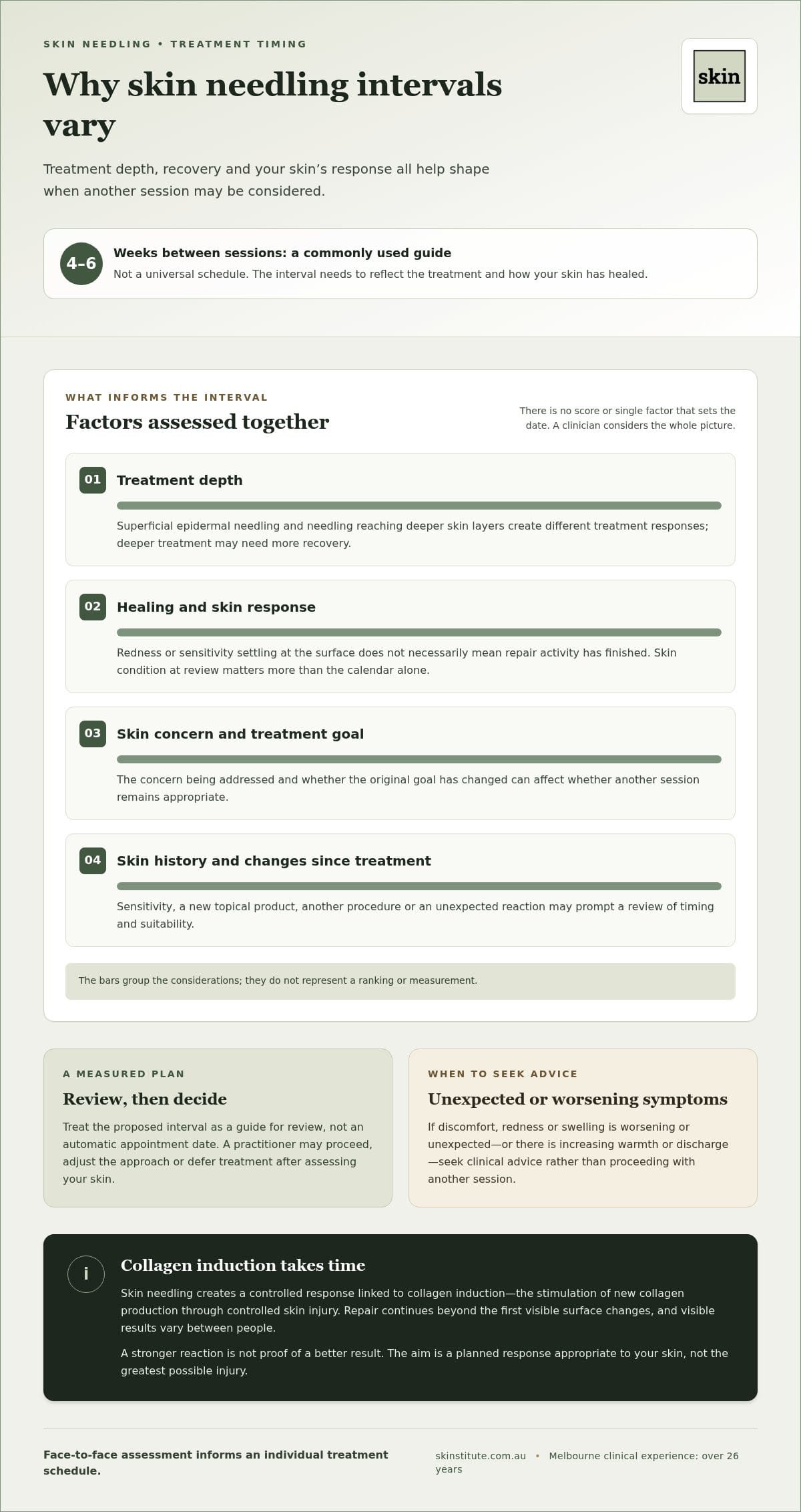
Could repeating skin needling too soon interfere with your skin’s recovery? If you’re wondering how often should you get skin needling, a commonly used guide is four to six weeks between sessions. That is not a universal schedule: treatment depth, the concern being addressed and your skin’s response all affect the interval.
It’s reasonable to want a clear timeframe while avoiding unnecessary treatment. Skin needs time to recover and progress through collagen induction, the stimulation of new collagen production through controlled skin injury. Deeper needling may require more recovery than superficial treatment, so the next session should be planned around how your skin has healed, not just a calendar reminder.
This guide explains why intervals vary, how treatment depth and recovery affect scheduling, and what to discuss during a professional assessment. Skinstitute’s medical professionals tailor treatment plans following a face-to-face consultation, drawing on more than 26 years of clinical experience in Melbourne. You’ll learn how to set realistic expectations and consider a measured schedule that supports improvement without over-treating your skin.
Key Takeaways
- There’s no single answer to how often should you get skin needling; treatment depth, skin response and recovery all influence the interval.
- Skin that looks settled on the surface may still be recovering, so appearance alone does not determine when another session is suitable.
- More frequent sessions don’t automatically lead to better results. A clinician considers treatment intensity, skin condition and how your skin responds.
- A review-led plan helps assess recovery and reconsider timing, rather than following a preset course regardless of your skin’s response.
- At Skinstitute in Melbourne, a face-to-face assessment informs an individual treatment schedule, supported by over 26 years of clinical experience.
How often should you get skin needling? Why there is no single interval
The timing of a follow-up session is a clinical decision, not simply a date to book in advance. A practitioner considers the treatment performed, the skin concern and whether another session remains appropriate for your circumstances. General guidance can help you prepare for that discussion, but it cannot set an individual schedule.
A plan may change during a course of treatment. If the original goal has shifted or a previous session caused an unexpected reaction, the clinician can review the approach before recommending another session. Treat the planned interval as a guide for review, not an automatic appointment date.
What professional skin needling involves
Professional skin needling is a controlled fine-needle procedure. The practitioner selects an approach based on the individual and the intended skin response. It may be considered to support collagen induction, but visible changes vary between people. It should not be understood as a guaranteed result or as a treatment that produces the same effect for everyone.
Microneedling (also known as collagen induction therapy) provides a general overview of the procedure and its commonly discussed uses. Professional treatment involves clinical assessment and an individually selected approach. At-home devices are a different context. A professional treatment plan does not provide instructions for their use or establish an equivalent schedule for home needling.
Why a fixed timetable can be misleading
A fixed timetable can overlook differences in the procedure and in the person receiving it. The practitioner may consider whether the treatment is superficial or intended to reach deeper layers, the concern being addressed and relevant skin history. These factors inform the proposed plan, but none alone determines when another session should take place.
Your circumstances may also change between appointments. You may develop sensitivity, start using a new topical product, have another procedure or find that the original concern needs a different approach. Sharing these changes allows the clinician to reconsider suitability and timing instead of relying on the original booking schedule.
For example, a planned follow-up may need to be reassessed if your skin is still unusually tender or a reaction has not settled as expected. The practitioner can decide whether to proceed, adjust the approach or defer treatment. This is more useful than applying a standard gap without considering your skin’s condition and treatment history. An online recommendation can provide general context, but it cannot account for those details or replace a clinical decision about your next session.
How collagen induction and skin recovery affect treatment spacing
Skin needling creates a controlled response that begins with the skin’s immediate reaction to fine-needle contact and continues as the tissue repairs. This repair activity is linked to collagen induction, but it develops over time rather than ending when the surface looks calmer. The visible appearance of your skin is therefore only one part of deciding whether another session is appropriate.
The skin response after treatment
Temporary redness, sensitivity or mild swelling can occur after treatment, although the response differs between people and procedures. As the skin repairs, biological processes associated with collagen production continue beyond the initial surface changes. Franciscan Health on Microneedling Recovery describes how microneedling prompts the skin’s repair mechanisms, offering context for why treatment planning considers more than immediate redness.
Less visible inflammation does not necessarily mean all repair activity has finished. A stronger reaction is not proof that treatment has worked better, either. The aim is a planned response appropriate to your skin, not the greatest possible injury. If discomfort, redness or swelling is worsening, appears unexpected, or is accompanied by signs such as increasing warmth or discharge, seek clinical advice rather than proceeding with another session.
Follow the practitioner’s aftercare instructions and report how your skin has responded at review. These observations help distinguish a reaction that is settling as expected from one that needs assessment before treatment timing is reconsidered.
Why depth changes the recovery discussion
Treatment depth, healing response and review of the skin together inform when another session may be considered. Superficial epidermal needling is limited primarily to the epidermis and is used for relatively minor concerns. Needling that reaches deeper skin layers creates a different treatment response, so the recovery and review plan may differ. There is no single interval that applies across all devices, depths and skin concerns.
Depth is only one part of the picture. The practitioner also considers the area treated, your skin’s sensitivity and how it has settled after the procedure. For example, if the surface appears calm but your skin remains unusually tender, the practitioner may recommend further review before deciding on another session. If recovery is proceeding as expected, the next step still depends on the treatment goal and your individual response.
This is why a set number of days cannot replace clinical judgement. Your skin’s condition at review matters more than simply reaching a planned date, and recovery should not be rushed to keep to a preset course. During a face-to-face skin assessment, Skinstitute’s medical team can consider the treatment approach and your recovery when planning the next step.
Does more frequent skin needling mean better results? Factors that change the interval
No. Increasing the frequency of skin needling doesn’t automatically improve results. Repeating treatment before your skin is ready may add irritation without giving it adequate time to recover. The appropriate schedule depends on the planned treatment, the concern being addressed and how your skin responded to previous sessions.
Clinical suitability and adequate recovery take priority over treatment frequency. A practitioner can weigh the factors below during assessment. None should be used alone to set a schedule.
Treatment depth, skin concern and sensitivity
Superficial epidermal needling and treatment at greater depths are distinct planning considerations. The selected depth relates to the intended skin response and the concern being assessed, not simply to how soon another session can be booked. A more intensive approach may call for closer review before treatment is repeated.
Skin sensitivity also matters. A history of reactive skin or lingering irritation after a previous treatment may lead the clinician to reassess suitability or adjust the plan. Your treatment goal helps shape the approach, but no schedule can guarantee a particular improvement for concerns such as uneven texture or acne scarring.
| Factor | How it may affect planning |
|---|---|
| Superficial treatment and a settled response | May support consideration of the planned next step after clinical review, but does not establish a universal shorter interval. |
| Greater treatment depth or persistent sensitivity | May call for more recovery time or a further review before another session. |
| Ongoing irritation or an unexpected reaction | May mean treatment should pause while the skin is assessed. |
| Different treatment goal | May change the approach, depth or overall plan rather than simply increasing session frequency. |
| Other procedures or active topical products | May affect suitability and sequencing, so the full treatment history should be considered. |
Previous treatment response and other procedures
Your skin’s response after an earlier session offers useful information for planning. At review, describe whether redness and sensitivity settled as expected, whether irritation persisted and whether you had other concerns. This history helps the clinician decide whether to continue as planned, modify the approach or defer treatment. A previous session that was well tolerated does not, by itself, prove that the same timing remains suitable if the plan changes.
Tell the clinician about other procedures and topical products, including when you used them. Combining or closely sequencing treatments can alter the overall plan, and suitability depends on the specific treatments and the condition of your skin. Regenerative approaches are distinct from needling. For example, Rejuran involves a different treatment approach and should be considered within an individual skin programme. Your schedule should account for the full plan rather than treating each procedure in isolation.
So, how often should you get skin needling? Use general schedules as background only. Your clinician should reconsider timing in light of treatment depth, skin sensitivity, goals and recovery observed at review, rather than treating frequency as a measure of effectiveness.
How to plan a skin needling schedule around recovery
A practical schedule uses assessment and review to guide decisions between sessions. This gives the clinician a chance to consider the treatment approach and your recovery before deciding whether to continue, adjust the plan or pause. Use these five steps to prepare for that process.
A review-led sequence between sessions
- 1. Assess. Discuss your skin concern, treatment goals, relevant skin and medical history, previous procedures and products that may affect suitability. This establishes the context for an individual plan.
- 2. Treat. The practitioner selects an approach based on the assessment, including the treatment area and depth. Ask what response to expect and how to follow the aftercare instructions for your procedure.
- 3. Follow aftercare. Follow the advice given for your treatment. Keep a note of reactions or concerns, and discuss new products or procedures with your practitioner before adding them to your routine.
- 4. Review recovery. At follow-up, describe how your skin has responded, including any changes that concern you. This gives the practitioner information to consider alongside their assessment.
- 5. Reconsider timing. The clinician can decide whether another session is appropriate, whether the approach needs adjustment or whether treatment should be deferred. A review does not automatically mean another session will proceed.
When to delay or seek clinical advice
If recovery is incomplete or differs from the aftercare guidance you were given, postpone another session and seek advice from the treating clinician. Don’t repeat treatment solely because an online schedule suggests it is time. Online guidance cannot account for your treatment, skin history or individual recovery.
Responses to skin needling vary, so follow the aftercare instructions provided for your procedure. If you notice an unexpected reaction, or one that is worsening or not settling as advised, contact the treating clinic for clinical guidance before arranging another session. A clinician can assess whether the response affects suitability or timing.
Keeping a brief record can make a review more useful. Note when the reaction began, whether it is changing, and any aftercare or products used. Share this information with the treating team rather than trying to diagnose the reaction or adjust the schedule yourself.
Skinstitute develops treatment plans around individual assessment and review. To discuss a recovery-led approach to Skinstitute skin needling, arrange an assessment with the team.
How Skinstitute tailors skin needling frequency in Melbourne
Skin needling frequency is considered as part of the treatment approach, not as a separate calendar decision. Planning takes account of your skin concern, previous treatments and the response observed between sessions. This helps shape a schedule around your circumstances rather than assuming the same course suits everyone.
What a personalised assessment considers
The clinician considers the area and concern being treated, relevant skin history and any sensitivity or reactions after previous procedures. Suitability is assessed alongside the intended treatment depth. Epidermal thickness, the measured thickness of the epidermal skin layer, may also inform the approach, although it is one consideration and does not determine timing by itself.
The plan can be reviewed if your skin’s response differs from what was anticipated. For example, persistent irritation may prompt the clinician to defer a further session or reconsider the treatment approach. Changes in the concern or your goals can also lead to a revised plan. This flexibility keeps decisions grounded in suitability and observed response rather than a preset course.
Discussing a longer-term regeneration plan
A regeneration plan is a personalised plan specifying treatment sessions and topical enhancements for skin renewal. It can clarify the intended sequence and points for reviewing progress, while leaving room to adjust treatment if your skin’s needs change. Topical products should be considered in the context of the procedure and your individual skin, rather than added automatically.
Maintenance is not a fixed continuation of an initial course. Whether it is appropriate, and when to consider it, depends on the concern, treatment approach and clinical assessment of your skin over time. The practitioner can discuss realistic aims, recovery considerations and how progress will be reviewed, without promising a particular outcome.
For people considering skin needling in Melbourne, a consultation is an opportunity to discuss suitability, previous treatment experiences and a plan that can be reassessed as needed. Skinstitute’s Melbourne team can help you consider these factors and develop an approach aligned with your skin and treatment goals.
Take the next step towards a considered skin plan
Planning skin needling is not about committing to a series before you know how your skin responds. It is about making informed decisions as treatment progresses, with room to reassess your goals and suitability. The question of how often should you get skin needling is best considered in the context of your skin, rather than answered by an online timetable.
Before a consultation, consider what you’d like to address, any past skin treatments and how your skin has reacted to procedures or products. These details can make the discussion more specific, including what recovery may involve and what signs should prompt a review. You can also discuss whether skin needling fits your priorities and what a realistic treatment plan might involve.
A considered conversation can help you move from general guidance to a plan that reflects your circumstances. Arrange a face-to-face consultation to discuss a personalised skin needling plan with Skinstitute’s medical team in Melbourne.
Frequently Asked Questions
Is there a standard number of weeks to wait between skin needling sessions?
There is no single interval in weeks that applies to everyone. The question of how often should you get skin needling has no one-size-fits-all answer because treatment depth, the concern being addressed, skin sensitivity and recovery after the last session all matter. For example, ongoing tenderness after treatment is a reason to seek review before booking again. A clinician can assess your skin and recommend timing; an online timetable can’t make that decision.
Can you have skin needling too often?
Yes. Repeating treatment before your skin has recovered may increase irritation without improving the outcome. Frequency should reflect the procedure performed and your skin’s response, not a desire to accelerate progress. If your skin is still irritated or you’ve had an unexpected reaction, postpone another session and seek clinical advice before proceeding. Follow the aftercare guidance for your treatment and share any concerns with the practitioner during review.
How many skin needling sessions are usually needed?
The number of sessions varies according to the skin concern, treatment depth, your response and the plan agreed with a clinician. A course shouldn’t be assumed to involve the same number of treatments for everyone. At assessment, discuss what you hope to address and how progress will be reviewed. This can clarify what might be a reason to continue, change the approach or pause treatment.
How long does skin needling recovery take before another treatment?
Recovery varies with treatment depth, skin sensitivity and your individual response, so a fixed number of days cannot be assumed for every procedure. Before another session is considered, your skin should be assessed as recovered. Follow the aftercare instructions given for your treatment. If a reaction is persistent or unexpected, contact the treating clinician for advice before arranging another session, rather than relying on a general recovery estimate.
Does deeper skin needling need a longer interval between sessions?
Deeper treatment may be planned differently from superficial epidermal needling because depth can affect the recovery and review plan. It does not determine timing by itself. A clinician also considers the concern being treated, skin sensitivity, treatment history and how your skin responded after the previous session. Don’t use a depth description alone to calculate your next appointment; ask for an individual assessment of whether your skin is ready.
Can skin needling help acne scarring?
Skin needling may be considered for some acne-scar concerns, but suitability depends on the scar pattern, your current skin condition and treatment goals. A clinical assessment helps determine whether needling is appropriate and what approach may be considered. If you have active or inflamed areas, don’t treat them without professional advice. Discuss the location and current state of your acne with the clinician before a treatment plan is made.
Can you combine skin needling with another skin treatment?
Combining procedures or topical treatments can affect suitability, recovery and how sessions are sequenced. The clinician needs to consider the specific treatments involved, your skin and its response; don’t arrange combinations independently. Bring details of recent procedures and the products you use to your assessment. Rejuran is a distinct regenerative approach that can be discussed as part of an individual plan, rather than assumed to follow the same timing as skin needling.