Correcting Botched Filler in Melbourne: When Dissolving May Help
October 27, 2026
Exosomes vs PRP for Skin: How Their Sources Differ
October 29, 2026
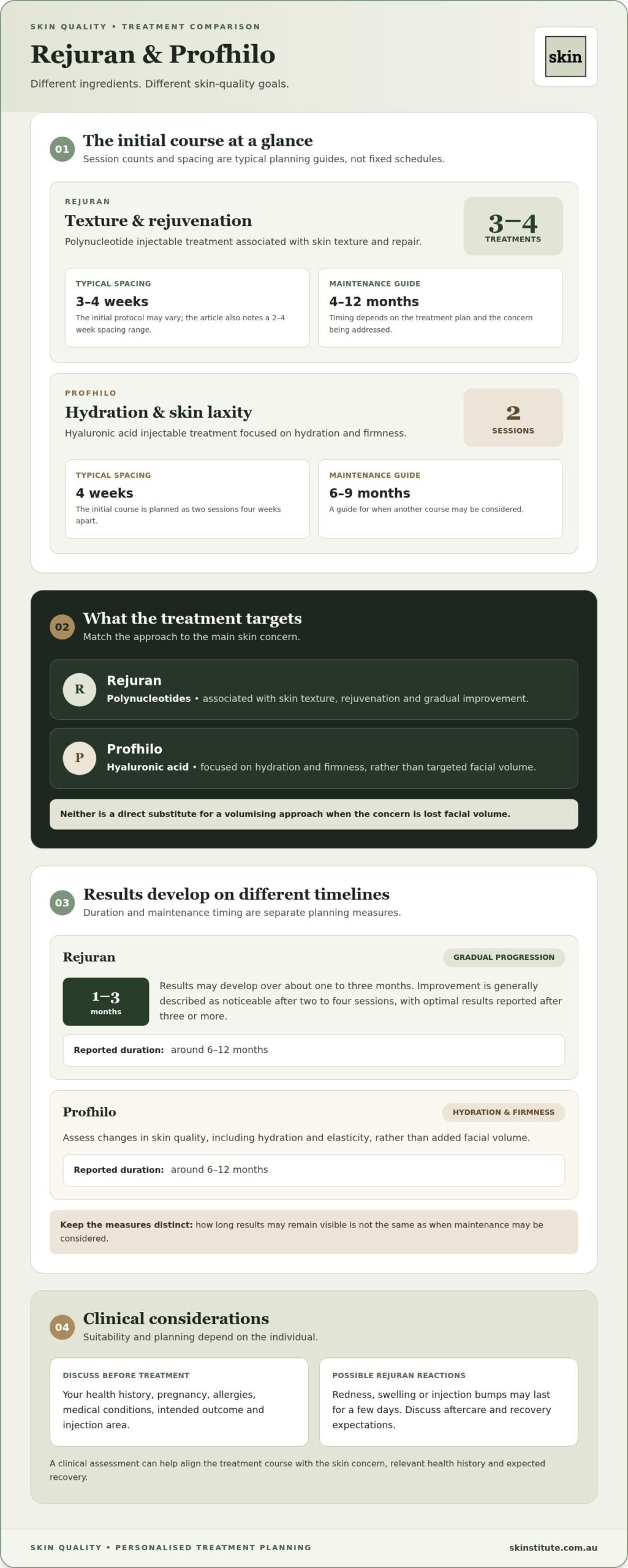
Choosing Rejuran vs Profhilo for anti-ageing depends on whether your priority is skin texture or hydration and tissue support. Rejuran uses polynucleotides, while Profhilo uses hyaluronic acid, so their injection techniques and treatment plans differ. A typical initial Profhilo course involves two sessions four weeks apart, while Rejuran is commonly planned as three to four sessions, usually spaced three to four weeks apart.
It’s understandable to compare these skin-rejuvenation treatments, but the differences matter when considering which concerns each may address and how results develop. Rejuran is often associated with skin texture and repair, while Profhilo is linked to hydration and improved skin laxity.
This guide explains what Rejuran is and how its injection technique and treatment areas compare with Profhilo. It also covers possible results and recovery timing, with a practical comparison to help you consider which approach may better suit your skin concerns and goals.
Key Takeaways
- Match the treatment approach to your main concern, such as skin texture, hydration or laxity.
- Understand how injection patterns and treatment areas shape the planning of each procedure.
- Allow for results to develop over time, and consider how treatment timing fits your schedule.
- Use the comparison to identify which questions about suitability and expected outcomes to discuss during an assessment.
Injection techniques and treatment areas
Profhilo and Rejuran use injectable treatments, but their protocols differ. Profhilo’s initial course is two sessions spaced four weeks apart. Rejuran is commonly planned as three to four treatments, with an initial protocol spaced two to four weeks apart. Rejuran sessions are also typically spaced three to four weeks apart.
The injection plan should reflect the concern being treated, rather than a preference for a popular product. Rejuran’s polynucleotide approach is associated with skin rejuvenation and texture. Profhilo’s hyaluronic acid formulation is used for hydration and skin laxity concerns. Neither should be treated as a direct substitute for restoring lost facial volume with a volumising approach.
| Option | Injection approach | Typical treatment focus | Initial timing | Maintenance |
|---|---|---|---|---|
| Rejuran | Polynucleotide injectable treatment | Skin texture and rejuvenation | Three to four treatments, usually three to four weeks apart | Typically four to twelve months |
| Profhilo | Hyaluronic acid injectable treatment | Hydration and skin laxity | Two sessions, four weeks apart | Typically six to nine months |
Maintenance intervals are guides, not fixed schedules for every face. Treatment longevity depends on the intended effect and the concern being addressed. Rejuran maintenance is commonly every four to six months in some protocols, while broader guidance places it at six to twelve months. Profhilo maintenance is typically every six to nine months.
Rejuran and Profhilo can be combined, with treatments generally spaced two to four weeks apart. Other anti-ageing procedures may also form part of a plan, but their sequence should account for the treatment areas and skin recovery.
Consider Rejuran for a plan centred on skin texture and rejuvenation, and Profhilo when hydration or laxity is the primary concern. Many skin clinics, including Revive Aesthetics & Wellness, structure their skin rejuvenation consultations around this exact distinction to ensure treatment protocols align with specific patient outcomes.
What is the main difference between Profhilo and Rejuran?
Profhilo and Rejuran differ in their active ingredients and intended effects on skin quality. Start by identifying the concern being treated, as well as relevant health history and the area planned for injection.
Profhilo’s hydration and firmness
Profhilo contains hyaluronic acid, with high- and low-molecular-weight forms in its formulation. Its focus is hydration and firmness rather than adding targeted facial volume like a conventional filler. This distinction matters when the concern is general dryness or laxity, rather than a specific hollow or contour that needs volume restoration.
As with any injectable, treatment can cause local reactions. Rejuran may cause redness, swelling or injection bumps that last for a few days. Before proceeding, discuss possible reactions, aftercare and your health history so the plan accounts for recovery and relevant clinical considerations.
Suitability for skin concerns
Rejuran uses polynucleotides as part of a skin-rejuvenation approach, while Profhilo focuses on hydration and firmness. Acne scarring, textural changes, skin damage, dryness and laxity are distinct concerns. Identify which matters most before comparing options. Neither treatment should be assumed to address every concern or replace a treatment designed for a different purpose.
Raise pregnancy, allergies and medical conditions during the suitability discussion, as these factors may affect whether treatment proceeds and how the plan is shaped. For an appointment in Melbourne, ask the clinician to explain their relevant qualifications, experience and role in the procedure. This is a practical safety consideration, not a statement of a specific regulatory rule.
Rejuran and Profhilo are injectable treatments used for different skin-quality goals. The discussion should cover the intended outcome, injection area, possible reactions and your health history, rather than relying on a broad label such as “anti-ageing”.
Expected results and when they may appear
Profhilo and Rejuran have different result timelines because they target distinct aspects of skin quality. Comparing onset, treatment course and maintenance helps set realistic expectations for fine lines, hydration and skin laxity.
Profhilo results and maintenance
Profhilo’s hyaluronic acid treatment focuses on hydration and skin firmness. Changes are assessed through skin quality, including how hydrated and elastic the treated area appears, rather than added facial volume. It may suit concerns such as dryness or mild laxity, rather than the goal of filling a specific line.
Reported results typically last around six to twelve months, with maintenance commonly scheduled every six to nine months. These are separate planning measures: expected duration describes how long results may remain visible, while maintenance timing guides when another course may be considered. Tracking skin laxity and hydration between sessions can help you assess whether the timing suits your goals.
Onset and duration of results
Rejuran results develop gradually over about one to three months as its skin-rejuvenation effects emerge. Some improvement may be noticeable within weeks, while changes to texture and fine lines are assessed across the treatment course. This gradual progression differs from focusing only on the immediate appearance of hydration after an injectable treatment.
Rejuran improvements are generally described as noticeable after two to four sessions, with optimal results reported after three or more sessions. Results typically last around six to twelve months, and maintenance is commonly considered within six to twelve months. Comparing photographs taken in consistent lighting can help track changes in texture and elasticity between appointments.
For either treatment, assess the intended outcome separately from how long results may last. Profhilo centres on hydration and firmness, while Rejuran focuses on gradual skin rejuvenation. A treatment plan should match the course and maintenance interval to the specific concern being monitored, rather than assume both injectables produce the same visible changes.
How Profhilo and Rejuran differ
Comparing Rejuran and Profhilo for anti-ageing is most useful when you define your treatment goal first. Identify the area of concern, the change you want to monitor and the features that matter most to you, such as smoother-looking skin or improved hydration.
Before treatment, describe your main concern specifically. For example, note whether uneven texture, visible dryness or reduced firmness is the priority. This gives the clinician a clearer basis for discussing suitability and helps you assess progress against your original concern, rather than relying on a general impression.
Keep the comparison focused on your own skin. Two people may describe their concern as ageing, yet one may focus on texture while another is concerned about laxity. The treatment discussion should distinguish these priorities and identify which outcome is realistic to track in the area being considered.
Existing skincare and recent aesthetic procedures also matter when planning treatment. Bring a clear account of the products and treatments you use, and note any changes in your skin. This context helps the clinician consider timing and whether the proposed approach fits your broader skin plan.
Use these points to prepare for an individual assessment: define the concern, identify the intended change and consider your treatment history. An individualised treatment assessment can help relate those priorities to the available options.
Profhilo contains 32 mg of high molecular weight hyaluronic acid and 32 mg of low molecular weight hyaluronic acid. Keep that stated composition separate from your treatment goal: it does not, by itself, identify which concern should guide an individual assessment.
Explain the specific change you hope to monitor, and ask the clinician to relate the product choice to that priority and your treatment history. This keeps the comparison focused on suitability rather than a broad label such as anti-ageing.
Skinstitute: Prescription injectables
Skinstitute provides prescription injectables for people considering non-surgical facial rejuvenation in Melbourne. A face-to-face assessment helps relate concerns such as skin quality or facial laxity to an appropriate treatment approach, and allows you to discuss suitability, expected changes and recovery.
Where a concern involves more than injectable treatment, options such as PDO Thread Lifting, Fractional CO2 or High Intensity Focused Ultrasound (HIFU) may also be considered. These treatments address different aesthetic concerns, so the plan should reflect the area being treated and the intended outcome rather than treating them as interchangeable alternatives.
Skinstitute’s medical team can discuss how available approaches relate to your goals and clinical considerations. Contact Skinstitute to discuss your treatment options.
Plan your next step with clear treatment goals
Before choosing an injectable, define the change you want to address. Is your priority improving skin texture, supporting hydration or addressing laxity? A considered approach to Rejuran versus Profhilo for anti-ageing starts with that distinction, then weighs the treatment area, skin history and practical recovery considerations.
Skinstitute offers prescription injectables, PDO Thread Lifting and Fractional CO2, which address different aesthetic concerns. An individual assessment can help determine whether an injectable aligns with your goals or whether another option is more appropriate. This discussion also gives you an opportunity to talk through expected results, treatment timing and any relevant health considerations before proceeding.
Contact Skinstitute to discuss your options and take the next step towards a treatment plan shaped around your concerns.
Frequently Asked Questions
What Is Rejuran?
Rejuran is the name of an injectable aesthetic treatment. To understand a proposed plan, clarify which area is being treated, the intended visible change, the planned course and aftercare. This keeps the discussion specific to your skin rather than relying on broad claims about rejuvenation. Ask how progress will be reviewed and what might prompt reassessment.
Which has less downtime?
Neither treatment can be said to involve less downtime for everyone. The visibility of temporary marks and comfort during recovery can vary with the injection area and individual response. If you have an important event, plan treatment well ahead and allow time for your skin to settle. Follow the aftercare instructions provided for your procedure.
Can Rejuran or Profhilo be dissolved if I am unhappy with the result?
Don’t assume either treatment can be dissolved on demand. The appropriate response to an unwanted result depends on the material, injection area, symptoms and timing. Contact the practitioner who performed the treatment for an assessment rather than trying to correct it yourself. Seek urgent medical attention for severe or rapidly worsening symptoms.
Do these treatments change how my face looks or freeze my expression?
These treatments are not intended to immobilise facial muscles or freeze expression. Their purpose differs from treatments designed to affect muscle movement. Before proceeding, describe the facial changes you want to avoid, such as altered movement when smiling. This gives the practitioner a clear reference for discussing the treatment area and whether the proposed approach matches your preference.
How Long Do the Results Last?
There is no single expiry date for treatment results. Rather than relying on a calendar estimate alone, note when you first see a change and when it becomes less apparent. Consistent photographs and notes about the same skin concern make comparisons more useful at review appointments and can support decisions about future treatment.
How many sessions will I need and how often?
The number and spacing of appointments depend on the treatment selected and the concern being addressed. Ask for the proposed course to be set out clearly, including when progress will be reviewed and what the next appointment is intended to achieve. Stick to that schedule rather than bringing a session forward solely because early changes seem subtle.