How to Avoid Looking Overdone With Filler by Timing Touch-Ups
October 23, 2026
What Can I Take for Bruising After Filler Injections?
October 25, 2026
The safety standards in Australian cosmetic clinics depend on the procedure: the National Safety and Quality Cosmetic Surgery Standards apply to invasive cosmetic surgery, while non-surgical procedures, including cosmetic injectables, are outside the standards’ definition of cosmetic surgery. The standards comprise 7 standards and 101 actions. This distinction matters because the rules for surgical facilities do not automatically describe the framework for non-surgical treatments.
It is understandable to expect one set of requirements to cover every cosmetic procedure. In practice, the procedure determines which standards apply, shaping what patients should understand about clinical governance, consent, communication and infection prevention.
This article explains what Australia’s cosmetic surgery standards cover, how accreditation applies to surgical facilities and how non-surgical procedures are treated. It also sets out practical safety considerations for people exploring cosmetic treatments in Melbourne, so you can understand the framework before considering a procedure.
Key Takeaways
- Distinguish invasive cosmetic surgery from non-surgical treatments to understand which national standards apply.
- For surgical procedures, informed consent should explain the procedure, its risks and recovery in language the patient understands.
- Clinical governance and infection prevention are central checks when assessing how a surgical facility manages patient safety.
- Cosmetic injectables and other non-surgical procedures sit outside the standards’ definition of cosmetic surgery, but still involve separate professional requirements.
- Understanding the procedure type and its safety framework can help you have a more informed discussion about treatment options.
The National Safety and Quality Cosmetic Surgery Standards
Australia’s National Safety and Quality Cosmetic Surgery Standards set requirements for facilities that perform cosmetic surgery. They address safety and quality across patient assessment, clinical care, communication and follow-up.
Providers Required to Meet the Standards
Cosmetic surgery services are generally expected to follow safety standards. Facilities performing invasive cosmetic surgery under sedation or general anaesthesia must comply and obtain accreditation. Cosmetic surgery means invasive surgery primarily intended to change appearance, rather than diagnose or treat a medical condition.
When assessing a provider, first identify whether the planned procedure is surgery and where it will take place. The Standards include psychological screening and suitability assessments. A process that moves straight to booking without assessing suitability warrants closer scrutiny. The Standards also cover post-operative care and complication management, not just the procedure itself.
Warning signs include unclear explanations of suitability, consent or follow-up arrangements. These matter because the Standards specifically address each of these areas.
Mandatory Safety and Quality Requirements
The Australian Cosmetic Surgery Standards contain 7 standards and 101 actions. Together, they address clinical governance, consumer partnership, medication safety, communication, acute deterioration, infection prevention and other safety processes. For example, Clinical Governance has 26 actions, while Medication Safety has 12 actions.
Facilities not accredited to the National Safety and Quality Health Service Standards are assessed against the 7 Cosmetic Surgery Standards. Two assessment pathways exist: standalone accreditation, or an integrated assessment against the NSQHS Standards and Cosmetic Surgery Module. Accreditation is how implementation of the Cosmetic Surgery Standards is confirmed.
For patients, the safety standards in Australian cosmetic clinics offer a practical framework for understanding what a surgical service should address. Ask how the facility’s assessment, consent and aftercare processes fit together, rather than focusing only on the operation.
Facilities Covered by the Standards
Facilities covered may include Australian day hospitals, specialist cosmetic clinics, plastic surgery practices and certain medical centres that provide surgical aesthetic procedures. Examples include breast augmentation, rhinoplasty, abdominoplasty, blepharoplasty, surgical facelifts, liposuction and fat transfer.
The setting matters because health service organisations performing cosmetic surgery may need to meet both the National Safety and Quality Health Service Standards and the Cosmetic Surgery Standards. The Australian Commission on Safety and Quality in Health Care introduced mandatory NSQHS Cosmetic Surgery Standards for cosmetic surgery in Australia.
The Standards also cover post-operative care planning and complication management. Ask who coordinates follow-up and how complications are managed. The framework does not give patients a universal checklist of emergency equipment: equipment needs depend on the clinical setting and planned care.
State Oversight and Applicable Regulations
The national Cosmetic Surgery Standards apply across Australia, but compliance deadlines differ between jurisdictions. State and territory governments have committed to implementing a licensing framework for facilities where cosmetic procedures are performed. National accreditation and jurisdictional implementation are related, but distinct.
The main requirements are the mandatory National Safety and Quality Cosmetic Surgery Standards, their accreditation processes, and the guidelines for registered medical practitioners who perform cosmetic surgery and procedures. The Australian Commission on Safety and Quality in Health Care introduced the mandatory Standards.
The three core documents are the Cosmetic Surgery Standards, the Cosmetic Surgery Module and the practitioner guidelines. The Cosmetic Surgery Module contains 11 new criteria for cosmetic procedures, with nine closely aligned to the NSQHS Standards. These distinctions help explain why a facility’s accreditation pathway can depend on its existing status.
Communication for safety
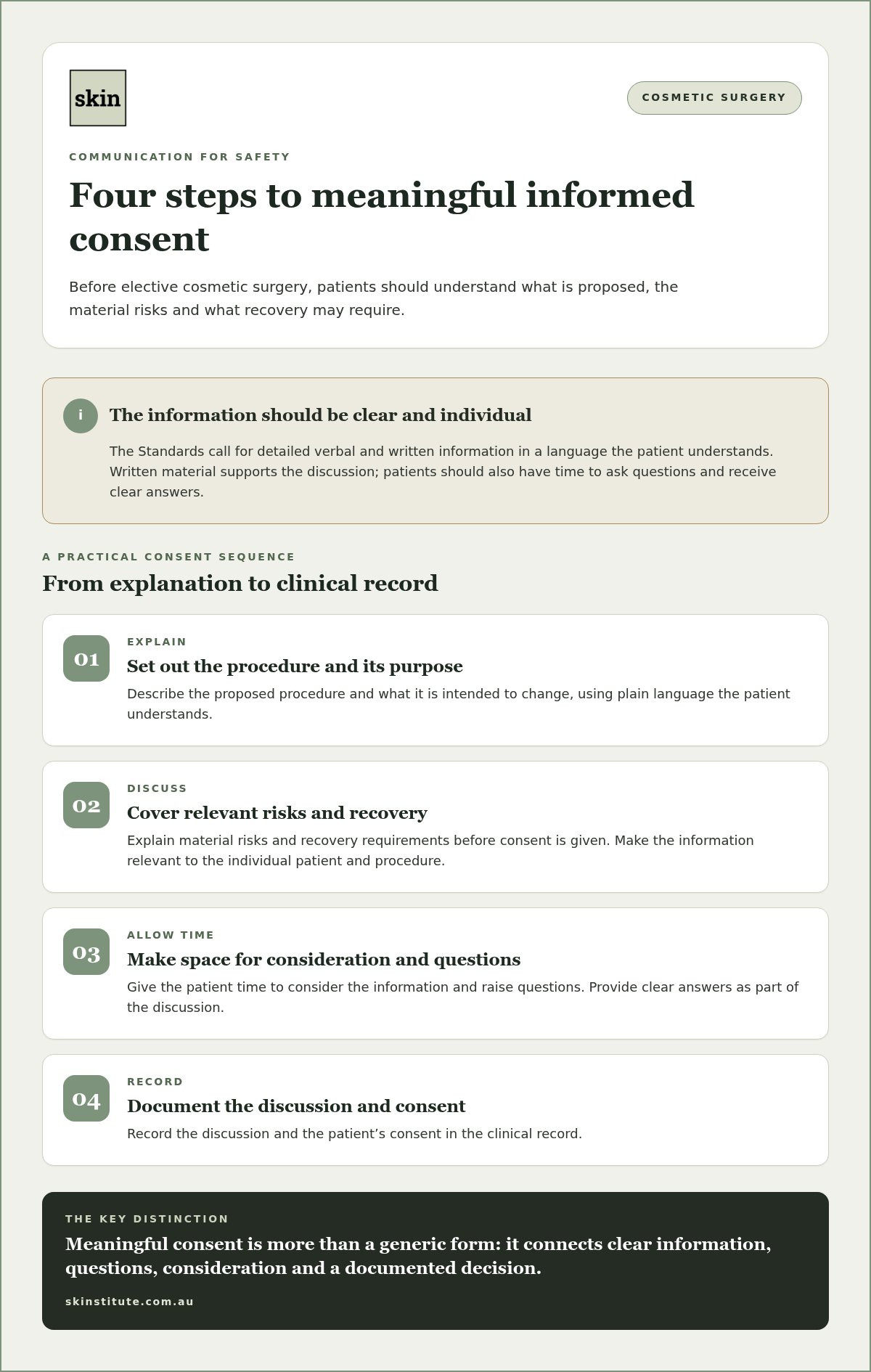
For cosmetic surgery, communication is part of safe clinical care, not just an administrative step. The National Safety and Quality Cosmetic Surgery Standards require informed consent suited to elective procedures intended to change appearance. Before deciding, patients need a clear explanation of what is proposed, what it involves and what recovery may require.
The Standards call for detailed verbal and written information in a language the patient understands. It should explain the procedure, material risks and recovery expectations. For example, someone considering rhinoplasty should understand what the operation aims to change, the risks discussed and the expected recovery process. Written material supports the discussion, but patients should also have the opportunity to ask questions and receive clear answers.
Consent is meaningful when it relates to the individual patient and procedure, rather than relying on a generic form alone. A practical sequence is to:
- Explain the proposed procedure and its intended purpose in plain language.
- Discuss relevant risks and recovery requirements before consent is given.
- Allow the patient time to consider the information and raise questions.
- Record the discussion and consent in the clinical record.
These steps support an informed decision and document what the patient was told. If a patient cannot explain the basic procedure, risks or recovery plan, further discussion may be needed before deciding.
The national framework recognises that cosmetic surgery is elective and appearance-based. The Australian Commission on Safety and Quality in Health Care’s Standards therefore place communication alongside patient partnership, rather than treating consent as a signature collected immediately before surgery. Organisations accredited to the NSQHS Standards also use the Cosmetic Surgery Module, which adds specific consumer-partnership actions to their assessment.
Age-specific requirements apply to non-surgical procedures as well. According to the Medical Board of Australia, people under 18 considering a non-surgical cosmetic procedure must have a seven-day cooling-off period between their first consultation and the procedure. This interval separates the initial discussion from treatment, giving the young person time to consider the decision.
Check that explanations are consistent between verbal discussions and written material. If the written information describes one procedure but the consultation discusses another, ask for the difference to be resolved before consenting. Pressure to decide immediately does not support careful consideration of elective surgery. Informed communication should leave patients able to describe the planned procedure, its key risks and recovery expectations in their own words.
Clinical governance
Clinical governance is the system a surgical service uses to oversee care, manage risk and improve quality. In the National Safety and Quality Cosmetic Surgery Standards, Clinical Governance contains 26 actions. These actions make responsibility for safe care a facility-wide matter, rather than leaving it solely to the practitioner performing surgery.
For patients, governance is visible in how a facility turns policies into consistent clinical practice. Documented processes should guide assessment, consent, treatment, follow-up and responses to concerns. Staff should be able to explain who coordinates a patient’s care and how relevant information is recorded. The aim is a traceable process, so decisions and responsibilities do not depend on informal conversations.
Clinicians also have professional responsibilities. The Australian Medical Board’s code of conduct requires doctors to recognise and work within their competence and scope of practice under section 3.2.1. Section 3.2.2 requires doctors to have adequate knowledge and skills to provide safe clinical care. In practice, these principles mean a practitioner’s education and experience should suit the procedure being undertaken.
Preparing a clinic for compliance involves practical work. Guidance for clinics includes reviewing governance processes, updating policies and procedures, training staff on consumer rights obligations, and preparing documentation for accreditation bodies. Those steps can be considered in sequence:
- Review policies against the clinical work performed at the facility.
- Update procedures where they do not clearly guide staff actions.
- Train staff to apply consumer-rights obligations during patient care.
- Prepare records and supporting documents for accreditation assessment.
A policy is useful only if the staff responsible for patient assessment know how to apply it and record their actions. Accreditation documentation helps demonstrate how written processes work in practice.
Governance also develops as the sector responds to identified concerns. The Australian Health Practitioner Regulation Agency and Medical Board of Australia released a report on practitioners performing cosmetic surgery in August 2022. On 1 September 2023, Australian Health Ministers approved a review of cosmetic procedure standards and a new licensing framework for facilities where cosmetic procedures are performed. These events show that oversight includes both practitioner conduct and facility systems.
When considering a surgical service, focus on clear accountability: who assesses suitability, who oversees care and how decisions are documented. These practical governance questions do not replace accreditation. Accreditation assesses whether a service’s systems meet applicable standards, while professional obligations apply to individual practitioners.
Infection prevention and control
Infection prevention and control is an important part of safety in cosmetic surgery. The Australian Commission on Safety and Quality in Health Care includes this area because infection prevention is integral to delivering safe cosmetic surgery. For patients, the practical issue is whether infection-control processes are part of routine care, rather than treated as an afterthought.
Infection can spread when microorganisms pass between people, equipment or clinical surfaces. Surgery opens the skin, so contamination at the treatment site can have clinical consequences. Specific risks and controls depend on the procedure and setting. The Standards place infection prevention within a broader health service safety and quality framework, linking everyday clinical processes with organisational compliance.
Patients can notice observable aspects of a visit without trying to assess technical compliance themselves. For example, observe whether the treatment area appears prepared for the planned procedure and whether staff explain how equipment and the clinical environment are managed. If the explanation is unclear, ask how the process relates to your procedure. The response should describe relevant steps, not just offer general reassurance.
Infection prevention is a process, not one visible item. A clean-looking room alone cannot demonstrate how instruments are processed or how staff manage clinical materials. Equally, a patient may not see every control used behind the scenes. The 19 actions in the Standards provide a formal basis for assessing a facility’s systems, while accreditation examines whether the applicable requirements are met. Patients should distinguish these formal assessments from a quick visual impression.
Useful questions can focus on the parts of care that affect your procedure:
- Which infection-control steps apply to the procedure being planned?
- How is equipment prepared and managed for that treatment?
- What should you do if the treatment area becomes increasingly red, painful or swollen during recovery?
Increasing redness, pain or swelling after a procedure can be a reason to seek clinical advice, particularly if symptoms worsen instead of settling. These signs do not establish a diagnosis, but reporting them allows a clinician to assess the treated area and determine appropriate care.
Facilities need documented infection-control processes that staff can apply consistently. For example, they should have a clear sequence for preparing the treatment area, managing equipment and responding to a patient’s concern after surgery. Within the national safety framework, these systems support the broader aim of quality cosmetic surgery. Clear explanations of the processes can help patients understand how a health service approaches safety.
Non-surgical cosmetic procedures outside the standards
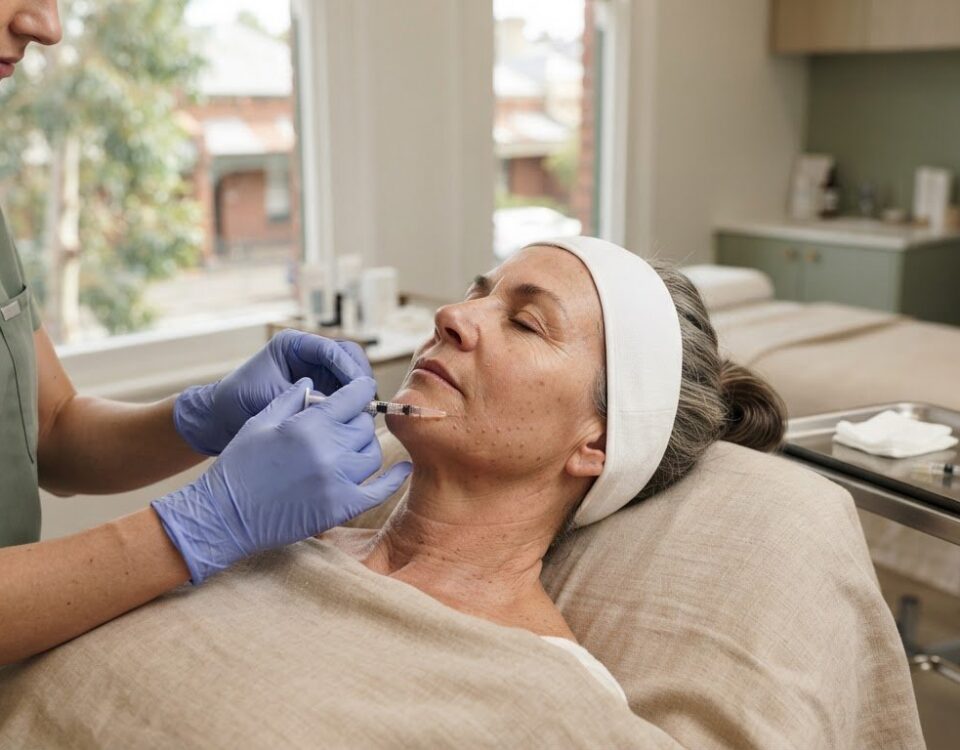
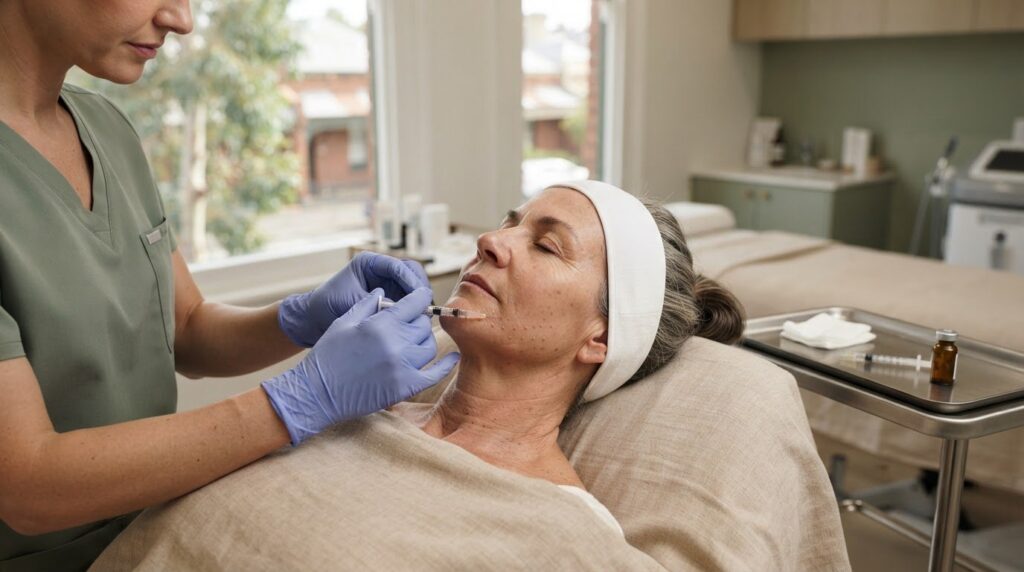
Cosmetic injectables and other non-surgical cosmetic procedures fall outside the definition of cosmetic surgery in Australia’s National Safety and Quality Cosmetic Surgery Standards. That does not mean they are free from professional requirements. Rather, the surgical standards and their accreditation pathway do not automatically govern injectable treatments or advanced skin rejuvenation services provided by aesthetic clinics such as LJ Aesthetics.
What are the safety standards for cosmetic injectables in Australia? The Cosmetic Surgery Standards do not cover cosmetic injectables as cosmetic surgery. Instead, relevant professional guidelines apply to regulated health professions, and practitioners must have sufficient education to perform procedures safely. Applicable requirements depend on the practitioner’s regulated profession and the treatment provided.
The Australian Commission on Safety and Quality in Health Care’s Cosmetic Surgery Module is designed for organisations accredited to the NSQHS Standards. It adds requirements for cosmetic procedures within that surgical framework, but does not make non-surgical injections cosmetic surgery. Patients should distinguish a facility’s surgical accreditation from the professional requirements governing the practitioner providing an injectable treatment.
For a practical assessment, focus on the clinical discussion rather than assuming surgical accreditation answers every question. Before proceeding, establish who will perform the treatment, what assessment informs its suitability, what it involves and which risks are explained. The practitioner’s education should be relevant to the procedure. Dedicated clinics, such as Esse Aesthetics, emphasise thorough consultations to ensure non-surgical treatments align with clinical safety and personalised skin health goals. For prescription injectables, discuss the treatment in the context of prescription requirements, rather than presenting it as a product patients can select independently.
- Confirm the practitioner’s regulated profession and role in your care.
- Look for a clear explanation of suitability, the proposed procedure and relevant risks.
- Check that the discussion gives you enough information to make an informed decision.
- Consider whether claims in advertising are balanced and specific to the treatment.
Advertising has separate safeguards. Australian advertisements for higher-risk non-surgical cosmetic procedures that use images must warn that results may vary for other patients. Rules also strengthen the ban on testimonials from social media influencers, while advertising aimed at people under 18 is prohibited. These standards affect how procedures can be promoted; they do not replace a clinical assessment or establish that a treatment is suitable for an individual.
For patients considering an injectable, the key takeaway is to assess the practitioner’s competence, the individual discussion and the information provided, rather than relying on cosmetic surgery accreditation alone. If you are considering prescription injectables, you can discuss prescription injectables as part of an informed treatment conversation.
Skinstitute: Prescription injectables
Skinstitute provides prescription injectables for people considering non-surgical aesthetic treatments in Melbourne. Since injectables fall outside the national surgical standards’ definition of cosmetic surgery, understanding the treatment plan and practitioner’s role remains central to an informed decision.
A face-to-face consultation allows the team to assess your concerns and discuss a tailored approach. Treatment planning should consider facial anatomy, the intended outcome, suitability and relevant risks, rather than treating an injectable as a standardised option. Skinstitute also offers PDO Thread Lifting, Fractional CO2 and High Intensity Focused Ultrasound (HIFU) for different aesthetic concerns.
If you are considering prescription injectables, contact Skinstitute to discuss treatment options, or visit skinstitute.com.au.
Make your next treatment decision with clarity
Use your understanding of the safety standards in Australian cosmetic clinics to identify a practical next step: clarify which procedure you are considering and whether it is surgical or non-surgical. This distinction helps you understand which framework applies and what information should guide your decision. Your treatment discussion should address your goals, suitability, relevant risks and the care involved, rather than relying on a general claim about safety.
For non-surgical aesthetic concerns, Skinstitute offers prescription injectables, PDO Thread Lifting and Fractional CO2. Each addresses different concerns, so the appropriate option depends on the treatment aim and clinical assessment. Clear information can help you consider these choices in relation to your own needs without assuming one approach suits everyone.
To discuss treatment options and take an informed next step, contact Skinstitute about your aesthetic concerns. A considered conversation can help you move forward with greater clarity.
Frequently Asked Questions
What Does This Mean for Your Clinic?
For a clinic, the first step is to identify whether it performs invasive cosmetic surgery or provides non-surgical treatments. That distinction determines whether the National Safety and Quality Cosmetic Surgery Standards apply. A surgical facility should map its clinical processes to the relevant accreditation pathway and organise supporting documentation. For patients in Melbourne, asking which procedure category applies can clarify what a clinic’s accreditation does and does not cover.
Who Must Comply?
Services performing cosmetic surgery may need to meet applicable safety standards. This includes facilities providing invasive surgery for appearance-related purposes, rather than treatment of a medical condition. A day hospital or medical centre may be within scope if it performs these procedures. What the service actually does matters more than whether its name or advertising describes it as a cosmetic clinic.
Who is required to comply?
The facility delivering cosmetic surgery is responsible for meeting applicable facility standards and accreditation requirements. Individual practitioners have separate professional obligations, including working within their competence and scope of practice. A practitioner’s responsibilities do not replace the facility’s obligations, and facility accreditation does not establish an individual clinician’s suitability for every procedure. Patients can ask who is responsible for each part of their care.
Which qualifications and registrations must cosmetic practitioners have in Australia?
Practitioners must have sufficient education to perform the cosmetic procedure safely and work within their professional competence. The Medical Board of Australia’s code requires doctors to practise within their competence and scope under section 3.2.1, and to have adequate knowledge and skills under section 3.2.2. Requirements depend on the practitioner’s profession and procedure. For nurses, expanding scope to non-surgical cosmetic procedures requires a period of practice.
What rules apply to prescribing and administering cosmetic injectables?
Cosmetic injectables are non-surgical procedures, so they fall outside the Cosmetic Surgery Standards’ definition of cosmetic surgery. Prescription injectables remain subject to prescription requirements, and relevant professional guidelines apply to regulated health professions. The patient discussion should clarify who assesses suitability, who is responsible for prescribing and who administers treatment. These roles should be explained in relation to the specific injectable being considered.
What infection control and sterilisation standards must Australian cosmetic clinics follow?
Facilities performing cosmetic surgery must address infection prevention under the Cosmetic Surgery Standards. The framework does not provide patients with a simple visual test for sterilisation compliance. For a planned procedure, ask how the facility manages the equipment and clinical materials involved. A clean-looking room alone cannot establish how reusable instruments are processed or how infection-control procedures are documented and followed.
What safety requirements apply to cosmetic surgery clinics and facilities in Australia?
Facilities performing cosmetic surgery must meet applicable Cosmetic Surgery Standards and accreditation requirements. Their safety systems address clinical governance, medication safety, communication, infection prevention and responses to acute deterioration. A health service already accredited to the NSQHS Standards may use an integrated assessment with the Cosmetic Surgery Module; other facilities can follow the standalone assessment pathway. The procedure and facility determine the relevant route.
What informed consent, consultation and advertising rules apply to cosmetic procedures?
For cosmetic surgery, consent should follow verbal and written information the patient understands, including details of the procedure, risks and recovery expectations. A consultation should allow time for questions before a decision is made. Advertising has additional controls: Australian advertisements for higher-risk non-surgical cosmetic procedures using images must warn that results may vary, and influencer testimonials are restricted. These rules govern communication and promotion, not individual suitability for treatment.