Clinical Guide to Cheek Filler in Melbourne: Structural Midface Restoration
July 19, 2026
Fractional CO2 Laser Melbourne: A Clinical Guide to Medical-Grade Skin Resurfacing
July 21, 2026
Skin needling is not merely an aesthetic facial; it is a precision-engineered biological trigger for dermal remodelling that requires high-level clinical expertise to master. For many individuals in Victoria, the cumulative effects of a harsh climate often manifest as persistent sun damage, uneven texture, or stubborn acne scarring that superficial skincare cannot adequately address. You likely understand that achieving genuine structural change in the skin requires more than a temporary glow. When seeking skin needling Melbourne patients often prioritise safety and technical proficiency to ensure their investment leads to measurable, long-term collagen induction rather than just short-term exfoliation.
This clinical guide offers a comprehensive overview of the physiological mechanisms behind medical-grade needling and the strict protocols required to maintain dermal integrity. We’ll explain how controlled micro-trauma stimulates the body’s natural wound-healing response to reduce pore visibility and refine scar tissue. We will also explore how advanced combinations, such as the integration of exosomes or bio-stimulators, can enhance these regenerative results. By understanding the science of skin health and the latest regulatory standards from AHPRA and the TGA, you can approach your treatment with confidence in both the process and the professional environment.
Key Takeaways
- Understand the biological phases of wound healing, specifically inflammation, proliferation, and remodelling, which drive long-term collagen synthesis and dermal structural integrity.
- Learn why professional skin needling Melbourne protocols require precise needle depth adjustments to effectively treat specific concerns like acne scarring and sun damage.
- Evaluate the clinical differences between mechanical needling and thermal-based treatments to determine the safest modality for your specific Fitzpatrick skin type.
- Discover how clinical-grade skin priming and meticulous aftercare protocols accelerate the regenerative response while minimising patient downtime.
- Explore the advanced therapeutic potential of integrating exosomes and Rejuran to maximise cellular repair through transdermal delivery channels.
Understanding Skin Needling: The Clinical Standard for Dermal Rejuvenation
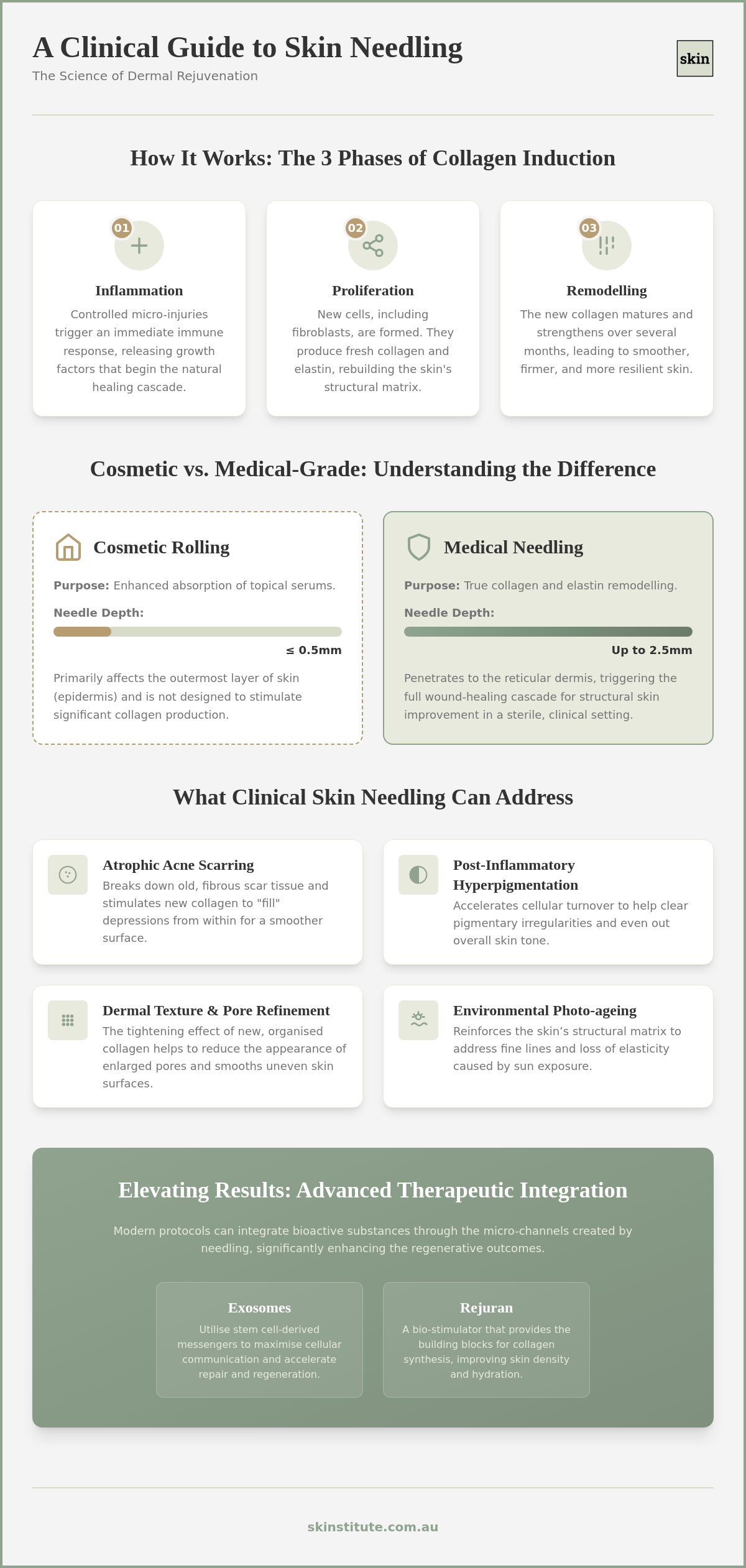
Skin needling, scientifically classified as Collagen induction therapy (CIT), represents a cornerstone of regenerative aesthetic medicine. Unlike superficial treatments that merely exfoliate the stratum corneum, skin needling facilitates structural change by engaging the body’s innate wound-healing cascade. This process involves the application of high-precision, medical-grade needles to create thousands of controlled micro-injuries in the dermal layers. These microscopic channels serve a dual purpose: they trigger the synthesis of new collagen and elastin fibres while providing a direct pathway for the transdermal delivery of bioactive substances.
The efficacy of skin needling melbourne has evolved significantly over the last 25 years. Early iterations relied on manual dermal rollers, which often produced inconsistent results and unnecessary epidermal trauma due to the angular entry and exit of the needles. Modern clinical practice has transitioned to automated, vertically oscillating devices. These advanced tools allow practitioners to calibrate needle depth with sub-millimetre precision, ensuring that the treatment reaches the specific depth required to address individual pathology without causing collateral damage to the surrounding tissue.
The Distinction Between Cosmetic and Medical-Grade Needling
There is a fundamental physiological difference between at-home cosmetic “rolling” and professional clinical treatments. Cosmetic devices typically utilise needle lengths of 0.5mm or less, which are primarily effective for increasing the absorption of topical serums. In contrast, medical-grade skin needling Melbourne protocols involve depths of up to 2.5mm. This depth is essential to reach the reticular dermis, where the most significant collagen remodelling occurs. Clinical environments also mandate the use of sterile, single-use needle cartridges and standardised sanitisation procedures to eliminate the risk of cross-contamination or infection. A professional skin analysis remains the indispensable prerequisite to determine the appropriate depth and density of the treatment based on the patient’s unique dermal thickness and concerns.
Primary Indications: What Can Skin Needling Address?
Clinical skin needling is highly versatile and particularly effective for conditions that stem from structural dermal deficiencies. The primary indications for this treatment include:
- Atrophic Acne Scarring: By breaking down old, fibrous scar tissue and stimulating new collagen production, needling helps to “fill” depressions from within.
- Post-Inflammatory Hyperpigmentation (PIH): The cellular turnover triggered by the treatment assists in the more rapid clearance of pigmentary irregularities.
- Dermal Texture and Pore Refinement: The tightening effect of new collagen reduces the appearance of enlarged pores and smooths uneven skin surfaces.
- Environmental Photo-ageing: Needling addresses fine lines and the loss of elasticity caused by the harsh Victorian climate by reinforcing the skin’s structural matrix.
By focusing on these biological markers, the procedure offers a reliable path toward long-term skin health rather than a temporary aesthetic fix.
The Biological Mechanism: How Controlled Micro-Injuries Stimulate Collagen
The clinical efficacy of skin needling melbourne relies on the body’s sophisticated ability to execute an orchestrated, three-stage wound-healing response. This biological sequence begins the moment medical-grade needles penetrate the dermis, initiating a cascade that leads to genuine structural regeneration. Unlike aggressive ablative therapies that remove the skin’s surface, this method preserves the epidermis while inducing deep-seated changes within the extracellular matrix. This ensures a safer recovery profile while still achieving the depth necessary for significant dermal remodelling.
The Inflammatory Response and Growth Factor Release
The primary phase is inflammation, which occurs immediately upon the creation of micro-channels. As the needles reach the targeted depth, they cause minor vascular disruption, leading to the immediate release of platelets and cytokines. These signalling molecules act as the primary triggers for the regenerative process. A comprehensive review of microneedling confirms that this controlled injury stimulates the release of essential growth factors, including Transforming Growth Factor-beta (TGF-beta), which are vital for tissue repair. Percutaneous Collagen Induction is the technical term for this process. This stage ensures that the epidermis remains structurally intact, providing a natural protective barrier while the deeper layers undergo intense stimulation.
Long-Term Dermal Remodelling
Following inflammation, the proliferation phase involves fibroblasts migrating to the micro-injury sites to synthesise new extracellular matrix components. Initially, the body produces Type III collagen, which is a temporary, less organised form of connective tissue. Over the subsequent weeks and months, the remodelling phase begins. This involves the gradual transformation of Type III collagen into Type I collagen, which is stronger, more organised, and provides the skin with its characteristic firmness and resilience.
This maturation process is not instantaneous. Results typically continue to improve for several months as the new collagen fibres align and the dermal-epidermal junction is reinforced. This structural strengthening leads to a visible “tightening” effect and improved skin elasticity. To ensure these biological triggers are correctly activated, a professional clinical assessment is necessary to tailor the needle depth to your specific dermal thickness. Regular sessions help maintain this regenerative momentum, ensuring the skin’s architecture remains robust and refined over time. Through this methodical approach, patients can achieve a sustained improvement in skin quality that reflects the underlying health of the dermal tissue.
Comparing Clinical Modalities: Skin Needling vs. Fractional CO2 and RF Needling
Selecting the most appropriate modality for dermal rejuvenation requires a clear understanding of how different energies interact with the tissue. While skin needling melbourne remains a foundational treatment for many, it is frequently compared to thermal-based technologies in a clinical setting. The primary distinction lies in the delivery of energy. Traditional skin needling is a purely mechanical process, whereas fractional CO2 laser resurfacing Melbourne utilises targeted heat to ablate or coagulate tissue for more intensive remodelling.
According to Yale Medicine on microneedling, the procedure is particularly valued because it avoids the risks associated with thermal injury. This mechanical approach makes traditional needling a safer alternative for patients with higher Fitzpatrick skin types or those prone to melasma. Heat-based treatments carry a higher risk of triggering post-inflammatory hyperpigmentation in sensitive skin. Consequently, the “heat vs. no heat” debate is central to patient safety and the customisation of treatment plans.
Skin Needling vs. Laser Resurfacing
The mechanical nature of skin needling offers a distinct advantage regarding recovery and safety. Lasers create thermal zones of injury that necessitate a more intensive healing process. For those considering skin needling melbourne, the mechanical approach is often the preferred starting point for general texture improvement. The decision between needling and laser resurfacing depends on the severity of the dermal damage and the acceptable level of downtime. Needling is typically more cost-effective and can be performed more frequently, which supports a consistent, long-term collagen building strategy without the significant interruption of social downtime.
Choosing the Right Treatment for Your Skin Concerns
Deciding on the optimal modality involves a precise assessment of the skin’s pathology. Skin needling is exceptionally effective for refining texture, reducing pore visibility, and managing atrophic acne scars. However, for deep rhytids or extensive solar elastosis, the more aggressive thermal remodelling of a fractional laser may be necessary. RF microneedling offers a hybrid solution, delivering radiofrequency energy through insulated needles to coagulate tissue and induce tightening. At Skinstitute, our clinical practitioners evaluate these factors to ensure the chosen method aligns with your biological requirements and lifestyle expectations.
- Skin Needling: Minimal downtime, typically 24 to 48 hours of mild erythema.
- RF Microneedling: Moderate downtime, with 3 to 5 days of swelling and redness.
- Fractional CO2: Significant downtime, requiring 7 to 14 days for complete re-epithelialisation.
The Clinical Protocol: Preparation, Procedure, and Dermal Aftercare
Adhering to a rigorous clinical protocol is what distinguishes medical-grade skin needling melbourne from standard beauty treatments. The process is a structured, multi-stage journey that begins with dermal preparation and concludes with a disciplined aftercare regime. By following a systematic approach, practitioners ensure that the biological triggers discussed in previous sections are activated safely while minimising the risk of adverse reactions such as post-inflammatory hyperpigmentation (PIH).
Preparing Your Skin for Optimal Results
The first step in any professional programme is a thorough clinical assessment. During this phase, the skin’s baseline health is evaluated to determine its readiness for controlled micro-injury. For many patients in the Victorian climate, years of UV exposure can leave the melanocytes in a hyper-reactive state. Consequently, the use of Tyrosinase inhibitors for at least two weeks prior to treatment is often essential, particularly for those with darker skin tones. These topical agents help to stabilise pigment-producing cells, significantly reducing the risk of rebound pigmentation following the procedure.
Patients must also refine their home care routine in the days leading up to their session. It is necessary to cease the use of Vitamin A derivatives (retinoids), high-strength Vitamin C, and exfoliating acids approximately five to seven days before treatment. This pause prevents the skin from being over-sensitised, allowing the needles to penetrate more effectively without causing excessive surface irritation. Maintaining high levels of dermal hydration through hyaluronic acid and ceramides is also recommended, as well-hydrated tissue responds more predictably to the regenerative cascade.
Post-Treatment Recovery and Sun Protection
The procedure itself involve the application of a topical numbing agent for patient comfort, followed by the precise adjustment of needle depth to suit the specific area being treated. Once the session is complete, an immediate post-treatment calming protocol is implemented. This often involves clinical-grade cooling masks or specialised serums designed to reduce heat and initiate the healing process. Patients should expect a sensation similar to a mild sunburn and a degree of erythema (redness) that typically resolves within 24 to 48 hours.
Critical aftercare during the first 48 hours is paramount to a successful outcome. Because the micro-channels remain open for several hours, patients must avoid touching the area or applying non-clinical makeup. The most vital rule in the Victorian sun is the application of a broad-spectrum SPF 50+. The skin is exceptionally vulnerable to UV damage during the remodelling phase; even incidental exposure can compromise the results. Long-term maintenance typically involves a series of three to six sessions, spaced four to six weeks apart, to allow for full collagen maturation. To ensure your skin is prepared according to these medical standards, you should book a clinical consultation to develop a personalised treatment plan.
Elevating Results: Integrating Skin Needling with Exosomes and Rejuran
While the mechanical process of skin needling creates the necessary architecture for repair, the integration of advanced bio-stimulators can significantly amplify the regenerative outcome. This synergy is achieved through the concept of “transdermal delivery”, where the micro-channels created during skin needling melbourne act as direct conduits for potent active ingredients. By bypassing the stratum corneum, these substances reach the viable dermis where they can influence cellular behaviour directly. This approach moves beyond simple surface refinement, allowing for a more profound level of dermal reconstruction and physiological health.
Exosomes: Accelerating the Healing Response
Exosomes represent the next frontier in aesthetic science and cellular communication. These nano-sized extracellular vesicles act as sophisticated messengers, facilitating intercellular communication by transporting proteins, lipids, and nucleic acids between cells. In the context of dermal repair, exosome-derived growth factors and signalling molecules instruct fibroblasts to accelerate the synthesis of collagen and elastin, thereby shortening the inflammatory phase. This biological acceleration not only enhances the final structural result but also noticeably reduces post-procedure downtime and erythema. The science of exosome-derived growth factors in dermal repair focuses on the precise signalling of cellular repair mechanisms to restore the skin’s natural barrier and elasticity more rapidly than mechanical stimulation alone.
Rejuran and Needling: The Ultimate Regeneration Duo
Another significant advancement in clinical protocols is the combination of Rejuran with mechanical needling. Rejuran is composed of Polynucleotides (PN) derived from salmon DNA, which are highly biocompatible with human tissue. When delivered through needling channels, these polynucleotides promote DNA-level healing and intense hydration from within the dermal matrix. This combination is particularly effective for managing deep-seated atrophic scarring and chronic dehydration, as the needling breaks down fibrous tissue while the Rejuran provides the biological building blocks for healthy tissue replacement.
Advancing Your Dermal Regeneration Strategy
Achieving significant structural change in the skin is a process rooted in biological precision rather than superficial aesthetics. Successful collagen induction requires a thorough understanding of the wound-healing response and the disciplined application of medical-grade protocols. By integrating advanced bio-stimulators such as Exosomes and Rejuran with traditional therapies, patients can access a higher standard of cellular repair and long-term dermal health. When considering skin needling melbourne, the clinical environment and the practitioner’s technical proficiency remain the most critical factors in ensuring both safety and efficacy.
Skinstitute brings over 26 years of medical aesthetic expertise to every consultation, ensuring your treatment plan is grounded in established scientific principles. Our specialisation in advanced regenerative therapies allows us to offer a truly modern approach to skin health through medical-grade protocols designed for superior safety and results. Book your clinical skin analysis at Skinstitute Melbourne today to begin your journey toward lasting dermal integrity. We look forward to partnering with you on your path to refined and resilient skin.
Frequently Asked Questions
How many skin needling sessions are typically required for acne scarring?
Most patients require between three and six sessions to achieve significant improvement in atrophic acne scarring. These treatments are typically spaced four to six weeks apart to allow the skin’s natural wound-healing response to complete its cycle. The exact number of sessions depends on the depth and age of the scar tissue, as deeper dermal depressions require more cumulative collagen induction to reach the desired level of structural refinement.
Is skin needling painful, and do you use numbing cream?
The procedure is generally well-tolerated because we apply a high-strength topical numbing agent prior to the treatment. This clinical-grade anaesthetic minimises discomfort, making the sensation feel like a light vibration or a mild scratchy feeling across the skin’s surface. Our practitioners adjust the needle depth and speed with sub-millimetre precision to ensure the treatment remains effective while maintaining patient comfort throughout the session.
What is the typical downtime after a skin needling treatment in Melbourne?
The typical downtime for skin needling melbourne is approximately 24 to 48 hours. During this initial phase, the skin will exhibit mild erythema and a sensation similar to a moderate sunburn. While most redness subsides within two days, some patients may experience minor dryness or flaking as the cellular turnover increases. Adhering to professional aftercare and avoiding direct sun exposure is essential during this brief recovery period.
Can skin needling be performed on all skin colours and types?
Yes, skin needling is a safe and effective modality for all Fitzpatrick skin types because it is a mechanical process that does not utilise thermal energy. Unlike some laser treatments that carry a risk of pigmentary changes in darker skin tones, needling preserves the epidermis. We often prescribe a priming period with tyrosinase inhibitors for patients with higher melanin levels to ensure the melanocytes remain stable throughout the regenerative process.
How long does it take to see visible results from microneedling?
Initial improvements in skin luminosity and texture are often visible within two weeks of the first treatment. However, the more significant structural changes, such as the reduction of fine lines and scars, take three to six months to manifest fully. This timeline reflects the biological reality of collagen maturation, where Type III collagen is gradually replaced by stronger, more organised Type I collagen fibres.
What is the difference between professional skin needling and a home derma roller?
Professional skin needling melbourne utilise motorised, vertically oscillating needles that create clean, perpendicular micro-channels without tearing the tissue. In contrast, home derma rollers enter and exit the skin at an angle, which can cause unnecessary epidermal trauma and “track mark” scarring. Clinical devices also reach depths of up to 2.5mm, whereas home rollers are restricted to superficial depths that cannot trigger a true dermal remodelling response.
Can I wear makeup immediately after my skin needling appointment?
No, you must avoid applying makeup for at least 24 hours following your procedure. The micro-channels created during the session remain open for several hours, and applying non-sterile cosmetic products can lead to bacterial infection or inflammatory granulomas. We recommend using only the specific clinical aftercare serums provided by your practitioner to support the healing cascade and maintain a sterile environment on the skin’s surface.
Is skin needling safe for someone with active acne?
We do not perform skin needling directly over active inflammatory acne or open pustules to avoid the risk of spreading P. acnes bacteria across the face. If you have a few isolated breakouts, your practitioner can carefully navigate around those areas while treating the rest of the skin. For those with widespread active acne, we focus on stabilising the condition through other clinical protocols before commencing a needling programme to address the resulting scars.