Skin Needling Melbourne: A Clinical Guide to Dermal Regeneration and Collagen Induction
July 20, 2026
HIFU vs Thread Lift Melbourne: A Clinical Comparison of Non-Surgical Facelifts
July 22, 2026
The efficacy of a skin resurfacing treatment is not determined by the raw intensity of the laser, but by the clinical precision with which thermal energy is delivered to the dermal layers. For many patients, persistent acne scarring and deep wrinkles remain stubbornly resistant to topical interventions, leading many to seek the precision of a fractional CO2 laser Melbourne clinical protocol. You may feel hesitant about the perceived intensity of ablative procedures, yet you recognise that meaningful structural improvement requires a more advanced, medical-grade intervention.
This guide provides a comprehensive overview of how precision-controlled technology regenerates skin texture and reverses advanced signs of ageing under strict clinical supervision. Backed by over 26 years of industry experience, we will explain the biological mechanisms of micro-fractional wounding and how these controlled micro-channels stimulate natural collagen production. You will discover the specific safety measures and clinical protocols that ensure a predictable recovery, allowing you to move forward with a clear understanding of how to achieve significant, long-term improvements in skin smoothness and scar depth.
Key Takeaways
- Understand the physiological impact of the 10,600nm wavelength and how microscopic thermal zones trigger deep dermal regeneration while maintaining tissue integrity.
- Learn how fractional co2 laser melbourne protocols are specifically calibrated to address complex textural concerns such as moderate to severe acne scarring and solar elastosis.
- Discover why a rigorous clinical skin analysis and the customisation of energy density parameters are essential for ensuring both patient safety and therapeutic efficacy.
- Gain a realistic perspective on the seven-day recovery timeline, including the management of the inflammatory phase and the transition to visible skin renewal.
- Recognise the critical role of medical-grade technology and over 26 years of clinical expertise in mitigating the risks associated with advanced resurfacing procedures.
Understanding Fractional CO2 Laser Technology and Physics
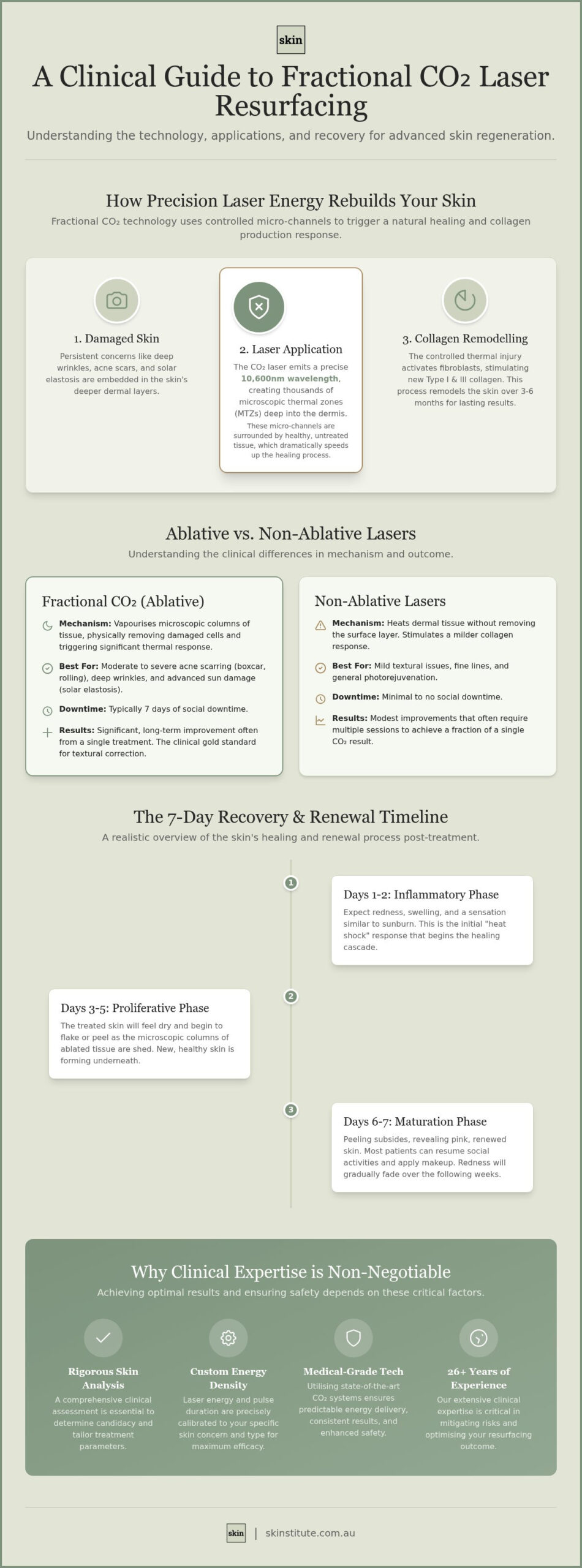
The carbon dioxide (CO2) laser is a sophisticated gas-based system that emits a specific wavelength of 10,600 nanometres. This precise wavelength is highly absorbed by intracellular water, which acts as the primary chromophore during the procedure. When the laser beam contacts the skin’s surface, it instantly vapourises the water within the tissue, leading to the precise removal of targeted layers of the epidermis and dermis. This process, known as ablation, allows for the removal of damaged skin cells with a level of accuracy that mechanical or chemical exfoliants cannot replicate.
The transition from traditional fully ablative lasers to fractional technology represents a significant clinical breakthrough in aesthetic medicine. Rather than removing the entire skin surface, a fractional co2 laser melbourne protocol utilises a scanner to deliver energy in a pixelated pattern. This creates thousands of microscopic thermal zones (MTZs), which are essentially vertical columns of vapourised tissue that extend deep into the dermis. Because these columns are surrounded by bridges of untreated, healthy tissue, the body’s natural healing mechanism is significantly accelerated. This methodology is central to the application of Photorejuvenation principles, using high-intensity light to address structural damage while minimising the risks associated with traditional bulk heating.
Ablative vs. Non-Ablative Laser Resurfacing
While non-ablative lasers heat the tissue without removing it, the fractional CO2 laser remains the clinical gold standard for addressing deep structural changes. Non-ablative options, such as Erbium glass or certain diode lasers, offer shorter downtimes but often require multiple sessions to achieve a fraction of the result seen with a single CO2 treatment. The CO2 laser’s ability to physically remove tissue and provide significant thermal contraction makes it indispensable for treating complex concerns like boxcar acne scars and advanced solar elastosis. Patients must weigh the increased social downtime against the superior regenerative outcomes that only an ablative system can provide.
The Role of Thermal Damage in Collagenesis
The efficacy of the CO2 laser depends on a controlled “heat shock” response within the dermal layers. This thermal injury triggers a complex biological cascade, activating fibroblasts to synthesise new Type I and Type III collagen. You will often notice an immediate skin tightening effect as existing collagen fibres denature and shrink under the heat. However, the most profound improvements occur during the long-term remodelling phase. Over the subsequent three to six months, the newly synthesised collagen matures, leading to increased skin density, improved elasticity, and a visible reduction in the depth of scars and wrinkles.
Clinical Applications for Melbourne Skin Concerns
Melbourne’s environmental conditions, characterised by high UV exposure and fluctuating humidity, contribute to specific patterns of dermal degradation. To address these concerns, a fractional co2 laser melbourne treatment is utilised not merely as a cosmetic enhancement but as a corrective medical procedure. The primary clinical objective is the remediation of structural defects within the skin’s architecture, including deep-seated acne scars and advanced solar elastosis. By targeting the deeper dermal layers, we can effectively reorganise the skin’s collagen matrix to restore a smoother, more resilient surface.
Beyond scarring and sun damage, this technology is highly effective for treating perioral and periorbital rhytids. These deep wrinkles around the mouth and eyes often resist milder treatments because they stem from significant dermal thinning and loss of elasticity. The laser’s thermal energy induces immediate contraction of the collagen fibres, while the subsequent healing phase replaces damaged tissue with new, organised fibres. This dual action results in a visible reduction in wrinkle depth and a refined skin texture that appears more uniform.
Fractional CO2 for Acne Scarring
Moderate to severe acne scarring, particularly boxcar and rolling scars, requires a treatment that can penetrate the deep fibrous bands tethering the skin. The CO2 laser’s 10,600nm wavelength allows for precise ablation of these scars, breaking down old, disordered collagen and triggering the growth of healthy tissue. For atrophic scars, the goal is to fill the depressions from within by stimulating new collagenesis. While hypertrophic scars require a different approach, the precision of fractional technology allows us to flatten raised areas without damaging the surrounding healthy dermis.
Reversing Photo-Ageing and Sun Damage
In the Australian climate, photo-ageing often manifests as solar elastosis, where the skin becomes thickened, yellowed, and deeply lined. A clinical overview of CO2 laser resurfacing highlights how this technology is uniquely suited for erasing the dyschromia and irregular pigmentation associated with chronic UV exposure. By following established fractional CO2 laser resurfacing Melbourne protocols, we can remove the damaged epidermal layers and reveal the healthier dermis beneath. If you are concerned about the long-term effects of sun damage, a professional consultation can help determine the optimal parameters for your skin type.
The Skinstitute Treatment Protocol: Safety and Precision
A successful clinical outcome begins with a meticulous skin analysis. At Skinstitute, we don’t view fractional resurfacing as a routine aesthetic procedure, but as a precise medical intervention. This diagnostic phase allows us to map out specific dermal deficiencies and determine the exact energy requirements for safe tissue regeneration. Every fractional co2 laser melbourne treatment we perform is customised based on the patient’s unique skin architecture, ensuring that the depth of penetration matches the severity of the structural concern.
Precision control is maintained through the adjustment of three primary variables: energy levels (measured in millijoules), spot density, and pulse duration. For deep atrophic scarring, higher energy levels are required to reach the reticular dermis, whereas general texture refinement may utilise a higher density of smaller “pixels” at a shallower depth. Managing Fitzpatrick skin types is a critical safety consideration in this process. Higher melanin levels, typically Fitzpatrick types IV through VI, require a conservative approach to energy density to mitigate the risk of post-inflammatory hyperpigmentation (PIH). By meticulously calibrating these parameters, we maintain the efficacy of the treatment while prioritising epidermal safety. You can find more Laser resurfacing procedure details regarding these technical safety standards on clinical resource sites.
The Consultation and Assessment Process
The initial consultation serves as a vital screening phase to identify potential contraindications. We conduct a thorough review of your medical history, specifically looking for recent use of photosensitising medications or history of hypertrophic scarring. If you’ve used oral isotretinoin within the last six to twelve months, the procedure must be deferred to ensure the skin’s natural healing capacity is fully restored. We also discuss active viral infections, such as the herpes simplex virus, which may require prophylactic antiviral medication prior to the session. Setting realistic clinical expectations is a priority; we explain that while a single session provides significant improvement, complex scarring often requires a staged approach for optimal results.
What to Expect During the Procedure
Patient comfort is managed through a multi-modal approach. We apply a high-strength topical anaesthetic approximately 60 minutes before the session to desensitise the treatment area. During the fractional co2 laser melbourne procedure, we utilise integrated cooling systems that deliver a continuous stream of chilled air to the skin, which offsets the thermal sensation of the laser. The sensation is often described as a series of rapid, warm prickles. A full-face session typically requires 30 to 45 minutes of active laser time. Immediately following the procedure, a specialised post-laser balm is applied to protect the compromised skin barrier and initiate the cooling process.
Managing Recovery and Optimising Resurfacing Results
The successful resolution of a fractional co2 laser melbourne treatment depends heavily on the patient’s adherence to a structured post-clinical recovery protocol. Immediately following the procedure, the skin enters an acute inflammatory phase. You’ll experience significant erythema (redness) and oedema (swelling), accompanied by a sensation similar to a severe sunburn. This heat typically persists for several hours. During this window, the microscopic channels created by the laser remain open, providing a unique physiological opportunity to enhance the healing process through the application of bio-active topicals.
A significant clinical advantage is found in the synergistic use of exosomes or Rejuran during the immediate post-laser period. While the CO2 laser provides the stimulus for regeneration, these bio-stimulators provide the essential signalling molecules and polynucleotides required for rapid cellular repair. Integrating these treatments can substantially reduce the duration of redness and accelerate the synthesis of new collagen. For a deeper understanding of these biological interactions, you may refer to our clinical guide to Rejuran, which details how polynucleotides support dermal bio-stimulation. This multi-modal approach ensures that the “social downtime” is managed efficiently while maximising the structural quality of the new tissue.
The Healing Timeline: Day 1 to Day 14
The first 48 hours are dedicated to managing inflammation and protecting the compromised skin barrier. By day three, a fine, grid-like pattern of microscopic crusts (the “dotting” effect) becomes visible as the vapourised tissue begins to shed. It’s critical that you don’t pick or exfoliate this tissue prematurely; doing so risks scarring or permanent pigment changes. Most patients find that the primary peeling process concludes by day seven, at which point it’s generally safe to return to work and apply mineral-based makeup. However, the underlying dermis remains in a state of active remodelling for several weeks, during which time a residual pinkish hue is considered a normal sign of increased vascular activity.
Protecting Your Investment in the Melbourne Sun
In the Melbourne climate, UV protection is the most critical factor in preventing post-inflammatory hyperpigmentation after a fractional co2 laser melbourne session. The newly revealed skin is exceptionally vulnerable to ultraviolet radiation. We mandate the use of a medical-grade, broad-spectrum SPF 50+ sunscreen every day, regardless of cloud cover. Physical barriers, such as wide-brimmed hats, should also be utilised during the first fortnight. Long-term maintenance of your results involves a combination of high-potency antioxidants and professional-grade skincare to protect the newly formed collagen from environmental oxidative stress. To ensure your recovery is progressing as expected, you can schedule a post-treatment review with our clinical team.
Why Professional Medical Oversight is Critical for CO2 Laser
The administration of high-energy ablative treatments requires a profound understanding of cutaneous biology and thermal physics. While many providers offer a version of the fractional co2 laser melbourne, the clinical outcomes vary significantly based on the practitioner’s ability to manage the delicate balance between therapeutic injury and tissue preservation. Opting for “bargain” treatments often involves the use of lower-powered, aesthetic-grade devices that lack the precision of medical-grade systems. More importantly, these settings frequently lack the expertise to manage adverse events, such as hypertrophic scarring or permanent pigmentary changes, which can occur if the laser’s energy density is incorrectly calibrated for a patient’s specific skin architecture.
Skinstitute has maintained a clinical presence in Melbourne for over 26 years. This longevity is a testament to our commitment to safety and technical mastery. In a medical-grade environment, the focus remains on evidence-based results rather than commercial throughput. We utilise medical-grade technology exclusively, ensuring that every pulse delivered is consistent and precisely targeted to the required dermal depth. Choosing a clinic with established authority means you’re prioritising the health of your skin over the convenience of a high-volume, generic service.
Similarly, for readers researching clinical excellence in the UK, you can check out Beauty Beam Ltd to learn more about their specialised approach to medical-grade laser treatments.
The Value of Clinical Experience
A seasoned practitioner doesn’t simply follow a pre-set protocol; they interpret the skin’s immediate physiological response during the procedure and adjust parameters accordingly. During a fractional co2 laser melbourne session, we monitor for specific indicators such as the level of tissue “frosting” or the intensity of immediate erythema. These real-time observations allow us to modify the energy density or pulse duration to ensure the treatment remains within the safe therapeutic window. Furthermore, having a medical professional available for post-care support is essential. If a patient experiences an atypical inflammatory response, we can provide immediate clinical intervention to ensure the healing process remains on track.
Next Steps: Booking a Professional Assessment
The journey toward structural skin renewal begins with a comprehensive clinical assessment. This is not a cursory glance, but a detailed analysis of your skin’s health, history, and regenerative capacity. During this session, we evaluate the depth of scarring or wrinkles and determine if your skin requires pre-treatment conditioning to optimise results. We don’t believe in “one size fits all” solutions. Instead, we develop a tailored treatment plan that aligns with your clinical needs and social downtime availability. To begin this process and ensure you’re receiving the highest standard of care, you should Schedule your clinical skin analysis at Skinstitute. This initial step ensures that your path to skin resurfacing is grounded in medical precision and professional integrity.
Advancing Toward Structural Dermal Regeneration
The transition from surface-level topical treatments to medical-grade resurfacing requires a thorough understanding of how thermal energy interacts with human tissue. We’ve explored how the fractional delivery of 10,600nm laser energy creates microscopic thermal zones to stimulate profound collagenesis while preserving the skin’s integrity. Success in treating complex acne scarring and advanced solar elastosis depends on the practitioner’s ability to calibrate energy density and pulse duration with clinical precision.
By choosing a fractional co2 laser melbourne protocol within a medical environment, you’re ensuring that your recovery is managed with over 26 years of clinical expertise. Our specialists in advanced laser and injectable therapies prioritise safety and evidence-based outcomes, moving beyond standard aesthetic practices to provide genuine structural skin renewal. This technical approach ensures that the biological triggers for healing are activated efficiently and safely.
If you’re ready to address persistent textural concerns with a tailored, professional plan, we invite you to take the next step in your skin’s health. Book a Clinical Consultation for Fractional CO2 Laser at Skinstitute to begin your journey toward a more refined and resilient complexion. Achieving significant skin smoothness is a methodical process, and we’re here to guide you through every stage of your dermal regeneration.
Frequently Asked Questions
How much downtime is required after a fractional CO2 laser treatment in Melbourne?
Social downtime typically lasts between seven and ten days for most patients. During the initial 48 hours, you’ll experience significant redness and swelling similar to a severe sunburn. This is followed by a phase where microscopic crusts form a grid-like pattern on the skin before naturally shedding. While you can usually return to work after a week, complete internal dermal remodelling continues for several months.
Is the fractional CO2 laser procedure painful?
Patient comfort is prioritised through the application of high-strength topical anaesthesia and integrated cooling technology. The anaesthetic cream is applied 60 minutes before the session to desensitise the treatment area. Most individuals describe the sensation as a series of rapid, warm prickles. Chilled air is continuously delivered to the skin’s surface during the procedure to offset the thermal energy and ensure the treatment remains tolerable.
How many sessions of CO2 laser are typically needed for acne scarring?
Significant reduction in scar depth is generally achieved within one to three sessions. The exact number of fractional co2 laser melbourne treatments required depends on the complexity and depth of the scarring. Because the procedure triggers a long-term biological healing response, we typically space sessions at least six months apart. This allows the newly synthesised collagen to mature and fill atrophic depressions effectively before the next intervention.
What is the difference between fractional CO2 laser and skin needling?
Fractional CO2 laser is an ablative medical procedure that vapourises columns of tissue, while skin needling is a non-ablative mechanical treatment. The laser uses thermal energy to induce immediate tissue contraction and a more profound regenerative response in the deeper dermis. While skin needling is effective for mild texture issues, the CO2 laser remains the clinical gold standard for correcting deep structural defects and advanced solar damage.
Can I have fractional CO2 laser if I have a darker skin tone?
Patients with darker skin tones (Fitzpatrick types IV to VI) can undergo treatment, but it requires a more conservative clinical approach. We meticulously adjust the energy density and pulse duration to mitigate the risk of post-inflammatory hyperpigmentation. In many cases, we prescribe a pre-treatment skin conditioning regimen using specific tyrosinase inhibitors to stabilise melanocyte activity and ensure a predictable and safe recovery process.
When will I see the final results of my laser resurfacing?
Visible improvements in skin texture begin to emerge within two weeks, but the final results of a fractional co2 laser melbourne treatment take three to six months to fully manifest. This timeline is dictated by the rate of cellular turnover and the maturation of new collagen fibres. The skin’s architecture continues to refine and tighten long after the initial redness has faded, resulting in progressive structural improvement over several months.
What are the potential side effects of medical-grade laser treatments?
Expected side effects include temporary erythema, oedema, and a grid-like pattern of microscopic crusting as the skin heals. These are normal physiological responses to controlled thermal injury. While rare, more significant risks can include prolonged redness, infection, or temporary pigment changes. These risks are minimised through rigorous clinical screening, the use of medical-grade technology, and the patient’s strict adherence to our specialised post-treatment aftercare protocols.
Can CO2 laser be combined with other treatments like Rejuran or HIFU?
Yes, combining these technologies often results in superior regenerative outcomes. Rejuran is frequently applied immediately after the laser session to provide the polynucleotides necessary for accelerated cellular repair and hydration. HIFU can be integrated into a broader treatment plan to target the deeper SMAS layers for lifting, while the CO2 laser focuses on epidermal resurfacing and dermal thickening. Each treatment is sequenced to optimise the body’s natural healing cascade.