Cost of PDO Thread Lift Melbourne: A Clinical Guide to Treatment Investment
September 12, 2026
Lip Filler Melbourne: A Clinical Approach to Natural Lip Augmentation
September 14, 2026
The most effective non-surgical facelift in Melbourne is not achieved through a single “miracle” device, but through a multi-layered clinical strategy that addresses the three distinct layers of ageing: structural laxity, volume loss, and cellular degradation. Many patients feel overwhelmed by the volume of conflicting marketing terms, such as HIFU and Ultherapy, and harbour a legitimate fear of the “overdone” aesthetic that often stems from non-medical environments. You’re right to seek clarity; true facial rejuvenation should respect your natural proportions while prioritising safety and evidence-based protocols.
This clinical guide will explain how medical-grade technologies like PDO threads, HIFU, and bio-stimulators work synergistically to provide structural lifting and improved skin “bounce” without the invasive downtime of traditional surgery. We’ll examine the biological mechanisms of these treatments, the importance of the 2025 AHPRA regulatory standards, and how a bespoke “Hybrid Lift” approach can restore your jawline definition and facial contours with precision. By the end of this article, you’ll understand how to achieve a restored, natural appearance through sophisticated medical rejuvenation.
Key Takeaways
- Understand why modern aesthetics favours a “lift and fill” philosophy to reposition facial tissue naturally, moving away from the invasive “pull and cut” methods of traditional surgery.
- Discover how a comprehensive non-surgical facelift melbourne utilises medical-grade technologies to address the three pillars of ageing: structural laxity, volume migration, and cellular health.
- Learn the technical differences between the mechanical suspension provided by PDO thread lifting and the deep thermal contraction achieved through High-Intensity Focused Ultrasound (HIFU).
- Explore the clinical importance of anatomical “vectoring” and professional skin analysis to restore facial contours and jawline definition with precision.
- Identify why a practitioner-led approach with over 26 years of clinical experience ensures the safe and effective use of prescription-only injectables for restorative outcomes.
Defining the Non-Surgical Facelift in a Clinical Context
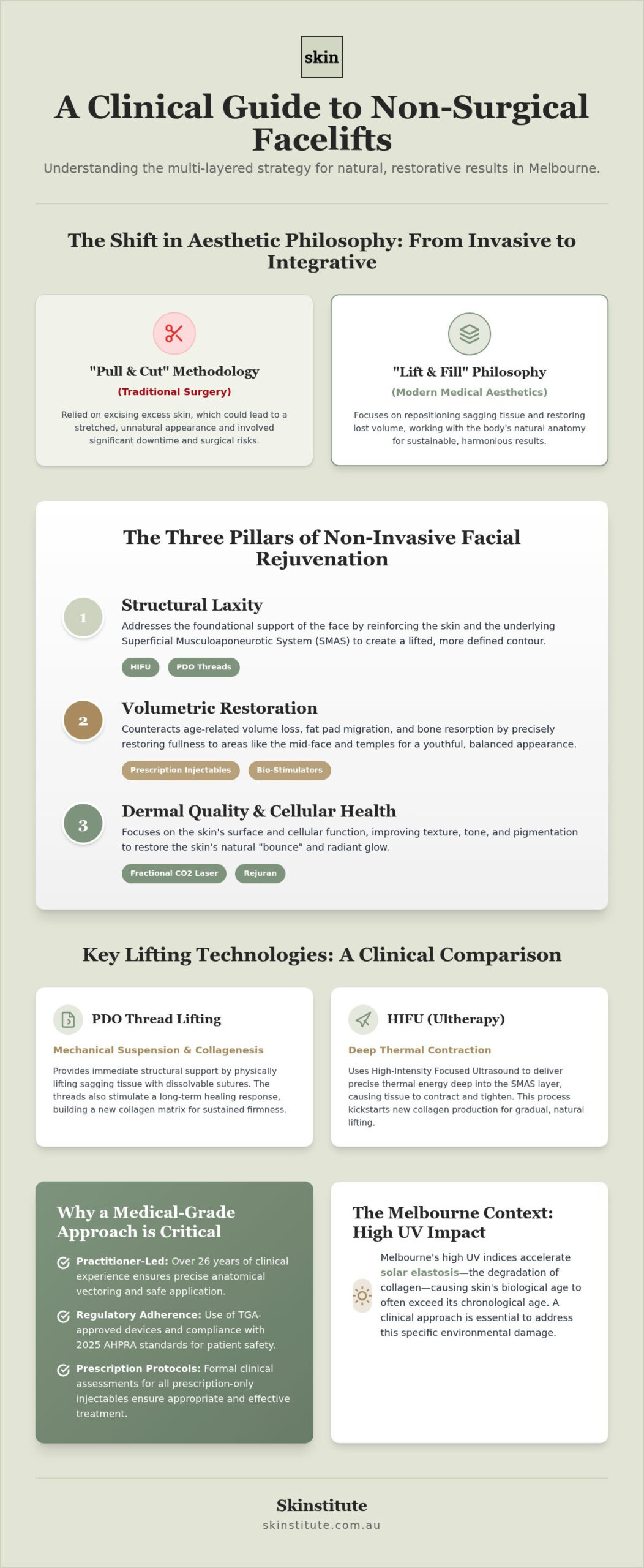
In a clinical setting, a non-surgical facelift melbourne is defined as a strategic integration of minimally invasive procedures designed to reposition sagging tissue and restore lost dermal density. Unlike a traditional clinical overview of rhytidectomy, which relies on a “pull and cut” methodology to excise excess skin, modern medical aesthetics prioritises a “lift and fill” philosophy. This approach focuses on the biological restoration of facial structures, addressing the underlying causes of laxity rather than merely stretching the surface. By combining mechanical support with regenerative stimulation, practitioners can achieve significant rejuvenation without the physiological trauma associated with invasive surgery.
Melbourne’s specific environmental factors, particularly the high UV indices characteristic of south-eastern Australia, contribute significantly to solar elastosis. This condition involves the accumulation of abnormal elastic tissue in the dermis, which accelerates the degradation of type I and III collagen. Such environmental stress often results in a biological age that exceeds an individual’s chronological age. Consequently, a clinical intervention must address this cellular degradation to restore the skin’s natural “bounce” and structural integrity. Effective treatment plans are therefore tailored to mitigate these environmental impacts while reinforcing the facial architecture.
The Shift from Surgery to Medical Aesthetics
The evolution of aesthetic technology over the last 26 years has radically transformed the risk-to-reward ratio for patients. Advanced modalities such as PDO thread lifting and HIFU provide a pathway to facial rejuvenation that involves significantly less downtime and fewer complications than surgical alternatives. This shift is driven by a clinical preference for restorative results that age gracefully alongside the patient. By utilising the body’s innate healing mechanisms to produce new collagen, medical-grade treatments offer a more sustainable and natural-looking outcome that respects the patient’s original anatomy.
Melbourne Regulatory Standards for Cosmetic Procedures
Adherence to Australian regulatory standards is a critical component of patient safety and procedural efficacy. In a professional medical environment, all devices must be TGA-approved, and any use of prescription-only injectables must be preceded by a formal clinical assessment. These regulations ensure that treatments are administered by qualified practitioners who understand the complex anatomy of the face. Choosing a medical-grade clinic for a non-surgical facelift melbourne guarantees that the products and technologies used meet rigorous safety benchmarks, providing a level of precision and accountability that is not available in non-medical aesthetic settings.
The Three Pillars of Non-Invasive Facial Rejuvenation
A successful non-surgical facelift melbourne is built upon three foundational pillars of rejuvenation. Each pillar addresses a specific biological layer of ageing, ensuring that the final result is both structurally sound and aesthetically natural. By viewing the face as a complex biological system rather than a series of isolated wrinkles, practitioners can employ a combination of minimally invasive procedures to achieve outcomes that were once only possible through surgery. These pillars must work in concert to prevent the “overdone” look that results from over-relying on a single modality.
- Pillar 1: Structural Laxity. This addresses the repositioning of the Superficial Musculoaponeurotic System (SMAS) and the skin. Modalities like High-Intensity Focused Ultrasound (HIFU) and PDO threads provide the necessary “lift” by reinforcing the facial scaffolding.
- Pillar 2: Volumetric Restoration. Ageing involves the migration of fat pads and a decrease in bone density, leading to hollows in the mid-face and temples. Prescription injectables are utilised to restore this lost volume with medical precision.
- Pillar 3: Dermal Quality. The final pillar focuses on the skin’s surface. Fractional CO2 laser and Rejuran address texture, pigmentation, and cellular health to provide the final “glow” and elasticity.
These pillars interact to create a holistic rejuvenation effect. Lifting the structural layers without addressing volume loss can result in a “tight but hollow” appearance; conversely, adding volume without structural support may lead to an unnatural, heavy look. Understanding these interactions is the first step toward a successful outcome. You can consult with our clinical team to determine which pillar requires the most focus for your specific anatomy.
Addressing Structural Laxity with HIFU
High-Intensity Focused Ultrasound (HIFU) is a cornerstone of non-invasive lifting. It delivers precise ultrasound energy to the deep structural layers, creating micro-zones of thermal coagulation at depths previously only accessible via surgery. These points of heat trigger a wound-healing response that stimulates the synthesis of new, organised collagen fibres. For a detailed technical breakdown of this process, refer to our Clinical Guide to HIFU. This deep-tissue remodelling provides a firmer foundation for subsequent treatments, ensuring the non-surgical facelift melbourne remains effective over the long term.
Regenerative Therapies: Rejuran and Exosomes
Modern aesthetics has moved beyond simple correction towards bio-stimulation. Rejuran, composed of salmon-derived polynucleotides, works at a cellular level to repair damaged DNA and improve skin healing. When combined with exosome treatments, which facilitate rapid cellular communication and protein synthesis, the skin’s regenerative capacity is significantly enhanced. These therapies ensure the skin has the biological “bounce” and health required to support a structural lift. This regenerative foundation is essential for patients in Melbourne whose skin may have been compromised by chronic UV exposure.
PDO Thread Lifting vs. HIFU: Vectoring for Facial Support
The success of a non-surgical facelift melbourne relies heavily on the clinical concept of vectoring. Vectoring is the precise practice of lifting and repositioning facial tissue along specific anatomical lines to counteract the effects of gravity and volume migration. While both PDO threads and High-Intensity Focused Ultrasound (HIFU) aim to restore these vectors, they do so through different physical mechanisms. PDO threads provide an immediate mechanical lift by physically anchoring and suspending sagging tissue. In contrast, HIFU utilizes heat-induced contraction to tighten the deep structural layers over time. Understanding the interplay between these mechanical and thermal forces is essential for achieving a balanced, restorative outcome.
A common concern among patients is the fear of looking “fake” or over-tightened. In a medical-grade setting, this risk is mitigated by the biological nature of the materials used. Polydioxanone (PDO) is a bio-compatible polymer that naturally degrades via hydrolysis over six to twelve months. As the thread dissolves, it is replaced by a column of the body’s own collagen, ensuring the lift remains natural and integrated with the patient’s own facial movements. This progressive transition from a physical scaffold to biological support prevents the static, artificial appearance often associated with more invasive surgical procedures.
The Mechanics of PDO Thread Lifting
PDO thread lifting involves the insertion of specialised polydioxanone sutures into the subcutaneous layer of the skin. These threads come in various forms, including “cog” threads with microscopic barbs for mechanical suspension and “monofilament” threads for localised collagen stimulation. The cogs act as a physical scaffold, allowing the practitioner to reposition tissue along the desired vector immediately. Beyond the initial lift, the presence of the thread stimulates fibroblasts to produce new collagen and elastin in the surrounding area. Precise clinical placement is vital; threads must be aligned with the natural musculature to ensure that facial expressions remain fluid and authentic.
HIFU: The Non-Surgical Alternative to Deep Tissue Surgery
HIFU technology is unique in its ability to reach the Superficial Musculoaponeurotic System (SMAS). This is the same deep fibrous layer that plastic surgeons manipulate during a traditional rhytidectomy. By delivering focused ultrasound energy to this depth, HIFU creates points of thermal coagulation that cause the SMAS to contract and tighten. Because the energy bypasses the surface of the skin, HIFU is a “no downtime” procedure, making it highly suitable for busy Melbourne professionals who cannot afford a lengthy recovery. While some initial tightening may be visible, the most significant results appear three to six months post-treatment as the new collagen matrix matures and strengthens the facial architecture.
Clinical Consultation: Mapping Your Rejuvenation Strategy
A successful non-surgical facelift melbourne begins with a technical mapping of the patient’s unique facial architecture. This is not a transactional process but a professional skin analysis designed to identify the primary biological drivers of ageing. In our clinic, we frequently observe the “Melbourne Face,” a specific pattern of ageing characterised by significant solar elastosis from chronic UV exposure and “tech neck” resulting from repetitive postural strain. These environmental and lifestyle triggers require a multi-stage clinical plan rather than a single-visit application. By utilising high-resolution clinical photography and precise measurement, a practitioner can track the biological response of the tissue and adjust the treatment vectoring as the collagen matrix matures.
The transition from a physical concern to a technical solution requires a methodical approach. Practitioners must account for the rate of cellular turnover and the time needed for neo-collagenesis to occur. This ensures that each stage of the rejuvenation strategy builds upon the previous one, creating a stable foundation for long-term results. Rather than pursuing aggressive, immediate changes that risk an unnatural appearance, the focus remains on steady, restorative progress that respects the patient’s natural anatomy and physiological limits.
What to Expect During a Professional Assessment
A professional assessment involves a systematic evaluation of skin elasticity, subcutaneous volume loss, and the degree of bone resorption. Understanding these biological markers is essential for determining the appropriate focal depth for HIFU or the specific gauge of PDO threads required for effective suspension. Your medical history is also reviewed to ensure suitability for prescription injectables or medical-grade lasers. At Skinstitute, this consultation is a collaborative process where technical expertise meets the patient’s aesthetic goals, ensuring that every intervention is evidence-based and follows strict safety protocols.
Integrating Laser Resurfacing for Final Polish
A structural lift is often incomplete if the overlying skin remains compromised by solar damage, pigmentation, or uneven texture. Integrating Fractional CO2 Laser Resurfacing allows the practitioner to remove damaged epidermal cells and stimulate resurfacing at a deep dermal level. This provides the final “polish” to the rejuvenation strategy, ensuring the skin’s surface quality matches the improved contours achieved through structural lifting. While laser treatments require a brief recovery window of five to seven days, the combined effect on skin “bounce” and structural support is profound. To begin your clinical journey, you can book a professional consultation at Skinstitute to receive a bespoke treatment map tailored to your skin’s biological age.
Why a Medical-Grade Approach at Skinstitute Ensures Precise Outcomes
Selecting a practitioner for a non-surgical facelift melbourne involves more than reviewing a portfolio of results; it requires an assessment of clinical longevity and technical mastery. Skinstitute has maintained a prominent presence in the Melbourne aesthetic landscape for over 26 years, prioritising a medical-grade approach that values scientific evidence over industry trends. This extensive history provides a level of stability and technical proficiency that’s vital when managing the complexities of facial anatomy. By offering a comprehensive suite of modalities, from prescription injectables to advanced energy-based devices, the clinic ensures that each treatment plan is dictated by the patient’s biological needs rather than the limitations of a specific device. It’s this commitment to quiet confidence that allows for restorative outcomes that appear both sophisticated and natural.
The benefits of a full-spectrum medical clinic extend beyond the initial procedure. When a clinic provides the entire range of medical aesthetics, including PDO thread lifting, HIFU, and regenerative therapies like Rejuran, practitioners can pivot the strategy as the skin’s biological age improves. This holistic oversight ensures that the structural lift, volumetric restoration, and dermal quality are always in balance. Relying on a medical-grade environment means every intervention is performed with an understanding of the underlying physiological processes, ensuring that the results are not just temporary fixes but long-term investments in your skin’s health.
Safety and Expertise in Prescription Injectables
The administration of prescription-only injectables is a precise medical intervention that demands rigorous safety protocols and expert anatomical knowledge. Within our clinical environment, every procedure is performed with a focus on precision and patient aftercare, adhering strictly to the latest Australian regulatory standards. A practitioner’s aesthetic judgement is refined over decades of clinical practice, allowing for a nuanced understanding of how different tissues respond to bio-stimulation and mechanical lifting. This experience is particularly relevant when managing the accelerated collagen breakdown common in Melbourne, where chronic environmental stress requires a sophisticated approach to ensure safety and efficacy.
Your Journey to Natural Facial Restoration
The clinical journey begins with a thorough skin analysis to map out the vectors of rejuvenation and identify specific ageing triggers. Throughout this process, the primary objective remains a natural facial restoration that respects your unique proportions and original anatomy. We believe that the most successful medical aesthetics are those that are imperceptible, providing a refreshed appearance that ages with grace. Once the assessment is complete, we’ll provide a multi-staged strategy designed to restore your skin’s structural integrity and dermal quality with medical precision. To begin this process, you can organise your clinical skin analysis at Skinstitute today.
Advancing Your Facial Rejuvenation Strategy
Achieving a refined and enduring outcome through a non-surgical facelift melbourne requires a sophisticated understanding of the three pillars of ageing: structural laxity, volume migration, and dermal quality. By integrating medical-grade technologies such as PDO thread lifting for mechanical suspension and HIFU for deep-tissue thermal contraction, you can restore facial vectors with clinical precision. This multi-modal strategy, supported by regenerative therapies like Rejuran and exosomes, ensures that the skin’s biological health is prioritised alongside its aesthetic appearance.
At Skinstitute, we draw upon over 26 years of clinical experience to deliver restorative results that respect your natural anatomy. Our reliance on TGA-approved technologies and prescription-only injectables reflects a commitment to safety and technical excellence. This professional oversight is essential for navigating the complexities of facial rejuvenation while avoiding the risks associated with non-medical aesthetic environments. We invite you to Book Your Clinical Facial Assessment at Skinstitute Melbourne to develop a bespoke treatment map tailored to your specific physiological needs. We look forward to partnering with you on your journey toward natural-looking facial restoration.
Frequently Asked Questions
Is a non-surgical facelift as effective as a traditional surgical facelift?
Non-surgical treatments serve a different clinical purpose than traditional surgery. While a surgical rhytidectomy involves the physical excision of excess skin, a non-surgical facelift melbourne focuses on repositioning existing tissue and improving dermal density. It’s a highly effective option for patients with moderate laxity who prioritise a restorative, natural aesthetic without the risks of general anaesthesia or permanent scarring. This approach addresses the biological causes of ageing rather than just the symptoms.
How long do the results of a non-surgical facelift in Melbourne typically last?
Results generally persist for 12 to 18 months, though this depends on the individual’s biological response and lifestyle factors. While PDO threads provide immediate mechanical support, the secondary collagen synthesis they trigger provides structural integrity as the material dissolves. Maintaining dermal health through medical-grade skincare and consistent sun protection in Melbourne’s climate is essential for extending the longevity of these restorative outcomes and protecting the new collagen matrix.
Are PDO threads safe, and what happens to them over time?
Polydioxanone (PDO) threads are safe and have been utilised in cardiovascular surgery for decades. These bio-compatible sutures naturally degrade through a process called hydrolysis over six to nine months. As the thread dissolves, it’s replaced by a column of your own type I and III collagen. This ensures the structural lift is maintained by your own biological tissue long after the physical thread has completely disappeared from the subcutaneous layer.
Is there any downtime required after a HIFU or thread lift procedure?
Downtime varies significantly between these two modalities. HIFU is a non-invasive procedure that typically requires no recovery period, allowing patients to return to their professional duties immediately. A PDO thread lift is minimally invasive and usually involves a recovery window of three to seven days. Patients might experience mild swelling or bruising during this time, which is a normal physiological response as the tissue begins to heal around the new scaffold.
Can I combine dermal fillers with a non-surgical thread lift?
Combining modalities is often the most effective way to achieve a comprehensive result. While threads address structural laxity by repositioning tissue, prescription injectables like dermal fillers correct the volumetric loss and fat pad migration that occur with age. This “lift and fill” approach ensures that the facial contours are both elevated and properly supported. A clinical assessment is necessary to sequence these treatments correctly for optimal safety and technical precision.
What is the ideal age to start considering non-surgical lifting treatments?
There’s no single “correct” age, as biological age often differs from chronological age due to environmental factors like UV exposure. Many patients begin considering a non-surgical facelift melbourne in their late thirties or early forties when early signs of jowling and mid-face descent appear. Implementing treatments like HIFU at this stage acts as a preventative intervention, maintaining tissue density and delaying the need for more invasive surgical procedures later in life.
How much does a non-surgical facelift cost in Melbourne?
The cost of a clinical rejuvenation plan is determined by the specific combination of technologies required to address your unique ageing triggers. Factors influencing the investment include the number of PDO threads utilised, the depth of HIFU application, and whether regenerative therapies like Rejuran are integrated. A bespoke clinical skin analysis is the only way to receive an accurate breakdown of the requirements for your specific facial architecture and aesthetic objectives.
Does the procedure hurt, and what pain management options are available?
Patient comfort is a priority in a medical-grade environment. While HIFU involves a sensation of deep thermal heat, PDO thread lifting requires the use of local anaesthesia to ensure the procedure is well-tolerated. We utilise clinical pain management strategies, including topical numbing agents and local anaesthetic injections, to minimise discomfort. Most patients describe the sensations as manageable, and the clinical team monitors your comfort levels throughout the entire duration of the treatment.