
The Clinical Guide to a Non-Surgical Facelift in Melbourne: Advanced Medical Rejuvenation
September 13, 2026
Under-Eye Injectables: A Periorbital Rejuvenation Guide
September 15, 2026
The most successful aesthetic enhancement is often the one that remains entirely undetectable to the untrained eye. While approximately 45% of Australians are now considering non-surgical treatments, many remain hesitant due to the pervasive fear of looking “fake” or experiencing long-term filler migration. When seeking lip filler Melbourne, it’s vital to move beyond marketing trends and focus on the precise biological interactions between prescription injectables and your unique facial anatomy. Achieving a balanced result requires a sophisticated understanding of dermal chemistry and the physiological layers of the lips.
You likely value safety and clinical precision over fast-paced trends, wanting to ensure your practitioner prioritises your long-term health and facial harmony. This article explores the medical science behind lip augmentation, demonstrating how a disciplined, clinical approach ensures results that are both safe and restorative. We will examine the different types of prescription-only substances available, the importance of anatomical symmetry, and the rigorous aftercare protocols required for a seamless recovery. Drawing on 26 years of industry experience, we provide the technical insight needed to achieve subtle hydration and refined definition without compromising your natural character.
Key Takeaways
- Learn how anatomical landmarks like the vermilion border and Cupid’s bow dictate the precise placement of prescription injectables for balanced results.
- Discover why choosing a professional for lip filler Melbourne with medical oversight is essential for ensuring safety and technical proficiency.
- Understand the physiological causes of filler migration and how a disciplined, incremental approach prioritises long-term facial harmony.
- Identify the necessity of a comprehensive medical consultation to assess lip movement and establish a safe treatment trajectory.
- Recognise how 26 years of clinical experience allows for the customisation of treatments based on your specific tissue density and hydration needs.
Understanding Lip Filler in Melbourne: Clinical Standards and Aesthetic Goals
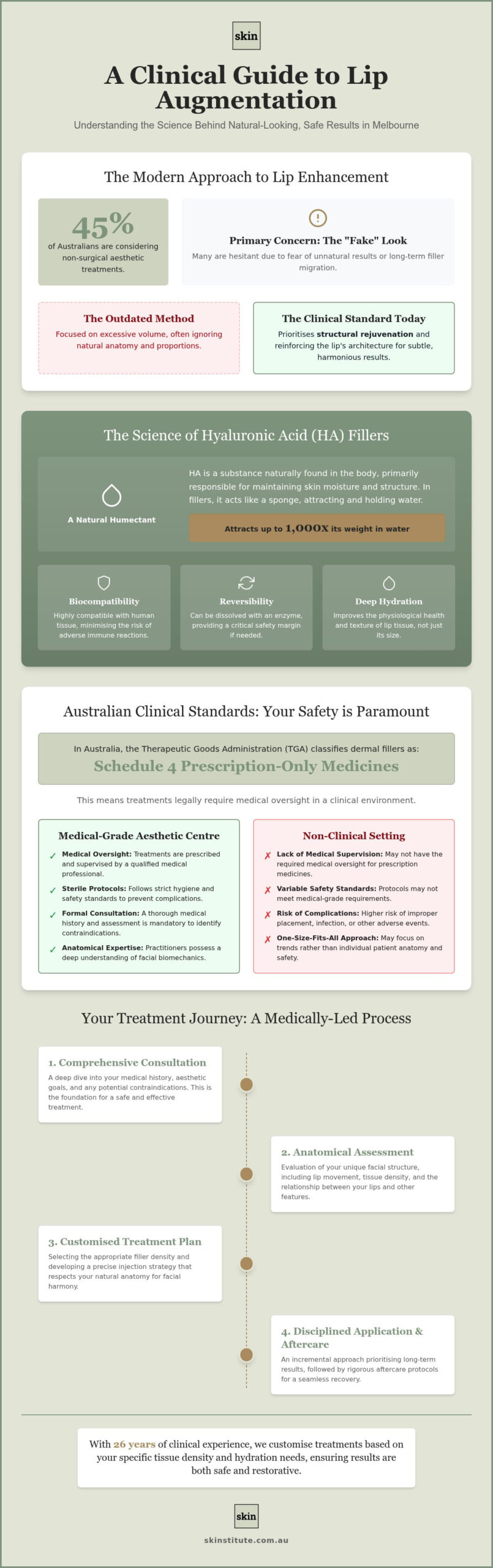
Lip filler in Melbourne represents a sophisticated medical intervention rather than a simple beauty treatment. These products are classified as prescription injectables, primarily composed of hyaluronic acid. This substance is designed to restore volume and enhance hydration through precise subcutaneous placement. Historically, the focus of this cosmetic procedure often leaned towards excessive volume. Today, the clinical standard has shifted towards structural rejuvenation. This approach prioritises the restoration of natural proportions and the reinforcement of the lip’s underlying architecture. It’s about respecting the patient’s original anatomy while addressing age-related volume loss.
The Role of Hyaluronic Acid in Lip Rejuvenation
Hyaluronic acid (HA) is a naturally occurring glycosaminoglycan found within the human extracellular matrix. Its primary function is to maintain structural integrity and moisture levels. When used in lip filler Melbourne treatments, HA molecules act as humectants, attracting up to 1,000 times their weight in water. This biological interaction improves lip texture and minimises fine perioral lines. Because HA is a native component of the body, the risk of rejection is minimal. Modern formulations vary in their cross-linking density, allowing practitioners to choose a product that mimics the natural feel of lip tissue.
- Bio-compatibility: HA is highly compatible with human skin tissue, reducing the risk of adverse immune responses.
- Reversibility: Modern injectables can be dissolved using hyaluronidase, providing a critical safety margin.
- Hydration: Beyond volume, HA improves the physiological health of the mucosal tissue.
Regulatory Oversight in the Australian Aesthetic Industry
The Australian regulatory framework is one of the strictest globally. The Therapeutic Goods Administration (TGA) classifies dermal fillers as Schedule 4 prescription-only medicines. This classification dictates that treatments must be performed within a clinical environment under medical oversight. A medical-grade aesthetic centre differs significantly from a traditional beauty salon. It maintains sterile protocols and requires a formal consultation with a qualified practitioner to identify potential contraindications. You won’t find these medical-grade standards in a non-clinical setting.
A comprehensive clinical assessment serves as the foundation for any successful outcome. Practitioners must evaluate the patient’s dental occlusion, soft tissue thickness, and the relationship between the lips and the surrounding facial features. This diagnostic phase ensures that the chosen injectable density matches the patient’s physiological requirements. It prevents the common pitfall of overfilling by establishing a logical treatment trajectory based on evidence-based principles. With 26 years of industry experience, we understand that technical mastery is only effective when paired with a thorough medical history and a clear understanding of facial biomechanics.
The Science of Prescription Injectables: How Modern Dermal Fillers Interact with Lip Anatomy
The lips are a complex, multi-layered structure where skin, muscle, and mucosa converge in a highly dynamic environment. When administering lip filler melbourne, a practitioner must account for the interaction between the injectable material and the orbicularis oris muscle. This sphincter muscle facilitates all perioral movement, including speech and mastication. If a filler is placed incorrectly or if the density is mismatched to the tissue plane, it can impede muscle function or lead to visible irregularities. Successful augmentation relies on placing the substance within the appropriate subcutaneous or submucosal layers to ensure the filler moves in tandem with the natural anatomy.
Defining the Aesthetic Landmarks of the Lip
A clinical approach to lip enhancement begins with a detailed assessment of specific anatomical landmarks. The Cupid’s bow is the primary focal point of the upper lip; its definition is essential for maintaining facial symmetry and a balanced philtral-labial relationship. Enhancing the philtrum columns, the two vertical lines extending from the Cupid’s bow to the nose, restores the youthful, three-dimensional projection that often flattens with age. This structural reinforcement provides a refined profile without the need for excessive volume.
The vermilion border serves as the critical transition zone between the cutaneous skin and the red mucosal tissue of the lip. Restoring the integrity of this border provides necessary definition and prevents the “bleeding” of cosmetic products into fine perioral lines. By reinforcing this edge, practitioners can achieve a crisp, defined look that remains subtle and anatomically correct. This precision is a hallmark of a medical-grade clinical assessment, where the goal is restoration rather than mere inflation.
Rheology and Product Selection: Choosing the Right Density
Filler rheology refers to the physical properties of an injectable, specifically its elasticity, viscosity, and cohesivity, which dictate how the gel responds to the mechanical stresses of facial expression. This scientific profile determines whether a product is better suited for structural support or soft integration.
- High-Cohesivity Fillers: These products possess a higher G-prime, providing the robust support needed to define the vermilion border or create significant volume in patients with thicker tissue.
- Low-Viscosity Fillers: These softer gels are designed for superficial placement. They are ideal for treating fine vertical lines and providing subtle hydration without altering the lip’s fundamental shape.
Selecting the correct product requires an understanding of the patient’s unique tissue thickness and age-related changes. For instance, a mature patient with significant collagen depletion requires a different rheological profile than a younger patient seeking subtle definition. By matching the product density to the specific physiological requirements of the tissue, practitioners ensure the result remains undetectable and the lip remains soft to the touch. This level of technical customisation is vital for avoiding the rigid, overfilled appearance often associated with non-clinical treatments.
Achieving Natural-Looking Results: Avoiding Common Pitfalls and the “Overfilled” Look
Natural results in lip augmentation are achieved by adhering to established mathematical principles of facial beauty and anatomical limits. When considering lip filler melbourne, the primary objective should be the preservation of anatomical authenticity. One of the most common clinical pitfalls is the “duck lip” phenomenon. This occurs when product is injected too superficially or in excessive quantities into the vermilion border, causing the lip to project upward rather than forward. This disrupts the natural transition between the lip and the cutaneous skin. To prevent this, a practitioner must employ a “less is more” philosophy, often recommending incremental treatments over several months to allow the tissue to integrate the substance gradually.
Filler migration remains a significant concern for many patients. This is the movement of the injectable substance beyond the intended anatomical boundary, often manifesting as a “filler moustache” above the upper lip. Clinically, this is prevented by respecting the tissue’s capacity and ensuring the product is placed in the correct histological plane. By prioritising structural integrity over sheer volume, we maintain the lip’s defining features while avoiding the distorted appearance associated with overfilling. Technical precision ensures the product remains localised within the target tissue layers.
The Importance of Facial Harmony
A thorough clinical assessment must extend beyond the lips to include the chin, nose, and jawline. The “Golden Ratio” of 1:1.6 (upper lip to lower lip) provides a foundational guide, but individual variations in facial morphology must be respected. In a profile view, overfilling can lead to “facial flattening,” where the lips protrude excessively, diminishing the perceived definition of the nose and chin. Correcting natural asymmetries, rather than simply increasing size, creates a more sophisticated and balanced profile. This ensures the lips complement the overall facial architecture instead of dominating it.
Managing Patient Expectations and Aesthetic Longevity
Patient education is a vital component of the clinical journey. It’s essential to distinguish between post-procedural oedema and the final integrated result. Initial swelling can persist for 48 to 72 hours, often leading to temporary over-projection. The rate of filler metabolism also varies significantly between individuals based on lifestyle, metabolic rate, and the specific rheology of the product used. A follow-up appointment, typically two weeks post-treatment, is a clinical necessity. This allows the practitioner to evaluate the integration of the substance and make any minor adjustments required for optimal symmetry. With 26 years of industry experience, we understand that longevity and safety are best achieved through precision and patience.
The Clinical Consultation: What to Expect During Your Treatment Journey
A successful outcome for lip filler melbourne begins long before the first injection. It starts with a comprehensive medical consultation designed to ensure patient safety and aesthetic precision. This mandatory phase involves a thorough review of your medical history to identify potential contraindications, such as active infections, autoimmune conditions, or specific allergies. By leveraging 26 years of industry experience, a specialised practitioner assesses both the static structure of the lips and their dynamic movement during speech and expression. This ensures the treatment plan respects your unique facial biomechanics rather than following a generic template. The application of topical anaesthetics is a standard clinical procedure used to significantly enhance patient comfort by desensitising the mucosal tissue before the injection process begins.
Developing a bespoke treatment plan requires a collaborative approach between the practitioner and the patient. We evaluate the ratio of the upper to the lower lip, the projection of the chin, and the overall facial symmetry. This diagnostic rigour allows us to determine the precise volume and rheology of the injectable required to meet your aesthetic goals safely. You can book a clinical consultation to begin this structured assessment process.
Step-by-Step Treatment Protocol
The procedure follows a rigorous medical protocol to maintain sterility and accuracy. After the initial cleansing with clinical-grade antiseptic, a high-potency numbing cream is applied to the perioral area. The injection process involves the precise placement of the substance using ultra-fine needles or micro-cannulas. Micro-cannulas are often selected for their ability to traverse tissue planes with minimal vascular disruption, which reduces the likelihood of bruising. Once the product is placed, a gentle moulding technique is used to ensure the filler integrates perfectly with the underlying lip architecture, resulting in a smooth and symmetric finish.
Clinical Aftercare and Recovery
Recovery is typically predictable, following a standard physiological timeline. Most patients experience minor oedema and potential bruising, which generally resolve within 24 to 48 hours. Adhering to clinical aftercare instructions is essential for optimal healing and the prevention of complications. Proper management during this window ensures the substance settles correctly within the target tissue layers.
- Activity Restrictions: Avoid strenuous exercise, saunas, and direct heat exposure for at least 24 hours to minimise blood flow to the treated area.
- Pressure Management: Refrain from applying firm pressure or massaging the lips for the first week unless specifically instructed by your practitioner.
- Monitoring: While mild tenderness is normal, signs such as persistent skin blanching, intense pain, or unusual discolouration require immediate communication with your Melbourne clinic.
Selecting a Melbourne Cosmetic Clinic: Why Clinical Experience and Medical Oversight Matter
Selecting a provider for lip filler melbourne requires a careful evaluation of clinical credentials and institutional stability. While the aesthetic market is saturated with rapid-service providers, a medical-grade environment prioritises the physiological health of the patient over commercial throughput. A technician-led approach often focuses on the application of volume alone, whereas a medical-grade clinical assessment involves a diagnostic review of tissue health, vascularity, and facial symmetry. Understanding these distinctions is fundamental to achieving a result that is both safe and aesthetically sophisticated. You can learn more about our philosophy in our Clinical Guide to Medical-Grade Aesthetic Treatments.
The Value of Practitioner Longevity
Longevity in the aesthetic industry is a primary indicator of clinical proficiency. With 26 years of industry experience, a practitioner develops an intuitive understanding of anatomical variations that can’t be replicated through short-term training. This depth of knowledge is critical when managing complex cases or addressing complications from previous treatments performed elsewhere. A stable clinic environment ensures continuity of care, allowing for the long-term monitoring of filler integration and tissue response. This methodical approach reduces the risk of adverse events and ensures that the patient’s aesthetic journey is managed with technical mastery and professional integrity.
Integrated Aesthetic Care at Skinstitute
At Skinstitute, lip augmentation is viewed as one component of a broader regenerative strategy. We often explore how we combine fillers with Rejuran in Melbourne for skin health and cellular rejuvenation. By addressing the biological health of the mucosal tissue, we ensure that the added volume looks natural and integrates seamlessly within the dermal layers. Our clinical protocols may also involve combining lip enhancement with other modalities like Fractional CO2 Laser to treat fine lines and surface texture around the mouth. This integrated focus on skin health and regeneration distinguishes our clinic as a centre of excellence, providing Melbourne patients with a comprehensive pathway to subtle, evidence-based results.
Prioritising Clinical Excellence in Lip Augmentation
Achieving a refined, natural result requires a departure from generic volume-based approaches in favour of precise anatomical restoration. By understanding the scientific principles of filler rheology and respecting the unique landmarks of your facial structure, you ensure that enhancements remain subtle and biologically integrated. A medical-grade environment provides the necessary oversight for safe outcomes, moving beyond surface-level aesthetics to focus on structural rejuvenation rather than temporary trends.
When you seek lip filler melbourne, prioritising a practitioner with extensive clinical experience is the most effective way to safeguard your long-term results. Our clinic offers over 26 years of specialised industry experience, ensuring that every procedure is conducted with technical mastery and a deep respect for facial harmony. We invite you to Book a Clinical Consultation at Skinstitute Melbourne to begin your journey toward restored volume and hydration in a professional, medical-grade setting. Taking this evidence-based approach ensures your results are both sophisticated and sustainable.
Frequently Asked Questions
How long do lip fillers typically last?
Lip fillers typically last between 6 and 12 months, though the exact duration depends on the patient’s individual metabolic rate and the specific rheology of the prescription injectable used. Highly dynamic areas like the lips may metabolise the substance faster than static facial regions. Regular maintenance treatments are often required to sustain the desired volume and structural definition over time, ensuring the results remain consistent with your aesthetic goals.
Does the lip filler procedure hurt?
Discomfort during the procedure is typically minimal due to the application of high-potency topical anaesthetics before treatment. Most modern dermal fillers also contain lidocaine, a local anaesthetic that further desensitises the tissue during the injection process. While some patients may experience a brief pinching sensation, the clinical environment and technical precision of a specialised practitioner ensure the process remains manageable and professional, prioritising your comfort throughout the session.
Can I dissolve my lip fillers if I am unhappy with the results?
Yes, hyaluronic acid-based lip fillers can be safely dissolved using a specialised enzyme called hyaluronidase. This substance breaks down the cross-linked HA molecules, allowing the body to naturally reabsorb the filler within 24 to 48 hours. This reversibility is a critical safety feature of modern prescription injectables, though it should only be performed by a medical professional to ensure the integrity of the surrounding natural tissue and an even aesthetic outcome.
What is the difference between lip fillers and a lip flip?
Lip fillers involve the subcutaneous placement of a substance to add physical volume and structural definition to the lips. In contrast, a lip flip utilises a different type of prescription injectable to temporarily relax the orbicularis oris muscle, allowing the upper lip to evert slightly. While fillers physically expand the tissue to improve projection, a lip flip focuses on the dynamic movement of the muscle to reveal more of the mucosal surface.
How much lip filler will I need for a natural look?
Achieving a natural look often requires between 0.5ml and 1ml of product, though the precise amount is determined during your clinical consultation. For patients seeking lip filler melbourne, the focus is on incremental enhancement rather than dramatic volume. Using a “less is more” philosophy allows the practitioner to respect your anatomical boundaries while restoring subtle hydration and definition without the risk of an overfilled or distorted appearance.
Are there any risks or side effects associated with lip injectables?
Standard side effects include temporary oedema, bruising, and tenderness at the injection site, which generally resolve within 48 hours. Rare but serious risks include vascular occlusion, infection, or filler migration. Seeking treatment in a medical-grade clinical environment with a practitioner who has 26 years of experience significantly mitigates these risks. Professional clinics maintain strict sterile protocols and possess the medical oversight necessary to manage any adverse tissue responses effectively.
How should I prepare for my lip filler appointment in Melbourne?
Preparation involves avoiding substances that may increase the risk of haematoma or bruising for at least one week prior to your appointment. This includes blood-thinning medications like aspirin, as well as supplements such as fish oil, Vitamin E, and alcohol. Ensuring you are well-hydrated and have had a recent meal before your session at our lip filler melbourne clinic contributes to a stable physiological state and a more comfortable treatment experience.
When will I see the final results of my treatment?
Final results are typically visible two weeks post-treatment, once the initial post-procedural oedema has completely subsided. While you will notice an immediate change in volume, the substance requires time to integrate with your natural lip tissue and settle into its final position. A scheduled follow-up appointment at our Melbourne centre allows for a clinical assessment of this integration to ensure the result is symmetric and structurally sound.